

How to migrate from rule-based to AI marketing automation
This practical guide walks through the data, pilot, and governance steps needed to layer AI onto existing marketing automation platforms without a rebuild — and explains why treating the migration as a workflow redesign rather than a technology swap is the difference between stalled experiments and measurable results.
Migrating to AI in marketing automation usually starts in a place nobody would put in a vendor demo: an existing workflow full of score thresholds, suppression lists, lifecycle-stage exceptions, and hand-built reports that have survived three strategy changes. The practical question is not whether HubSpot, Marketo-style workflows, ActiveCampaign, Salesforce Einstein, HubSpot Breeze, BrazeAI, or another system can add AI. Most of them already expose some mix of predictive scoring, send-time optimization, campaign intelligence, or content assistance. The harder question is which workflow is clean enough, narrow enough, and reviewed enough to start learning without quietly damaging pipeline.
That is why this migration should not be treated as a platform swap. Improvado describes the shift from traditional automation to AI-powered automation as moving from systems that execute a defined strategy to systems that help define, refine, and execute strategy in a continuous optimization loop.[1] That sounds abstract until it lands inside a nurture program: a rule-based branch waits for the condition you wrote; an AI-assisted workflow uses past behavior, fit signals, timing, or performance data to recommend or trigger the next move. If the underlying fields are stale or the handoff logic is unclear, the system does not become smarter. It just makes the old ambiguity move faster.
Most teams are still somewhere in the middle of that shift. A Shopify summary of Gartner research reported that about 32% of marketing organizations had fully integrated AI into workflows, while 43% were still experimenting.[2] That is useful context, not a race clock. The teams that get measurable value are not simply the ones with the most tools; McKinsey found that organizations redesigning workflows around AI were about 3.6 times likelier to see more than 5% EBIT impact than those that bolted AI onto unchanged processes.[3]
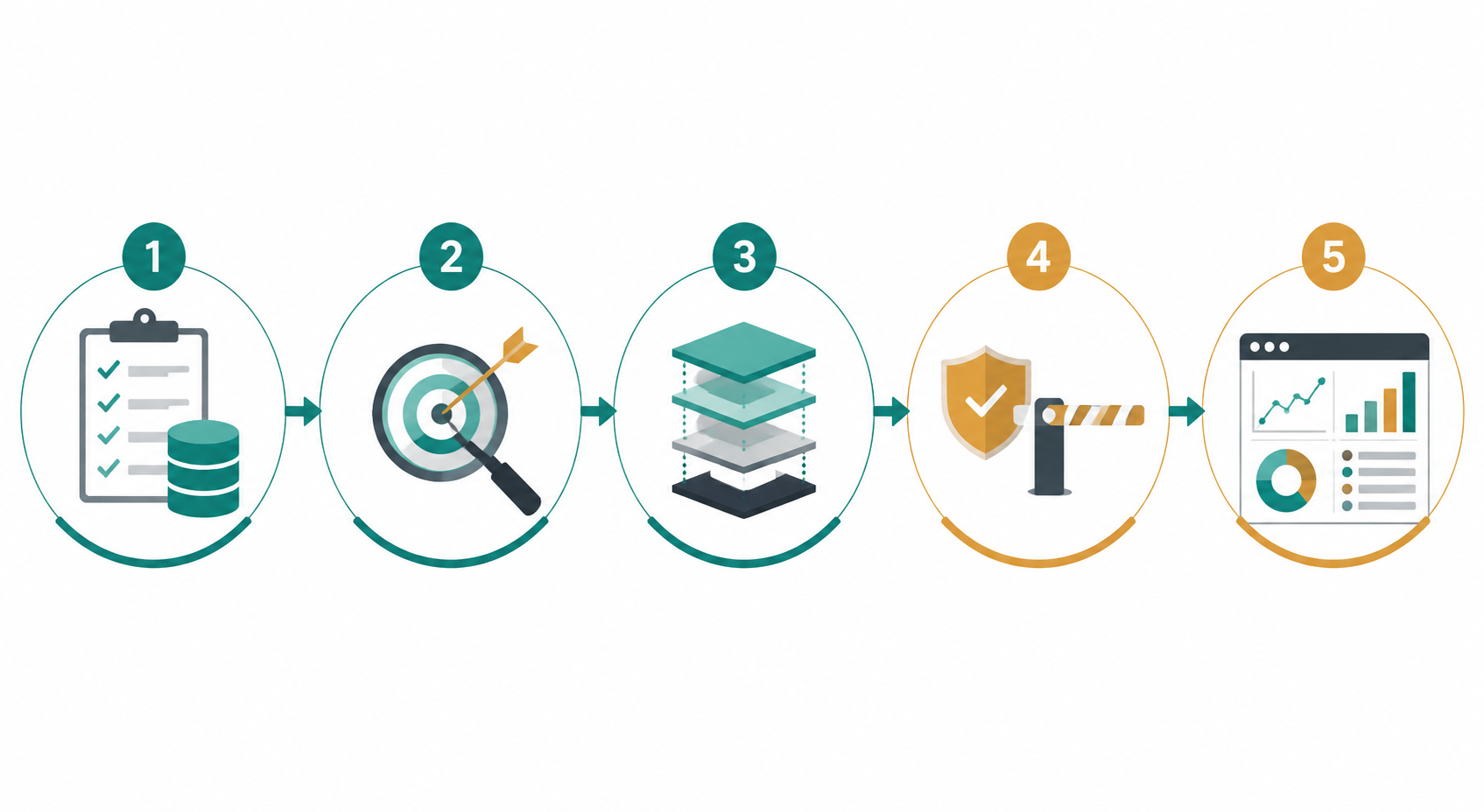
A safer migration path is therefore simple in shape, even if the work is not glamorous: prove data readiness, pick one bounded workflow, layer AI into the current platform, add review gates, then measure whether outcomes changed. If tool sprawl is already part of the problem, it is worth resolving ownership before adding more automation surface area; this content automation stack consolidation guide is a useful companion for that earlier cleanup.
Start With the Workflow, Not the Model
A rule-based automation program is usually built around explicit decisions: if the contact fills out this form, add this score; if the score crosses this number, assign this lifecycle stage; if the person has not opened in this many days, move them to a different branch. Those systems are understandable, but they become brittle when every new campaign adds another exception.
AI changes the operating model because the workflow can adapt based on patterns the team did not manually encode. Predictive lead scoring can weigh combinations of firmographic, behavioral, and historical conversion signals. Send-time optimization can choose timing based on prior engagement patterns. Campaign intelligence can surface performance changes without requiring an analyst to rebuild the same dashboard every week. The migration question is whether those recommendations will enter a workflow that has clear inputs, ownership, and review.
| Migration stage | Operational test | What should be true before moving on |
|---|---|---|
| Data readiness | Can the AI read consistent, current, permissioned data? | Core fields, labels, consent status, lifecycle stages, and historical outcomes are usable. |
| Pilot selection | Is the first workflow bounded and reversible? | The team can compare before and after performance without changing every campaign at once. |
| Workflow layering | Can AI be added inside the current stack? | The platform can support prediction, recommendation, or optimization without a rebuild. |
| Governance | Who reviews recommendations and generated outputs? | Human review gates, brand rules, and exception paths are documented. |
| Measurement | Did outcomes improve, or did activity just increase? | The team tracks lift, time savings, quality, and downstream effects. |
The Data Readiness Gate Is Where Most AI Automation Plans Slow Down
Data readiness is easy to underestimate because the current rule-based system may appear to be working. In practice, many automation stacks work because people have built compensating rules around bad inputs: a suppression list that corrects an old consent problem, a workflow branch that fixes a lifecycle-stage mismatch, a manual report filter that excludes records everyone knows are unreliable. Those workarounds are institutional memory disguised as logic.
Improvado places data audit and integration at the beginning of AI marketing automation setup, and the reason is operational rather than theoretical.[1] If historical campaign outcomes are incomplete, the model has a weak basis for learning. If source fields are inconsistent across forms, imports, enrichment tools, and CRM updates, predictive scoring can reward the wrong patterns. If consent or subscription status is unreliable, send-time optimization may make a compliant message perform better while also making a compliance problem more visible.
Treat the readiness check as a migration gate, not a documentation exercise. Before the pilot starts, audit the fields and labels that the selected workflow will actually use.
- Field consistency: confirm that key properties use the same format across forms, CRM objects, imports, and integrations.
- Lifecycle definitions: verify what counts as subscriber, lead, MQL, SQL, opportunity, customer, and disqualified, and identify who can change each value.
- Consent and status data: check opt-in, subscription, regional compliance, bounce, suppression, and do-not-contact fields before adding optimization.
- Historical outcomes: make sure the system can connect campaign exposure to meaningful outcomes such as meetings, opportunities, revenue, renewal, or product activation.
- Hidden compensation rules: identify workflow branches, lists, and report filters that exist mainly to correct known data problems.
The last item matters more than it looks. If a legacy workflow says “exclude anyone with blank industry unless source equals partner import,” that may be a temporary patch from two years ago or it may still be protecting the sales team from bad routing. AI migration exposes those decisions. Someone has to decide whether to fix the input, preserve the exception, or retire the branch.
This is also where analytics maturity becomes a real dependency. A team moving from reactive reporting to predictive recommendations needs stable definitions before it can trust patterns. For a deeper look at that progression, see the predictive analytics maturity framework.
Pick One Pilot That Can Survive Close Inspection
The first AI workflow should be important enough to matter and small enough to unwind. A broad “AI nurture engine” pilot is usually too large because too many variables change at once: audience, timing, scoring, copy, routing, reporting, and sales follow-up. A better pilot has a narrow input set, a known owner, a baseline, and a clear fallback if performance gets worse.
| Pilot option | Why it works as a first migration | Primary caution |
|---|---|---|
| Predictive lead scoring | It replaces or augments brittle point-based rules and connects directly to sales prioritization. | Bad lifecycle and opportunity data can teach the model the wrong definition of quality. |
| Automated reporting | It can reduce repetitive analysis and surface campaign movement faster. | Time saved does not matter if review meetings and decision rights stay unchanged. |
| Send-time optimization | It is bounded, measurable, and usually less politically sensitive than lead routing. | It should not run on audiences with unclear consent or weak engagement history. |
Lead scoring is often the best first test, if the CRM history is trustworthy
Lead scoring deserves special attention because it makes the rule-based-to-predictive shift visible. A traditional score usually reflects what the team believed mattered when the scoring model was built: job title, company size, page visits, form fills, event attendance, and a set of penalties for students, competitors, or inactive contacts. Over time, the score can become a museum of old assumptions.
Predictive scoring can compare many signals against historical conversion outcomes and adjust weights accordingly. Vellum’s marketer guide cites HubSpot data indicating AI lead-scoring models delivered 75% higher conversion rates than rule-based scoring.[4] That is a strong claim and should be treated as attributed evidence rather than a universal guarantee. It is still useful because it points to the right kind of pilot: one where the old rules are measurable, the new model can be compared against them, and downstream sales acceptance can be checked.
For teams choosing between HubSpot and Salesforce approaches to this specific pilot, the predictive lead scoring comparison is the better place to go deep on fit, routing implications, and sales adoption.
Automated reporting is safer, but only if it changes decisions
Automated reporting is attractive because the blast radius is smaller. If the system summarizes performance, flags anomalies, or drafts weekly campaign notes, a bad recommendation is less likely to misroute accounts or over-message customers. Vellum’s analysis estimates campaign intelligence use cases can save 10 to 15 hours per week.[4] That range is useful for planning, but it comes from a vendor analysis and should not be booked as recovered capacity before the review workflow changes.
The question is what the saved analyst or campaign-manager time will replace. If every AI-generated summary still requires the same manual spreadsheet check, the same approval meeting, and the same executive recap, the team may have created another review queue rather than freed capacity.
Send-time optimization is bounded, but it still depends on clean consent and engagement data
Send-time optimization is often a good early candidate because it changes when a message goes out, not the entire campaign strategy. It is easier to compare engagement, unsubscribe behavior, and downstream conversion against a control. It also gives the team experience with a system that adapts without asking them to rewrite every nurture branch.
The constraint is data quality. Optimization should not be layered onto lists with unresolved consent questions, heavy bounce issues, or engagement history distorted by old imports. Timing can improve response, but it cannot fix whether the person should have been messaged in the first place.
Layer AI Into the Stack You Already Operate
Once the pilot is selected, the platform conversation becomes more useful. The goal is not to admire a feature list; it is to determine where prediction, recommendation, or generation enters the workflow you already own.
HubSpot Breeze, Salesforce Einstein, and BrazeAI are examples of how this shows up inside familiar systems. Improvado’s guide describes HubSpot Breeze capabilities such as AI-powered content assistance, predictive lead scoring, and smart send-time optimization; Salesforce Einstein capabilities such as predictive scoring, next-best-action recommendations, and campaign intelligence; and BrazeAI capabilities such as predictive targeting, send-time optimization, and content selection.[1] In practice, these are configuration surfaces. The migration work is deciding what data they can use, what action they are allowed to recommend or trigger, and who reviews the result.
This is where buying and architecture decisions should stay grounded. If the team is comparing broader AI marketing platforms, use an AI marketing cloud buyer’s guide for capability coverage, and the HubSpot Breeze vs. Salesforce Einstein TCO comparison before committing to a three-year cost profile. If the issue is how data, orchestration, content, analytics, and activation tools fit together, the AI marketing stack architecture guide is more relevant than another feature checklist.
For a lead-scoring pilot, layering might mean running predictive scores alongside the existing point score for a defined period before changing routing. For reporting, it might mean letting AI draft weekly insights while the analyst validates anomalies and adds business context. For send-time optimization, it might mean enabling AI timing on one newsletter or nurture stream while holding back high-risk operational emails. The operating principle is the same: add learning to one workflow without letting it silently rewrite the whole system.
Governance Is Where Speed Either Becomes Capacity or Review Debt
AI can increase output before the organization is ready to absorb it. SQ Magazine’s 2026 roundup reports a directional cross-study consensus that AI saves marketers roughly 11 to 13 hours per week.[5] That is encouraging, but saved task time is not automatically recovered capacity. If approvals, exception handling, legal review, sales feedback, and performance readouts do not change, the work simply moves from drafting to checking.
Pragmatic Digital describes this failure pattern as “review debt”: teams use AI as a speed tool, produce more drafts, and overload the review process instead of redesigning it.[6] Marketing operations teams feel this quickly. A campaign manager may now receive five AI-generated subject-line variants instead of one human draft. A RevOps lead may get more scoring recommendations without a documented rule for sales overrides. A content reviewer may become the bottleneck because brand standards were never translated into usable constraints.
The governance layer should be designed before output volume increases. At minimum, define what the AI can decide, what it can recommend, what it can draft, and what it cannot touch without human approval.
- Behind-the-scenes decisions: scoring, timing, routing, prioritization, and reporting can often start with tighter operational review rather than full brand review.
- Customer-facing content: email copy, landing-page copy, paid creative, chatbot responses, and personalized recommendations need source material, brand rules, and human approval paths.
- Exceptions: compliance-sensitive segments, strategic accounts, customer communications, and high-value lifecycle moments should have explicit fallback rules.
- Overrides: sales, customer success, legal, and marketing leaders need a documented way to challenge or pause AI-driven decisions.
The distinction between behind-the-scenes automation and customer-facing generation is not cosmetic. SQ Magazine reports that 56% of consumers have made a purchase after AI-assisted research, while Shopify reports that 50% would prefer buying from brands that do not use generative AI in customer-facing messages.[5][2] Those findings can coexist. A customer may benefit from AI-assisted relevance while still resisting copy that feels machine-made or unaccountable.
The better brand examples are disciplined systems, not novelty acts. Pragmatic Digital’s case review highlights Adore Me using AI agents trained on product data with human review gates, and Farfetch using AI-optimized email language within brand constraints.[6] The useful lesson is not that every team should copy those tactics. It is that strong AI marketing systems define source material, brand boundaries, review responsibility, and measurable outputs before scaling production.
For teams expanding into generated content, the governance work needs its own operating model. A practical place to continue is the guide to brand voice governance for AI content.
Measure Outcome Lift, Not Just Automation Volume
The measurement plan should be written before the pilot goes live. Otherwise the team will end up proving activity: more emails personalized, more reports drafted, more leads scored, more variants tested. Activity may be useful, but it is not the same as migration success.
For predictive lead scoring, measure whether the AI-assisted score improves conversion to accepted lead, meeting, opportunity, or revenue compared with the old score. Also watch negative signals: sales rejection rate, disqualification reasons, time to follow-up, and whether high-fit accounts are being missed because their behavior differs from the historical pattern.
For automated reporting, measure cycle time and decision quality. A useful reporting pilot might reduce the time between campaign performance change and action. A weak one merely drafts a prettier summary that still waits for the same meeting cadence. Vellum’s time-saved ranges can help estimate possible capacity, but the team should separately document what happens to the hours if the pilot works.[4]
For send-time optimization, measure engagement and downstream behavior together. Opens and clicks can move without improving qualified conversions. Unsubscribes, spam complaints, and fatigue indicators matter because better timing can also make over-messaging more efficient.
Digital Applied’s AI ROI measurement framework organizes AI payback around models such as productivity, revenue lift, cost reduction, risk reduction, and strategic option value.[7] Marketing teams do not need all of those for a first pilot. They do need to pick the payback logic in advance. A lead-scoring pilot is usually a revenue-quality test. A reporting pilot is often a productivity and decision-speed test. A governance pilot around content may be partly risk reduction.
This is also the point to separate adoption from effectiveness. A team can have high user adoption of an AI reporting assistant and still make the same campaign decisions at the same speed. A team can generate more personalized email variants and still see no improvement in pipeline. For broader context on why AI activity often outruns ROI proof, see the AI marketing ROI paradox.
When the Pilot Is Ready to Expand
Expansion should not depend on whether the demo was impressive or whether the team feels behind the market. It should depend on whether the first workflow became more survivable after AI was added.
A pilot is ready to expand when four conditions are true: the inputs are clean enough for the chosen use case, the human oversight path is documented, the before-and-after metric shows a real outcome change, and the team has decided what to do with the capacity the workflow saves. That last decision is easy to skip. If AI saves campaign managers time, will they launch more experiments, improve QA, shorten reporting cycles, or reduce backlog? Without that answer, time savings remain a talking point instead of an operating change.
The next workflow can then be selected with the same standard. A lead-scoring pilot may expand into next-best-action recommendations. A reporting pilot may expand into campaign forecasting. A send-time optimization pilot may expand into content selection for a clearly governed audience. Each expansion should inherit what the first pilot proved: clean inputs, visible review, measured lift, and a fallback path if the system learns the wrong lesson.
References
- AI Marketing Automation Guide, Improvado.
- 34 AI in Marketing Statistics, Shopify.
- The State of AI: Global Survey, McKinsey, 2025.
- 2026 Marketer's Guide to AI Agents, Vellum.
- AI in Marketing Statistics 2026, SQ Magazine.
- 7 AI Marketing Case Studies for 2026, Pragmatic Digital.
- AI ROI Measurement Framework, Digital Applied.

Comments
Join the discussion with an anonymous comment.