

The AI Marketing ROI Paradox: 91% Adoption but Only 41% Can Prove Results
Despite 91% AI adoption among marketers, the share who can prove ROI dropped to 41% year-over-year. This article explains why the measurement gap exists and how shifting from activity metrics to business-outcome metrics can close it.
The uncomfortable part of artificial intelligence and digital marketing in 2026 is not that marketers are ignoring AI. They are not. Jasper reports that 91% of marketers now use AI, yet only 41% say they can prove its ROI, down from 49% the year before.[1] That 8-point drop is the number that should make a budget owner sit up straight.
It does not mean AI suddenly stopped creating value. A cleaner read is that adoption moved faster than measurement. Teams learned how to generate drafts, summarize research, build audience variants, and accelerate campaign production before they learned how to connect those activities to conversion rate, CAC, sales cycle movement, or campaign velocity.
That distinction matters in a QBR. “We shipped more” is useful operational context. It is not a financial argument. The CFO is not buying a content volume chart unless someone can show what volume changed downstream.
The ROI Gap Is Mostly a Design Problem
The Jasper survey is useful because it captures both sides of the paradox: AI is everywhere, and proof is still scarce. It also gives a clue about where the proof appears. According to Jasper, teams that can measure AI performance are 60% more likely to report 2–3× returns.[1]
That finding should be handled carefully. Jasper is a vendor, and the survey covered 1,400 marketers, a sample that may lean toward people already interested in or active with AI.[1] It is not neutral ground. Still, the pattern is hard to dismiss because it matches what tends to happen inside marketing operations: value becomes visible only when the pilot is attached to a measurable workflow.
A measurable AI pilot does not begin with “let the team use the tool and we’ll see what happens.” It begins with a specific operating question: can this workflow reduce production cycle time, improve conversion rate, lower acquisition cost, increase qualified pipeline per campaign, or expand personalization without increasing review burden?
The difference sounds minor until someone has to defend the spend. If the pilot was never tied to one business metric, the team ends up retrofitting a story from whatever dashboards happen to look favorable. That is how a strong productivity gain turns into a weak ROI case.
Activity Metrics Are Where the Story Usually Breaks
Most early AI reporting overcounts activity because activity is easy to see. The team can count drafts, images, subject-line variants, social posts, campaign briefs, translations, and repurposed assets. Those numbers make a pilot feel productive, and sometimes they are genuinely useful. They just do not prove business impact by themselves.
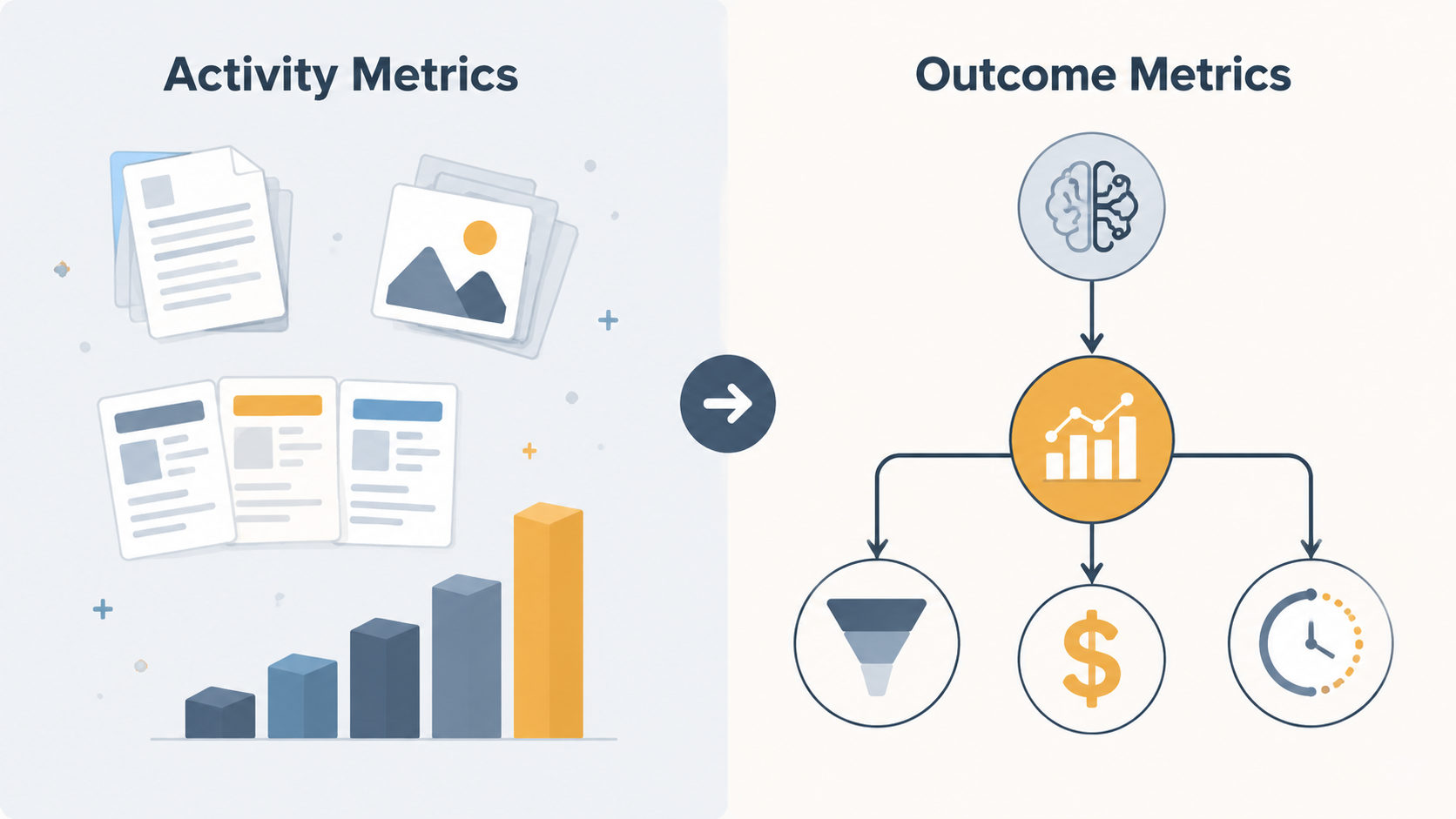
A team that produces 100 landing page variants has shown that AI changed production capacity. It has not yet shown that AI improved marketing performance. The business case starts when those variants are connected to the next measurable step: faster test launch, higher landing page conversion, lower media waste, reduced agency spend, or shorter campaign development time.
| What Teams Often Report | What Budget Reviewers Usually Need |
|---|---|
| Number of AI-generated drafts | Change in content cycle time or cost per approved asset |
| Number of ad variants created | Change in click-through rate, conversion rate, or cost per acquisition |
| Number of personalized emails produced | Change in qualified response rate, revenue per send, or unsubscribe rate |
| Number of campaigns shipped | Change in campaign velocity, pipeline contribution, or time-to-market |
| Hours saved by the team | Where those hours were redeployed and what output or decision improved |
Hours saved deserve special caution. They are often real, and they matter. But unless the saved time removes external spend, increases campaign throughput, improves quality control, or lets the team run tests it previously could not run, it may not survive as ROI. Finance will ask whether the time became capacity, cost reduction, or revenue movement.
That is where many AI pilots lose the thread. They measure the machine’s output instead of the workflow’s change.
A Defensible AI ROI Pilot Has a Narrower Shape
The cleanest AI ROI cases are usually not the broadest ones. They do not try to prove that “AI improved marketing.” They try to prove that one AI-assisted workflow changed one business metric against a baseline.
For example, a demand generation team might decide that AI will support paid search landing page testing. The metric is not “number of pages created.” The metric is the time from campaign brief to test launch, plus the conversion rate and CAC of AI-assisted tests compared with the prior testing process. If launch speed improves but CAC gets worse, the pilot has produced speed, not ROI. If speed improves and CAC holds or falls, the case becomes much stronger.
A content team might choose a different metric. If AI is used to create first drafts for SEO refreshes, the measurement design should compare cycle time, editorial revision load, organic traffic movement, assisted conversions, or cost per updated page against a pre-AI baseline. Counting published pages alone invites the wrong behavior: more output, regardless of whether the output earns attention.
The practical sequence is simple enough to fit into a spreadsheet, which is why it is often skipped too casually:
- Pick one workflow where AI changes a defined step, such as drafting, segmentation, QA, translation, reporting, or variant generation.
- Choose one primary business metric before the pilot starts.
- Record the baseline from the prior process, including time, cost, conversion, quality, or review burden.
- Separate AI-assisted work from non-AI work so the comparison is not contaminated.
- Decide how human review, brand risk, and compliance time will be counted.
- Report the result in the same language leadership already uses: CAC, conversion rate, campaign velocity, pipeline, cost per asset, or cycle time.
This is also where a simple implementation tool helps. An AI marketing ROI calculator template can keep the pilot honest by forcing the team to write down the baseline, cost inputs, expected business metric, and actual result before the success story starts drifting.
The Baseline Is Not Optional
A baseline is the part of the ROI case nobody celebrates, but it is what prevents the argument from becoming theater. If the team says AI reduced campaign turnaround time, the reviewer needs to know reduced from what. If AI lowered creative costs, the reviewer needs to know which costs were included. If AI improved conversion, the reviewer needs to know whether the audience, offer, channel, and budget were comparable.
The baseline does not need to be perfect. Marketing data rarely is. But it has to be meaningful enough that the comparison does not collapse under the first reasonable question. A previous quarter, a similar campaign type, a holdout group, or a non-AI workflow can all work if the limits are stated clearly.
The mistake is treating AI adoption itself as the baseline. A team can have high adoption and still have no controlled view of whether performance changed. That is one reason the 91% adoption number and the 41% proof number can coexist without contradiction.[1]
Published ROI Benchmarks Are Signals, Not Promises
The market is not short on impressive AI marketing ROI numbers. SQ Magazine’s 2026 AI marketing statistics roundup includes published estimates such as 544% ROI over three years for marketing automation, up to 748% ROI for B2B content marketing, and an average 32% CAC reduction associated with AI-enabled marketing.[2]
Those figures are useful as directional benchmarks, not as promises to paste into a budget request. The same source is an aggregation, and the underlying methodologies are not fully visible from the roundup.[2] That does not make the numbers worthless. It means they should be used to frame the possible range of outcomes, while the company’s own pilot design carries the burden of proof.
This is the difference between saying, “Published benchmarks suggest AI can produce material returns in automation, content, and acquisition efficiency,” and saying, “Our team will get 544% ROI.” The first statement is defensible. The second is a hostage note to your future self.
Case studies deserve the same treatment. Vendor-reported wins can show what is possible under favorable conditions, but they are naturally more likely to feature successful implementations than ordinary ones. A marketing manager can learn from them without pretending they represent the median outcome.
If prioritization is the immediate problem, it is better to rank use cases by their measurement quality and business proximity. A use case that touches CAC, conversion, or sales velocity usually has a cleaner ROI path than one that only increases asset volume. The AI marketing use-case ROI ranking is a more useful next step than trying to make every workflow look equally strategic.
Governance Counts Because Bad Output Has a Cost
AI ROI is not only a productivity question. Review time, rework, brand risk, legal escalation, and customer trust can all change the economics of a workflow. A fast draft that requires heavy cleanup may still be useful, but its value is lower than the production dashboard suggests.
Shopify’s 2026 AI marketing statistics article notes an informal “30% rule” used by some teams, where roughly 70% of production is AI-supported and 30% remains human-led as a trust floor.[3] That should not be treated as a validated industry benchmark. It is better understood as a governance cue: keep humans visibly responsible for judgment, quality, and risk-sensitive decisions.
The operating question is not whether every asset touched by AI must receive the same level of review. It is which decisions create enough risk or enough value that human judgment should remain explicit. A paid social variation may need a light brand check. A regulated claim, executive message, pricing page, or customer-facing lifecycle sequence may need a much heavier one.
That review load belongs in the ROI model. If AI cuts drafting time by half but doubles approval time, the workflow did not become twice as efficient. It moved labor from one column to another.
Cost Savings Are Real, but They Need Translation
The executive conversation around AI increasingly includes headcount, cost savings, and operating model changes. Spencer Stuart’s CMO-focused research frames 2026 as a make-or-break year for marketers confronting AI’s impact on cost structures and team expectations.[4] The sample and format make it better as a directional signal than a population-level conclusion, but it reflects the pressure many marketing leaders already feel.
That pressure can distort measurement. If the organization only wants a labor-reduction story, teams may undercount the more durable sources of value: faster testing, better segmentation, improved reporting, stronger localization coverage, fewer bottlenecks, or more consistent campaign QA. Those benefits still need to be translated into business language, but they should not be ignored just because they are not immediate headcount cuts.
A good ROI model can hold both. It can show direct cost reduction where it exists, and it can show capacity gains where people were redeployed to higher-value work. The second claim requires evidence. “The team saved time” is weaker than “the team used the saved time to launch two additional tests per month, and those tests improved conversion against the pre-AI baseline.”
Why the Proof Standard Is Rising
The drop from 49% to 41% proving ROI could reflect poor measurement, but it may also reflect a tougher proof standard.[1] In the first wave of AI adoption, leadership often accepted speed stories because the tools were new and the upside felt obvious. By 2026, that grace period is shorter. A pilot that once looked impressive because it produced more assets now has to show whether those assets changed performance.
That is a healthy development, even if it makes the dashboard look worse for a while. A stricter standard will expose weak use cases, inflated productivity claims, and workflows where AI adds novelty without removing friction. It will also make the strong cases easier to defend.
The teams most likely to benefit are not necessarily the teams with the largest tool stack. They are the teams that know what business metric each AI workflow is supposed to move and have the discipline to stop counting outputs as outcomes.
For teams trying to avoid the common traps, the useful companion question is why AI marketing projects fail to show ROI in the first place. The recurring patterns are usually not mysterious: vague ownership, no baseline, too many use cases at once, quality issues counted outside the model, and success metrics chosen after the pilot is already over. The AI marketing ROI failure-patterns guide is the “what not to do” counterpart to the measurement design.
What to Bring Into the Budget Meeting
A defensible AI marketing ROI case does not need to prove that every AI-assisted activity pays off. It needs to show where the tool changed a workflow, how that workflow was measured, and which business result moved compared with a credible baseline.
The strongest version is plain: before AI, this campaign type took a certain amount of time, cost a certain amount to produce, converted at a certain rate, or required a certain review load. After AI was introduced into a defined step, here is what changed. Here is what did not change. Here is what we will scale, stop, or retest.
That is the managerial line between enthusiasm and accountability. AI ROI becomes provable when pilots are designed around business change from the start, not retrofitted after the tool has already spread through the team.
References
- State of AI Marketing 2026, Jasper
- AI in Marketing Statistics 2026, SQ Magazine
- AI Marketing Statistics 2026, Shopify
- The AI Reckoning: Why Marketers Think 2026 Is a Make-or-Break Year, Spencer Stuart

Comments
Join the discussion with an anonymous comment.