
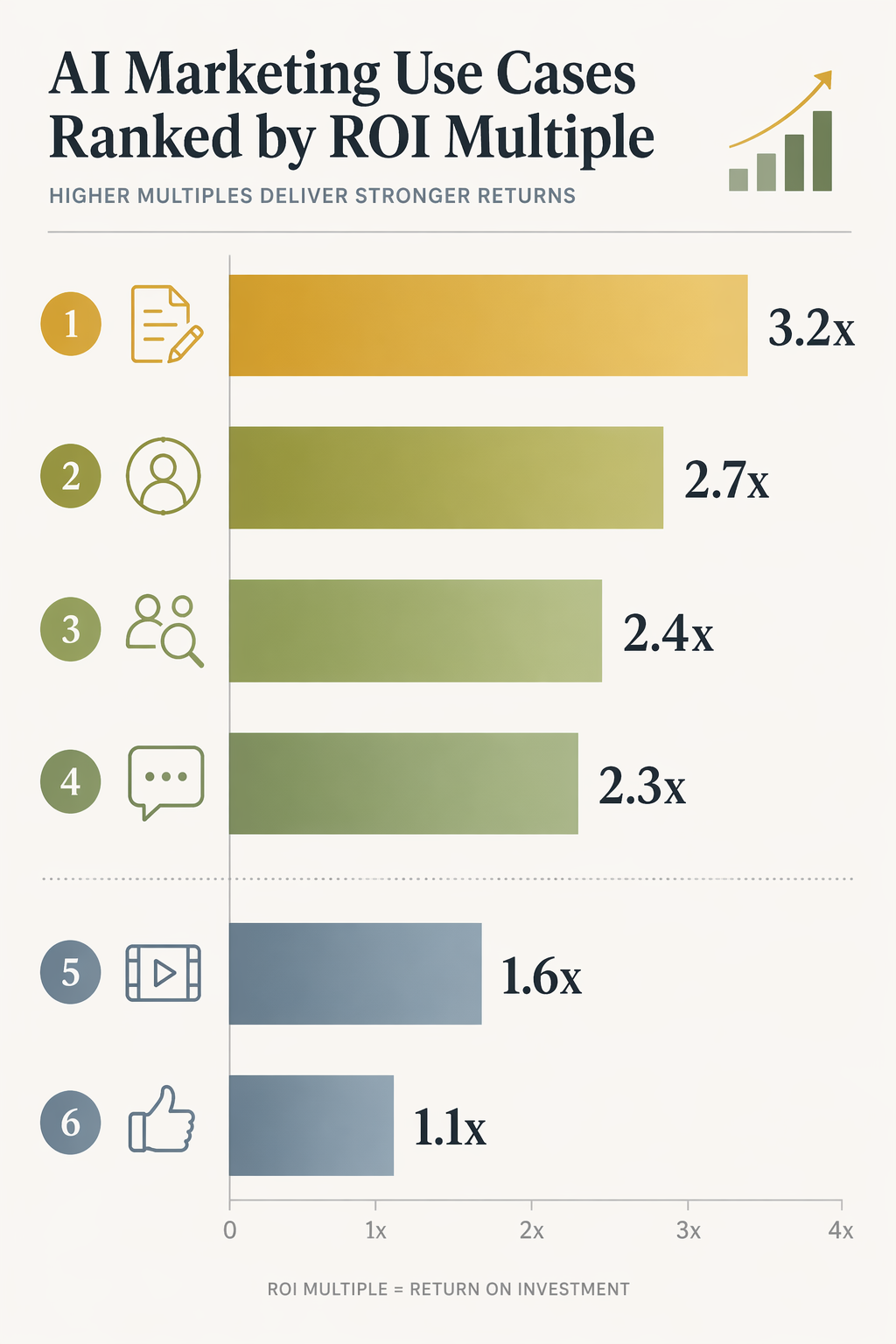
What Actually Works vs. What's Overhyped — AI Marketing Use Cases Ranked by ROI
A data-backed ranking of AI marketing applications by verifiable ROI, showing which use cases deliver 2.7x–3.2x returns and which underperform at 1.1x–1.6x, with real brand examples and the platform dynamics that explain the gap.
The useful way to evaluate artificial intelligence in digital marketing examples in Q3 2026 is not by novelty. It is by return spread. McKinsey’s 2026 AI marketing application findings put content drafting at about 3.2x ROI, personalization at about 2.7x, audience research and ad copy in the 2.3x–2.4x band, and AI video or generic paid social creative closer to 1.1x–1.6x depending on the cited implementation.[1]
That is a budget-allocation map. It says the highest-return use cases are usually not the most theatrical ones. They are the ones that remove a measurable production bottleneck, make relevance possible at a scale humans could not cover manually, or tie generated variants directly to response data. The weaker cases tend to create more assets without proving that the feed, auction, customer, or revenue system values those assets.
| AI marketing use case | Reported ROI band | Best reading of the evidence | Budget implication |
|---|---|---|---|
| Content drafting | ~3.2x | Strongest ranked application in the cited McKinsey findings; supported by brand-reported production-cost and time reductions | Prioritize where content volume, localization, or versioning blocks execution |
| Personalization and recommendations | ~2.7x | High-return when AI changes what each customer sees, not merely how fast a team produces assets | Fund when customer data, decision rules, and measurement are already usable |
| Audience research | ~2.3x–2.4x | Useful when it compresses analysis cycles and informs segmentation, messaging, or channel choices | Use to speed planning, not to replace market judgment |
| Ad copy and headline testing | ~2.3x–2.4x | Works best when generation is attached to controlled testing and response data | Fund inside a testing system, not as a standalone copy factory |
| AI-generated paid social creative | ~1.1x–1.6x in cited underperformer range | Production speed can be offset by platform ranking, sameness, and creative fatigue | Treat as experimental unless lift is proven inside the platform |
| AI video | ~1.1x–1.6x in cited underperformer range | Promising format, weak 2026 production ROI evidence in the cited set | Keep pilots narrow and measured against incremental performance |
For teams building an investment case, the ranking pairs well with a broader AI marketing ROI framework. A use case that looks efficient in a demo still has to survive four questions: what human bottleneck disappears, what customer decision changes, what system records the lift, and what cost remains after review, governance, and rework.
The Bottleneck Test Separates Useful AI From Busy AI
A marketing team can use AI every day and still fail to integrate it into the work that determines revenue. That gap shows up in the adoption data: HubSpot-referenced statistics put daily AI tool use among marketers at 87%, while survey convergence cited in the same 2026 statistics set places full workflow integration much lower, in the 6%–30% range depending on definition and respondent group.[2]
Daily use often means someone drafted a paragraph, summarized a call, generated a few email subject lines, or asked for campaign angles. Those are not trivial tasks, but they are not automatically operational leverage. Integration means the tool has entered the planning, production, QA, activation, testing, and reporting loop tightly enough that a manager can point to fewer hours, more variants shipped, higher response, lower cost per usable asset, or better revenue per customer.
The bottleneck test is intentionally plain: if the AI output does not remove a slow step, expand a constrained step, or improve a measured customer interaction, it is probably a productivity anecdote rather than an investment case.
Why Content Drafting Sits At The Top
Content drafting earns its position because it attacks a familiar constraint: capable marketers spend too many hours turning briefs, product notes, campaign angles, customer segments, and compliance edits into usable copy. The cited McKinsey ranking places the use case at about 3.2x ROI, the highest return in this research set.[1]
The strongest evidence is not that a model can write. Everyone has seen that. The stronger evidence is that brands report lower production cost or shorter content cycles after AI enters structured workflows. In the Leonardom.com database of 119 verified AI marketing entries, Adidas is reported as achieving a 91% cost reduction on personalized email creative, while Nestlé is reported as reducing content production time by 60%.[3]
Those figures should be read as brand-reported case outcomes, not universal benchmarks. They are still useful because they point to the economic mechanism. AI improves the unit economics of producing acceptable first drafts, variations, and localized or personalized versions. Human reviewers still matter, but they spend less time staring at a blank page and more time deciding what is on-brand, legally safe, channel-appropriate, and worth shipping.
Purpose Brand’s generative AI examples support the same production-economics pattern: the value is not simply faster copy, but faster movement from idea to usable content when teams already have brand guidance, review paths, and campaign context.[4] A content operation with no editorial standards may only produce more mediocre material. A content operation with standards can use AI to compress the least differentiated part of the work.
For managers comparing internal candidates, content drafting is attractive because the before-and-after math is visible. Count the number of drafts, variants, approval rounds, hours, and pieces shipped. If those numbers do not move, the tool is not creating the return implied by the category.
A useful next layer is the broader pattern library in 119 AI marketing case studies, because repeated production gains are more persuasive than one polished transformation story.
Personalization Works When It Changes The Customer Experience
Personalization sits just behind content drafting in the cited ranking, at about 2.7x ROI.[1] It is a different kind of win. Drafting reduces the cost of making marketing assets. Personalization changes which offer, message, product, or content a customer encounters.
The clearest examples involve AI scaling relevance beyond what a team could manually orchestrate. Sephora is cited in the 2026 AI marketing statistics set with a 29% customer lifetime value lift from AI personalization.[2] Amazon is widely cited in the same research set as attributing 35% of revenue to AI recommendations, a company-announced or estimated figure that should not be treated as independently audited performance proof.[2]
Even with that caveat, recommendations are a useful example because the labor being replaced is not simply copywriting labor. No team can manually decide, in real time and at full catalog scale, which products or messages should be shown to each customer based on current behavior, prior behavior, inventory, and likely next action. The value comes from decisioning density: more relevant choices made more often than a human workflow could support.
This is where many personalization projects quietly fail. They buy the interface before they fix the inputs. If customer data is fragmented, consent rules are unclear, product metadata is thin, and campaign reporting cannot isolate lift, the personalization engine has little room to prove its value. The better-funded version of the same mistake still looks busy; it just has more dashboards.
A sensible personalization budget therefore belongs close to data operations, lifecycle marketing, merchandising, and measurement. Creative generation can support it, but the return comes from making the next interaction more relevant, not from saying the customer’s first name in another subject line.
Audience Research And Ad Copy Are Useful, But Only Inside A Learning Loop
Audience research and ad copy occupy the middle of the ranking, with reported returns around 2.3x–2.4x in the cited McKinsey application set.[1] That is still meaningful. It is just less forgiving than content drafting because the output has to influence a decision or win a test, not merely exist.
Audience research can compress the early work of reading reviews, summarizing calls, clustering objections, comparing competitors, and finding language patterns. The danger is false confidence. AI can organize inputs quickly, but it cannot make weak source material representative. Treat it as an analyst that accelerates synthesis, then check the insight against actual customer behavior before it becomes a campaign premise.
Ad copy has a better case when generation is tied to live performance. JPMorgan Chase’s work with Persado is cited in ROI and AI marketing use-case analysis as achieving up to 4x click-through-rate lift with AI-generated headlines.[5][6] The important phrase is not “AI-generated.” It is “headline lift.” The copy entered a testing system, response data judged it, and the winning language had a measurable job.
That bridge case explains why ad copy belongs above generic paid social creative in the ranking. Copy variants can work when they are constrained by offer, audience, channel, and test design. A copy engine throwing out hundreds of lines without a clean experiment attached is just making review work for someone else.
The Underperformers: AI Video And Generic Paid Social Creative
AI video and AI-generated paid social creative are where the ranking becomes least intuitive. They look like the future in a vendor demo. They can also be the place where production savings disappear after distribution.
The underperformance band in the research set is roughly 1.1x–1.6x. MIT IDE research on personalized AI video ads is cited for weak returns in that range, while the paid-social concern comes from practitioner analysis that Meta, TikTok, and Google ranking environments in 2026 have become less friendly to detectable or obvious AI creative.[7][8]
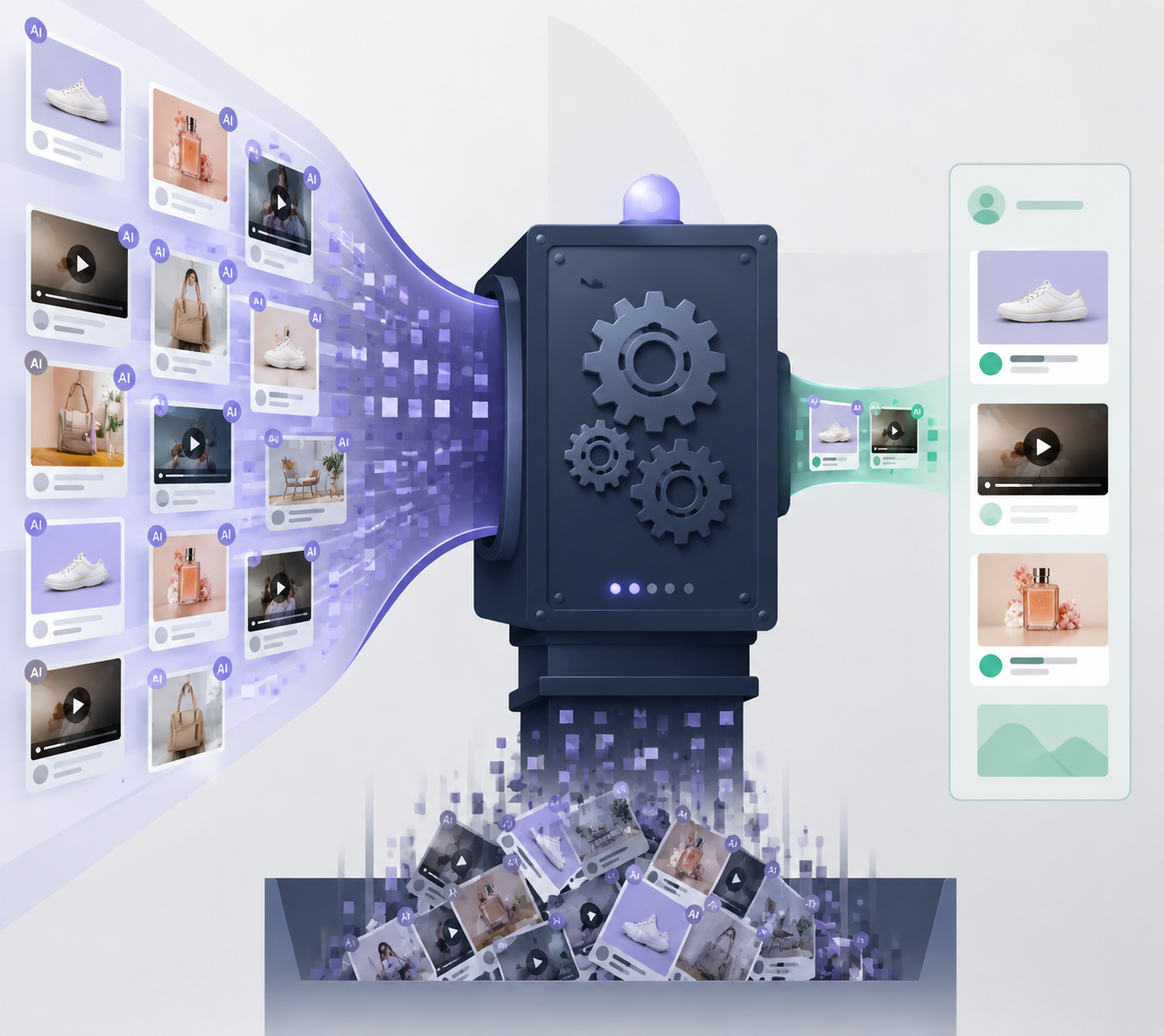
That platform claim should be labeled carefully. It is practitioner-sourced intelligence, not a platform-confirmed universal policy.[8] Still, it matches what many performance teams are trying to measure: more creative output does not guarantee more delivery, lower CPM, better thumb-stop behavior, stronger conversion rate, or higher incrementality. The platform is not a neutral shelf. It is an active ranking system.
This is the part that makes the ROI spread plausible. Content drafting usually improves an internal process before the asset reaches the market. Personalization improves a customer decisioning process. Generic AI paid social creative enters a hostile auction and feed environment where sameness is punished by users, rankings, or both. If ten brands use similar tools trained on similar patterns to make similar-looking ads, the cost of production drops while the cost of attention may rise.
Creative fatigue compounds the problem. A team can generate more variations, but if the variations share the same synthetic pacing, visual grammar, hooks, and stock-like emotional register, the platform may learn quickly that users do not respond. The production dashboard celebrates volume. The media dashboard records indifference.
AI video has another burden: review cost. Video assets can require brand, legal, product, talent, localization, accessibility, and channel checks. If AI reduces editing time but increases review time or creates uncertainty about rights and realism, the apparent production gain shrinks. This does not mean AI video will remain weak forever. It means the 2026 investment case should be narrower than the demo reel suggests.
Managers evaluating these formats should keep the test close to platform outcomes: holdout groups, incremental conversions, AOV effects, frequency curves, fatigue rate, and delivery quality. The companion benchmarks in why AI marketing projects fail to show ROI and the AI vs. human ad creative framework are more useful here than another tour of tools.
Market Growth Does Not Prove Application ROI
Analyst estimates put the AI marketing market at $57.99 billion in 2026 and project $107.5 billion by 2028.[9][10] That context matters for vendor funding, procurement pressure, and executive attention. It does not prove that a specific use case works inside a specific marketing organization.
Market size is adoption context. ROI is operating evidence. Confusing the two is how teams end up defending a platform renewal with category-growth charts instead of campaign, lifecycle, or production metrics.
A Q3 2026 Investment Rule
Prioritize AI where it removes a measurable human bottleneck or enables personalization at a scale the team could not manually execute. Content drafting, lifecycle versioning, recommendation logic, audience synthesis, and tested copy variants deserve serious budget when their before-and-after metrics are visible.
Treat AI video and generic paid social creative as experiments unless the team can prove incremental lift inside the current platform environment. The approval question should not be “Can we make more?” It should be “Did the system reward what we made after all review, media, and fatigue costs were counted?”
References
- The State of AI: Global Survey 2026, McKinsey & Company, 2026
- AI Marketing Statistics 2026, Digital Applied AI, 2026
- 119 Verified AI Marketing Case Studies, Leonardom.com, 2026
- Generative AI Examples, Purpose Brand
- 10-Company AI Marketing ROI Analysis, Pecan.ai, 2026
- AI Marketing Use Cases, Coupler.io
- Personalized AI Video Ads Research, MIT Initiative on the Digital Economy
- 2026 AI Creative Platform Ranking Case Study Analysis, Pragmatic Digital, 2026
- AI Marketing Market Size 2026, All About AI, 2026
- Artificial Intelligence in Marketing Market Forecast, Statista

Comments
Join the discussion with an anonymous comment.