

BCG
This article examines why most AI marketing investments fail to produce measurable returns and what the minority that succeeds does differently. It provides a diagnostic framework based on BCG's 10/20/70 rule and evidence from multiple studies to help marketers realign their approach.
Outcome
74% of AI marketing projects fail to show measurable ROI — source: BCG/Deloitte/IBM studies, 2026
This outcome is independently verified via the primary source linked above.
The uncomfortable number in AI marketing is not how many teams have tried it. It is how many still cannot show what changed after the license was bought, the pilot was announced, and the first dashboards went live.
The figure most often attached to that gap is 74%: a broad indication that most enterprises are not yet capturing sufficient value from AI. It should be read carefully. BCG, Deloitte, and IBM have not all measured the same thing in the same way; some analyses look at whether AI pilots reach production, others at whether companies meet financial-return thresholds or capture enterprise value. Still, the convergence matters. Across different definitions, the pattern is the same: adoption has moved faster than accountability.[1]
That distinction matters for anyone looking for AI marketing ROI case study examples that leaders can trust. A case study is not useful because it proves that a tool category works in the abstract. It is useful when it shows the operating conditions that made ROI measurable: the business question, the data state, the workflow change, the people expected to use the system, and the metric that would count as success.
The Useful Diagnosis: BCG's 10/20/70 Rule
BCG's 10/20/70 rule is not a budget template, and it should not be treated as one. It is more useful than that. The rule says that successful AI transformations tend to allocate about 10% of the effort to algorithms, 20% to technology and data, and 70% to people and processes.[2] In other words, most of the work that determines whether AI creates value happens after the demo.
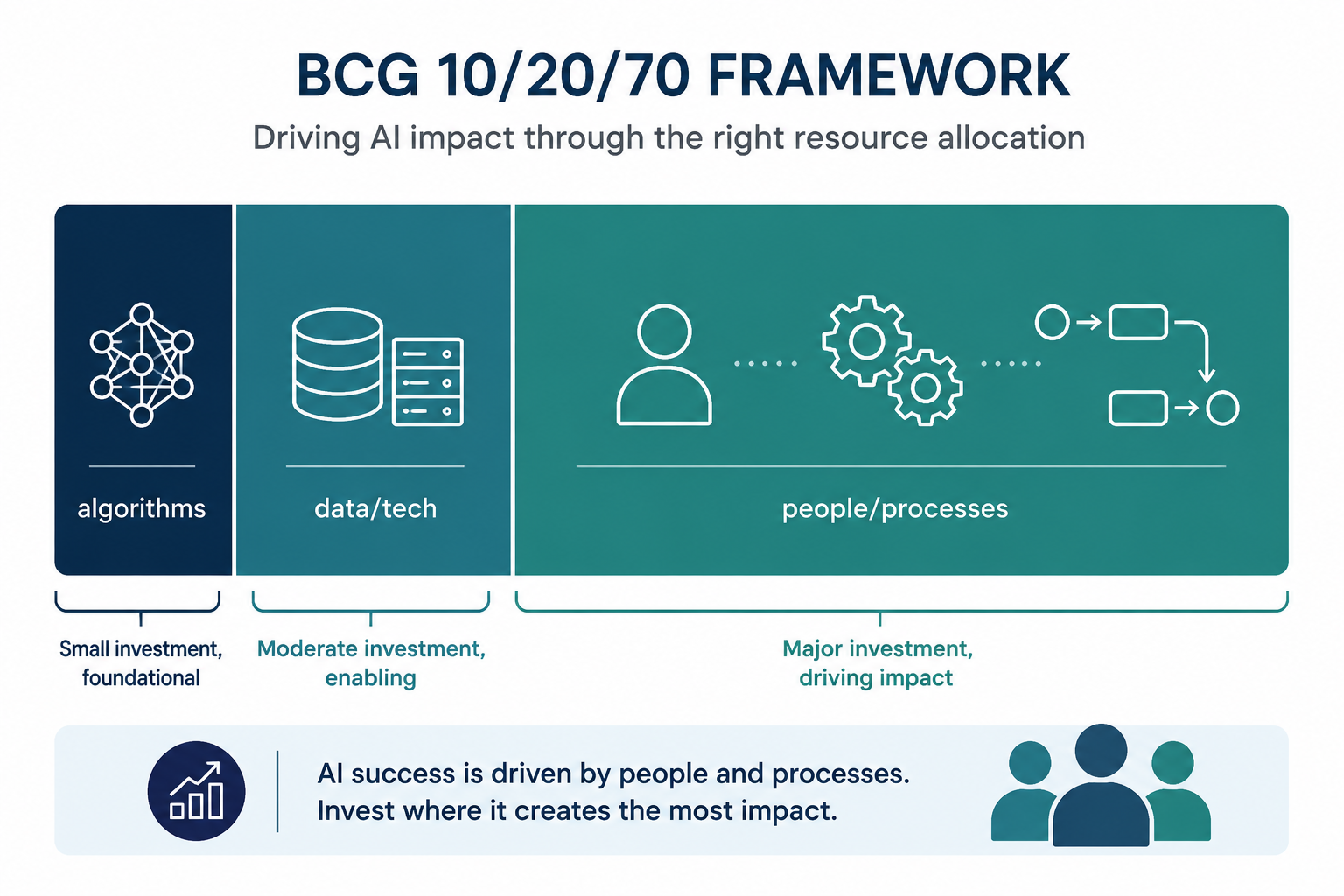
That framework explains why so many AI marketing programs look rational at purchase time and fragile at measurement time. The buying process naturally overweights what is easiest to compare: features, integrations, model claims, templates, and projected lift. The work that decides whether the lift appears in the business is harder to package: field hygiene, audience definitions, approval paths, campaign handoffs, training, governance, and attribution design.
A lifecycle team can buy an AI journey builder and still have no agreement on what counts as an incremental conversion. A content team can use generative AI and still have no review workflow that protects brand standards or search intent. A demand generation team can deploy predictive scoring and still have sales reject the output because no one involved the reps in the definition of a qualified account. None of these are failures of model capability in isolation. They are failures of operating design.
BCG's later work on the AI impact gap reinforces the same point: leading companies put the majority of AI resources into people and processes rather than algorithms or technology.[1] The successful minority is not simply choosing better tools. It is spending its scarce attention in a different place.
Why Tool-First AI Programs Lose the ROI Thread
Marketing teams rarely start tool-first because they are careless. They start there because the organization has already made the technology visible. A vendor demo creates urgency. A competitor anecdote creates anxiety. A board question creates a deadline. By the time marketing operations is asked to "prove ROI," the use case may already be framed as implementation rather than diagnosis.
The problem is that ROI is not a reporting layer added at the end. It is a design constraint at the beginning. If the team has not named the baseline, the counterfactual, the audience, the workflow owner, and the decision that will change because of the AI output, the dashboard inherits ambiguity. It can show activity, usage, and even correlated performance movement. It cannot confidently show that the AI project caused business value.
This is where broad AI promise figures are both useful and dangerous. McKinsey-related reporting has pointed to 10-20% sales ROI improvement for organizations investing deeply in AI, and AI personalization has been associated with 5-8x ROI on marketing spend.[7] Those numbers should keep marketers from dismissing AI's upside. They should not be used as if every marketing organization can unlock the same return by adding a tool to its existing process.
The phrase "investing deeply" is doing real work. Deep investment includes the dull parts: data readiness, training, process redesign, and measurement discipline. Without those, the team may still get productivity benefits, but it will struggle to connect them to margin, revenue, retention, pipeline quality, or cost avoidance.
The Data Problem Is Not a Cleanup Chore
Data quality is often described as a prerequisite for AI. That makes it sound like a box to check before the interesting work begins. In practice, it is one of the main places where ROI is either created or lost.
In the research cited by CDO Times and Informatica, 43% identified data quality as the top barrier, and data issues were said to consume 80% of AI project work.[3] Those numbers are easy to nod past until they show up inside a marketing workflow. Duplicate accounts distort account-based marketing prioritization. Inconsistent lifecycle stages make nurture performance unreadable. Missing consent fields limit activation. Channel naming drift weakens attribution. Product usage data arrives too late to support timely retention campaigns.
The immediate consequence is not just that AI output becomes worse. The measurement becomes worse. If a model recommends audiences based on unreliable fields, and the campaign is measured against an unstable baseline, the team can end up debating the data instead of the decision. The project may have improved something real, but the organization cannot defend it. In leadership terms, invisible ROI is often treated the same as no ROI.
This is also where deployment costs get underestimated. CIO Dive, citing IBM, reported that companies can underestimate AI deployment costs by as much as 10x.[4] In marketing, those hidden costs are rarely confined to engineering. They include taxonomy work, CRM cleanup, data warehouse changes, consent and governance review, analytics QA, enablement sessions, and the time senior operators spend reconciling definitions that should have been settled before rollout.
A sensible AI marketing ROI conversation therefore has to include data labor as part of the investment, not as an unfortunate delay. If a personalization program requires months of identity resolution and content tagging before it can be measured, that work belongs in the business case. Leaving it out makes the projected ROI look cleaner and the actual ROI harder to explain.
Training Is Where Strategy Becomes Behavior
The people side of AI marketing is often softened into a change-management talking point. It deserves sharper treatment. If campaign managers, analysts, content leads, and lifecycle marketers are expected to use AI in live workflows, training is not a morale benefit. It is part of the control system.
SQ Magazine reported that 70% of marketing professionals receive no formal generative AI training.[5] That gap explains a lot of inconsistent adoption. One team member uses AI for first drafts, another for segmentation ideas, another for SQL assistance, another avoids it entirely, and no one is quite sure which outputs need review. Usage spreads, but the operating model does not.
The performance implication is not theoretical. Iterable, citing InformationWeek, reported that organizations that trained employees in AI saw a 43% higher success rate deploying AI projects.[6] Because that figure comes through secondary reporting, it should not be treated as a universal multiplier. It is still directionally consistent with what marketing operations teams see on the ground: tools become more valuable when people know when to trust them, when to challenge them, and how to route their outputs through the business.
Training also changes the quality of measurement. A trained analyst is more likely to ask whether a lift is incremental or merely seasonal. A trained content lead is more likely to separate production-speed gains from performance gains. A trained campaign manager is more likely to document where AI changed the workflow: fewer manual variants, faster QA, better audience selection, shorter launch cycles, or more consistent follow-up.
This is why the skills gap should not be framed as employee resistance. In many teams, people are being asked to absorb AI into already overloaded workflows without a shared playbook. The issue is explored more directly in Why Your AI Marketing Tools Are Underdelivering, but the practical point is simple: untrained users turn even capable platforms into inconsistent behavior.
Measurement Maturity Decides Whether ROI Can Be Seen
AI does not fix a weak measurement culture. It usually exposes it faster.
McKinsey-related reporting has noted that zero Fortune 500 CMOs in one cited finding could quantify martech ROI.[7] The exact context of that finding matters, but the signal is familiar: many marketing organizations already struggle to connect technology investment to financial impact before AI enters the stack. Add probabilistic outputs, automated decisions, generated content, and more complex customer journeys, and the attribution problem does not get easier.
A weak AI ROI dashboard usually has one of three problems. It measures usage instead of value. It measures outcomes without a credible baseline. Or it measures a blended business result that too many other changes influenced at the same time. None of those problems can be solved by adding more charts.
| If the AI use case is... | The ROI question should be... |
|---|---|
| Content production assistance | Did cycle time, cost per approved asset, or performance per asset improve after review standards stayed constant? |
| Personalized lifecycle messaging | Did incremental conversion, retention, or revenue per recipient improve against a comparable holdout or baseline? |
| Predictive lead or account scoring | Did sales acceptance, conversion rate, or pipeline quality improve for the scored segment? |
| Campaign analysis automation | Did the team make better or faster budget, audience, or creative decisions because analysis latency decreased? |
The discipline is to define the decision before defining the dashboard. If AI will not change a decision, reduce a bottleneck, improve a customer interaction, or lower a cost, the team may be measuring novelty rather than return.
What the 26% Do Differently
The minority of organizations that do capture value from AI are not immune to messy data, skeptical users, or attribution debates. The difference is that they treat those issues as part of the project instead of exceptions to it.
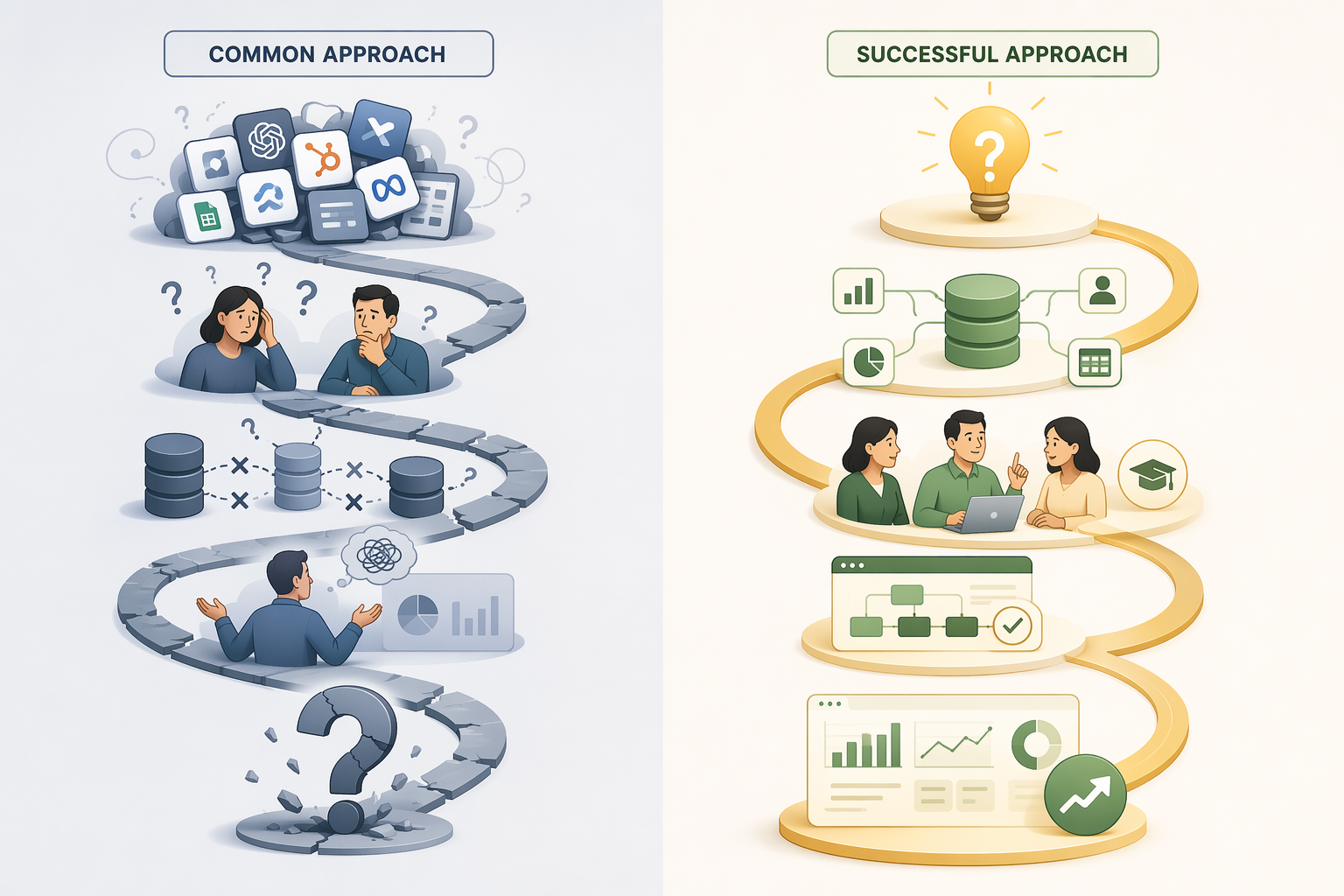
They start with a business question, not a platform category. A better opening question is not "Where can we use generative AI?" It is "Which marketing constraint is expensive enough to fix?" That constraint might be campaign launch speed, poor nurture relevance, slow reporting, inconsistent sales follow-up, content localization cost, or churn-risk identification. The use case earns attention because the business problem is visible.
They redesign the workflow around the AI output. If a model produces account recommendations, someone has to decide how those recommendations enter sales plays, who can override them, how feedback returns to the model, and what happens when the recommendation conflicts with existing territory priorities. If AI drafts content variants, someone has to decide what review step is shortened, what risk controls remain, and how final assets are tagged for learning.
They also fund the boring work. Data definitions are clarified. Training is scheduled. Governance is written down. Analytics owners are involved before launch. The team agrees whether the first goal is revenue lift, cost reduction, speed, quality, or capacity. That agreement prevents the common post-launch argument where one executive expected pipeline impact, the campaign team optimized production efficiency, and finance sees neither clearly enough.
The pattern shows up repeatedly across stronger AI marketing case studies: the technology matters, but the case becomes credible only when it explains the surrounding operating change. For a broader read on those patterns, see Five Real Patterns from 119 AI Marketing Case Studies.
A Better Test for AI Marketing ROI
Before approving or expanding an AI marketing project, the most useful test is not whether the vendor can show impressive benchmarks. It is whether the internal team can answer five questions without hand-waving.
- Business question: What specific constraint, cost, revenue opportunity, or customer experience problem is this project meant to change?
- Workflow change: Which step will be removed, accelerated, improved, or reassigned because AI is involved?
- Data requirement: Which fields, events, taxonomies, permissions, and integrations must be reliable enough for both activation and measurement?
- Training plan: Who is expected to use the system, review its output, override it, and explain the result?
- Measurement method: What baseline, holdout, comparison period, or operational metric will show whether the project created value?
This test is intentionally less exciting than an AI roadmap slide. It is also harder to fake. A team can have a polished use-case inventory and still be unable to name the workflow owner. It can have a forecasted lift and still lack a baseline. It can have an executive sponsor and still have no training plan for the people whose behavior must change.
For teams that need to turn the diagnostic into a phased operating plan, a 90-day structure can help sequence the work without pretending the organization will solve every data and process issue at once. The practical version is outlined in AI Marketing Strategy in 2026.
The cleanest conclusion from the evidence is narrow, but useful. AI marketing projects usually do not fail to show ROI because AI has no marketing value. They fail because the organization treats ROI as something to prove after implementation rather than something to design into the implementation.
If an AI marketing project cannot name the business question, the workflow change, the data requirement, the training plan, and the measurement method, it is probably not an ROI project yet. It is a tool deployment waiting for an operating model.
References
- From Potential to Profit: Closing the AI Impact Gap, BCG
- The Leader's Guide to Transforming with AI, BCG
- Informatica research cited by CDO Times on AI data quality barriers, CDO Times
- IBM research cited by CIO Dive on AI deployment cost underestimation, CIO Dive
- AI in Marketing Statistics 2026: ROI, Tools & Trends, SQ Magazine
- 15+ Stats About Achieving ROI From AI Marketing, Iterable
- McKinsey research cited in secondary reporting on AI sales ROI, personalization ROI, and martech ROI quantification, McKinsey


Comments
Join the discussion with an anonymous comment.