
AI Marketing Strategy in 2026: A 90-Day Phased Implementation Roadmap
A step-by-step 90-day phased roadmap for building your AI marketing strategy in 2026, with exact weekly milestones, budget allocation percentages, and measurement checkpoints to avoid common pilot failures.
The first 90 days of an AI marketing strategy should not start with a tool trial. Start with the order of operations: what has to be trusted before anything gets automated, generated, or scaled.
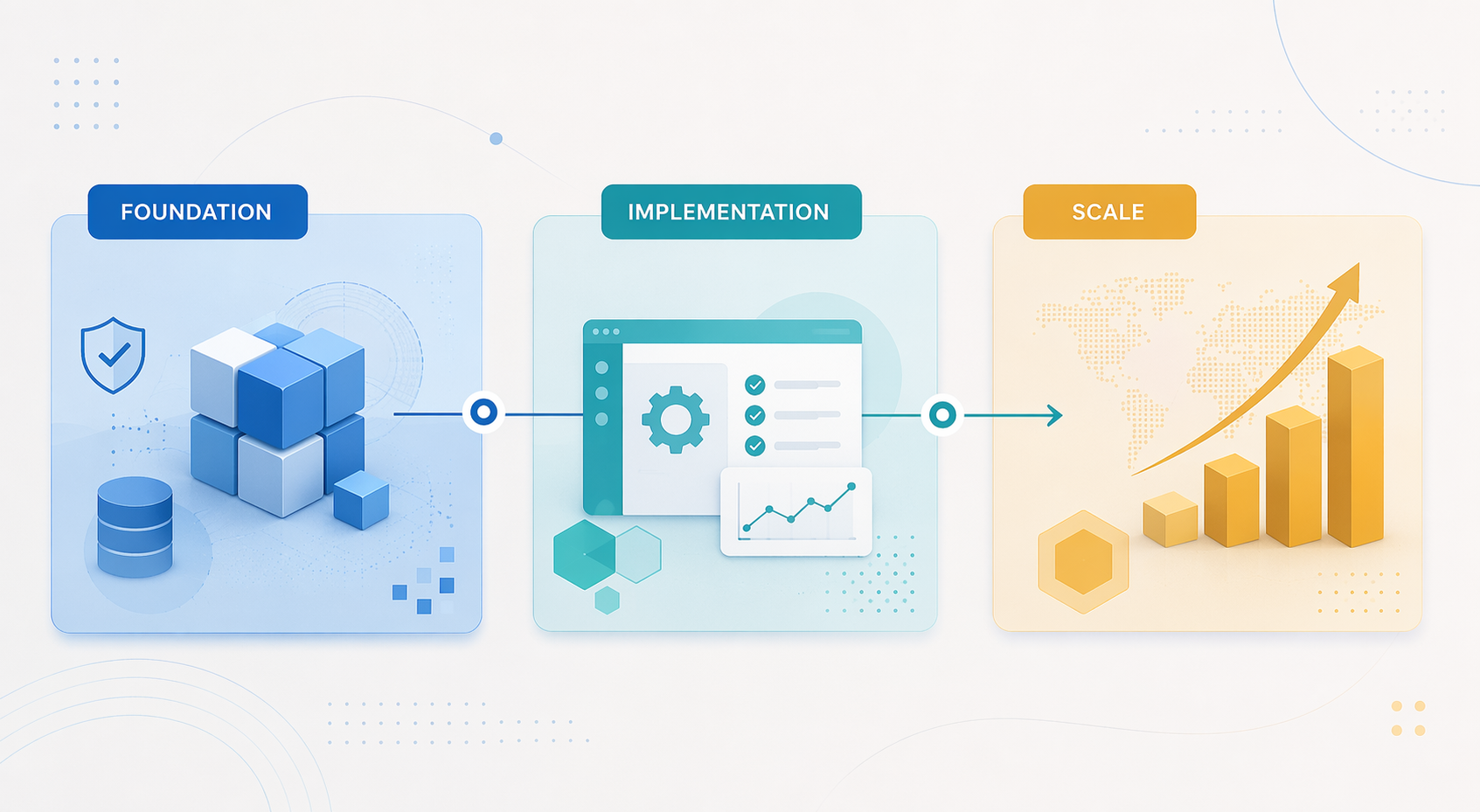
| Phase | Weeks | Main job | Budget posture | Exit checkpoint |
|---|---|---|---|---|
| Foundation | Weeks 1–4 | Audit data, content, workflows, search visibility, governance, and measurement baselines | Fence off 5–7% for governance infrastructure before scaling content generation | Approved use cases, data readiness score, governance rules, baseline dashboard |
| Implementation | Weeks 5–8 | Run controlled pilots in priority workflows and connect reporting to existing marketing operations | Keep tools, content, automation, and analytics inside pre-set allocation bands | Pilot results reviewed against baseline, human review paths confirmed, attribution intact |
| Scale | Weeks 9–13 | Expand the workflows that improved speed, quality, or visibility without creating cleanup debt | Increase spend only where workflow evidence supports it | Operating model, owner map, KPI cadence, and next-quarter backlog are in place |
This roadmap uses a Foundation → Implementation → Scale sequence aligned with 90-day AI marketing planning guidance from Digital Applied, while treating budget allocation as an operating constraint rather than a slide-deck afterthought.[1] If you need the broader strategic architecture first, the companion 5-step AI marketing strategy framework answers what belongs in the strategy. This article is about when each piece lands and what must be ready before the next move.
Why the Sequence Matters in 2026
The pressure to move faster is real, but it is uneven. Search behavior is shifting, AI answer surfaces are changing discovery, and marketing teams are being asked to produce more without adding much operational slack. That does not make random experimentation safer. It makes sequencing more important.
Improvado reports that 47% of brands still lack a deliberate AI search strategy, and its analysis also says GPTBot and ClaudeBot collectively account for about 22% of bot requests, rivaling Bingbot in visibility implications.[2] That is not a universal law about every site, and it comes from a commercial source, but the operational takeaway is practical: if AI crawlers cannot access the right public content, the brand may be absent from answer environments where buyers are beginning research.
Search also gives teams less room to treat answer-engine optimization as a later enhancement. Seer Interactive’s September 2025 CTR study found that more than 65% of Google searches in its sample ended without a click, but the study focused on informational and educational queries across 42 client organizations, so it should not be stretched to commercial, transactional, or local intent without additional evidence.[3] For content and SEO teams, the narrower conclusion is still enough: if your AI marketing strategy ignores zero-click and AI answer visibility during the first month, you are building measurement around a shrinking part of the journey.
Weeks 1–4: Foundation Before Generation
The Foundation phase is where the strategy either becomes usable or becomes another pilot with a cleanup phase attached. The work is not glamorous: inventory, access, naming conventions, review paths, baseline metrics, and decision rights. It is also where most of the later speed is earned.
| Week | Milestone | Owner | What must be true before moving on |
|---|---|---|---|
| Week 1 | Audit current data, content, workflows, AI tool usage, and search visibility | Marketing ops with SEO, content, analytics, and channel leads | The team knows which systems, pages, prompts, dashboards, and handoffs already exist |
| Week 2 | Select priority use cases and reject low-readiness ideas | Growth or marketing lead with functional owners | Use cases are ranked by business value, data readiness, risk, and workflow fit |
| Week 3 | Create governance, review, and approval rules | Content lead, legal or compliance where needed, brand, SEO, and ops | Human review paths, disclosure rules, source standards, and escalation rules are documented |
| Week 4 | Build baseline measurement and launch criteria | Analytics lead with channel owners | Dashboards show pre-AI performance and define what a pilot must improve |
Week 1: Audit the Mess Before You Automate It
Week 1 should produce a working inventory, not a strategy memo. List the marketing systems that hold customer, content, campaign, SEO, paid media, CRM, and analytics data. Then list where AI is already being used unofficially: content briefs, ad variants, email drafts, sales enablement, reporting summaries, image generation, chatbot scripts, keyword clustering, and meeting notes.
This is also the right time to run a failure diagnostic. If past AI tests created duplicate content, unreviewed claims, broken UTMs, off-brand messaging, or unclear ownership, document those failures before approving new experiments. The AI marketing strategy failure diagnostic is useful here because the question is not whether the team is interested in AI. The question is whether the operating environment can absorb it.
For search, the audit needs to include robots.txt rules, indexability, structured data, content freshness, author and reviewer signals, and the pages most likely to be summarized by AI systems. Because AI crawler behavior now has visibility implications, blocking or allowing crawlers should be a deliberate policy choice, not a leftover technical default.[2]
Week 2: Pick Use Cases That the Organization Can Actually Support
A useful use-case shortlist has fewer items than the team wants. Rank candidates on four dimensions: business value, data readiness, review complexity, and workflow disruption. A content refresh workflow with clear source material and an existing SEO review path may be a better first pilot than a fully automated campaign generator, even if the second sounds more impressive in a leadership meeting.
- Start now: workflows with clean inputs, existing owners, low compliance exposure, and measurable before-and-after baselines.
- Hold for later: workflows that depend on fragmented customer data, unclear brand rules, or manual attribution fixes.
- Reject for this quarter: use cases where nobody owns quality control, customer impact, or post-launch monitoring.
Smart Insights’ 2026 digital marketing trends guidance frames AI adoption inside broader planning systems such as RACE rather than as a standalone software decision.[4] That matters in Week 2 because a use case should map to a real marketing objective: reach, engagement, conversion, retention, efficiency, or decision quality. If it does not, it is probably a demo.
Week 3: Write the Rules Before the Drafts Exist
Governance is the part everyone claims they will add once the pilot works. That order is backwards. By the time a generated asset is live, the organization has already accepted risk across accuracy, brand voice, copyright, disclosure, privacy, SEO quality, and customer trust.
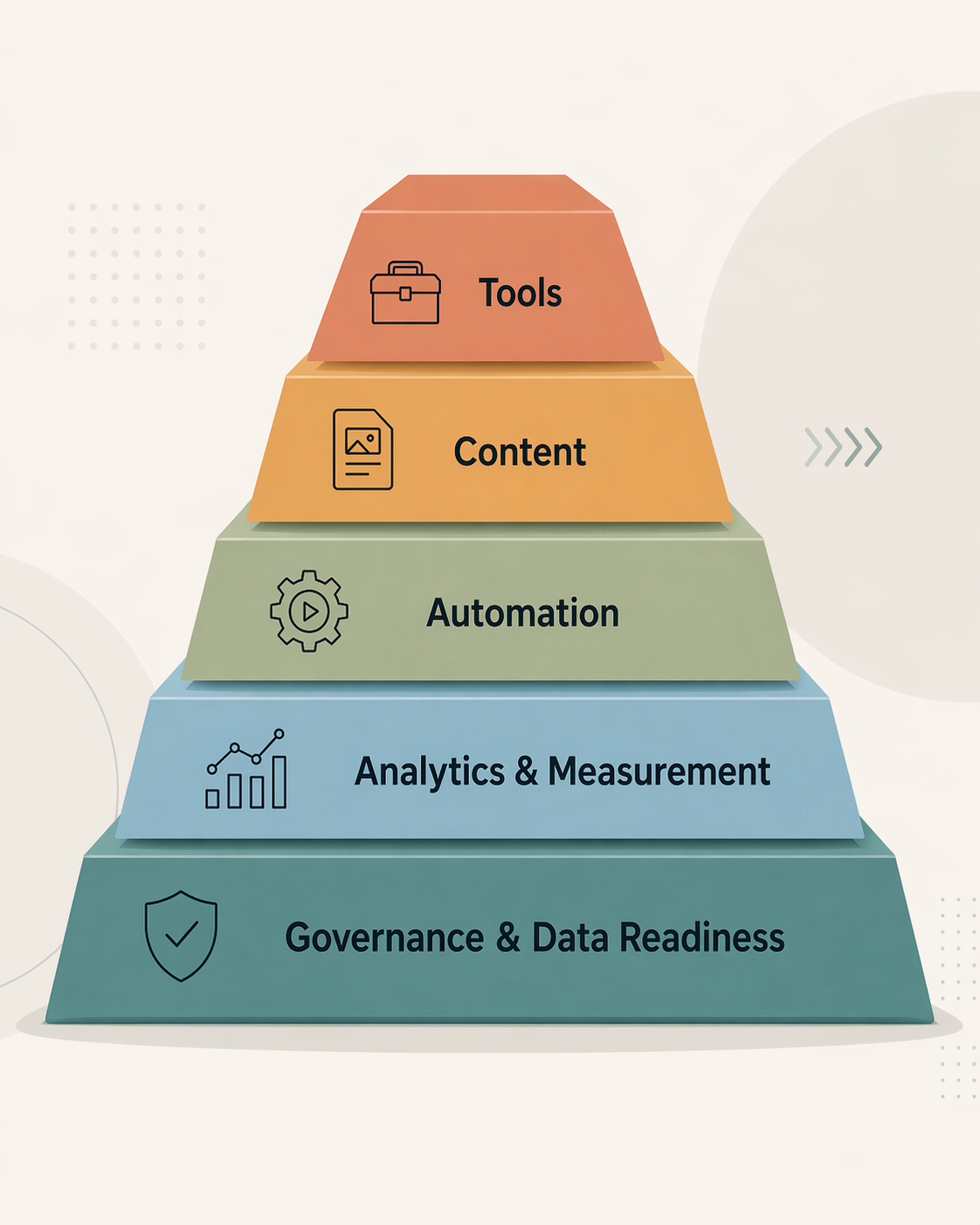
Reserve 5–7% of the AI marketing budget for governance infrastructure before scaling content generation. That includes review workflows, source standards, access controls, prompt and output documentation, approval routing, crawler policy, and training for the people who will inherit the system. This reserve is small enough to protect experimentation, but large enough to prevent the common pattern where teams fund content tools first and then ask operations to clean up the residue.
Improvado’s benchmark discussion points to a familiar imbalance: organizations often allocate heavily toward content tools while governance receives a much smaller share, with roughly 22% of budget going to content tools and about 3% to governance in the cited benchmark.[2] Treat those figures cautiously because the source has a vendor lens, but the direction is believable enough to change behavior. If governance is not funded, it will be borrowed from someone’s evenings.
The governance checklist should be concrete:
- Approved and prohibited AI use cases by channel
- Required human review roles for factual, legal, brand, and SEO checks
- Source rules for claims, statistics, quotes, and product information
- Customer data rules, including what cannot be entered into AI systems
- Versioning rules for prompts, briefs, generated drafts, and final assets
- Escalation paths when AI output conflicts with policy or performance data
This is also where trust belongs in the budget discussion, not after a campaign goes sideways. If the organization needs a deeper view of consumer and internal trust issues, the AI marketing trust gap is the better companion read.
Week 4: Measure the Baseline Before the Pilot Gets Credit
Week 4 is where teams prevent false wins. Before any pilot launches, capture the current baseline for the workflow it will affect. For a content refresh pilot, that might include production cycle time, organic impressions, clicks, non-click visibility indicators, rankings for target query sets, assisted conversions, review time, and revision count. For an email workflow, it might include build time, approval delays, segmentation errors, deliverability, click rate, conversion rate, and unsubscribe behavior.
The key is to separate activity from improvement. More drafts, more variants, and more dashboards do not prove that the AI marketing strategy is working. They prove the system is producing more artifacts. A pilot earns expansion only if it improves a defined business or workflow measure without breaking quality control.
For ROI context, use the generative AI marketing ROI guide alongside your internal baseline. External benchmarks can help frame expectations, but the expansion decision should rest on your own pre- and post-pilot evidence.
Budget Allocation: Set the Guardrails Before Spend Expands
A 90-day AI marketing budget should make it hard to overspend on shiny tools and underfund the work that makes those tools useful. Digital Applied’s roadmap and Improvado’s benchmark discussion support a phased allocation model: 30–40% tools, 25–35% content, 20–25% automation, 10–15% analytics, with 5–7% reserved for governance before content generation scales.[1][2]
| Budget area | Operating range | What it covers | Scaling rule |
|---|---|---|---|
| Tools | 30–40% | AI platforms, integrations, workflow software, experimentation environments | Do not add seats faster than adoption, governance, and reporting can support |
| Content | 25–35% | Briefing, generation support, editing, SME review, optimization, refresh work | Increase only after quality standards and review capacity are proven |
| Automation | 20–25% | Workflow triggers, routing, CRM or MAP connections, reporting automation | Automate stable processes, not unresolved decisions |
| Analytics | 10–15% | Dashboards, attribution QA, search visibility tracking, KPI review cadence | Protect this line item before leadership asks whether the pilot worked |
| Governance reserve | 5–7% | Policies, access controls, training, review systems, crawler and content rules | Fund before scaling content generation |
These ranges are not precise financial laws. They are pressure valves. If tools rise above the range, something else is probably being starved. If analytics is treated as optional, attribution cleanup will arrive later. If governance is squeezed below the reserve, the content lead and ops team will pay for it in rework.
For a deeper investment breakdown across sales and marketing functions, use the AI sales and marketing budget allocation guide. For this roadmap, the important decision is simpler: no major content scale-up until governance, analytics, and ownership are funded.
Weeks 5–8: Controlled Implementation
Implementation should feel narrower than the brainstorm that produced it. Pick two or three pilots that passed the Foundation screen. Connect them to existing work rather than creating a parallel AI theater where everything looks fast because it is detached from real approval, publishing, and reporting systems.
| Week | Milestone | Main decision |
|---|---|---|
| Week 5 | Configure tools, access, prompts, templates, and approval routing | Can the workflow run inside existing operations? |
| Week 6 | Launch pilots with human review and baseline comparison | Is the output usable after normal review, or is it creating hidden rework? |
| Week 7 | Connect reporting and search visibility checks | Can performance be read without manual reconstruction? |
| Week 8 | Hold the pilot review and choose expand, revise, or stop | Did the workflow improve enough to deserve more budget? |
Google’s AI for Marketing Engine frames AI maturity around connected data, creative, media, measurement, and organizational capability rather than isolated tools.[5] That is the useful lens for Weeks 5–8. A pilot that produces decent copy but cannot connect to measurement, review, or distribution is not mature enough to scale.
Content and SEO Pilots Need AEO Built In
For many teams, the first implementation pilot will involve content because the efficiency gain is visible. That is fine if the pilot is not reduced to draft volume. In 2026, content pilots should include answer-engine optimization, structured information, source clarity, and crawler accessibility from the start.
A practical pilot might refresh a cluster of educational pages with clearer entity coverage, better summaries, updated internal links, stronger source handling, and review notes for AI-generated sections. The KPI set should include production time and quality indicators, but also visibility measures that account for zero-click behavior. Seer’s CTR findings do not prove every query has become zero-click, but they do warn against judging informational content only by last-click traffic.[3]
If the team needs channel-level implementation detail, the function-by-function guide to AI in digital marketing can sit beside this phase. Keep the roadmap itself focused on sequencing: stable workflow first, then channel expansion.
Automation Comes After the Decision Path Is Stable
Automation should remove repeat work, not conceal judgment gaps. In Week 6 or 7, automate routing, status updates, brief creation, QA reminders, or reporting pulls only where the decision path is already clear. If two teams still disagree about who approves a claim, automation will simply move the disagreement faster.
A useful test is whether the workflow can be explained without naming the AI tool. For example: an SEO manager flags a page cluster, the content lead approves the brief, the AI system drafts against approved sources, the editor revises, the SME reviews factual claims, the SEO manager checks structure and internal links, and analytics tracks the before-and-after dashboard. If that path is coherent, automation can reduce handoffs. If it is not, the tool is being asked to manage the organization.
The Week 8 Review Should Be Allowed to Say No
By Week 8, every pilot should face the same decision: expand, revise, or stop. Do not let enthusiasm create a fourth option where the pilot continues indefinitely because people like the idea. Continuing without a decision is how temporary workarounds become operating debt.
- Expand if the workflow improved a defined KPI, preserved quality, and reduced or held review burden.
- Revise if the result is promising but blocked by data access, prompt quality, review rules, or integration gaps.
- Stop if the output requires more cleanup than the original process, creates measurement ambiguity, or depends on unmanaged risk.
Weeks 9–13: Scale What Survived Contact With Operations
Scale is not the moment to add every AI feature the team postponed. It is the moment to expand the workflows that proved they can survive real approvals, real reporting, and real ownership. The organization should now have enough evidence to decide where AI belongs in the next quarter’s marketing operating model.
| Week | Milestone | Output |
|---|---|---|
| Week 9 | Standardize the winning workflows | Reusable templates, prompts, QA rules, reporting views, and owner map |
| Week 10 | Expand to adjacent teams or channels | Controlled rollout plan with training and review capacity |
| Week 11 | Harden analytics and attribution | Dashboard QA, naming conventions, source tracking, and decision cadence |
| Week 12 | Review budget and vendor fit | Renew, consolidate, expand, or cut tool spend based on evidence |
| Week 13 | Lock the next-quarter operating model | Backlog, governance updates, KPI targets, and leadership readout |
The important change in this phase is ownership. During a pilot, a motivated manager can carry missing process with extra attention. At scale, that breaks. Every expanded workflow needs a named business owner, a technical or operations owner, a quality owner, and a measurement owner. In a small team, one person may hold more than one role, but the role still has to be explicit.
Week 11 deserves more attention than teams usually give it. Attribution can look intact during a small pilot because someone manually fixes naming, tags, or reports. Once scale begins, manual correction becomes a tax. Harden campaign naming, UTM rules, CRM field handling, dashboard definitions, and AI-assisted reporting notes before the next wave of content or automation goes live.
The Week 12 vendor review should be unsentimental. Keep tools that made approved workflows faster or better. Cut tools that created disconnected outputs, duplicated existing capabilities, or required more governance than their value justifies. A clever feature is not a strategy line item unless it survives procurement, process, and performance review.
The 90-Day Scorecard
By day 90, the question is not whether the marketing team used AI. It is whether the organization now has an operating model that can keep using AI without creating avoidable cleanup for the next quarter.
| Area | Day-90 evidence | Warning sign |
|---|---|---|
| Data readiness | Priority workflows have accessible, trusted inputs and documented restrictions | Teams still paste sensitive or inconsistent data into tools ad hoc |
| Governance | Use cases, review rules, source standards, and escalation paths are documented | Generated assets move faster than approvals can verify them |
| Measurement | Baselines and pilot outcomes are visible in shared dashboards | Success is described as activity volume rather than performance change |
| Search and AEO | Crawler policy, structured content, and zero-click visibility are part of SEO review | AI search visibility is postponed until after content scale-up |
| Budget | Spend follows allocation bands and governance is funded before expansion | Tool seats grow while analytics, review capacity, or training lag behind |
| Workflow ownership | Every scaled process has named owners and a decision cadence | The pilot depends on one person remembering how everything works |
This is a deliberately plain finish line. The goal is not a pile of connected tools or a content calendar inflated by AI drafts. The goal is data readiness, governance, baseline measurement, controlled implementation, and a scale path the team can defend when leadership asks what changed.
If the sequence held, the next quarter starts with fewer unknowns: which workflows are worth expanding, which tools earned their place, which metrics matter, and who owns the consequences. That is enough. The strategy is now operational, not accidental.
References
- AI Marketing Strategy Complete Roadmap 2026, Digital Applied
- AI Marketing Trends, Improvado
- AIO Impact on Google CTR: September 2025 Update, Seer Interactive, September 2025
- Digital Marketing Trends 2026, Smart Insights
- How to Use AI for Marketing, Google Business

Comments
Join the discussion with an anonymous comment.