
AI for Sales and Marketing in 2026: Where to Invest Your Budget for Maximum ROI
A data-driven guide for senior marketing and sales leaders on allocating AI budgets in 2026. Covers the 3x ROI gap between top and bottom use cases, proven tactics like predictive lead scoring and AI-personalized outreach, what to skip, and why governance deserves more than 3% of your spend.
The Adoption Debate Is Over — Budget Allocation Is the New Differentiator
For the last two years, the defining question in marketing and sales leadership has been: "Should we adopt AI?" That question is now settled. Sopro's 2026 research puts marketer AI adoption at 94%, leaving only 6% of organizations yet to experiment. Among sales teams specifically, 86% report positive ROI within the first year of deployment. The adoption debate is over.
The strategic question for 2026 is not whether to use AI — it is where to allocate budget for maximum return. This article builds on our earlier analysis of the generative AI marketing landscape by extending the scope to both sales and marketing domains, and by making budget allocation — not just ROI — the central argument. The data reveals a roughly 3x gap between the highest- and lowest-performing use cases, yet most organizations allocate spend as if all AI investments are roughly equal. That mismatch is the single largest drag on aggregate returns.
The 3x ROI Gap: Which AI Use Cases Deliver and Which Don't
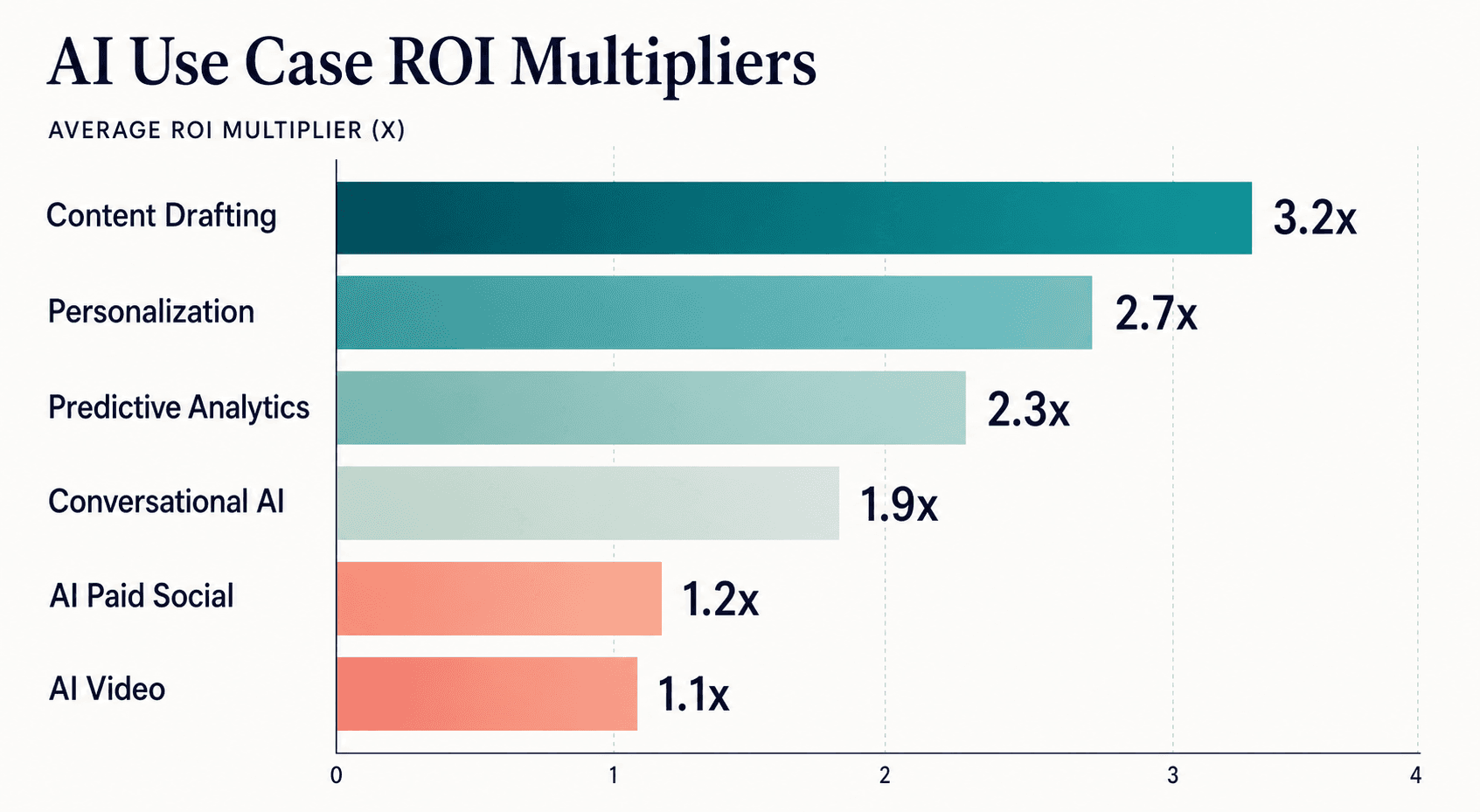
Not all AI use cases are created equal. McKinsey's Global AI Survey 2026, compiled by Digital Applied, provides one of the clearest ROI rankings available. The spread between top and bottom performers is dramatic — and it has direct implications for where your next dollar should go.
| Use Case | ROI Multiple | Category |
|---|---|---|
| Content drafting | 3.2x | Top quartile |
| Personalization engines | 2.7x | Top quartile |
| Audience research | 2.4x | Top quartile |
| Ad copy generation | 2.3x | Second quartile |
| SEO briefs and optimization | 2.1x | Second quartile |
| Campaign analytics | 1.9x | Third quartile |
| AI-generated paid social creative | 1.2x | Bottom quartile |
| AI-generated video | 1.1x | Bottom quartile |
The pattern is clear: AI delivers the highest returns when it augments human judgment in tasks that are repetitive but require contextual nuance — drafting content, personalizing messages, analyzing audiences. It underperforms when applied to creative production that audiences perceive as low-effort or generic, such as AI-generated video or unedited social creative.
For a senior leader, the implication is straightforward: if your AI budget is spread evenly across use cases, you are effectively subsidizing 1.1x and 1.2x returns with dollars that could be generating 2.7x or 3.2x. Rebalancing toward the top quartile is not a marginal optimization — it is the single highest-leverage move available.
How Marketing and Sales Teams Are Actually Spending Their AI Budgets in 2026
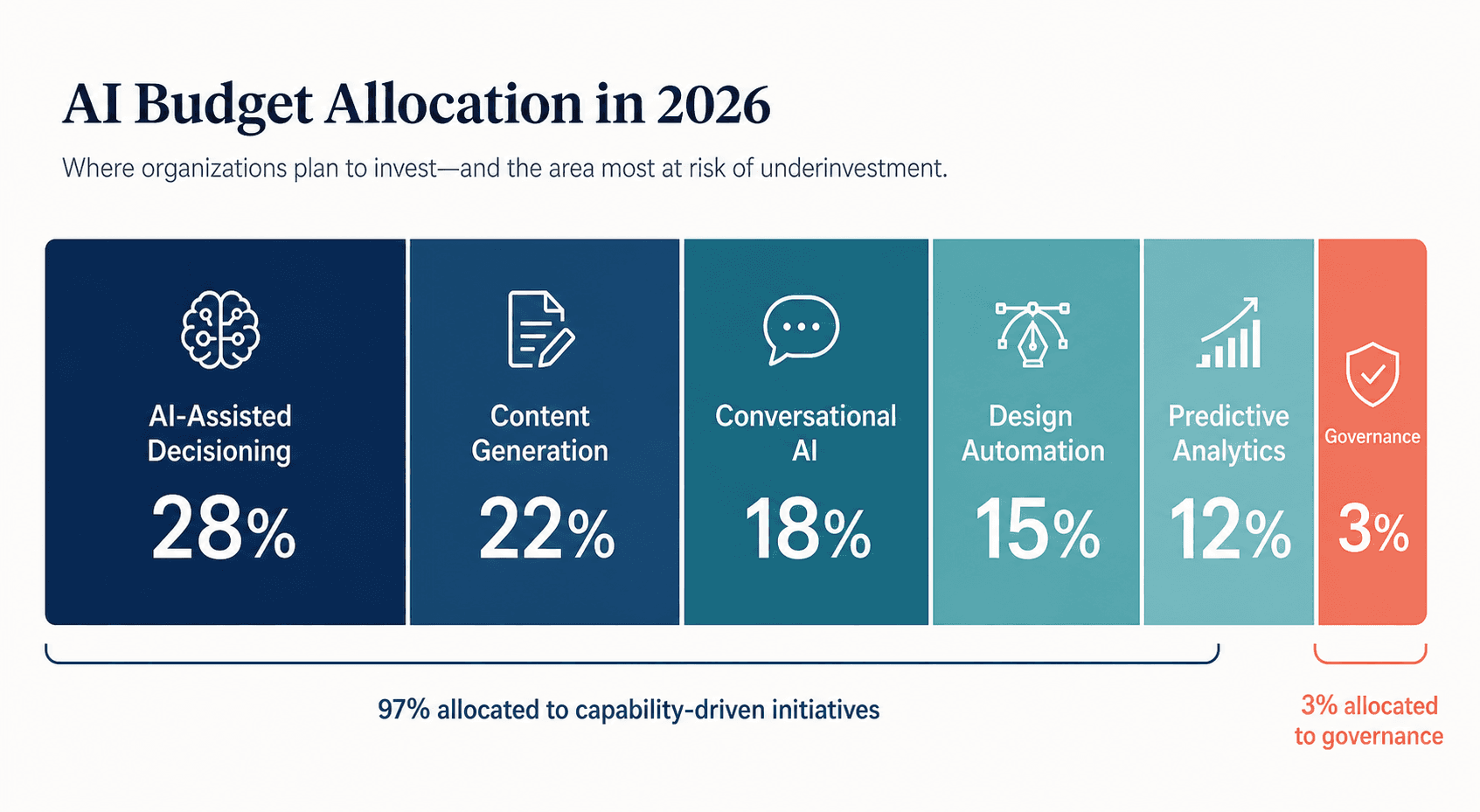
Understanding where the industry is spending provides a useful benchmark — and a warning. Digital Applied's 2026 analysis, aggregating data from Salesforce, HubSpot, and Gartner, reveals the following allocation across marketing and sales AI budgets:
| Category | Share of AI Budget |
|---|---|
| AI-assisted decisioning | 28% |
| Content generation | 22% |
| Conversational AI | 18% |
| Design automation | 15% |
| Predictive analytics | 12% |
| Governance | 3% |
Several observations stand out. First, content generation commands 22% of budgets — roughly in line with its 3.2x ROI potential. That is defensible. Second, AI-assisted decisioning (28%) and predictive analytics (12%) together account for 40% of spend, reflecting a healthy shift toward data-driven pipeline management.
But the 3% allocation to governance is the outlier that demands attention. According to the same data, 61% of CMOs cite data leakage through prompt sharing as a top concern, yet only 31% of enterprises have deployed AI ethics or governance tools. The gap between concern and action is nearly 2:1. Governance at 3% of spend is not a rounding error — it is a strategic vulnerability that threatens the ROI of every other category.
What's Actually Working in 2026: Proven Tactics with Sourced Outcomes
Beyond the aggregate ROI data, three specific tactics stand out for their consistent, sourced outcomes across multiple studies. These are not theoretical — they are being deployed today by teams that are seeing measurable results.
1. Predictive lead scoring: 20–30% conversion lift
Predictive lead scoring — using AI to rank leads by likelihood to convert based on behavioral and firmographic signals — consistently produces conversion improvements of 20–30%, according to both Sopro's research and Tommaso Maria Ricci's 2026 guide. Sopro reports that companies using AI in marketing see 20–30% higher ROI than traditional methods, while Ricci's analysis of sales implementations confirms the same range for conversion rates specifically.
For a B2B team generating 500 leads per month, a 25% conversion improvement on a 5% baseline means roughly 6 additional closed deals per month — without increasing lead volume. The ROI calculation is straightforward: the cost of the AI tooling is typically a fraction of the incremental revenue.
2. AI-personalized outreach: 15–25% response rates vs. 3–5% baseline
Generic email outreach has long struggled with single-digit response rates. AI-personalized outreach — where the tool drafts individualized messages based on prospect data, recent activity, or intent signals — changes that equation. Ricci's analysis reports response rates of 15–25% compared to a 3–5% baseline for generic templates. Sopro's data independently confirms that AI-powered campaigns launch 75% faster and deliver 47% better click-through rates.
The caveat: personalization at scale requires clean CRM data. Ricci explicitly identifies "CRM data neglect" as one of the five common AI implementation failure modes. If your contact data is stale or incomplete, even the best AI personalization engine will produce irrelevant messages.
3. Conversation intelligence: cutting new hire ramp from 6–9 months to 3–4 months
Conversation intelligence platforms that analyze sales calls and surface coaching insights are delivering one of the most concrete operational improvements in the sales stack. Ricci reports that organizations using these tools have cut new sales hire ramp time from 6–9 months to 3–4 months — a 50–55% reduction.
For a team hiring five new reps per year, each earning $80,000 base salary, shaving 3 months off ramp time translates to roughly $100,000 in accelerated productivity per cohort. That is before accounting for the revenue those reps generate during the months they would otherwise have spent in training.
What to Skip: Three AI Investments That Are Underwhelming in 2026
Not every AI investment is worth making. The data identifies three categories where the returns are weak, the risks are elevated, or both.
- Unedited AI content at scale. Digital Applied's analysis finds that purely AI-generated pages without human editing win top-3 rankings 3.1x less often than mixed or human-led content. Worse, 18% of sites that published unedited AI content at scale lost 40% or more of their organic traffic after Google's March 2026 core update. The AI marketing trust gap is real, and search engines are actively penalizing the lowest-effort content.
- AI-generated paid social creative. With an ROI multiple of just 1.2x, this category sits near the bottom of the McKinsey ranking. Beyond the weak returns, platforms are increasingly downranking or flagging content that appears fully AI-generated. The combination of low ROI and platform risk makes this a poor candidate for scaled investment.
- Full automation without human oversight. Ricci's analysis identifies "tool before process" and "big bang deployment" as two of the five most common AI implementation failure modes. The pattern is consistent: teams that deploy AI tools without first designing the human workflow around them see adoption stall and ROI collapse. The case study on why most companies don't see real ROI documents this failure mode in detail.
The Agentic Frontier: Autonomous Agents Enter Production
The most significant structural shift in the 2026 AI landscape is the emergence of autonomous agents in production marketing and sales workflows. Digital Applied reports that 34% of enterprise marketing teams now run at least one autonomous agent in production, up from 14% in Q4 2025. That is more than a doubling in roughly 12 months.
For senior leaders, this is not a speculative future — it is a present operational reality. Agents are handling bounded, repetitive tasks with clear success criteria: automated lead enrichment, sequence-triggered follow-ups, dynamic content assembly for email campaigns, and basic pipeline health monitoring.
The key to successful agent deployment is scope discipline. Agents perform best when the task has a clear input, a defined output, and unambiguous success metrics. They fail — sometimes expensively — when given open-ended objectives or when deployed into workflows that lack human escalation paths. The 34% adoption figure is encouraging, but it comes with the caveat that most implementations are still narrow in scope.
Governance Is Not a Cost Center — It's a Strategic Investment
The 3% governance allocation is the most dangerous number in this article — not because it is small, but because it is disconnected from the risk that leaders themselves identify. 61% of CMOs cite data leakage through prompt sharing as a top concern, yet only 31% of enterprises have deployed AI ethics or governance tools. That gap represents a direct threat to the ROI of every other AI investment.
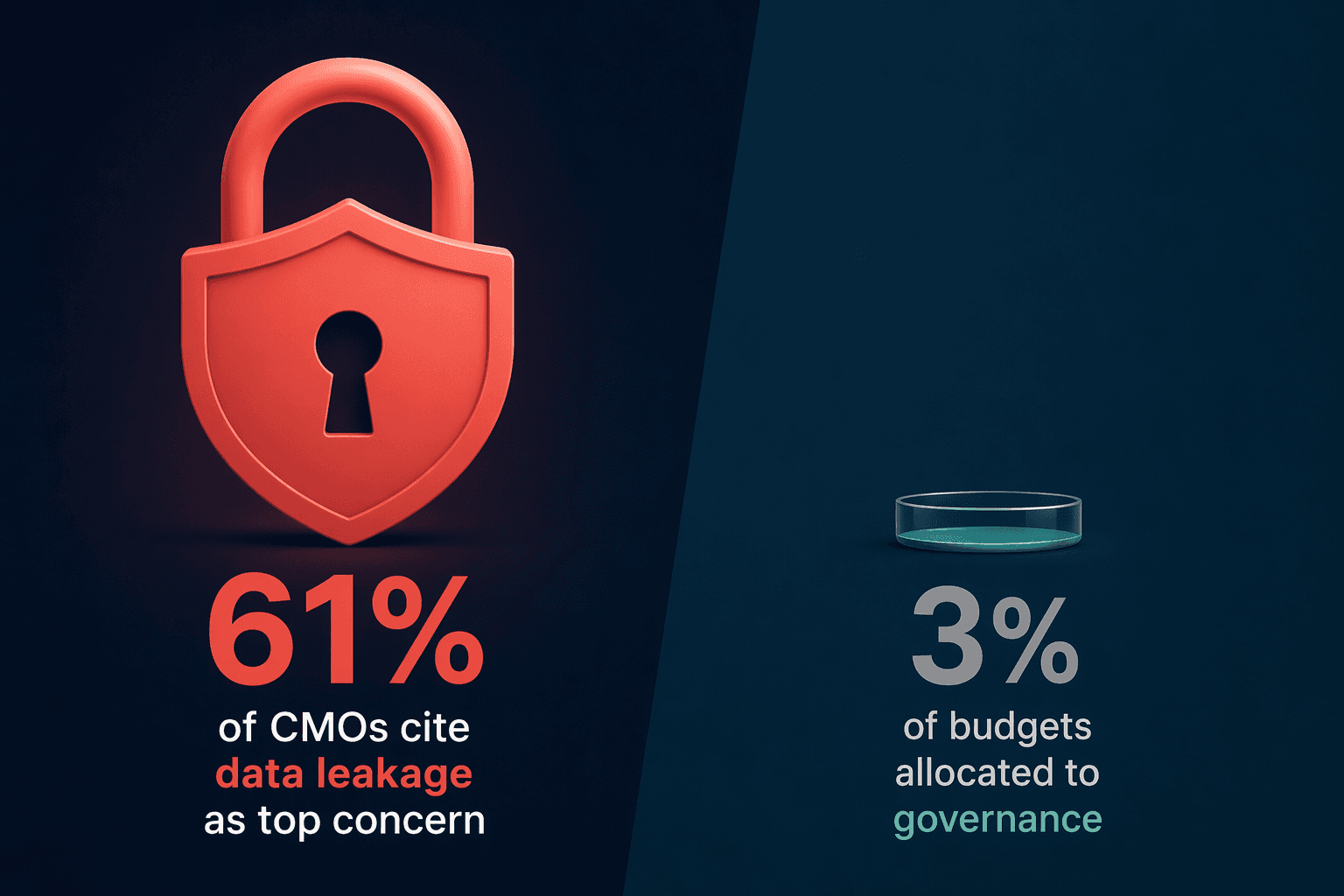
Governance is not a compliance checkbox. It is the mechanism that protects the value of every other AI dollar you spend. Without it, a single data leakage incident — a sales rep pasting customer PII into a public LLM prompt, a marketing team inadvertently exposing proprietary campaign data — can trigger regulatory penalties, brand damage, and loss of customer trust that far exceeds any efficiency gain.
Practical governance investments for 2026 include:
- Data access policies that define what information can be used in AI prompts and what must remain in secured environments.
- Prompt-sharing guidelines that prevent proprietary data from being exposed to public models.
- Regular model output audits to detect hallucination, bias, or brand-voice drift before content reaches customers.
- Disclosure compliance frameworks that align with evolving FTC guidelines on AI-generated content.
- Training programs that ensure every team member understands the risks of ungoverned AI use.
A Decision Framework for the Next 12 Months
The data in this article points to a clear set of actions for senior leaders. The following framework is designed to be implemented over the next four quarters, with each step building on the previous one.
| Step | Action | Timeline | Expected Impact |
|---|---|---|---|
| 1 | Audit current AI spend against the ROI gap data. Map every dollar to a specific use case and its expected ROI multiple. | Q3 2026 | Identifies 20–40% of budget that may be allocated to below-median use cases. |
| 2 | Rebalance toward top-quartile use cases. Shift at least 15% of budget from bottom performers (AI video, unedited social creative) to top performers (content drafting, personalization, predictive scoring). | Q3–Q4 2026 | Expected portfolio ROI improvement of 0.5–1.0x based on the McKinsey spread. |
| 3 | Allocate at least 10% of AI budget to governance and training. This is a 3x increase from the current 3% benchmark. | Q4 2026 | Reduces data leakage risk and enables faster, safer deployment of other AI investments. |
| 4 | Pilot one autonomous agent in a bounded, repetitive workflow. Choose a task with clear inputs, defined outputs, and measurable success criteria. | Q4 2026 – Q1 2027 | Builds organizational capability for agentic AI without exposing the business to open-ended failure modes. |
| 5 | Establish quarterly AI budget reviews. Treat AI spend as a dynamic portfolio, not a static allocation. | Ongoing from Q1 2027 | Ensures budget stays aligned with rapidly changing tool capabilities and market conditions. |
For a deeper treatment of the strategic planning process behind these steps, see our AI marketing strategy framework, which provides a structured approach to building the organizational foundation that makes AI investments sustainable.
The central takeaway is this: AI adoption is no longer a competitive advantage — it is table stakes. The organizations that will outperform in 2027 are not the ones that spend the most on AI, but the ones that allocate their AI budgets with the same rigor they apply to media spend, headcount, or any other material investment. The data is available. The framework is clear. The execution is up to you.


Comments
Join the discussion with an anonymous comment.