
How to Build an AI Marketing Strategy in 2026: A 5-Step Framework
A practical, data-backed guide for marketing managers and directors who need to move beyond tool experimentation and build a governed, measurable AI marketing strategy. Covers a maturity audit, prioritization matrix, governance foundation, and a 90-day implementation checklist.
Why AI Marketing Strategy Is an Infrastructure Problem, Not a Tool Problem
If you are a marketing manager or director in 2026, you have likely already crossed the adoption threshold. According to HubSpot's 2026 State of Marketing Report, 80% of marketers now use AI for content creation, and 75% use it for media production. The same report found that 61% of marketers believe the profession is undergoing its biggest disruption in 20 years. The question is no longer whether your team should use AI — it is whether you are using it better than the competition.
The data reveals a clear split. Most teams treat AI as a task-level tool: a faster way to draft blog posts, generate ad copy, or summarize reports. A smaller group — roughly the top quartile — treats AI as an operational layer: governed, measured, and embedded into decisioning, personalization, and campaign execution. The difference between these groups is not the tools they own. It is the infrastructure they have built around those tools.
The five steps that follow move from diagnosis to execution: audit your current maturity, set objectives tied to business outcomes, prioritize using a readiness-versus-urgency matrix, build the governance foundation that most teams skip, and implement in measured phases. A 90-day checklist at the end gives you a concrete starting point.
Step 1: Audit Your Current AI Maturity Across Five Dimensions
Before deciding where to invest, you need an honest baseline. Most teams overestimate their AI maturity because they equate tool usage with capability. Using ChatGPT to draft emails is not the same as having an operationalized content workflow with human review checkpoints, performance tracking, and brand safety guardrails.
Assess your organization across these five dimensions. For each, determine whether your team is at an ad hoc, experimental, operationalized, or optimized stage.
| Dimension | Ad Hoc | Experimental | Operationalized | Optimized |
|---|---|---|---|---|
| Content & AEO | Individual team members use AI tools without guidelines | Some teams use AI for drafts; no brand voice controls | Standardized prompts, human review, and A/B testing in place | AI-generated content is continuously optimized for search and conversion |
| Personalization | No AI-driven personalization | Basic product recommendations or email subject line testing | Segmented campaigns use AI for dynamic content and offers | Real-time, cross-channel personalization with predictive models |
| Analytics & Decisioning | Manual reporting; no AI in analysis | AI used for basic data visualization or anomaly detection | AI-assisted decisioning for budget allocation and campaign optimization | Predictive analytics and automated decisioning across channels |
| Paid Media | Manual bid management and creative testing | Automated bidding on one platform (e.g., Google Performance Max) | AI-driven creative generation and cross-platform bid optimization | Fully automated, governed media buying with performance benchmarks |
| Governance & Risk | No AI governance policy exists | Informal guidelines shared verbally or in a document | Documented policy covering data privacy, brand safety, and human review | Active governance tools, regular audits, and incident response protocols |
Be honest about where you land. A common pattern in 2026 is high maturity in content generation (most teams are at least experimental) and very low maturity in governance. According to Improvado's 2026 analysis, content generation receives 22% of AI budgets with 81% adoption, while governance tools receive only 3% of budgets with 31% deployment. That imbalance creates what Improvado calls "governance technical debt" — a gap that becomes expensive when an AI-generated campaign runs afoul of brand safety or regulatory requirements.
Step 2: Set Objectives Tied to Measurable Business Outcomes
The most common mistake in AI strategy is measuring adoption instead of impact. Tracking how many team members use a tool or how many prompts were generated tells you nothing about business value. The teams that report real ROI tie their AI initiatives to specific, measurable business outcomes.
SQ Magazine reports that 83% of marketing teams now report clear, measurable ROI from generative AI tools, and 81% of marketing leaders say AI has significantly improved team productivity and strategic execution. But those numbers come from teams that defined success before they started. They did not adopt AI and then look for results — they identified a business problem and applied AI to solve it.
Define your objectives in terms of metrics your CFO or CEO already cares about. Examples include:
- Content cost per unit: Reduce the cost of producing a blog post, video, or ad variant by a specific percentage.
- Pipeline velocity: Shorten the time from lead capture to qualified opportunity using AI-assisted lead scoring or personalized nurture sequences.
- Conversion rate lift: Improve landing page or email conversion rates through AI-driven copy optimization or dynamic creative testing.
- Wasted ad spend reduction: Decrease inefficient spend through AI-driven bid management and audience targeting.
- Time-to-market: Reduce campaign launch cycles by automating creative production and approval workflows.
Write down no more than three primary objectives for the next quarter. Each objective must have a baseline measurement, a target, and a time frame. If you cannot define how you will measure success before you start, you are not ready to scale.
Step 3: Choose Your Priority Entry Point Using a Readiness vs. Urgency Matrix
Once you know your maturity level and your objectives, the next question is where to start. Most teams try to do everything at once — content AI, ad automation, predictive analytics, conversational AI — and end up spreading their budget and attention too thin. A prioritization framework prevents that.
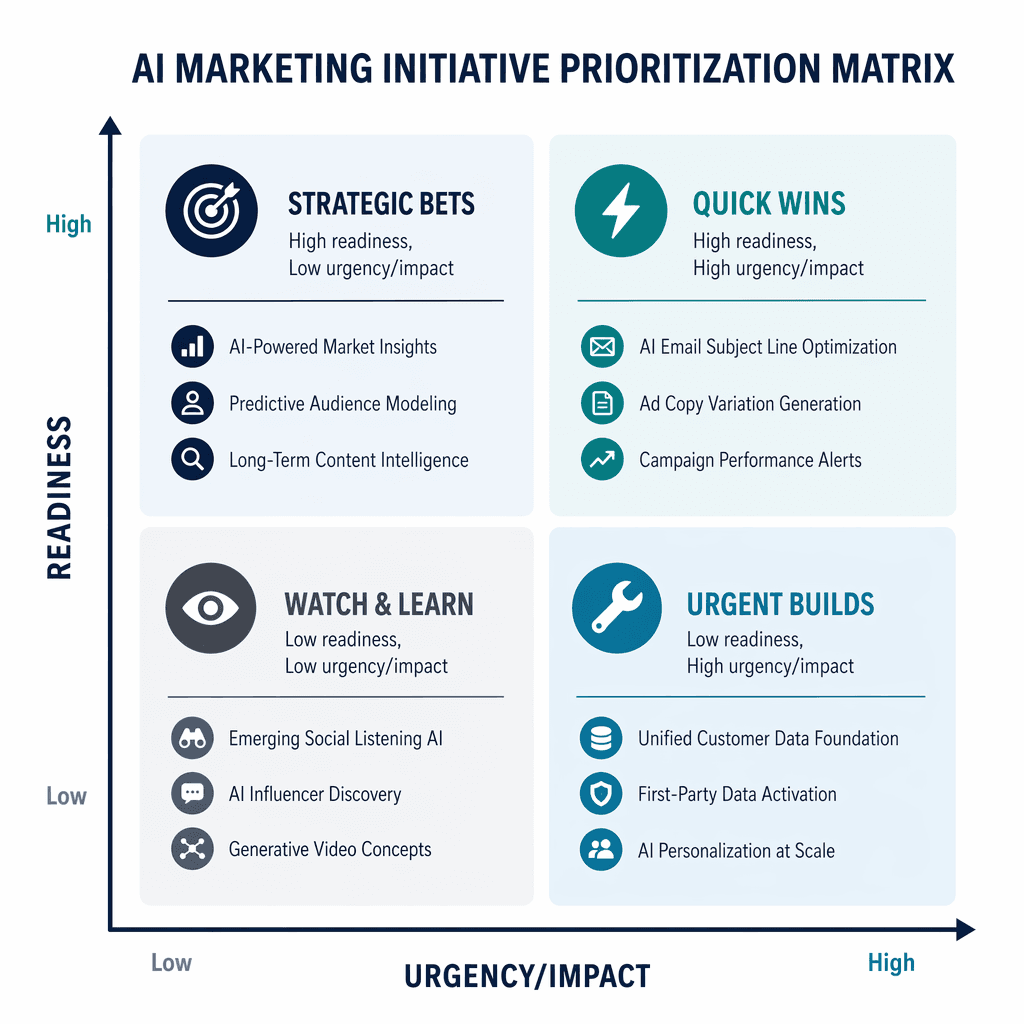
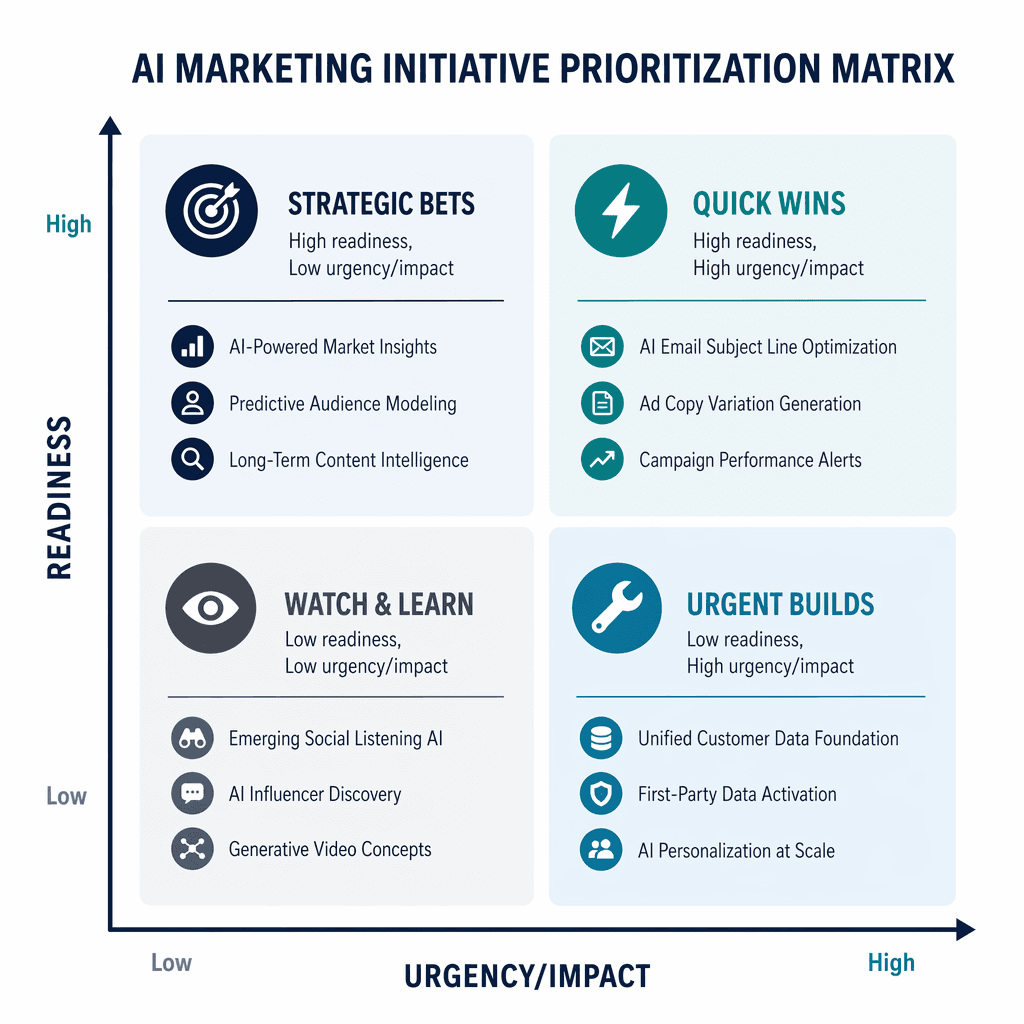
Improvado's Trend Prioritization Matrix plots potential AI initiatives on two axes: organizational readiness (how prepared your team, data, and infrastructure are to execute) and business urgency (how quickly the initiative will impact your objectives). This produces four quadrants:
| Quadrant | Description | Example Initiatives | Action |
|---|---|---|---|
| Quick Wins (High readiness, high urgency) | Initiatives your team can execute now with existing data and skills, and that will deliver near-term impact | AI-assisted content brief generation, automated ad copy variants, email subject line optimization | Start immediately. Allocate 40-50% of your near-term AI budget here. |
| Strategic Bets (High readiness, low urgency) | Initiatives you are capable of executing but that do not need to happen this quarter | Building a customer data platform for AI personalization, training a custom brand voice model | Plan for next quarter. Allocate 20-30% of budget for exploration. |
| Urgent Builds (Low readiness, high urgency) | Initiatives that are critical for competitive positioning but require infrastructure investment first | AI governance framework, data quality improvements, AEO optimization for AI Overviews | Begin foundational work now. Expect a longer timeline to impact. |
| Watch & Learn (Low readiness, low urgency) | Emerging capabilities that are not yet mature or relevant to your current objectives | Agentic AI for autonomous campaign management, multi-modal creative generation | Monitor quarterly. Do not invest budget until readiness or urgency shifts. |


Comments
Join the discussion with an anonymous comment.