
B2B Paid Search with AI Bidding: Case Study Results and Deployment Lessons
A practitioner-focused breakdown of what AI bidding actually produces in B2B paid search accounts — grounded in real Q1 2026 campaign data — covering the signal quality failures that suppress performance, the four most common deployment errors, and a phased framework for moving from form-fill optimization to CRM-closed-loop value bidding. For performance marketers and demand-gen managers running complex-cycle B2B accounts on Google Ads.
AI Tools Used
The Real Problem Isn't the Algorithm
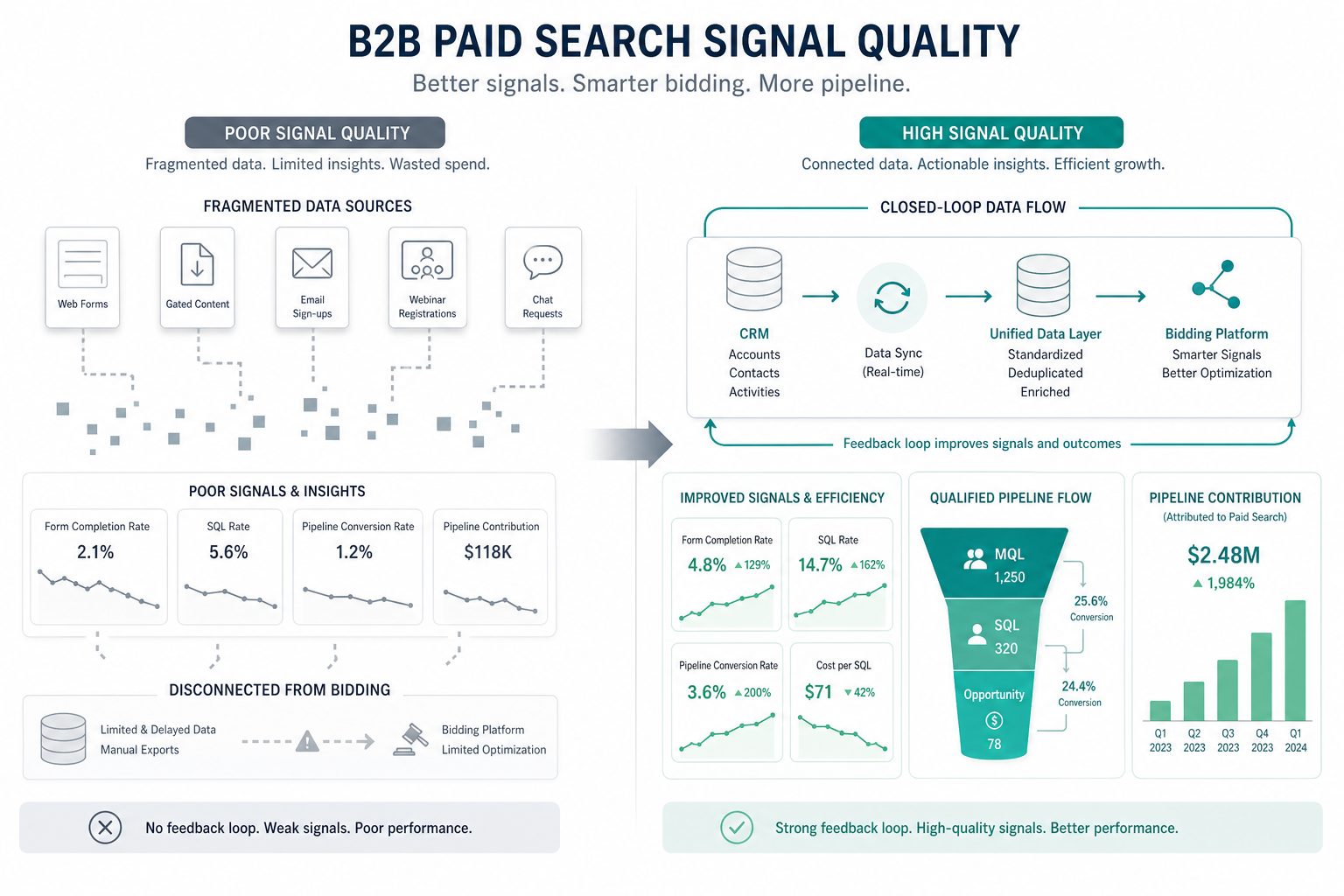
When B2B performance marketers say AI bidding doesn't work for them, they're usually describing a real problem — but diagnosing the wrong cause. The algorithm isn't the bottleneck. The data fed into it is.
Google's smart bidding systems are optimizing continuously and accurately. The issue is what they're optimizing for. When a B2B account sends form-fill events as its primary conversion signal, the bidder learns to find more people who fill out forms. It does this very efficiently. The problem is that in most complex-cycle B2B accounts, form fills and qualified pipeline have almost no correlation. A 10:1 or 15:1 MQL-to-SQL ratio is common. The bidder is being rewarded for generating leads that the sales team will discard.
This is a signal quality problem, and it compounds across every layer of the account. Short attribution windows miss most B2B conversions. Campaigns split before they have sufficient volume fragment the signal further. Strategy switches reset learning periods. Each of these errors is individually damaging; together, they make AI bidding look fundamentally broken in accounts where it could actually perform well.
What follows is grounded in real campaign data from Q1 2026 and earlier — with explicit source attribution, acknowledged caveats, and honest accounts of what failed alongside what worked. The goal is a deployable framework, not a vendor pitch.
What the Case Data Shows: Real B2B Account Outcomes
Three documented outcomes from real B2B accounts illustrate the range of what AI bidding produces — and the conditions that determine which end of that range you land on.
CPaaS Account, APAC: −49.8% Cost Per Opportunity
A CPaaS (communications platform as a service) account documented in the TripleDart Q1 2026 B2B SaaS PPC report saw cost per opportunity in APAC fall from €10,298 to €5,174 — a 49.8% reduction. The change that drove this was a correctly sequenced campaign intent split: the team waited until the parent campaign exceeded 60 monthly conversions before splitting by intent tier, which gave each child campaign a clean, sufficient signal to work from. The bidder wasn't changed. The signal architecture was.
The same report documents the counterfactual directly: a separate account ran the same split below the 60-conversion threshold. The result was a Generic campaign that spent $1,583 for a single wrong-intent conversion. Premature splitting doesn't just slow performance — it can actively misdirect spend.
Payments-Infrastructure SaaS: +46% MQL Quality, −32% CPL, $5.3M Net-New Revenue
A payments-infrastructure SaaS account, also from the TripleDart Q1 2026 dataset, restructured its campaigns toward quality over volume. The reported outcomes: MQL quality improved 46%, cost per lead fell from $1,700 to $1,100 (−32%), and the account generated $5.3M in net-new revenue on 17% less spend.
These accounts are anonymized in the source — described by vertical rather than company name. The outcomes are reported as observed results within the managed account set, not independently audited figures. They are directionally significant but should not be treated as guaranteed benchmarks.
AI Max in a B2B SaaS Project Management Account: 0.76% CVR vs 4.67% for Exact Match
A September 2025 Search Engine Land analysis of a B2B SaaS account promoting project management software found AI Max producing a 0.76% conversion rate against 4.67% for exact match — the worst-performing match type in the account despite a reasonable €0.89 CPC. The author attributes this to AI Max expanding into informational queries from users not yet in a buying cycle, with 68.6% of captured queries being new terms with low purchase intent.
| Account / Context | AI Method | Primary Outcome | Source |
|---|---|---|---|
| CPaaS SaaS, APAC (anonymized) | Intent-split campaign architecture; AI bidding on clean signal | Cost per Opportunity: €10,298 → €5,174 (−49.8%) | TripleDart Q1 2026 |
| Payments-infrastructure SaaS (anonymized) | Quality-over-volume restructure with CRM signal | +46% MQL quality, −32% CPL ($1,700 → $1,100), $5.3M net-new revenue on −17% spend | TripleDart Q1 2026 |
| B2B SaaS project management (anonymized) | AI Max vs exact match comparison | AI Max CVR: 0.76% vs exact match: 4.67% — worst-performing match type in account | Search Engine Land, Sept 2025 (small dataset, not statistically significant) |
Four Deployment Failures That Suppress AI Bidding Performance
Most B2B AI bidding underperformance traces to a small set of configuration errors. These aren't edge cases — they appear consistently across accounts that report poor results. Each one degrades the signal the bidder receives, and they compound when they occur together.
Failure 1: Optimizing for Form Fills Instead of SQL or Opportunity Events
This is the most common and most damaging error. When a B2B account sets form submission as its primary conversion event, the bidder optimizes efficiently for that signal — and generates volume that has little relationship to pipeline. At a 15% MQL-to-SQL conversion rate, a $150 form-fill CPA translates to a $1,000 cost per SQL. If the tCPA is set at $150, the algorithm is being asked to find cheap form fills, not qualified opportunities.
The GrowthSpree smart bidding guide states this directly: if your form-fill CPA is $150, you should set tCPA at the actual SQL cost — which in a 10:1 MQL-to-SQL account is $1,500 — not at the form-fill cost. The micro-conversion is only useful as a volume-building proxy in the earliest account stage, before CRM data is flowing back into the platform.
Failure 2: Using Google's Default 30-Day Attribution Window Against an 84-Day Sales Cycle
B2B sales cycles average 84 days. Google Ads' default attribution window is 30 days. This means the majority of B2B conversions — the ones that actually close — fall outside the window the bidder is learning from. The algorithm is making optimization decisions based on an incomplete picture of what's actually working.
The Involve Digital B2B SaaS Google Ads guide recommends setting the attribution window to 60–90 days for B2B accounts. This is a configuration step, not a bidding strategy — but it's foundational. Without it, even accounts with clean CRM signal are feeding the bidder a truncated view of performance.
Failure 3: Splitting Campaigns Before the Parent Reaches 60 Monthly Conversions
Campaign splits by intent, audience, or keyword theme are often the right structural move — but only after the parent campaign has generated sufficient conversion volume for the bidder to learn from. The TripleDart Q1 2026 data documents what happens when this threshold isn't met: a Generic campaign split below the conversion threshold spent $1,583 on a single wrong-intent conversion. The bidder had too little signal to differentiate between intent tiers and defaulted to volume.
The CPaaS account that achieved −49.8% cost per opportunity did so by waiting until the parent exceeded 60 monthly conversions before splitting. The split itself wasn't the differentiator — the sequencing was.
Failure 4: Switching Bidding Strategies Before the Learning Period Completes
Every bidding strategy change triggers a new learning period. Google recommends a minimum of several weeks; the practical guidance from GrowthSpree's bidding framework is a minimum of 8 weeks per strategy before evaluation. Switching from Maximize Conversions to Target CPA to Target ROAS within a three-month window means the account spends more than six weeks in learning mode — a period during which spend efficiency is degraded and the bidder is effectively guessing.
- Primary conversion event set to form fill rather than SQL or Opportunity
- Attribution window left at Google's 30-day default (correct setting: 60–90 days for B2B)
- Campaign split before parent reaches 60 monthly conversions, fragmenting bidder signal
- Bidding strategy changed before the 8-week minimum learning period completes
The Phased Deployment Framework: From Form Fills to Revenue Signal
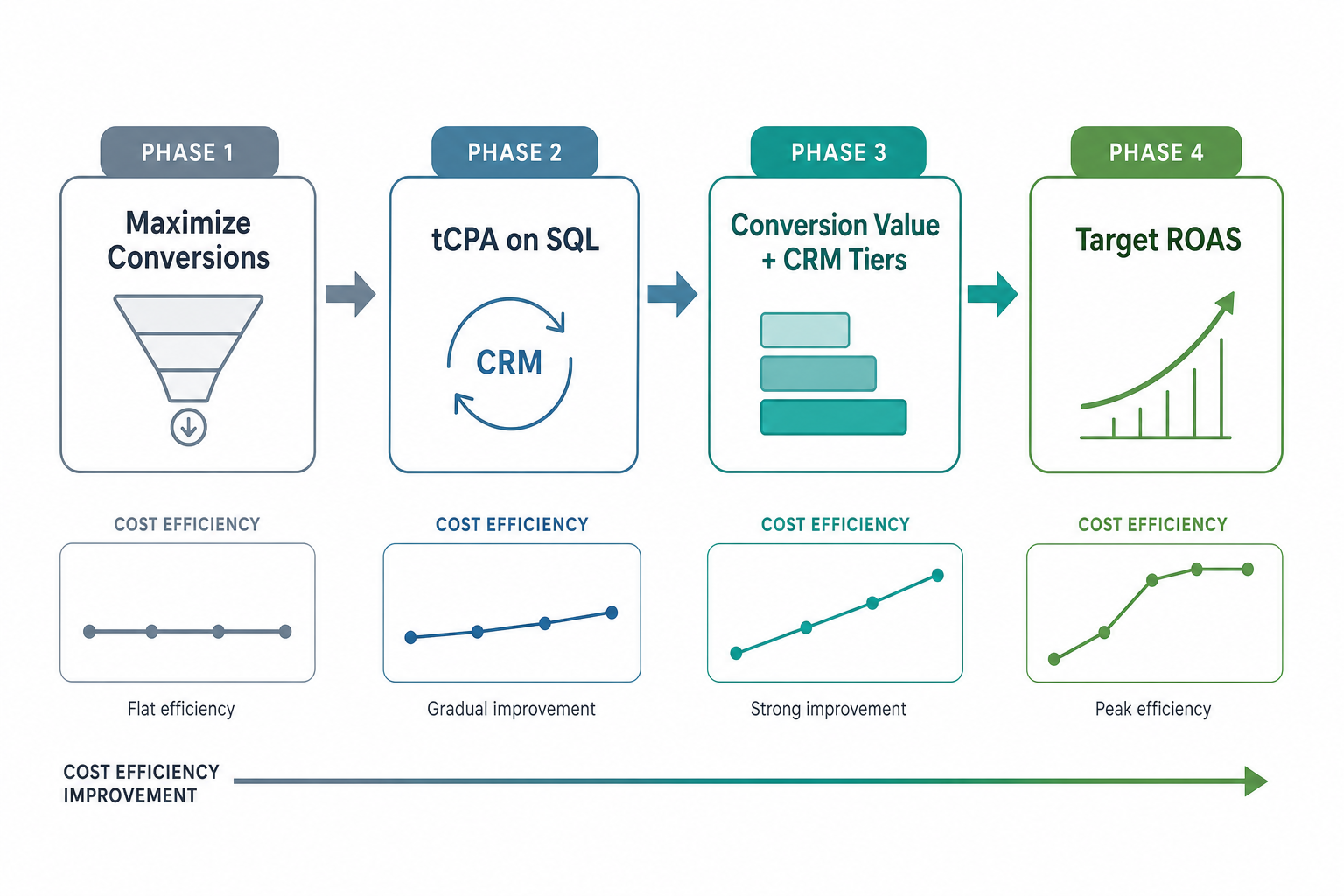
AI bidding in B2B accounts works best as a progression — not a binary switch. The four phases below are tied to account maturity and conversion volume thresholds. Moving through them too quickly replicates the strategy-switching failure described above. Moving too slowly leaves pipeline efficiency on the table.
| Phase | Timeline | Bidding Strategy | Primary Conversion Event | Threshold to Advance |
|---|---|---|---|---|
| 1 — Volume Building | Months 1–3 | Maximize Conversions | Demo request or form fill | 30–50 conversions/month in campaign; CRM offline import live |
| 2 — SQL Signal | Months 3–6 | Target CPA | SQL event from CRM | tCPA set at actual SQL cost, not form-fill CPA; 30+ SQLs/month |
| 3 — Value Tiers | Months 6–12 | Maximize Conversion Value | CRM value tiers (MQL, SQL, Opportunity, Closed-Won) | Consistent value data flowing from CRM; 60+ conversion events/month |
| 4 — Revenue Bidding | Month 12+ | Target ROAS | Revenue data from CRM | Sufficient Closed-Won events for ROAS calculation to be meaningful |
The tCPA Calculation Error Most Accounts Make
When accounts move to Phase 2, the most common error is carrying the form-fill CPA into the tCPA setting. The math makes the problem concrete: if your form-fill CPA is $150 and your MQL-to-SQL rate is 15%, the actual cost per SQL is $1,000. Setting tCPA at $150 tells the bidder to find $150 SQLs — which don't exist. The bidder will optimize for volume and deliver low-quality leads at the target cost.
The correct tCPA for Phase 2 is the actual cost per SQL from your CRM data, not the form-fill CPA. This number will be significantly higher than what most teams expect, and it will initially feel like the campaign is underperforming. It isn't — it's bidding for the right thing at the right price for the first time.
CRM Value Tiers for Phase 3
When advancing to Maximize Conversion Value, the CRM value tiers need to reflect real pipeline economics rather than arbitrary weights. A workable starting structure assigns relative values across funnel stages — for example, MQL at $10–50, SQL at $500–900, Opportunity at $2,000–3,000, and Closed-Won at actual average contract value. These values teach the bidder which lead types produce revenue, not just which types convert.
The Involve Digital analysis reports that accounts implementing offline conversion tracking and value-based bidding together generate 3x more pipeline at 31% lower cost per lead. This is reported as a benchmark for accounts that implemented both components simultaneously — not a guaranteed outcome for any single account, and not attributable to either component alone.
When to Stay on Manual CPC
Accounts below 30–50 monthly conversions should not use tCPA or tROAS. The Negator analysis of smart bidding failure scenarios is explicit: when each sale is worth $50,000 or more but an account closes two or three deals per month, there is no path to the 30–50 monthly conversions smart bidding needs to function. Manual CPC with value-based bid adjustments for high-intent late-stage keywords is the correct starting point — not a fallback or a failure.
AI Max in B2B: What the Early Evidence Actually Shows
AI Max is Google's most aggressive automation layer — it expands match types, generates ad copy variants, and broadens audience targeting simultaneously. In B2B accounts, the structural mismatch is predictable: AI Max is designed to find more of the right people, but "the right people" in a complex B2B buying cycle are a narrow segment of high-intent, in-market buyers. AI Max's query expansion tends to capture informational researchers, not decision-stage buyers.
The B2B SaaS project management account documented in Search Engine Land illustrates this directly. AI Max produced a 0.76% CVR against 4.67% for exact match — the weakest match type in the account. Of the queries AI Max captured, 68.6% were new terms not in the existing keyword set, and the author identifies most of them as low-intent informational searches. The CPC was reasonable at €0.89, but the conversion rate made the effective CPA unworkable.
The TripleDart Q1 2026 data provides a more nuanced picture. Across 19 A/B tests on a single self-serve SaaS account, AI Max won 11 of 19 — but the winning condition was specific: tROAS targets set 25% below the account's baseline. When tROAS was set at or above baseline, AI Max lost consistently. The ROAS headroom is not a minor configuration detail — it appears to be the primary variable determining whether AI Max generates enough volume to learn and optimize effectively.
A 30-day Altitude Marketing AI Max test across B2B-oriented campaigns found a slight CTR improvement but no significant performance gains. The team reported that AI Max frequently reused outdated ad copy from past campaigns and website content, creating accuracy risks. Time savings were negligible — in some cases the team spent more time correcting AI-generated errors than they would have spent creating ads manually. The conclusion was honest: AI Max did not revolutionize the workflow or deliver material performance gains in this test period.
| Source / Context | AI Max Condition | Result | Key Variable |
|---|---|---|---|
| Search Engine Land, B2B SaaS project management (Sept 2025) | AI Max vs exact match, mature keyword set | 0.76% CVR vs 4.67% exact match — worst in account | Query expansion into informational, low-intent terms (small dataset, not statistically significant) |
| TripleDart Q1 2026, self-serve SaaS, 19 A/B tests | tROAS set 25% below account baseline | AI Max won 11 of 19 tests (58%) | ROAS headroom — AI Max lost consistently at or above baseline |
| Altitude Marketing, B2B-oriented campaigns, 30-day test | Standard AI Max deployment | Slight CTR lift, no significant performance gains, outdated copy reuse | Short test window; single agency's campaigns |
The practical implication: AI Max in B2B is a rolling test regime, not a binary deployment decision. If you test it, set tROAS targets 25% below your account baseline, run a minimum 4–6 week test with a clean holdout, and evaluate CVR and pipeline contribution — not just CTR or CPC. A broader industry poll cited in the Search Engine Land analysis found more than 50% of advertisers reported neutral outcomes from AI Max, 16% reported good results, and 28% reported poor performance. The variance is wide enough that your account conditions matter more than any aggregate finding.
The PMax Brand Cannibalization Trap
Performance Max absorbs branded search queries by default. This creates a reporting problem that is invisible until you actively look for it: PMax captures branded conversions at a lower CPC than your dedicated Brand campaign, which makes PMax's reported performance look strong — while the Brand campaign's numbers look weaker than they are. The aggregate conversion count appears healthy. The underlying dynamics are not.
The TripleDart Q1 2026 report documents this directly. PMax was absorbing branded queries and taking conversion credit at a lower CPC than the Brand campaign. After pre-loading brand-term negatives before PMax launch, signup-to-upgrade rate and retention metrics improved — indicating that the branded conversions PMax had been claiming were not actually incremental. On Microsoft Ads, CPL dropped from $600–800 to $200–300 once PMax stopped absorbing branded queries there as well. The gap had been invisible while PMax was inflating its own numbers.
Brand campaigns should also not use tCPA when competitors are actively bidding on your brand terms. In that environment, tCPA constraints can cause the Brand campaign to lose impression share to competitors at exactly the moment when winning that auction is most valuable. Manual CPC or Target Impression Share is the appropriate strategy for brand defense under active competitive pressure.
Decision Checklist: Is Your Account Ready for AI Bidding?
AI bidding is appropriate when the conditions for it to function are present. When those conditions are absent, manual CPC is not a fallback — it's the correct choice. The following checklist maps account conditions to strategy recommendations.
| Condition | AI Bidding Appropriate? | Recommended Strategy | Notes |
|---|---|---|---|
| 30–50+ monthly conversions per campaign | Yes | tCPA or Maximize Conversions | Minimum threshold for bidder to learn effectively |
| CRM offline conversion import live, SQL or Opportunity as primary event | Yes | tCPA set at SQL cost, or Maximize Conversion Value with tiers | tCPA must reflect actual SQL cost, not form-fill CPA |
| Attribution window extended to 60–90 days | Yes — required baseline | Any AI strategy | Without this, bidder sees incomplete conversion data regardless of strategy |
| Campaign below 30 monthly conversions | No | Manual CPC | Smart bidding cannot converge without sufficient volume |
| LinkedIn ABM audiences under 1,500 accounts | No | Manual CPC | TripleDart Q1 2026: switching to Manual CPC cut CPCs 90% and CPMs 70% on sub-1,500 audiences |
| Brand campaign under active competitor bidding pressure | No (for tCPA) | Manual CPC or Target Impression Share | tCPA constraints can cause impression share loss at high-value brand auctions |
| New campaign, no conversion history | No | Manual CPC, then Maximize Conversions once threshold met | Build volume first; do not start on tCPA or tROAS |
| AI Max test — first deployment | Conditional | tROAS set 25% below account baseline | Run with ROAS headroom; evaluate CVR and pipeline contribution, not just CTR |
When AI Bidding Consistently Beats Manual
- 30–50+ monthly conversions per campaign, with conversion volume stable over at least 8 weeks
- CRM offline conversion import live and sending SQL or Opportunity events back to Google Ads
- tCPA set at the actual cost per SQL, not the form-fill CPA
- Attribution window extended to 60–90 days to capture the full B2B sales cycle
- Brand-term negatives pre-loaded in any PMax campaign before launch
- Bidding strategy held stable for a minimum of 8 weeks before evaluation or change
When Manual CPC Is Still the Right Answer
- Account or campaign below 30–50 monthly conversions — smart bidding cannot converge
- LinkedIn or Google ABM audiences under 1,500 accounts — insufficient audience scale for automated delivery to optimize
- New campaigns with no conversion history — build volume first, then graduate to Maximize Conversions
- Brand campaigns with active competitor bidding — tCPA constraints create impression share risk at the worst possible moment
- High-value, low-volume accounts (e.g., $50,000+ ACV, two to three deals per month) — the conversion math never supports automation

Comments
Join the discussion with an anonymous comment.