
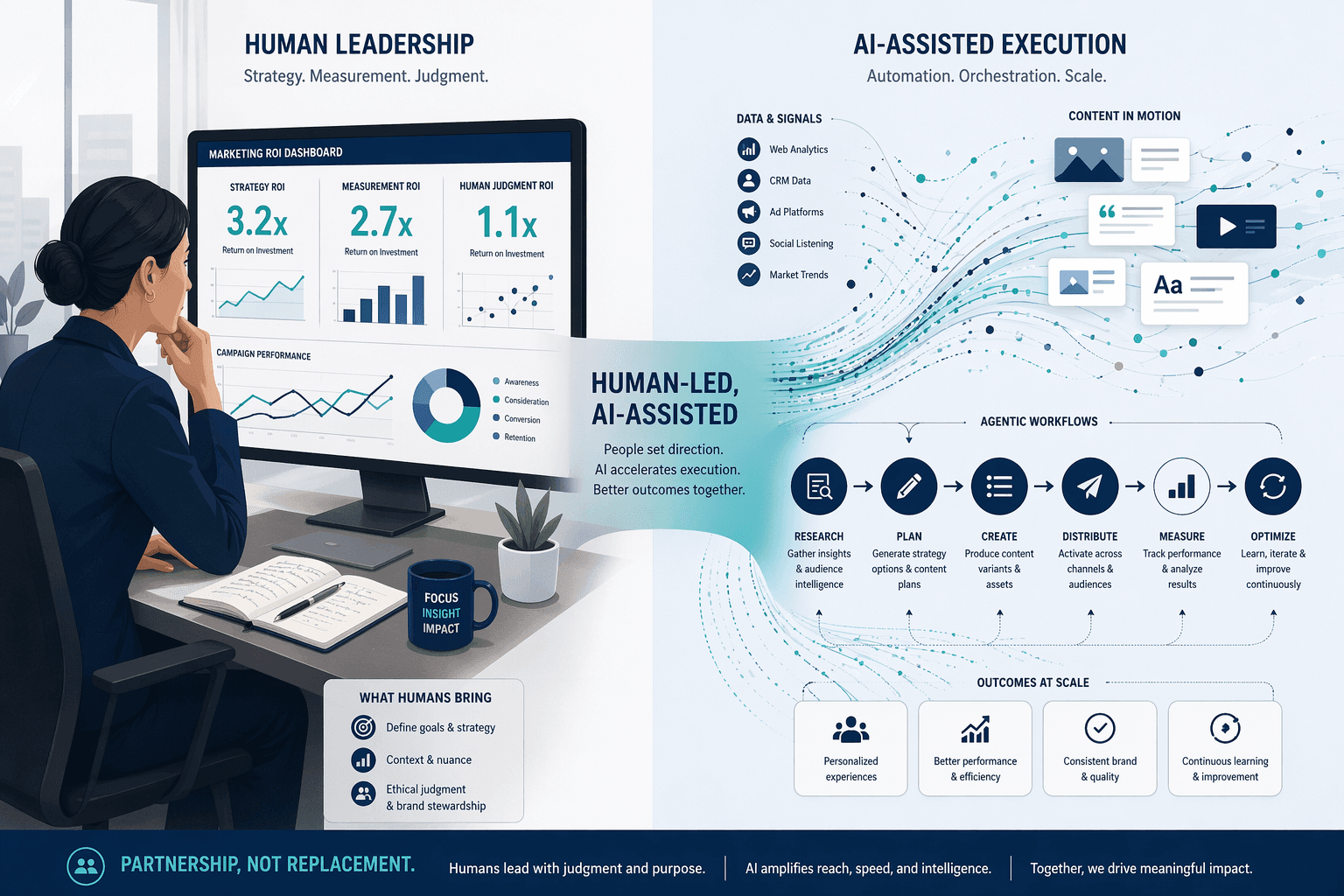
The Generative AI Marketing Landscape in 2026: A Practitioner's Guide to What Works, What Doesn't, and Where to Invest
A strategic decision guide for marketing managers and senior practitioners. Covers the 3x ROI spread across use cases, agentic workflow adoption, headcount shifts, and a practical framework for prioritizing the next 12 months of AI investment.
The 3x ROI Spread: Why Use Case Selection Matters More Than Adoption
By Q1 2026, the question of whether to use generative AI in marketing has been settled. According to the Salesforce State of Marketing 2026 report, 87% of marketers now use generative AI in at least one recurring workflow, up from 51% in early 2024. The adoption debate is over. What remains unresolved — and far more consequential — is where to deploy it.
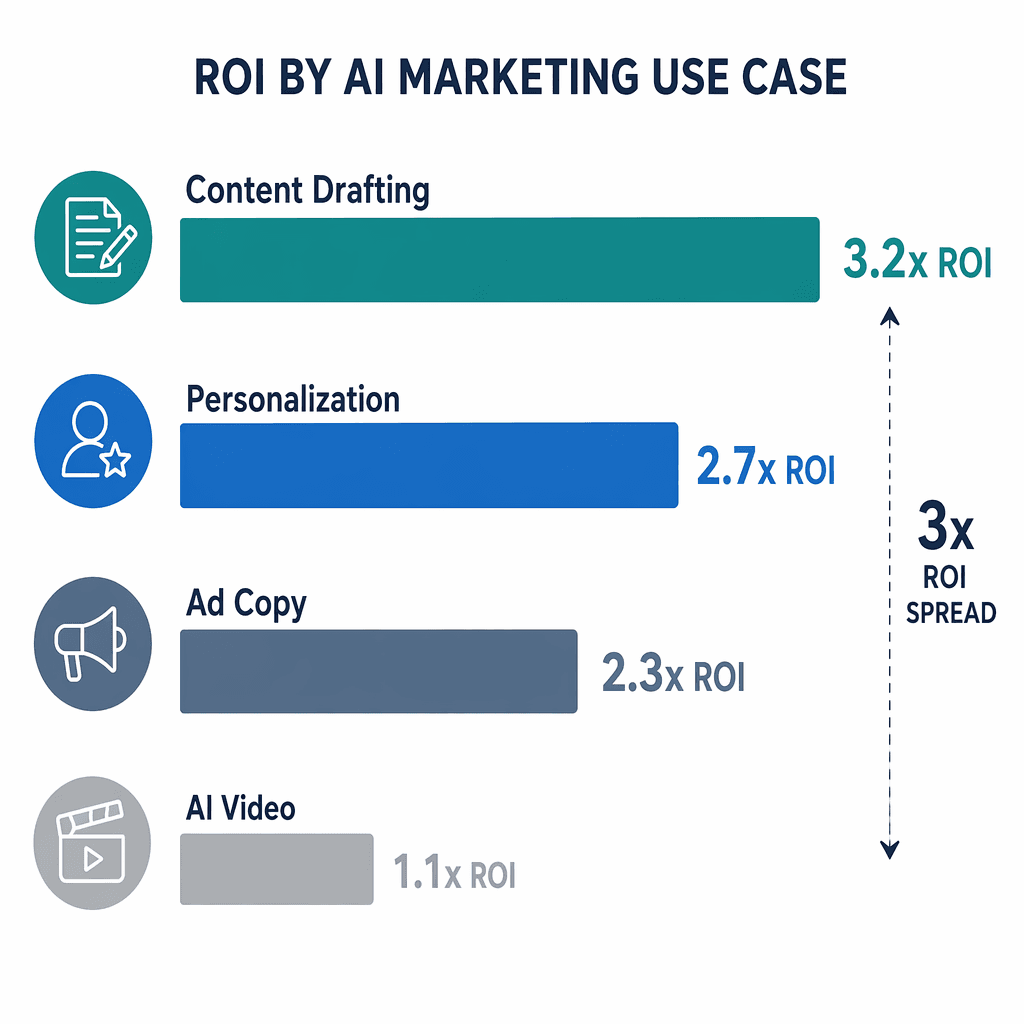
The data from McKinsey's Global AI Survey 2026 reveals a 3x spread in return on investment across common marketing use cases. Content drafting delivers a median 3.2x ROI, while AI video creation sits at 1.1x. That gap is not noise. It reflects structural differences in task complexity, output quality variance, and the amount of human oversight each application requires.
This article is not about whether AI works for marketing. It is a decision guide for marketing managers and senior practitioners who need to allocate budget, team time, and tooling investment across the next 12 to 18 months. The central strategic question has shifted from "should we adopt AI?" to "which use cases deserve our best people and budget, and which should we deprioritize?"
The 2026 Adoption Reality: Universal but Uneven
The headline 87% adoption figure masks significant variance beneath the surface. Enterprise teams report a blended AI ROI of 3.4x, mid-market teams 2.8x, and SMBs 2.3x, according to data aggregated by Digital Applied from the McKinsey Global AI Survey 2026. The gap is not primarily about tool quality. It reflects differences in data infrastructure, integration maturity, and the availability of skilled human oversight.
| Segment | Blended AI ROI | Key Differentiator |
|---|---|---|
| Enterprise (1,000+ employees) | 3.4x | Dedicated AI ops teams, integrated data stacks |
| Mid-market (50–999 employees) | 2.8x | Focused use-case deployment, growing oversight |
| SMB (1–49 employees) | 2.3x | Tool-level adoption, limited workflow integration |
The regional picture is similarly uneven. North American and European marketing teams report higher adoption density — meaning AI is embedded in more workflows per team — while APAC and LATAM show faster growth rates from a lower base. Role-level data tells an important story: content marketers, SEO specialists, and paid media managers are the heaviest users, while brand strategists and senior creative directors remain the most skeptical, often because their work involves higher-stakes judgment calls where AI output quality is still inconsistent.
For a full statistical breakdown across sources, sample sizes, and methodologies, see our 2026 AI Marketing Adoption Benchmarks reference. The key takeaway for decision-makers: adoption is no longer a competitive differentiator. Use case selection is.
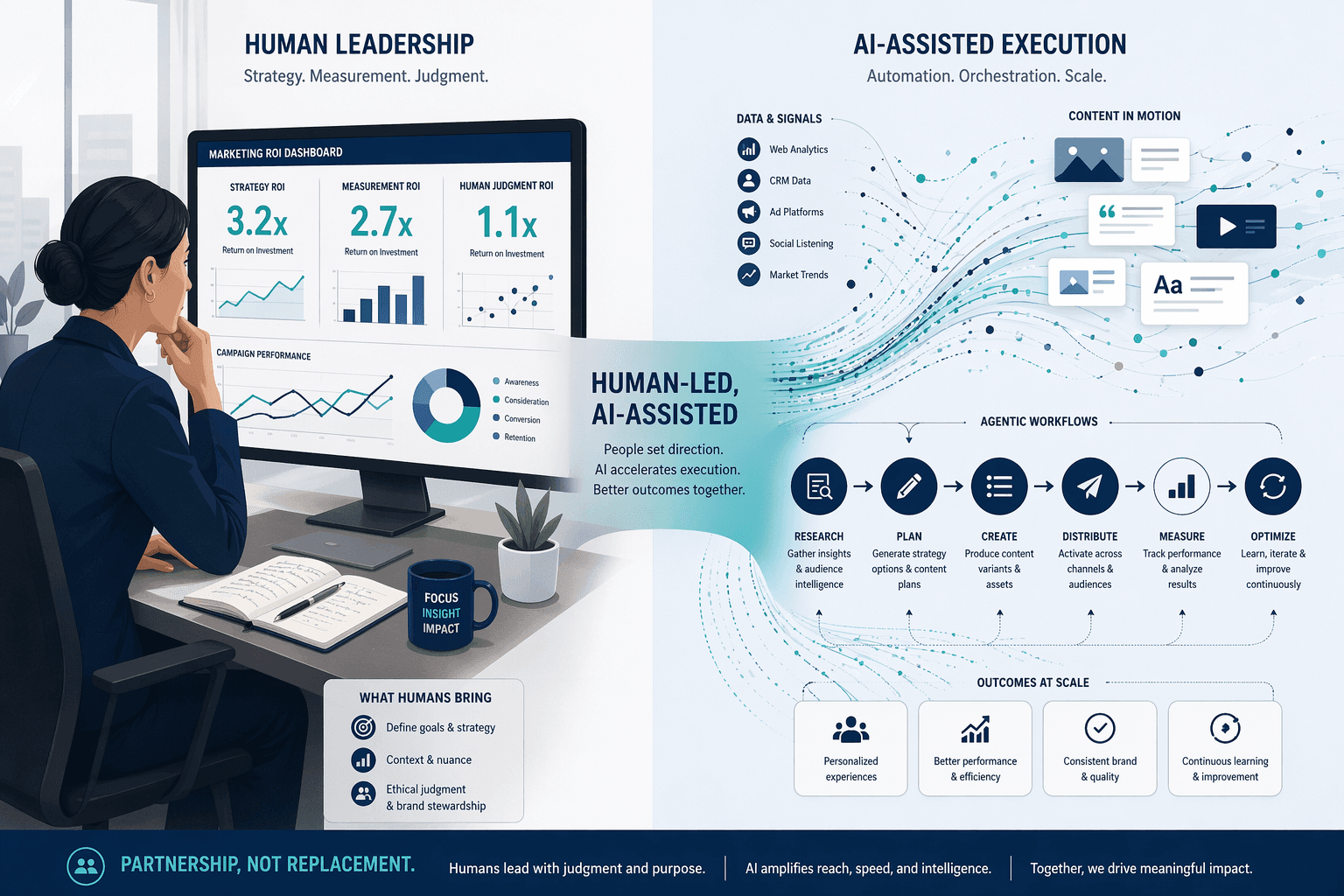
ROI by Application: Where Returns Compound and Where They Disappoint
The most actionable data for investment planning is the use-case-level ROI breakdown. The table below summarizes median ROI multiples and interquartile ranges from the McKinsey Global AI Survey 2026, as reported by Digital Applied. These figures represent self-reported returns from marketing teams that have deployed AI in each specific application for at least six months.
| Use Case | Median ROI | IQR Range | Payback Period |
|---|---|---|---|
| Content drafting | 3.2x | 2.4x–4.1x | 3–5 months |
| Personalization engines | 2.7x | 2.0x–3.6x | 4–6 months |
| Audience research | 2.4x | 1.8x–3.2x | 2–4 months |
| Ad copy generation | 2.3x | 1.7x–3.0x | 3–5 months |
| SEO content briefs | 2.1x | 1.5x–2.8x | 3–5 months |
| Campaign analytics | 1.9x | 1.4x–2.5x | 4–7 months |
| Email subject lines | 1.8x | 1.3x–2.4x | 2–4 months |
| Video scripts | 1.6x | 1.2x–2.1x | 5–8 months |
| Lead scoring | 1.4x | 1.1x–1.8x | 6–10 months |
| Paid social creative | 1.2x | 0.9x–1.6x | 6–12 months |
| AI video creation | 1.1x | 0.8x–1.4x | 8–14 months |
Several patterns emerge. First, the highest-ROI use cases — content drafting, personalization, audience research — share a common structure: they automate tasks that are time-consuming but relatively low-risk in terms of brand damage if the output is imperfect. A draft blog post that needs editing is far less risky than a video asset that goes live with a hallucinated statistic or an off-brand visual.
Second, the median payback period across all use cases is 4.2 months, down from 7.8 months in 2024. That compression reflects both lower tooling costs and faster integration timelines as teams gain experience. But the range is wide: content drafting pays back in 3–5 months, while AI video creation can take 8–14 months — a critical distinction for teams with limited budget runway.
Where ROI Has Disappointed — and Why
The low end of the ROI spectrum deserves honest attention, especially because vendor marketing tends to obscure it. AI video creation (1.1x) and AI-generated paid social creative (1.2x) sit at the bottom of the table for structural reasons, not because the tools are poorly built.
- Output quality gaps: Current generative models produce video and image assets that still require significant human direction, editing, and brand alignment. The time saved in initial generation is often consumed in revision cycles.
- Platform detection and consumer skepticism: Social platforms increasingly label AI-generated content, and consumer trust in AI-driven brand experiences has declined year-over-year. A 2026 HubSpot survey found that 81% of B2B buyers do not mind AI-assisted content if it is factually accurate and example-rich, but that tolerance drops sharply for visual creative, where authenticity matters more.
- Human creative direction remains essential: The highest-performing AI-generated ad creative still requires a human strategist to define the concept, target audience, and emotional tone. The AI handles execution, not strategy. Teams that treat AI video tools as a replacement for creative direction consistently report lower ROI.
This does not mean these use cases are worthless. It means they are not yet ready for independent deployment. Teams that pair AI video generation with strong human creative direction and rigorous A/B testing can achieve acceptable returns. But the data does not support treating them as priority investments for 2026.
The Agentic Shift: From Assistants to Autonomous Workflows
The most significant structural change in the 2026 AI marketing landscape is the emergence of agentic workflows. According to data from multiple 2026 surveys aggregated by Digital Applied, 34% of enterprise marketing teams now run at least one autonomous agent in production, up from 14% in Q4 2025. These are not simple chatbots. They are multi-step task completion systems that can execute a sequence of actions — research, draft, check, revise, publish — with minimal human intervention.
In practice, agentic workflows look like this: an agent receives a content brief, searches internal knowledge bases and external sources, drafts a first version, checks it against brand guidelines and SEO criteria, flags potential factual errors, and either publishes or routes the output for human review. The human role shifts from doing the work to defining the parameters and auditing the output.
Adoption is still early. The same surveys show that 62% of organizations are experimenting with AI agents, but only 7% have fully scaled them across their enterprise. Gartner projects that 40% of enterprise applications will include task-specific AI agents by the end of 2026. For marketing teams, the implication is clear: the next 12 months are the window to build the oversight infrastructure — quality checks, brand guidelines encoded as rules, escalation paths — that will make agentic workflows safe and effective.
- Start with bounded, low-risk tasks: content brief generation, SEO meta description drafting, social media scheduling copy.
- Define explicit failure modes: what should the agent do when it cannot find a source for a claim? When brand tone guidelines conflict?
- Build a human review loop for any output that goes external. The 3.1x ranking penalty for unedited AI content (discussed below) is a strong incentive to keep humans in the loop.
Headcount Implications: The Structural Shift in Marketing Teams
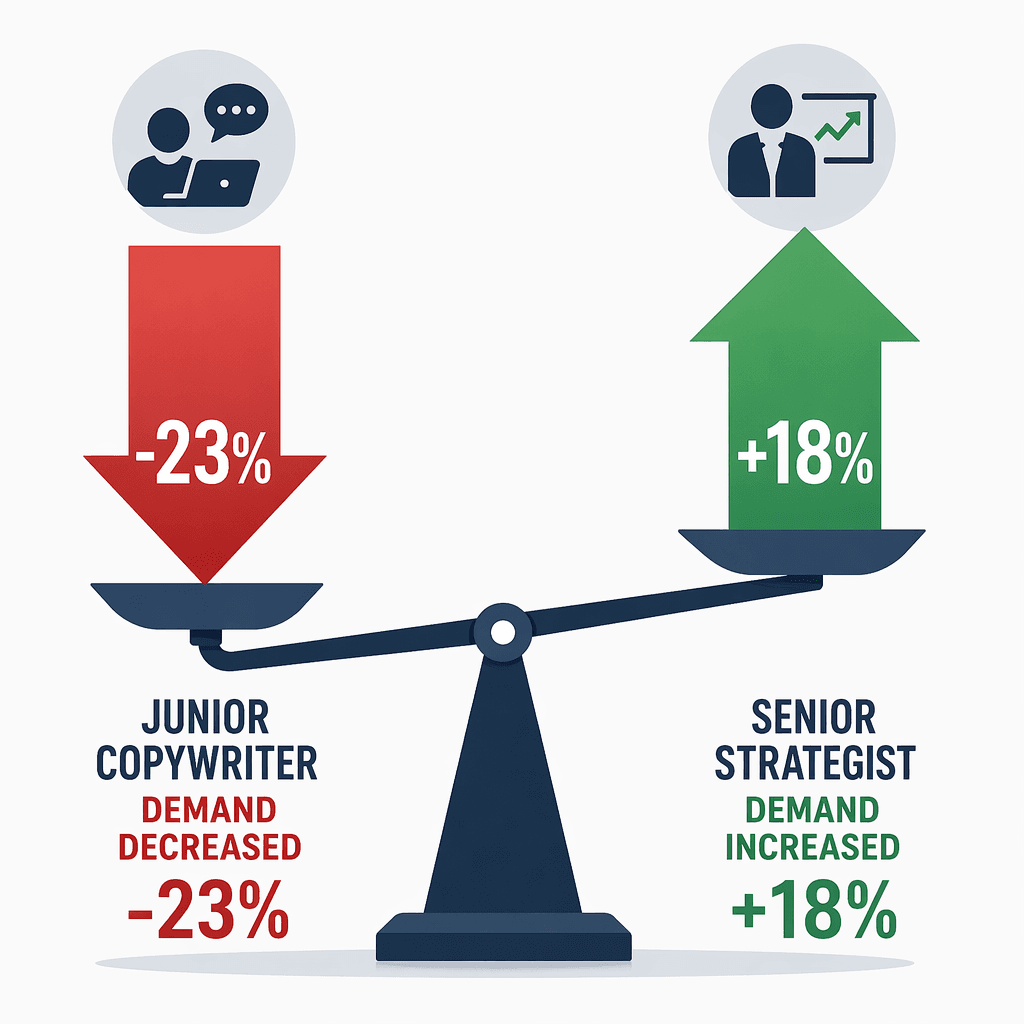
The workforce data from the Gartner CMO Spend Survey, reported by Digital Applied, tells a clear story about where AI is reshaping marketing teams. In 2025, 23% of agencies reduced junior copywriting headcount. In 2026, 31% plan further cuts. Meanwhile, demand for senior strategists is up 18%.
| Role Type | 2025 Change | 2026 Planned Change | Net Direction |
|---|---|---|---|
| Junior copywriter | -23% | -31% | Contracting |
| Senior content strategist | +12% | +18% | Growing |
| AI operations / prompt engineer | +28% | +35% | Growing fast |
| SEO specialist | +5% | +8% | Stable growth |
| Paid media manager | +3% | +5% | Stable |
The pattern is not simple job displacement. It is a skill composition shift. AI handles execution tasks — drafting, formatting, basic research — that were previously entry-level work. Senior strategists are in higher demand because their judgment, brand intuition, and ability to evaluate AI output quality cannot be automated. The 32% of organizations that expect workforce decreases due to AI, reported by Master of Code's analysis of multiple 2026 surveys, are likely those that treat AI as a cost-cutting lever rather than a capability multiplier.
For marketing managers, the practical implication is to invest in upskilling your junior team members toward oversight and strategy roles, not to protect execution tasks that AI will increasingly handle. The teams that report the highest AI ROI are those where senior practitioners spend more time on strategy and quality control, not less.
Governance Risks: What Mature Teams Are Doing Differently
Governance is not the most exciting topic in AI marketing, but it is the one that separates sustainable programs from short-lived experiments. The data is stark: unedited AI pages win top-3 search rankings 3.1x less often than human-reviewed content, according to Digital Applied's analysis of search performance data. After Google's March 2026 core update, 18% of sites that were publishing unedited AI content at scale lost 40% or more of their organic traffic.
The risks extend beyond SEO. The Master of Code analysis of multiple 2026 surveys found that 51% of organizations report experiencing negative consequences from AI, with inaccuracy (hallucinations) remaining the number one risk. For marketing teams, a hallucinated statistic in a white paper or a misattributed quote in a social post can cause real brand damage.
- Implement a human review gate for any AI-generated content that will be published externally. The 3.1x ranking penalty for unedited content is a strong signal that search engines are already penalizing low-effort AI output.
- Create a brand guidelines document that includes AI-specific rules: what the AI is allowed to generate independently, what requires human approval, and what is off-limits entirely.
- Track AI-related incidents — factual errors, brand tone violations, compliance issues — as a separate metric. Teams that measure this data are better positioned to identify systemic problems before they escalate.
- For a deeper treatment of governance frameworks and incident prevention, see our AI Targeted Marketing Pitfalls guide, which covers the 70% incident rate and how mature teams build governance into their workflows.
A Framework for Prioritizing Your Next 12 Months of AI Investment
The data in this article supports a clear investment prioritization framework. The goal is not to adopt more AI. It is to allocate budget, team time, and attention to the use cases that deliver the highest returns with acceptable risk.
- Audit current AI deployment across use cases. Measure ROI per use case using your own data, not vendor benchmarks. If you cannot measure ROI for a specific application, deprioritize it until you can.
- Shift budget from low-ROI to high-ROI applications. If your team is spending significant time on AI video creation or paid social creative generation, consider reallocating those hours to content drafting, personalization, or audience research — where the median returns are 2–3x higher.
- Build human oversight workflows for high-impact use cases. The highest-ROI teams are not the ones that automate the most. They are the ones that combine AI execution with human strategy and quality control. Invest in senior strategist talent to manage AI outputs.
- Pilot one agentic workflow in a controlled environment. Choose a bounded, low-risk task — content brief generation, SEO meta description drafting, or social media scheduling copy. Define explicit failure modes and human review gates before scaling.
- Invest in measurement infrastructure. Fewer than 20% of enterprises track defined KPIs for generative AI, according to McKinsey. Without measurement, you cannot prioritize. Build an analytics stack that tracks AI-specific metrics: output quality scores, human review time per asset, revision rates, and ROI per use case.
For budget allocation, the Digital Applied AI Marketing Strategy 2026 roadmap recommends the following split: 30–40% on tools and infrastructure, 25–35% on content creation and optimization, 20–25% on automation and workflow integration, and 10–15% on analytics and measurement. These are starting points, not fixed rules. Your actual allocation should reflect your team's specific ROI data.
| Category | Recommended Allocation | Priority Use Cases |
|---|---|---|
| Tools & infrastructure | 30–40% | Content drafting, personalization engines, analytics platforms |
| Content creation & optimization | 25–35% | SEO briefs, ad copy, email subject lines, audience research |
| Automation & workflow integration | 20–25% | Agentic workflows, content calendar automation, review loops |
| Analytics & measurement | 10–15% | ROI tracking, output quality scoring, incident monitoring |
For tool selection guidance, see our use-case-driven framework for choosing AI copywriting software. For building the measurement infrastructure to track ROI, see our step-by-step guide to building an AI marketing analytics stack.
The 2026 generative AI landscape is not about whether to adopt. It is about where to focus. Teams that understand the 3x ROI spread, invest in the right use cases, build human oversight into their workflows, and measure what matters will be the ones that turn AI from a cost center into a genuine competitive advantage.


Comments
Join the discussion with an anonymous comment.