
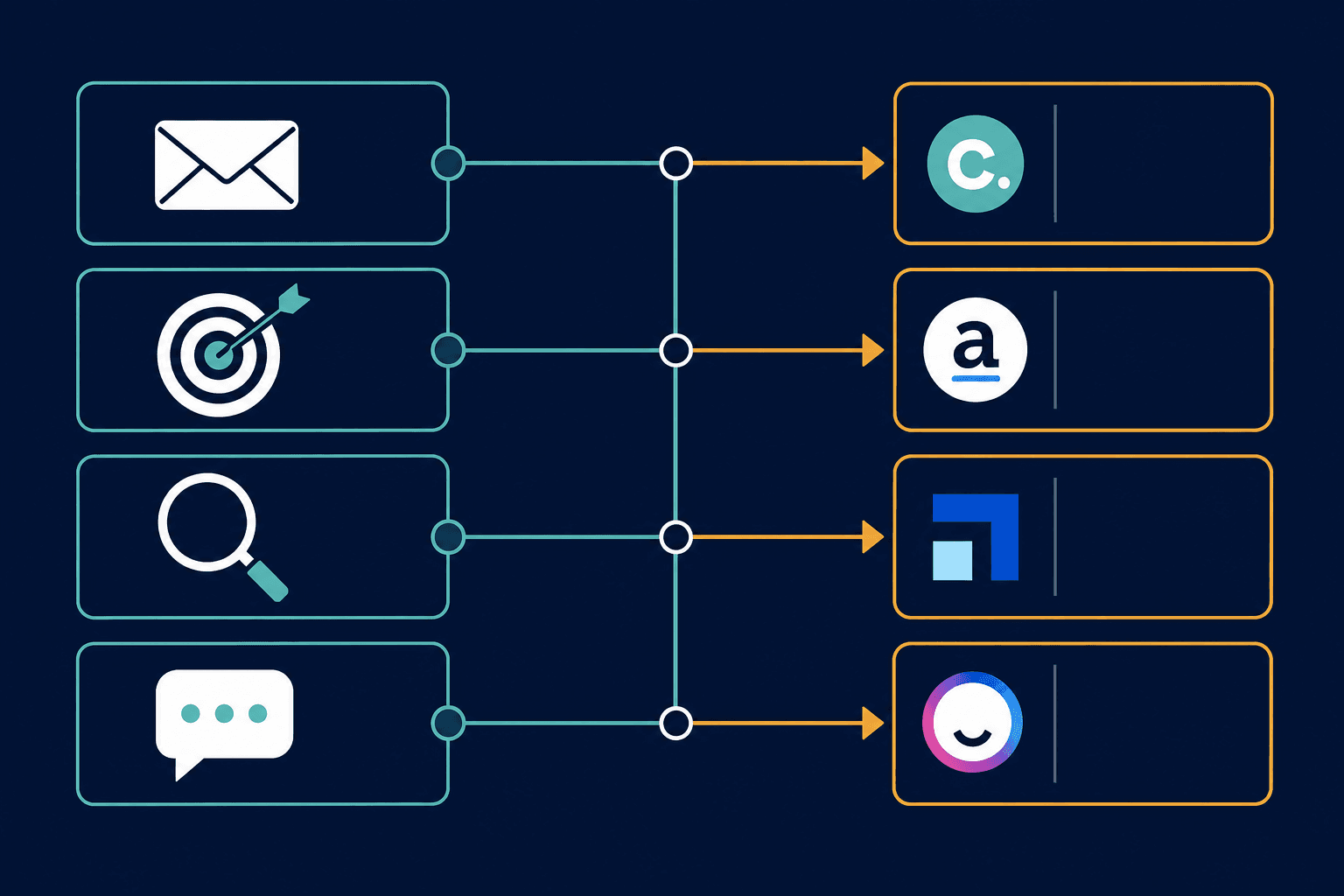
Jasper, Copy.ai, Anyword, Scalenut, Wordtune, ChatGPT, Claude
A decision framework for mid-level marketing managers and content strategists evaluating AI copywriting tools. Instead of a generic ranked list, this guide matches tools to specific content workflows — email, ads, long-form SEO, social, product descriptions, and editing — so you can choose the right tool for your team's dominant output.
Key Integrations
Marketing Categories
⚠ Notable Limitations
Hallucination, long-form coherence drops, narrow focus per tool
Why "Best AI Copywriting Tool" Is the Wrong Question in 2026
The AI copywriting tool market has reached a level of specialization that makes the generic "best tool" question a category error. In 2026, asking for a single best AI copywriting tool is like asking for the best vehicle — the answer depends entirely on whether you need to haul lumber, commute through city traffic, or transport a family of five. The tools have diverged by content type, workflow, and output format to a degree that listicle rankings obscure rather than clarify.
The stakes of choosing correctly are measurable. According to the Salesforce State of Marketing 2026, 87% of marketers now use generative AI in at least one workflow, up from 51% in 2024. But the McKinsey Global AI Survey reveals a 3.2x ROI spread across use cases — content drafting delivers a median 3.2x return (interquartile range 2.4x–4.1x), while AI video creation returns only 1.1x. Ad copy generation sits at 2.3x, and personalization engines at 2.7x. When the ROI difference between one AI application and another is nearly threefold, the tool you choose for your dominant workflow directly impacts your team's measurable return.
The financial commitment reinforces the point. The median mid-market marketing team now spends $3,400 per month on AI tools, up from $1,200 in Q1 2025. Selecting a tool optimized for a workflow your team rarely produces is not just inefficient — it is a measurable budget error.
The Six Content Workflow Categories That Define Your Tool Choice
Before evaluating tools, define which content types dominate your team's weekly output. Most marketing teams produce a mix, but one or two categories typically account for 70–80% of volume. The tool that excels for that dominant category should anchor your stack.
1. Email and GTM Workflows
High-volume, template-driven copy: nurture sequences, prospecting outreach, webinar invitations, product announcements, and onboarding emails. Quality requirements favor clarity, personalization, and conversion intent over creative flair. Typical volume: 10–50+ unique emails per week for active campaigns.
2. Advertising Copy
Paid search headlines, social ad body copy, display banners, and A/B test variants. Character limits, platform-specific formatting, and performance data feedback loops define this category. The best tools here offer predictive scoring against historical campaign data rather than just generating text.
3. Long-Form SEO Content
Blog posts, pillar pages, whitepapers, and guides ranging from 1,500 to 5,000+ words. Quality requirements include topical depth, factual accuracy, keyword integration, and readability. Tools that integrate SERP analysis and content scoring against competitor pages have an advantage here.
4. Short-Form Social Copy
LinkedIn posts, Twitter threads, Instagram captions, and TikTok scripts. Character constraints, platform voice expectations, and high publishing frequency (often daily or multiple times per day) define this category. Speed and variety matter more than depth.
5. Product Descriptions
Ecommerce listings, catalog copy, and feature descriptions. High volume, repetitive structure, and SEO requirements (unique descriptions to avoid duplicate content penalties). Tools that handle bulk generation with consistent formatting and keyword insertion perform best here.
6. Editing and Polish
Rewriting, condensing, tone adjustment, grammar correction, and proofreading of existing copy. This is not a generation task — it is a refinement task. Tools in this category work as browser extensions or integrations within existing writing environments.
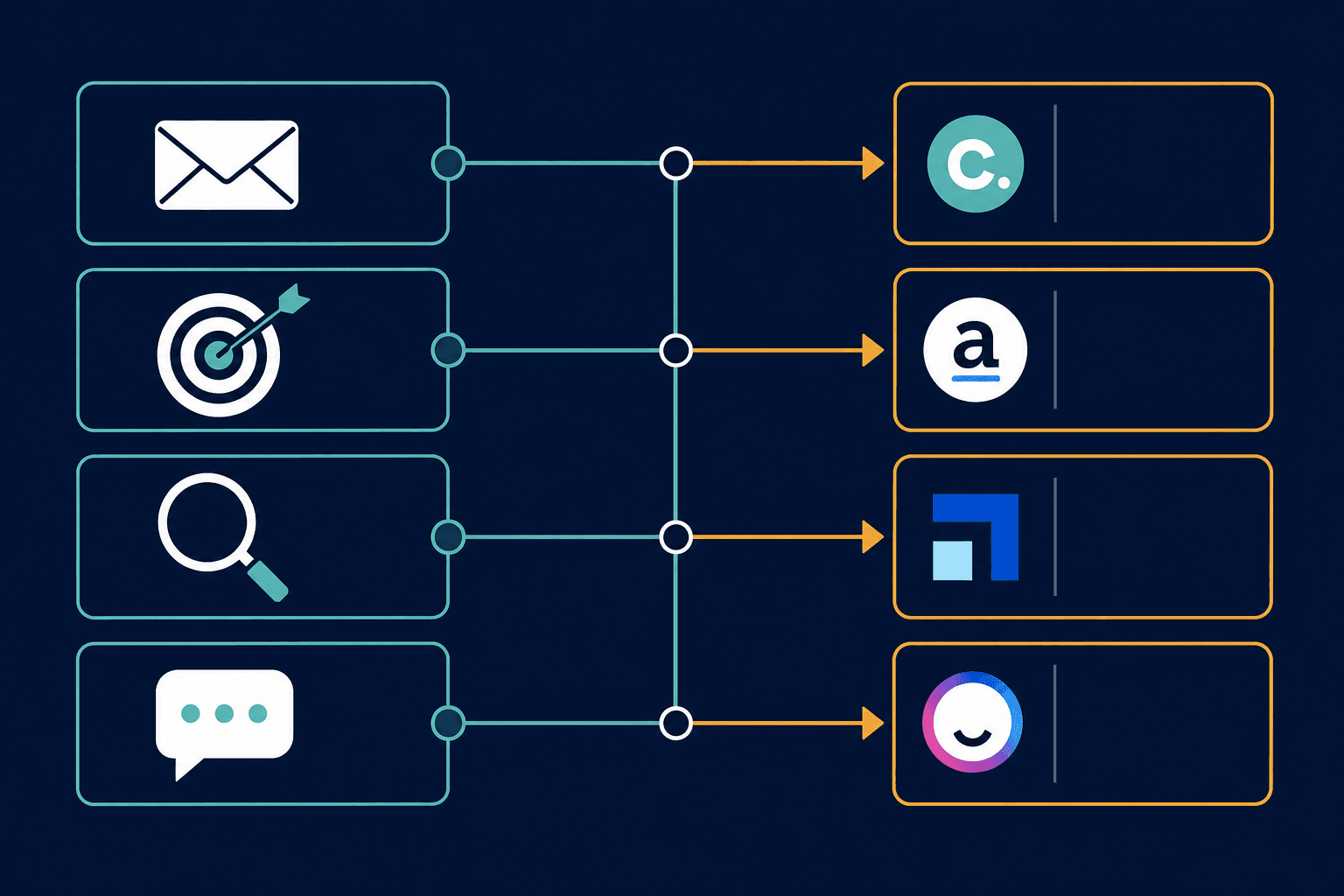
Tool-by-Tool Matchup: Which Tool Wins for Each Workflow
The following matchup maps each major tool to its strongest content workflow based on published testing from multiple independent reviewers. Pricing reflects publicly available plans as of mid-2026; verify on vendor sites before purchasing.
| Tool | Best Workflow | Starting Price | Key Strength | Key Limitation |
|---|---|---|---|---|
| Jasper | Long-form brand copy, sales copy | $69/mo (Creator) | Brand voice training via Jasper IQ; Surfer SEO integration; strong long-form coherence | No free plan; can hallucinate facts and repeat itself in extended output |
| Copy.ai | Email and GTM workflows | $29/mo (Chat plan) | Purpose-built email sequences and prospecting outreach; workflow automation | Long-form coherence drops above 1,500 words; free version limited to older models |
| Anyword | Ad copy with predictive scoring | $49/mo | Predictive performance scoring using billions of data points; platform-specific ad formats | Narrow focus on ad copy; limited utility for other content types |
| Scalenut | SEO content | ~$39/mo | Built-in SERP analysis and real-time content scoring; no separate Surfer subscription needed | Weaker for short-form marketing copy and non-SEO content |
| Wordtune | Editing and polish | $9.99/mo (Unlimited) | Sentence-level rewriting; browser extension; low cost | Cannot generate original copy from scratch; limited to refinement tasks |
| ChatGPT / Claude | Brainstorming, ideation, general drafting | Free to $30/mo (Claude Pro) | Broad capability; strong creative output (Claude); low barrier to entry | No workflow-specific optimization; requires manual prompt engineering for consistent brand voice |
Jasper: Long-Form Brand Copy
Multiple independent testers identify Jasper as the strongest option for long-form content that requires brand consistency. Alex Birkett's testing found Jasper's "Boss Mode" capable of writing an article from a single prompt, and the tool's brand voice training via Jasper IQ allows teams to maintain consistent tone across outputs. The Surfer SEO integration adds a content scoring layer against SERP competitors, making it viable for SEO-driven long-form work. However, Peer to Peer Marketing's testing of 15 tools noted that Jasper tends to repeat itself in extended output and can hallucinate facts — their test example added unsupported claims about product attributes. The $69/month Creator plan has no free tier, and the 7-day trial requires credit card entry.
Copy.ai: Email and GTM Workflows
Copy.ai has positioned itself specifically for go-to-market teams. Its workflow-based approach supports prospecting sequences, personalized outreach, and sales enablement copy. Birkett called it "truly fantastic" for sales copy and email subject lines. The $29/month Chat plan provides access to workflow templates, but multiple reviewers note that long-form blog quality does not match Jasper's level, and coherence degrades noticeably above 1,500 words. The free tier exists but is limited to GPT-3.5 and Claude 3 Haiku models. For teams whose primary output is email sequences and prospecting copy, Copy.ai is the strongest dedicated option.
Anyword: Ad Copy with Predictive Scoring
Anyword differentiates itself through predictive performance scoring. The tool analyzes generated ad copy against billions of data points to predict engagement and conversion likelihood before the copy runs. For paid media teams running high-volume A/B tests across Google Ads, Meta, and LinkedIn, this predictive layer reduces the iteration cycle. The $49/month plan is competitive for ad-focused teams, but the tool's narrow focus means it has limited utility for email, long-form, or social content. For a detailed look at Anyword's predictive features, see our Anyword AI Ad Copy Generator deep dive.
Scalenut: SEO Content
Scalenut competes directly with Surfer by bundling SERP analysis and real-time content scoring into its base subscription at approximately $39/month. For SEO teams that need to produce content optimized for specific keyword targets and competitor landscapes, Scalenut provides the integrated workflow without requiring a separate SEO tool subscription. Reviewers note that it is weaker for short-form marketing copy and non-SEO content, making it a specialist tool rather than a generalist solution.
Wordtune: Editing and Polish
Wordtune occupies a distinct category: it refines existing copy rather than generating from scratch. Its browser extension works across Google Docs, email clients, and CMS platforms, offering sentence-level rewriting, tone adjustment, and length control. At $9.99/month for the Unlimited plan, it is the lowest-cost option among dedicated tools. Multiple testers emphasize that Wordtune cannot generate original content — it is a polish layer, not a production engine.
ChatGPT and Claude: Generalist Brainstorming
Generalist LLMs remain valuable for ideation, outlines, headline variations, and first drafts across multiple content types. Claude is noted by CrazyEgg as more creative than GPT-4o, though both are susceptible to hallucination. The key limitation is the lack of workflow-specific optimization — achieving consistent brand voice requires manual prompt engineering, and there are no built-in integrations for SEO scoring, ad performance prediction, or email sequence automation. For teams that need a flexible brainstorming layer alongside a specialized production tool, a generalist LLM complements rather than replaces the dedicated options above.
Decision Framework: Matching Tools to Team Profiles
The following scored assessment table matches each tool to common team profiles. Scores reflect fit based on published testing criteria: output quality for the dominant workflow, workflow-specific features, pricing relative to team size, and integration with existing marketing stacks. The median mid-market spend of $3,400/month serves as a budget anchor — most teams should allocate 30–50% of that to their primary tool and the remainder to complementary tools.
| Team Profile | Jasper | Copy.ai | Anyword | Scalenut | Wordtune | ChatGPT / Claude | Recommendation |
|---|---|---|---|---|---|---|---|
| Email-heavy team (nurture, prospecting, onboarding) | 3/5 | 5/5 | 2/5 | 2/5 | 3/5 | 3/5 | Copy.ai (primary) + Wordtune (polish) |
| Ad/PPC team (search, social, display) | 2/5 | 2/5 | 5/5 | 1/5 | 2/5 | 3/5 | Anyword (primary) + ChatGPT (ideation) |
| SEO/content team (blog, pillar pages, guides) | 4/5 | 2/5 | 1/5 | 5/5 | 3/5 | 3/5 | Scalenut or Jasper (primary) + Wordtune (editing) |
| Social media team (LinkedIn, Twitter, Instagram) | 3/5 | 3/5 | 2/5 | 2/5 | 3/5 | 4/5 | Claude (primary) + Jasper (brand templates) |
| Generalist team (mixed content types) | 4/5 | 3/5 | 2/5 | 3/5 | 4/5 | 4/5 | Jasper (anchor) + Wordtune (polish) + ChatGPT (ideation) |
Honest Blind Spots: What Each Tool Does Poorly
Every AI copywriting tool has documented weaknesses. Surfacing these honestly is the difference between a useful decision framework and vendor marketing. The following limitations are drawn from published testing across multiple independent reviewers.
- Jasper: Tends to repeat itself in long-form output and can hallucinate facts. Peer to Peer Marketing's testing found Jasper adding unsupported claims about product attributes (e.g., vegan/cruelty-free labels to a soap product). First drafts often contain punctuation errors requiring cleanup.
- Copy.ai: Long-form coherence drops significantly above 1,500 words. The free version is limited to older models (GPT-3.5, Claude 3 Haiku). Not suitable as a primary tool for SEO content teams producing 2,000+ word articles.
- Anyword: Narrow focus on ad copy limits utility for other content types. If your team produces a mix of email, social, and blog content alongside ads, Anyword cannot serve as your primary tool.
- Scalenut: Weaker for short-form marketing copy and non-SEO content. The SEO focus means social copy, email sequences, and ad copy are outside its core competency.
- Wordtune: Cannot generate original copy from scratch. It is a refinement tool, not a production engine. Teams expecting it to replace a generation tool will be disappointed.
- ChatGPT / Claude: No workflow-specific optimization. Achieving consistent brand voice requires manual prompt engineering. No built-in integrations for SEO scoring, ad prediction, or email sequencing. Output quality varies significantly with prompt quality.
The Human Overlay: Editing, Brand Voice, and Fact-Checking Requirements
AI copywriting produces usable first drafts, but the percentage of human editing required varies significantly by tool and content type. The following estimates are based on published testing observations and should be treated as minimums — complex or high-stakes copy (homepage, pricing page, legal disclaimers) requires 100% human authorship per multiple reviewers.
| Tool Category | Estimated Editing % | Brand Voice Training Effort | Fact-Checking Requirement |
|---|---|---|---|
| Jasper (long-form) | 30–50% | Medium (Jasper IQ brand voice setup) | High — hallucination risk documented in multiple tests |
| Copy.ai (email/GTM) | 20–35% | Low (template-based, less voice variation) | Medium — factual claims in outreach copy need verification |
| Anyword (ad copy) | 15–25% | Low (character-limited formats) | Low — ad copy is typically benefit-driven, not fact-heavy |
| Scalenut (SEO content) | 30–45% | Medium (SEO tone settings) | High — SEO content often makes factual claims requiring verification |
| Wordtune (editing) | 5–15% | Minimal (refines existing copy) | Minimal — does not generate new factual claims |
| ChatGPT / Claude (generalist) | 40–60% | High (manual prompt engineering required) | Very high — no domain-specific guardrails |
For a broader framework on content-type classification and quality control across AI-generated marketing materials, see our AI-Generated Marketing Content taxonomy and quality-control framework. That article provides a systematic approach to categorizing content by type and establishing editorial standards that apply regardless of which tool you choose.

Quick-Reference Recommendation Table by Team Type
For busy managers who need a decision today, the following table summarizes the best tool recommendation for each team profile, including runner-up options and budget notes. These recommendations assume the team's dominant workflow accounts for at least 60% of total content output.
| Team Type | Primary Tool | Runner-Up | Monthly Budget Estimate | Key Consideration |
|---|---|---|---|---|
| Email-heavy team | Copy.ai ($29/mo) | Jasper ($69/mo) | $30–100/mo | Copy.ai's workflow templates reduce setup time for sequences |
| Ad/PPC team | Anyword ($49/mo) | ChatGPT ($20/mo) | $50–100/mo | Anyword's predictive scoring reduces A/B test cycles |
| SEO/content team | Scalenut (~$39/mo) or Jasper ($69/mo) | Wordtune ($9.99/mo) | $40–80/mo | Scalenut bundles SERP analysis; Jasper offers stronger brand voice |
| Social media team | Claude ($30/mo) | Jasper ($69/mo) | $30–70/mo | Claude's creative output suits platform-specific voice variation |
| Generalist team | Jasper ($69/mo) + Wordtune ($9.99/mo) | Copy.ai ($29/mo) + Claude ($30/mo) | $80–100/mo | Two-tool stack covers long-form, email, and polish |
| Budget-constrained solo practitioner | Copy.ai free tier + Wordtune free | ChatGPT free + Rytr free | $0–30/mo | Free tiers have model limitations but cover basic needs |
For teams evaluating Jasper and Copy.ai specifically for agency use, our Jasper vs. Copy.ai head-to-head comparison provides a detailed feature matrix, workflow comparison, and pricing guide tailored to agency workflows.

Comments
Join the discussion with an anonymous comment.