
How to Build an AI Marketing Analytics Stack: A Step-by-Step Framework for Enterprise and Mid-Market Teams
A prescriptive, four-step framework for marketing ops leads, analytics managers, and CMOs to build an AI-powered analytics infrastructure. Focuses on data readiness, use-case prioritization, decision velocity, and measurement—not tool selection.
The Problem: Reactive Reporting vs. Real-Time Intelligence
Most marketing teams today operate on a reporting cadence that was designed for a slower, less complex media environment. Weekly dashboards, monthly performance reviews, and quarterly planning cycles are the norm. But the gap between when a signal appears (a sudden drop in conversion rate, a competitor shift in ad positioning, a viral social moment) and when the team can act on it is measured in days or weeks, not minutes. That latency is expensive.
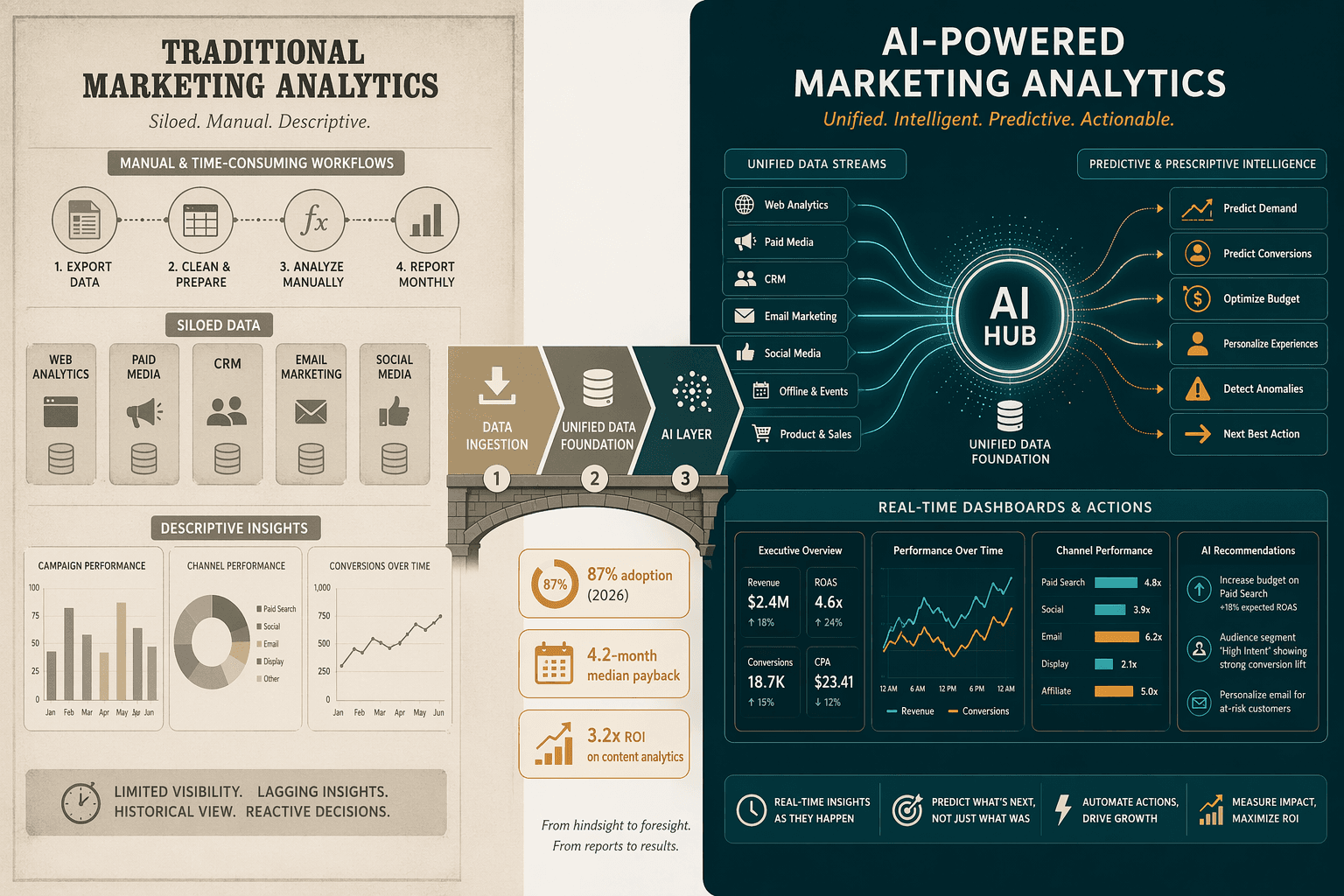
The root cause is not a lack of tools. Most mid-market and enterprise teams already own a dozen analytics platforms. The problem is structural: data lives in silos, reporting is manual, and the output is descriptive rather than prescriptive. You get a chart showing what happened last week, not a recommendation for what to do next.
| Dimension | Traditional Analytics | AI-Powered Analytics |
|---|---|---|
| Primary focus | Descriptive (what happened) | Predictive and prescriptive (what will happen, what to do) |
| Data sources | Structured, internal only | Structured + unstructured, internal and external |
| Speed of insight | Hours to days | Seconds to minutes |
| Scale | Sampled or aggregated data | Billions of data points simultaneously |
| Insight type | Historical trends and summaries | Anomaly detection, forecasts, recommendations |
| Proactivity | Reactive (user queries a report) | Proactive (system alerts on deviation) |
| Skill requirement | Analyst to query and interpret | Natural language queries, automated interpretation |
| Optimization | Manual, periodic | Continuous, automated |
The shift from reactive to real-time intelligence is not primarily a technology upgrade. It is an infrastructure and process transformation. Teams that attempt to bolt AI onto a fragmented data foundation end up with faster versions of the same flawed reports. The data in this article — drawn from the 2026 AI Marketing Adoption Benchmarks and Statistics reference — shows that 87% of marketers now use generative AI in at least one recurring workflow, up from 51% in 2024. Yet campaign analytics, despite growing +26 percentage points in weekly adoption year-over-year, delivers only 1.9x ROI compared to 3.2x for content drafting. That gap suggests many teams are adopting analytics AI before their data infrastructure is ready to support it.
What AI Marketing Analytics Actually Means: Six Capability Areas
Before building anything, it helps to define the scope. AI in marketing analytics is not a single capability. Based on the LatentView enterprise framework, it spans six distinct areas, each with different data requirements, maturity levels, and ROI profiles.
- Predictive customer intelligence. Models that forecast customer behavior — purchase probability, churn risk, lifetime value — using historical interaction data and external signals.
- Dynamic customer segmentation. Segments that update in real time as behavior changes, rather than static quarterly groupings. Enables micro-segmentation at scale.
- Accelerated marketing mix modeling (MMM). Bayesian and machine-learning MMM that runs in hours instead of weeks, allowing teams to reallocate budget mid-campaign rather than post-hoc.
- Content intelligence and personalization at scale. AI that analyzes content performance across channels, recommends creative variations, and personalizes messaging for individual segments.
- Social and unstructured data mining. Natural language processing applied to social conversations, reviews, support tickets, and survey responses to surface sentiment trends, emerging topics, and competitive intelligence.
- Real-time campaign performance and anomaly detection. Automated monitoring that flags statistically significant deviations in KPIs — a sudden CPA spike, a drop in engagement rate — and triggers alerts or automated adjustments.
This article is a prescriptive build framework — how to construct an analytics stack that supports these capabilities. For a deeper descriptive reference on what each capability does and which tools serve it, see the AI Marketing Analytics: A Practitioner's Reference Guide. The framework below assumes you have read that guide or already understand the capability landscape.
Step 1: Audit Your Marketing Data Estate
Every failed AI analytics deployment I have seen shares one root cause: the team tried to build intelligence on top of a data foundation they had not fully mapped or cleaned. The principle is simple — garbage in, garbage out — but it is routinely ignored in the rush to deploy. As Improvado's guide notes, if source data is inaccurate or incomplete, AI-driven insights will be flawed regardless of model sophistication.
A proper data estate audit covers three dimensions:
- Source mapping. Document every system that generates or stores marketing data: CRM, ad platforms (Google Ads, Meta, LinkedIn, TikTok), analytics tools (GA4, Mixpanel, Amplitude), email platforms (HubSpot, Marketo), social listening tools, survey platforms, and offline data sources (POS, call tracking). For each source, note the data schema, update frequency, and access method (API, CSV export, data warehouse connector).
- Silo identification. Map where data lives and whether it is currently joined. Common silos include: ad platform data that never reaches the CRM, web analytics that sits separate from email engagement data, and offline conversion data that is manually uploaded weeks after the fact. Each silo represents a blind spot that AI models will inherit.
- Quality assessment. For each source, evaluate completeness (are there gaps in the time series?), consistency (do the same metrics mean the same thing across platforms?), and accuracy (are there known tracking issues, deduplication problems, or attribution discrepancies?). A simple traffic-light system — green (ready), yellow (needs work), red (unusable) — helps prioritize cleanup efforts.
The output of Step 1 is a documented data estate map with quality scores per source and a prioritized cleanup backlog. Do not proceed to Step 2 until you have at least three to five high-quality, cross-joined data sources. Without that foundation, every subsequent decision will be built on assumptions rather than evidence.
Step 2: Prioritize Use Cases by Impact-to-Readiness Ratio
Once you know what data you have and its quality level, the next decision is where to apply AI first. The temptation is to start with the most exciting use case — predictive customer intelligence or real-time anomaly detection. But the right starting point depends on two factors: the potential ROI of the use case and the readiness of your data to support it.
The table below maps common analytics use cases against their reported ROI multiples and the data infrastructure prerequisites each requires. The ROI figures are drawn from McKinsey's Global AI Survey 2026, as compiled by DigitalApplied.
| Use Case | Median ROI Multiple | IQR Range | Data Readiness Required |
|---|---|---|---|
| AI content drafting and optimization | 3.2x | 2.4x – 4.1x | Low: content performance data, editorial metadata |
| Personalization engines | 2.7x | 2.0x – 3.5x | Medium: user behavior data, segment definitions, real-time event stream |
| Campaign analytics and reporting | 1.9x | 1.4x – 2.6x | Low to medium: unified campaign data, consistent naming conventions |
| AI-generated paid social creative | 1.2x | 0.8x – 1.7x | Low: ad performance data, creative asset library |
| AI video production | 1.1x | 0.7x – 1.6x | Low: brief and brand guidelines |
Several observations stand out. Content drafting delivers the highest ROI and requires the least data infrastructure — which explains why it is the most widely adopted AI use case in marketing. Campaign analytics, despite being the fastest-growing use case (+26 percentage points in weekly adoption year-over-year), delivers only 1.9x ROI. That does not mean campaign analytics is a bad investment. It means many teams are deploying analytics AI before their data is clean and unified enough to generate reliable insights. The low ROI is a symptom of infrastructure immaturity, not a limitation of the technology.
To apply the impact-to-readiness framework:
- Score each use case. Rate potential impact (1–5) based on expected ROI, strategic importance, and stakeholder demand. Rate data readiness (1–5) based on your estate audit results.
- Plot on a 2x2 matrix. High impact + high readiness = quick wins (start here). High impact + low readiness = strategic bets (invest in data cleanup first). Low impact + high readiness = efficiency plays (automate if the effort is low). Low impact + low readiness = deprioritize.
- Sequence your roadmap. Deliver one or two quick wins in the first quarter to build organizational confidence and prove the infrastructure works. Then tackle one strategic bet per quarter, using the quick-win momentum to fund data cleanup for the next use case.
Step 3: Build for Decision Velocity, Not Just Analytical Depth
The most common mistake teams make after deploying AI analytics is building dashboards that are information-rich but decision-poor. They surface dozens of metrics, complex visualizations, and deep drill-downs — but the marketing team still does not know what to do differently on Monday morning.
Decision velocity means designing every analytics output around a specific decision. For each use case you prioritized in Step 2, ask: What decision does this insight enable? Who makes that decision? How quickly do they need the information? What format reduces friction between insight and action?
Common decision-analytics mappings include:
- Budget allocation. Accelerated MMM outputs a recommended reallocation percentage per channel, not just a historical ROI chart. The decision is: move 12% from search to social this week.
- Audience selection. Predictive customer intelligence surfaces a specific high-intent segment with a purchase probability score and recommended offer. The decision is: activate this 28-million-user cohort with a 15% discount.
- Channel mix. Real-time anomaly detection flags that CPA on LinkedIn rose 22% in the last 48 hours while Facebook CPA dropped 8%. The decision is: shift 20% of LinkedIn budget to Facebook and investigate the LinkedIn creative.
- Content optimization. Content intelligence identifies that long-form guides convert 3x better than listicles for the top-of-funnel segment. The decision is: brief two long-form guides this week, pause listicle production.
A powerful enabler of decision velocity is natural language querying (NLQ). Instead of requiring an analyst to write a SQL query or navigate a dashboard, NLQ allows a marketing manager to ask, "What was our best-performing channel last week by ROAS, broken down by campaign type?" and receive an immediate answer. This democratizes access to analytics and reduces the bottleneck of analyst availability. Tools like Google Analytics 4 already offer predictive metrics — purchase probability, churn probability — and automated anomaly detection at no additional cost, making NLQ-adjacent capabilities accessible to teams without dedicated data science resources.
Step 4: Measure, Document, and Expand Deliberately
The final step is often the most neglected. Teams deploy AI analytics, see early positive signals, and immediately expand to new use cases without establishing baselines or documenting what worked. This creates two problems: you cannot prove the value of the investment when leadership asks, and you cannot replicate successful patterns across the organization.
A deliberate measurement and expansion process includes four components:
- Establish baseline KPIs before deployment. For each use case, document the current performance on relevant metrics: time to insight, decision accuracy, campaign ROI, analyst hours spent on reporting. Without a baseline, you cannot measure improvement.
- Track post-implementation results at defined intervals. Measure at 30, 60, and 90 days, then quarterly. Use the same metrics and methodology as the baseline. The median payback on AI tooling is now 4.2 months, down from 7.8 months in 2024 (Gartner), so you should expect to see measurable returns within two quarters.
- Build an internal evidence base. Document each deployment in a consistent format: use case, data sources used, model or tool, baseline metrics, post-implementation metrics, unexpected outcomes, and lessons learned. This evidence base serves as the foundation for internal advocacy and future budget requests.
- Expand deliberately. Only move to the next use case on your roadmap after the current one has demonstrated measurable improvement and the team has absorbed the operational changes. Rushing expansion risks compounding infrastructure debt.
For a deeper treatment of why measurement fails in practice and how to build a robust ROI framework, see the AI Analytics ROI Gap: Why Most Teams Can't Measure What Their Tools Are Worth and How to Fix It article. The key insight from that analysis is that AI's value often compounds over time, making short-term metrics misleading. A use case that shows 1.5x ROI in the first quarter may reach 3x by the fourth quarter as the model improves with more data and the team becomes more proficient at acting on its outputs.
Tool Landscape Overview: Platform vs. Point Solution
The platform vs. point solution decision is a consequence of your Step 1 data estate audit, not a starting point. If your audit reveals a highly fragmented data landscape with 15+ sources, inconsistent schemas, and manual data stitching, a unified analytics platform may reduce operational overhead and improve AI accuracy by providing a single source of truth. If your data is already centralized in a warehouse and you have a strong data engineering team, best-in-class point solutions for specific use cases (anomaly detection, MMM, content intelligence) may deliver better results.
| Decision Factor | Platform Approach | Point Solution Approach |
|---|---|---|
| Data fragmentation | High fragmentation favors consolidation | Low fragmentation allows specialization |
| Team capability | Smaller teams benefit from all-in-one | Larger teams can manage multiple tools |
| Use case breadth | Multiple use cases from day one | Single, high-priority use case |
| Budget model | Higher upfront, lower per-tool cost | Lower upfront, potential for cost creep |
| Integration overhead | Lower (one integration to maintain) | Higher (multiple API connections) |
| Vendor lock-in risk | Higher (harder to switch) | Lower (easier to replace individual tools) |
The tool comparison pages from Whatagraph and Cometly provide detailed feature matrices for six to nine analytics platforms, with pricing ranging from $79/month (Whatagraph starter) to custom enterprise tiers at $24k–$48k/month. Agency case studies on those pages claim 100 hours/month and 63 hours/month saved on reporting, though these are vendor-reported figures and should be evaluated critically. For readers specifically evaluating attribution tools, the AI Marketing Attribution Models in 2026: How to Choose and Layer MMM, MTA, and Incrementality Testing guide provides a deeper methodology comparison.
Common Pitfalls and How to Avoid Them
Even teams that follow the four-step framework encounter obstacles. Based on the research sources and practitioner reports, here are the most common failure modes and how to address them.
- Skill gaps and the black box problem. AI analytics outputs can feel opaque. When a model recommends a budget reallocation, stakeholders want to understand why. The solution is not to simplify the model but to invest in explainability layers — feature importance charts, what-if simulations, and natural language summaries of model reasoning. 73% of teams now require human-in-the-loop review for public-facing AI outputs, up from 41% (DigitalApplied, 2026). Build that review into your workflow from the start.
- Surface-level metrics obsession. Hurree's analysis identifies four common measurement mistakes: focusing on surface-level metrics (vanity metrics like impressions) instead of business outcomes, baseline blindness (not measuring before deployment), automation accounting gaps (not tracking time saved), and short-termism (evaluating AI on 30-day windows when value compounds over quarters). The fix is a balanced scorecard that includes revenue & growth metrics, efficiency & cost metrics, customer experience metrics, and strategic & operational metrics.
- Governance and data quality erosion. Data quality is not a one-time fix. As new data sources are added and existing ones change, quality degrades silently. Establish a data governance board (or assign a data steward) with authority to enforce naming conventions, schema standards, and quality thresholds. Schedule quarterly data estate reviews as part of your analytics operations cadence.
- Over-reliance on AI recommendations. AI models are probabilistic, not deterministic. A model that recommends a 12% budget shift is making a prediction based on historical patterns — it cannot account for a competitor's surprise product launch or a platform policy change. Always pair AI recommendations with human judgment, especially for high-stakes decisions. The goal is augmented intelligence, not automated decision-making.
Building an AI marketing analytics stack is a multi-quarter effort, not a tool purchase. The four-step framework — audit your data estate, prioritize by impact-to-readiness, build for decision velocity, and measure and expand deliberately — provides a repeatable methodology that works regardless of which tools you choose. Start with the audit. Everything else follows from what you find.


Comments
Join the discussion with an anonymous comment.