
The AI Analytics ROI Gap: Why Most Teams Can't Measure What Their Tools Are Worth and How to Fix It
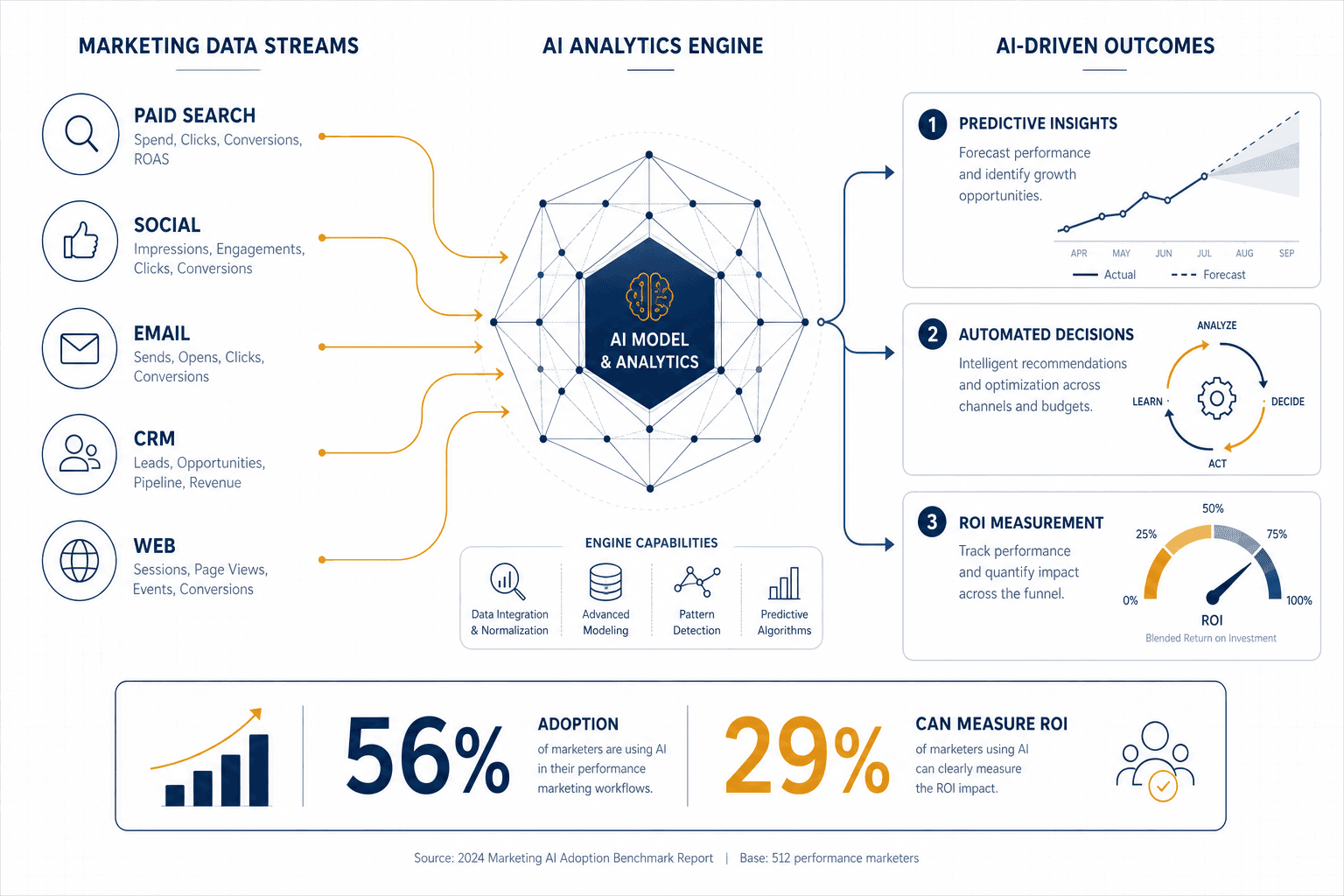
56% of marketing teams use AI analytics, but only 29% can quantify the ROI. This article diagnoses the three root causes of that gap — siloed attribution, data quality issues, and a training deficit — and provides a measurement-first framework to close it.
The ROI Gap: 56% Adoption, 29% Measurability
Here is the uncomfortable truth about AI in marketing analytics in mid-2026: more than half of marketing teams have adopted AI-powered analytics tools, but fewer than a third can tell you whether those tools are actually paying off. According to data aggregated by DigitalApplied from Gartner, Forrester, eMarketer, and HubSpot, 56% of marketing teams now use AI analytics, yet only 29% of those adopters can quantify the ROI of those tools. That is a 27-percentage-point gap between adoption and accountability.
This gap is not a technology failure. The models work. AI analytics delivers a 64% average reduction in time-to-insight and a 28–35% improvement in forecast accuracy, per the same source. The problem is that most organizations deploy these tools into a measurement environment that is already broken — fragmented attribution, dirty data, and under-skilled teams. The AI then accelerates outputs without fixing the underlying measurement logic, producing faster answers to the wrong questions.
This article is not another survey of what AI can do in analytics. Our existing AI Marketing Analytics: A Practitioner's Reference Guide already covers that ground comprehensively, and the Function-by-Function Guide for 2026 addresses the broader cross-channel picture. Here, we are diagnosing a specific, painful problem: why most teams cannot measure what their AI tools are worth, and what to do about it.
Root Cause 1: Siloed Attribution Methods Produce Conflicting Signals
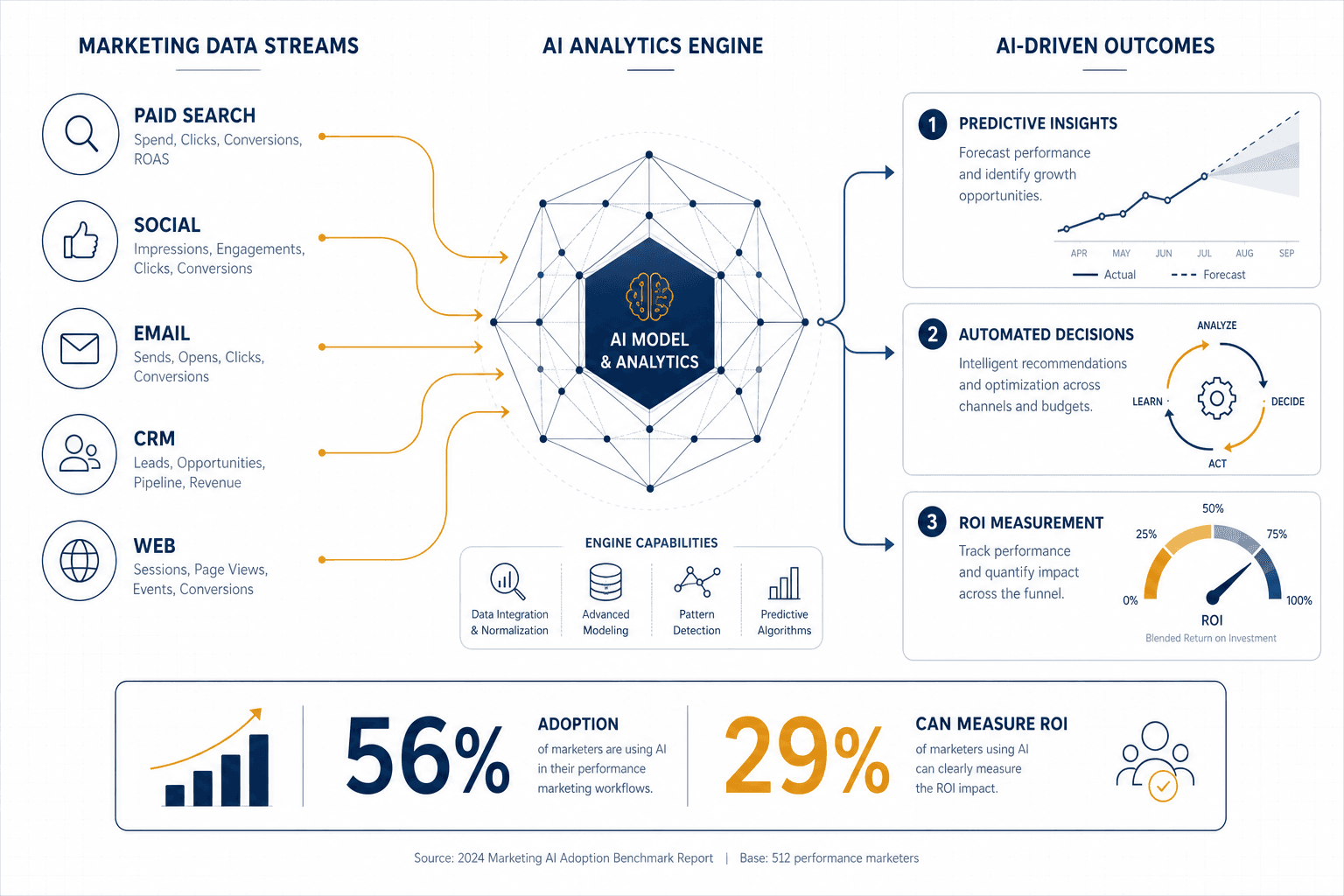
The first reason AI analytics ROI remains invisible is that the attribution frameworks feeding those models are inconsistent. Most marketing organizations use a mix of multi-touch attribution (MTA), marketing mix modeling (MMM), and incrementality testing — but they use them in isolation, often managed by different teams with different data sources and different time horizons.
When these methods produce conflicting channel credit signals — and they will — the AI model has no reliable ground truth to train on. A B2B example from Improvado's trend analysis illustrates the scale of the problem: depending on which attribution method you use, the credit assigned to a single channel can swing by as much as 58 percentage points. If your AI analytics tool is learning from data that says paid search drove 12% of conversions on Monday and 70% on Tuesday, its output will be noise.
| Attribution Method | Time Horizon | Data Requirements | Best Use Case | Key Limitation |
|---|---|---|---|---|
| Multi-Touch Attribution (MTA) | Short-term (days/weeks) | User-level clickstream data | Digital channel optimization | Breaks down with offline touchpoints; 60% of orgs abandon within 6 months |
| Marketing Mix Modeling (MMM) | Long-term (quarters/years) | Aggregated spend and sales data (2+ years) | Budget allocation across channels | Low granularity; 63% of new implementations use open-source frameworks |
| Incrementality Testing | Campaign-specific | Randomized control groups | Causal impact of specific campaigns | Expensive; limited to testable channels |
The data on MTA abandonment is particularly telling. Improvado reports that 60% of organizations abandon multi-touch attribution within six months of implementation, with 40% of those failures attributed directly to data hygiene issues. Teams invest heavily in setting up attribution, discover their data is too messy to support it, and revert to last-click or no attribution at all. The AI tool they purchased to solve this problem then trains on the same broken data.
Root Cause 2: The $12.9M Data Quality Tax
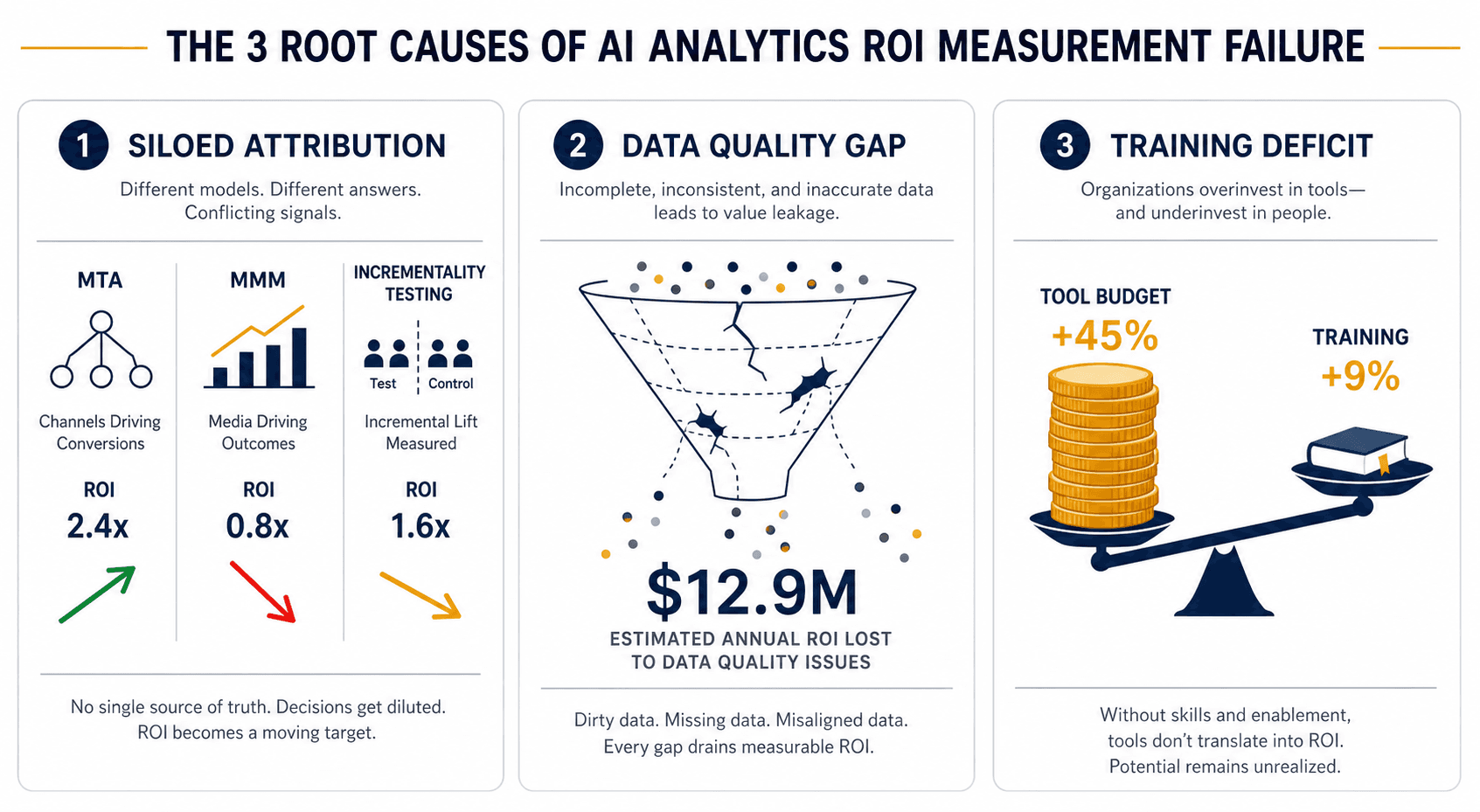
Even if your attribution method is sound, dirty data will corrupt the output. The scale of the data quality problem in marketing is staggering. According to the DigitalApplied aggregation, the average annual cost of poor marketing data quality at the enterprise level is $12.9 million. That is not a rounding error — it is a line item that exceeds the salary of an entire analytics team.
The root causes are well documented:
- 42% of CRM records have at least one data quality issue — duplicate entries, outdated fields, missing values, or incorrect formatting.
- 87% of marketers say data-driven decisions are critical to their success, but only 32% have high confidence in their data quality — a 55-percentage-point confidence gap.
- Data quality issues compound in AI systems. A model trained on dirty data does not produce slightly worse outputs — it produces confidently wrong outputs at scale, because AI systems are pattern matchers that will learn and amplify the errors in the training data.
This is the hidden tax that most ROI calculations ignore. When a marketing team reports a 15% efficiency gain from AI analytics, they rarely subtract the cost of the data cleanup required to get there. The $12.9M figure suggests that for many enterprises, the data quality tax alone may exceed the value the AI tool delivers — making the net ROI negative even when the tool-level metrics look positive.
Root Cause 3: The Training Deficit — 5:1 Spend Ratio on Tools vs. People
The third root cause is structural and arguably the hardest to fix: organizations are investing in AI tools at a much higher rate than they are investing in the people who need to use them. The DigitalApplied data shows that 45% of organizations are increasing their AI tool budgets, while only 9% are investing proportionally in training. That is roughly a 5:1 ratio of tool spend to people development.
The consequences are measurable. Improvado's analysis found that 58% of analysts report that faster outputs from AI tools have not improved the quality of their insights. Even more concerning, 12% report that insight quality has actually declined since adopting AI analytics. Speed without understanding creates a dangerous dynamic: teams produce more reports, charts, and dashboards, but the underlying analysis is shallow or misleading.
This is the "speed without insight" trap. An analyst who does not understand how the model works, what data it was trained on, or what assumptions it encodes cannot validate the output. They publish the AI-generated insight, leadership acts on it, and the organization builds strategy on a foundation the analyst never verified.
The training deficit also explains why the ROI gap persists even in organizations that have solved attribution and data quality. You can have perfect data and a unified measurement framework, but if your team lacks the skills to interpret AI outputs critically, you will still fail to translate tool performance into business value.
A Measurement-First Framework: Baseline, Test, Unify
Fixing the ROI gap requires reversing the typical deployment sequence. Most organizations buy the AI tool first, then try to retrofit measurement. The measurement-first framework flips that order: establish baseline KPIs, run causal tests to isolate AI's contribution, and unify your measurement approach before scaling the tool.
The framework has three phases:
- Baseline: Before deploying any AI analytics capability, document your current performance on the specific metrics the tool is supposed to improve. If the tool promises better forecast accuracy, measure your current forecast error rate over at least six months. If it promises faster time-to-insight, measure your current average report generation cycle. Without a baseline, any post-deployment improvement is anecdotal.
- Test: Use causal inference methods — specifically incrementality testing — to isolate the AI tool's true contribution. Run a controlled experiment where one team or region uses the AI tool while a control group continues with existing methods. Measure the difference in outcomes, not just the tool's reported metrics. This is the only way to separate correlation from causation.
- Unify: For organizations that qualify — those with clean data, cross-functional buy-in, and at least 18 months of historical data — adopt a unified MTA+MMM framework. According to Improvado, only 27% of organizations have integrated MTA+MMM frameworks in 2026, but those that do achieve 40% efficiency gains compared to single-method organizations. Adoption is projected to reach 42% by 2028.
| Phase | Key Action | Success Criterion | Common Pitfall |
|---|---|---|---|
| Baseline | Document current KPI performance over 6+ months | Clear pre-deployment benchmark for each target metric | Skipping this step and relying on retrospective estimates |
| Test | Run controlled incrementality experiment | Statistically significant difference between test and control groups | Confounding variables not controlled for (seasonality, other campaigns) |
| Unify | Integrate MTA + MMM into single framework | 40% efficiency gain vs. single-method approach | Attempting unification before data quality is enterprise-grade |
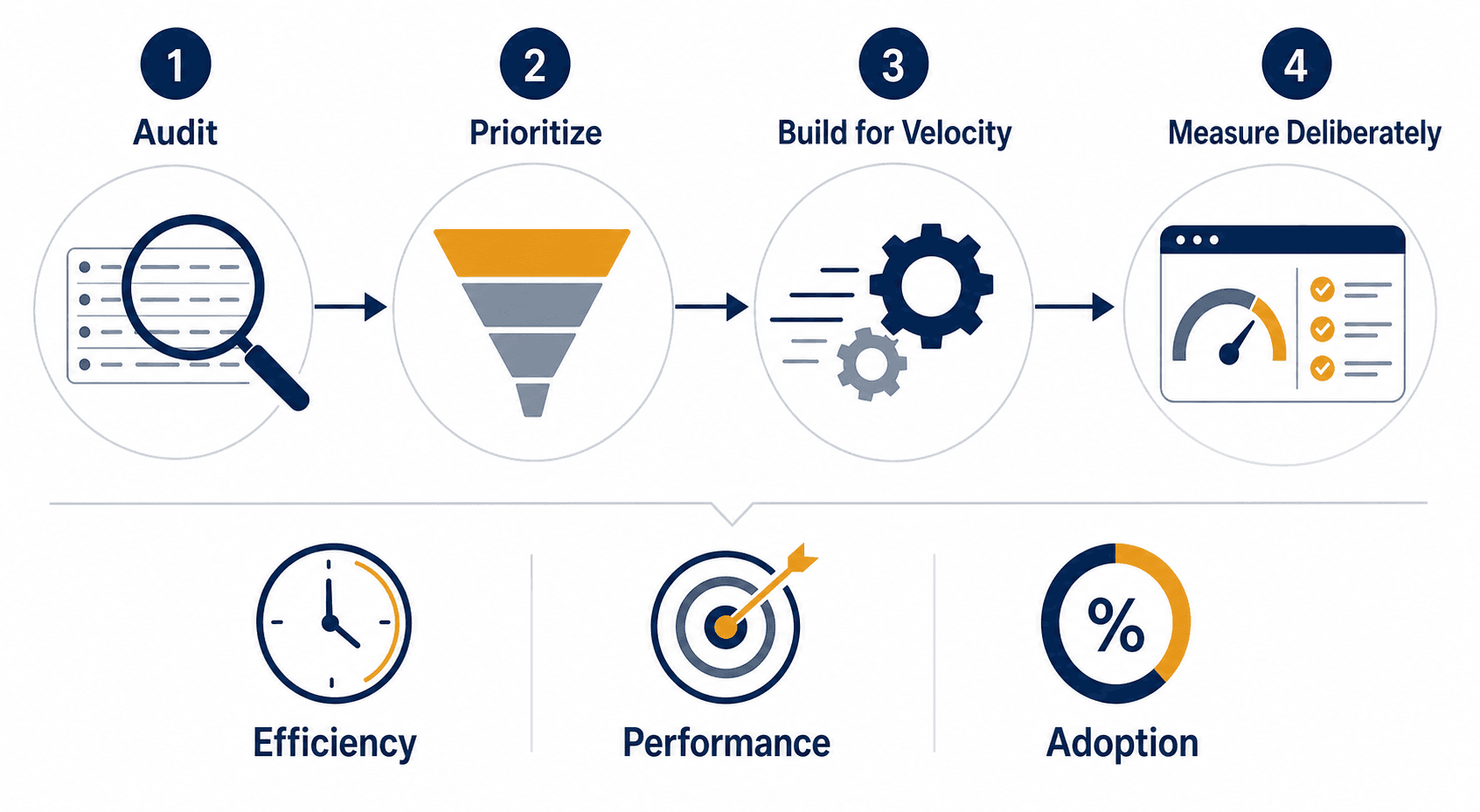
The 4-Step Readiness Framework: Audit, Prioritize, Build for Velocity, Measure Deliberately
Beyond the high-level measurement-first approach, organizations need a concrete operational framework for getting ready. The LatentView enterprise readiness framework provides a structured four-step sequence that maps directly to the root causes we have identified.
| Step | Practitioner Task | Tools / Methods | Success Criteria |
|---|---|---|---|
| 1. Audit your marketing data estate | Catalog all data sources, assess quality scores, identify gaps and duplications | Data profiling tools, CRM audit, source-to-target mapping | Complete inventory with quality scores for each source; documented data lineage |
| 2. Prioritize use cases by impact-to-readiness ratio | Score each potential AI analytics use case on business impact vs. data readiness | Impact-readiness matrix, stakeholder interviews | Ranked list of 3–5 use cases with clear go/no-go criteria |
| 3. Build for decision velocity, not just analytical depth | Design dashboards and alerts that surface actionable insights within the decision cycle | Real-time data pipelines, automated alerting, decision workflow integration | Measurable reduction in time from insight to action (target: <1 business day) |
| 4. Measure, document, and expand deliberately | Track ROI per use case using the baseline-test-unify framework; document learnings | Incrementality testing, unified MTA+MMM, ROI dashboard | Documented ROI for at least one use case before expanding to the next |
A real-world example illustrates the power of the prioritization step. LatentView's case study describes a U.S.-based multinational technology conglomerate with a user base of 255 million. Using their MARKEE analytics solution, the company identified 28 million high-intent users — just 12.4% of the total base — who were driving the majority of growth. By shifting from broad-reach marketing to precision targeting of this segment, the company reversed declining sales trends.
Three Metrics That Actually Measure AI Analytics ROI
Once the measurement infrastructure is in place, what should you actually track? Many organizations fall into the trap of tracking tool-level metrics — API calls, reports generated, models deployed — that have no direct line to business value. The following three metrics are designed to bridge that gap.
- Efficiency: Time saved per analysis cycle. Measure the average time from data request to insight delivery before and after AI deployment. The industry benchmark from DigitalApplied is a 64% average reduction in time-to-insight. Track this monthly and segment by report type. A common pitfall is measuring only the tool's processing time while ignoring the human time spent validating and interpreting outputs.
- Performance: Forecast accuracy improvement. Compare your AI model's forecast error rate against your pre-deployment baseline. The expected range is 28–35% improvement. Track this separately for different forecasting horizons (weekly, monthly, quarterly) because AI performance degrades significantly for longer horizons. Improvado specifically warns that AI forecasting fails for seasonal businesses with less than 18 months of data and for B2B sales cycles exceeding 24 months.
- Adoption: Percentage of decisions informed by AI analytics. This is the most overlooked metric. An AI tool that produces perfect forecasts but is never used in decision-making delivers zero ROI. Survey decision-makers monthly: what percentage of their last 10 decisions were informed by AI analytics output? Target: >60% within six months of deployment. Below 30% indicates a trust or usability problem that no amount of model tuning will fix.
For organizations that implement this measurement discipline, the payoff is substantial. The DigitalApplied data shows that top-quartile AI analytics adopters report 3.2x higher marketing ROI compared to non-adopters. The difference between top-quartile and average performance is not better AI models — it is better measurement frameworks that allow those organizations to know what is working, double down on it, and stop wasting budget on tools that look good in demos but deliver no measurable impact.
The Path Forward: Close the Measurement Gap First
The AI analytics ROI gap is not a technology problem that will be solved by the next software update or the next model release. It is a measurement framework problem that requires deliberate structural changes: unifying attribution methods, investing in data quality before deploying AI, and closing the training deficit that leaves teams with faster tools but no deeper understanding.
The stakes are rising. Improvado projects that AI analytics adoption will reach 78% by 2028, up from 56% today. As more competitors adopt these tools, the competitive advantage shifts from adoption itself to the ability to measure and optimize. The organizations that build measurement infrastructure now — while adoption is still below 60% — will be the ones capturing the 3.2x ROI premium. Those that wait will find themselves in the majority that cannot answer the most basic question: is this working?
The path forward is clear:
- Audit your data quality before you buy another AI tool. The $12.9M data quality tax will eat your ROI before the tool generates any value.
- Unify your attribution approach. If your MTA, MMM, and incrementality tests are telling you different stories, fix that before you train an AI model on the output.
- Invest in training at the same ratio as tools. A 5:1 spend ratio produces faster outputs, not better insights. Rebalance toward people.
- Measure deliberately. Track efficiency, performance, and adoption — not just API calls and dashboard views.
For a deeper look at the broader adoption trends and investment benchmarks shaping this landscape, see our Gartner AI Marketing Technology Forecast 2025. For a comprehensive overview of AI capabilities across the analytics function, the Practitioner's Reference Guide remains the best starting point.


Comments
Join the discussion with an anonymous comment.