
AI Marketing Analytics: A Practitioner's Reference Guide
A structured reference guide covering how AI applies to marketing analytics — what tasks it handles reliably, where it fails, which tool categories exist, and what practitioners need to know before adopting it in their analytics workflow.
Marketing analytics is where AI has delivered some of its most concrete, measurable value — and also where practitioners have run into some of the most frustrating failure modes. Anomaly detection that fires on noise. Attribution models that confidently output numbers that contradict each other. Natural language query interfaces that hallucinate SQL results.
This guide is organized around what AI actually does in marketing analytics as of mid-2026, not what vendors claim it can do. It covers the task categories where AI adds real value, the categories where human judgment is still doing most of the work, the tool landscape by function, and the failure patterns practitioners encounter most often.
What AI Actually Does in Marketing Analytics
The most useful frame for evaluating AI in analytics is task type, not tool name. AI capabilities in this function cluster into five distinct task types, each with different maturity levels and different failure modes.
| Task type | AI maturity | What AI handles | Where humans still lead |
|---|---|---|---|
| Anomaly detection | High | Flagging statistical outliers in time-series data; alerting on traffic drops, conversion rate shifts, spend spikes | Determining whether the anomaly is meaningful or a data artifact |
| Audience segmentation | High | Clustering users by behavioral patterns; RFM modeling; lookalike generation from first-party data | Deciding which segments are worth acting on given business context |
| Forecasting | Medium | Revenue and demand projections from historical data; budget pacing recommendations | Accounting for external factors: seasonality, competitive moves, macro events |
| Attribution modeling | Medium | Data-driven attribution within platform ecosystems; multi-touch path analysis | Cross-platform attribution; distinguishing correlation from causation |
| Natural language reporting | Low–Medium | Generating narrative summaries from structured data; answering ad-hoc metric questions | Verifying output accuracy; catching hallucinated figures |
Maturity here means reliability under real working conditions — not whether the feature exists in a product. A tool can ship anomaly detection that technically works but fires so many false positives that analysts mute it within a week. That is low maturity in practice.
Anomaly Detection: The Most Mature AI Capability
Statistical anomaly detection on time-series marketing data is where AI earns its keep most reliably. The core task — identifying when a metric deviates from expected range given historical patterns and seasonality — is well-suited to machine learning. It scales across thousands of metrics simultaneously, which a human analyst cannot.
Google Analytics 4's Insights feature, Looker's anomaly detection, and dedicated tools like Supermetrics' anomaly alerts all do this reasonably well on single-channel data. Where they struggle is cross-channel correlation: understanding that a drop in organic traffic might explain a rise in branded paid search, for example.
Audience Segmentation: Where AI Adds Genuine Lift
Behavioral clustering has been an ML application in marketing for over a decade, but the tooling has matured significantly. What used to require a data science team and a custom Python pipeline is now available inside CRM platforms, CDPs, and ad platforms natively.
RFM Modeling
Recency-Frequency-Monetary segmentation, when AI-assisted, goes beyond static score buckets. Tools like HubSpot's predictive lead scoring and Klaviyo's predictive analytics layer can dynamically re-score customers as behavior changes, rather than requiring manual recalculation on a schedule. The practical benefit: your "at-risk churner" segment stays current without analyst intervention.
Lookalike Audiences
Meta's Advantage Lookalikes and Google's Similar Audiences (now largely replaced by optimized targeting within Performance Max) are the most widely used AI segmentation tools in paid marketing. They work well when your seed audience is large enough — typically 1,000+ matched users — and when your conversion signal is clean. Feed them a weak seed and the lookalike will be noisy.
Forecasting: Useful but Overconfident
AI-generated forecasts in marketing analytics tools have a consistent problem: they present confidence intervals that look narrower than they should be, especially when the historical data window is short or the business has experienced structural changes (a rebrand, a new product line, a major channel shift).
Google Ads' budget forecasting and Meta's campaign budget optimization both use ML-driven projection models. They are useful for directional planning — "at this budget level, here's the expected impression and conversion range" — but should not be used as precise financial forecasts without sanity-checking against your own historical actuals.
- Use AI forecasts as a starting point, not a deliverable. Layer in your own seasonality adjustments and business context.
- Check whether the model's training window captures relevant historical events — if your data includes a major anomaly period (e.g., a supply chain disruption), forecasts trained on that window will be skewed.
- Run parallel forecasts with different model assumptions when presenting to finance or leadership. Single-point AI forecasts tend to get treated as commitments.
- Forecasting accuracy degrades quickly past 90 days in most marketing contexts. Treat anything beyond a quarter as directional only.
Attribution: The Hardest Problem AI Has Not Solved
Attribution modeling is where AI marketing analytics promises the most and delivers the most inconsistently. The fundamental challenge is not algorithmic — it is data. Attribution requires knowing what happened across every touchpoint in a customer journey, and that data is fragmented, delayed, and increasingly incomplete as privacy restrictions tighten.
Data-Driven Attribution Within Platforms
Google's data-driven attribution (DDA) model, available in GA4 and Google Ads, uses ML to assign fractional credit across touchpoints based on observed conversion patterns. It is more defensible than last-click and avoids the arbitrary assumptions of linear or time-decay rules. Within Google's own ecosystem, it works reasonably well — but it only sees Google touchpoints.
Cross-Channel Attribution Tools
Tools like Northbeam, Triple Whale, and Rockerbox attempt cross-channel attribution by ingesting data from multiple ad platforms, email, and organic channels. They use different modeling approaches — some algorithmic, some Markov chain-based, some blended with media mix modeling. The outputs differ substantially between tools on the same dataset, which is itself informative: if three attribution tools give you three different ROAS numbers for the same campaign, the honest answer is that you have attribution uncertainty, not a definitive answer.
Natural Language Reporting and AI Query Interfaces
This is the newest AI capability in marketing analytics and the one with the highest variance in quality. The premise: ask a question in plain English, get a data-backed answer. In practice, the reliability depends heavily on how well the underlying data schema is structured and documented.
Looker's Explore Assistant, Tableau Pulse, and similar NL query tools work acceptably when querying clean, well-labeled data in a single source. They struggle — and sometimes hallucinate plausible-sounding but wrong figures — when the query requires joining across multiple tables, when metric definitions are ambiguous, or when the question involves a time period with data gaps.
- Always verify NL query outputs against the raw data, especially for any figure going into a report or presentation.
- NL interfaces are most reliable for simple aggregations: totals, averages, top-N lists. They are least reliable for comparative or conditional queries ("which campaigns performed better than last month after excluding brand keywords").
- If the tool cannot show you the underlying query it ran, treat the output as unverified.
Tool Categories in Marketing Analytics AI
The market segments into four functional categories. Most practitioners use tools from two or three of these simultaneously — they do not replace each other.
| Category | Examples | Primary use | Typical buyer |
|---|---|---|---|
| Platform-native AI analytics | GA4 Insights, Google Ads Smart Insights, Meta Advantage Analytics | Campaign performance monitoring within a single platform ecosystem | Performance marketers managing within-platform budgets |
| Multi-channel attribution | Northbeam, Triple Whale, Rockerbox, Hyros | Cross-channel ROAS and path analysis | DTC brands, e-commerce teams running 3+ paid channels |
| BI with AI layer | Looker (Explore Assistant), Tableau Pulse, Power BI Copilot | Ad-hoc querying, automated narrative summaries, anomaly alerts across business data | Analytics teams, marketing ops, data-literate marketers |
| Predictive CRM / CDP analytics | HubSpot Breeze Intelligence, Salesforce Einstein Analytics, Klaviyo Predictive | Lead scoring, churn prediction, LTV forecasting, segmentation | B2B demand gen, e-commerce retention, email marketers |
The category boundaries are blurring. GA4 now includes predictive audiences. Salesforce Einstein has attribution features. Northbeam has added NL query. But the primary use case still largely determines which tool a team should anchor on — and which capabilities are mature versus bolted on.
What to Evaluate Before Adopting AI Analytics
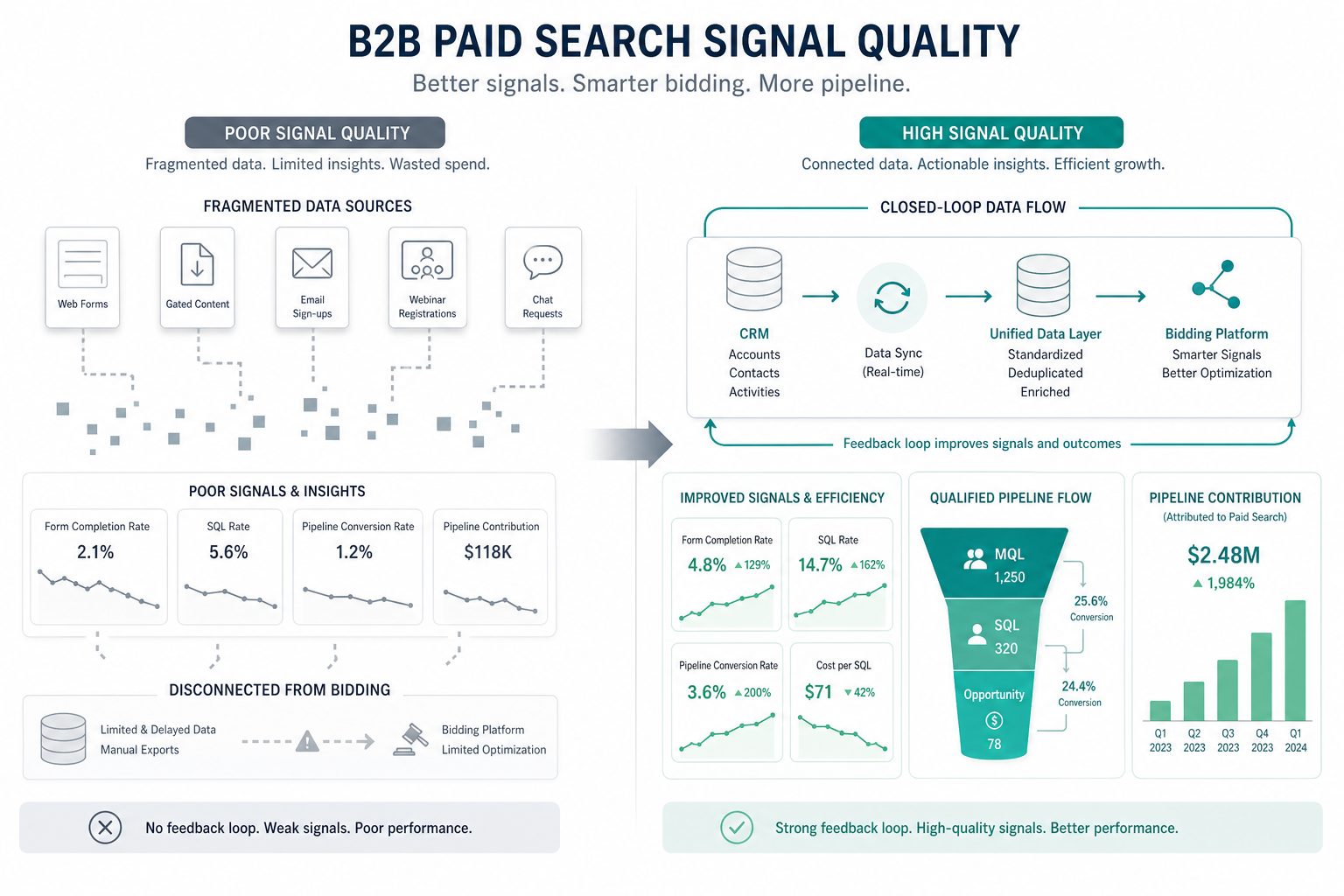
Most AI analytics failures are not failures of the AI — they are failures of the data feeding it. Before evaluating any AI analytics capability, it is worth auditing the underlying data quality first.
Data readiness questions
- Is your conversion tracking consistent and complete? Missing or duplicate conversion events will produce misleading AI outputs regardless of model quality.
- How long is your historical data window? Most ML models need at least 90 days of clean data to produce reliable patterns. Forecasting models need at least a full year to capture seasonality.
- Are your UTM parameters consistently applied? Attribution tools depend on consistent tagging. Gaps in UTM coverage show up as direct traffic and skew attribution toward last-touch.
- Do your metric definitions match across platforms? "Conversion" in Google Ads may not match "conversion" in your CRM. AI tools will not reconcile these for you — they will report whatever the data says.
- What is your data latency? Some AI analytics features require near-real-time data. If your data pipeline has a 24–48 hour lag, real-time anomaly detection will fire on stale signals.
Capability evaluation questions
- Can you see the model's assumptions? A black-box attribution model that outputs numbers without explaining its logic is harder to defend to stakeholders and harder to debug when it produces surprising results.
- What happens when data is missing? Ask the vendor specifically how the model handles gaps, nulls, or delayed data. The answer tells you a lot about model robustness.
- Is there a way to validate outputs against known ground truth? Can you run the model against a holdout period where you already know the outcome?
- Who owns the model updates? AI models drift over time as behavior patterns change. Understand whether the tool retrains automatically, on a schedule, or only when you request it.
Common Failure Patterns
These failure modes come up repeatedly in practitioner accounts and are worth knowing before you commit to a tool or workflow.
The alert fatigue trap
Anomaly detection set to default sensitivity generates too many alerts. Teams initially investigate each one, then start ignoring them, then disable the feature. The fix is not a better tool — it is a deliberate alert configuration process. Define which metrics matter enough to interrupt workflow, and set thresholds accordingly.
Attribution model shopping
When teams have access to multiple attribution models (last-click, data-driven, multi-touch from a third-party tool), there is a tendency to cite whichever model makes the current campaign look best. This is not an AI problem — it is a governance problem that AI tools enable. Establish a single attribution model as the official source of record before deploying multiple tools.
Over-relying on platform-reported ROAS
Every ad platform's AI analytics is optimized to make that platform look good. Google's Smart Insights will highlight campaigns that performed well in Google's ecosystem. Meta's analytics will show strong performance in Meta's view window. Neither is lying — they are reporting what they can see. But platform-reported ROAS almost always overstates true incrementality. Cross-reference with your own first-party revenue data.
NL query hallucinations in reporting
This one is genuinely dangerous. A marketer asks an AI query interface "what was our email revenue last quarter" and gets a confident-sounding number that is wrong because the model misinterpreted the date range or joined the wrong tables. The number goes into a slide deck. Someone makes a budget decision based on it.
The mitigation is simple but requires discipline: any AI-generated figure that will be cited in a decision should be verified against the underlying data source before it leaves your desk.
Where Human Judgment Is Still Doing the Work
There are tasks in marketing analytics where AI assists but does not lead, and where the quality of the output depends almost entirely on the analyst's judgment.
- Interpreting anomalies in business context. AI flags the deviation; a human decides whether it is a tracking bug, a competitor move, a seasonality artifact, or a real performance shift.
- Designing measurement frameworks. Deciding what to measure, how to define success, and which metrics align with business goals is a strategic task that AI tools do not perform.
- Causality assessment. AI attribution models identify correlation patterns. Determining whether a channel is actually driving incremental sales — rather than capturing credit for purchases that would have happened anyway — requires experimental design.
- Communicating findings to non-technical stakeholders. AI can generate narrative summaries, but translating analytics findings into recommendations that influence budget and strategy decisions requires human judgment about what matters and why.
- Auditing model outputs for bias. AI segmentation models trained on historical data can encode historical biases. A human needs to check whether the model's outputs reflect what you want to optimize for, not just what the data showed in the past.
Practical Starting Points by Role
The right entry point for AI analytics depends on what you are already doing and where the biggest time sink is.
| Role | Highest-value AI starting point | Avoid starting with |
|---|---|---|
| Performance marketer (paid search/social) | Platform-native anomaly alerts on budget and ROAS; smart bidding optimization signals | Cross-channel attribution tools (data quality requirements are high) |
| Email / CRM marketer | Predictive segmentation and churn scoring in your CRM or ESP | NL query interfaces (email data schemas are often messy) |
| Analytics / marketing ops | Anomaly detection on core KPI dashboards; automated narrative reporting for weekly summaries | AI attribution before tracking is audited and clean |
| Demand gen / B2B marketer | AI lead scoring in your CRM; intent data integration with segmentation | Platform ROAS as a primary success metric (attribution is especially hard in long B2B cycles) |
| E-commerce / DTC | Multi-channel attribution tool (Triple Whale, Northbeam) after tracking audit; predictive LTV in ESP | AI forecasting with less than 12 months of clean revenue data |
What This Guide Does Not Cover
The tool landscape in this space changes frequently — pricing tiers, model updates, and feature additions happen on timescales of weeks. For specific tool evaluations with last-verified dates, see the AI Tool Directory profiles, which are updated on a rolling basis rather than replaced.
Comments
Join the discussion with an anonymous comment.