
AI Targeted Marketing Pitfalls: The 70% Incident Rate and Why Governance Is the New Competitive Advantage
70% of marketers have already experienced an AI targeting incident — from hallucinations to brand damage. This article explains why simple human review isn't enough at scale and presents a four-pillar governance framework that turns oversight into a competitive edge.
The Adoption Speed vs. Safeguards Gap
AI targeting has moved from experimental to operational faster than most marketing organizations anticipated. By early 2026, five of the six top buyer focus areas identified in the IAB Outlook Study were AI-related, and nearly two-thirds of buyers were actively concentrating on agentic AI for ad buying and campaign execution. The adoption curve is steep, and it is accelerating.
But there is a parallel curve that is not keeping pace: safeguards. The IAB/Aymara 2025 survey of 125 U.S. advertising executives found that over 70% of marketers have already encountered an AI-related incident in advertising. These incidents range from hallucinations — where AI fabricates audience profiles or data — to biased segmentation, off-brand creative, and opaque optimization decisions that no one on the team can explain. Forty percent of respondents had to pause or pull ads as a direct result. More than a third dealt with brand damage or PR fallout.
The response, however, has not matched the scale of the problem. Only about 35% of organizations plan to increase investment in AI governance over the next 12 months. Nearly 90% of marketers told IAB they felt prepared to catch AI issues before launch — a confidence level that stands in direct contradiction to the 70% incident rate. This overconfidence gap is where the real risk lives.
Meanwhile, the broader context is that most companies are still struggling to translate AI adoption into measurable ROI — a related but distinct challenge. The governance gap compounds that problem: even when the technology works, the absence of oversight creates waste, reputational exposure, and missed efficiency gains.
The window for building structured governance is open now. Teams that act early — before a high-profile incident forces their hand — will turn oversight into a competitive advantage. Those that wait will find themselves reacting to damage rather than preventing it.
The Five Most Common AI Targeting Failures
Understanding the specific failure modes is the first step toward building effective governance. The IAB data and practitioner reports point to five recurring categories.
1. Hallucinations and Data Fabrication
AI models, particularly large language models used in ad copy and audience generation, can produce confident-sounding but entirely fabricated outputs. A model might invent a demographic segment that does not exist, cite a nonexistent study to support a claim in ad copy, or generate a targeting rule based on spurious correlations. The IAB survey confirms hallucinations as a top reported incident type. Industry surveys cited by SQ Magazine indicate that 56% of marketers say hallucinations and inaccuracies are the main issues slowing deployment.
2. Biased Segmentation and Exclusion
AI targeting models trained on historical data can inherit and amplify existing biases. A model might systematically exclude certain demographic groups from high-value audiences, or it might reinforce stereotypes in creative targeting. The IAB data shows this is a documented incident category, and broader research — including the 43% of businesses put off by inaccuracies or biases of AI content (WebFX, cited by Adobe) — confirms the scope of the concern.
3. Off-Brand and Tone-Deaf Creative
Generative AI can produce thousands of ad variants in minutes, but it lacks the contextual understanding to judge whether a given headline or image is appropriate for a specific audience or moment. The result is creative that is technically on-brief but culturally or emotionally off-target. Over-automation, as noted by Hello Operator, can erode brand personality and lead to PR disasters if AI misreads context. The IAB data confirms that off-brand content is a leading incident type.
4. Frequency Overexposure and Audience Saturation
AI optimization engines are designed to maximize a target metric — conversions, clicks, or reach — often without built-in frequency capping that accounts for user experience. The result is that the same user may see the same ad dozens of times, driving negative brand sentiment and wasted spend. This is a failure of optimization logic, not of intent, but it is a failure nonetheless.
5. Opaque Black-Box Optimization
When an AI system decides to bid on a particular placement or shift budget to a specific audience segment, the rationale is often invisible to the human operator. This lack of explainability makes it impossible to audit decisions, diagnose performance drops, or identify bias. The IAB data shows that this opacity is a significant concern, and it directly undermines the ability to implement corrective action.
Why "Just Use Human Review" Isn't Enough at Scale
The most common response to AI targeting failures is to add a human review step. A person checks the ad copy before it goes live. A manager approves the audience segments. A compliance officer signs off on the targeting logic.
This approach breaks down at scale for three reasons.
- Volume mismatch. AI can generate thousands of ad variants, bid on millions of impressions per hour, and adjust targeting parameters in real time. No human team can review that volume. The IAB data underscores this: nearly 90% of marketers felt prepared to catch issues before launch, yet 70% still experienced incidents. The confidence is not matched by the capability.
- Speed mismatch. An AI system can make a targeting decision and serve an ad in milliseconds. A human review loop that takes hours — or even minutes — means the ad has already run, and the damage is done. The 40% of marketers who had to pause or pull ads did so after the fact.
- Human reviewers are subject to fatigue, confirmation bias, and inconsistent judgment. A reviewer who has approved 50 ad variants without issue is likely to skim the 51st. The IAB finding that only 6% of marketers believe current safeguards are enough suggests that even practitioners recognize the inadequacy of manual-only approaches.
The solution is not to eliminate human review — it is to augment it with automated guardrails that operate at the same speed and scale as the AI systems they are meant to oversee.
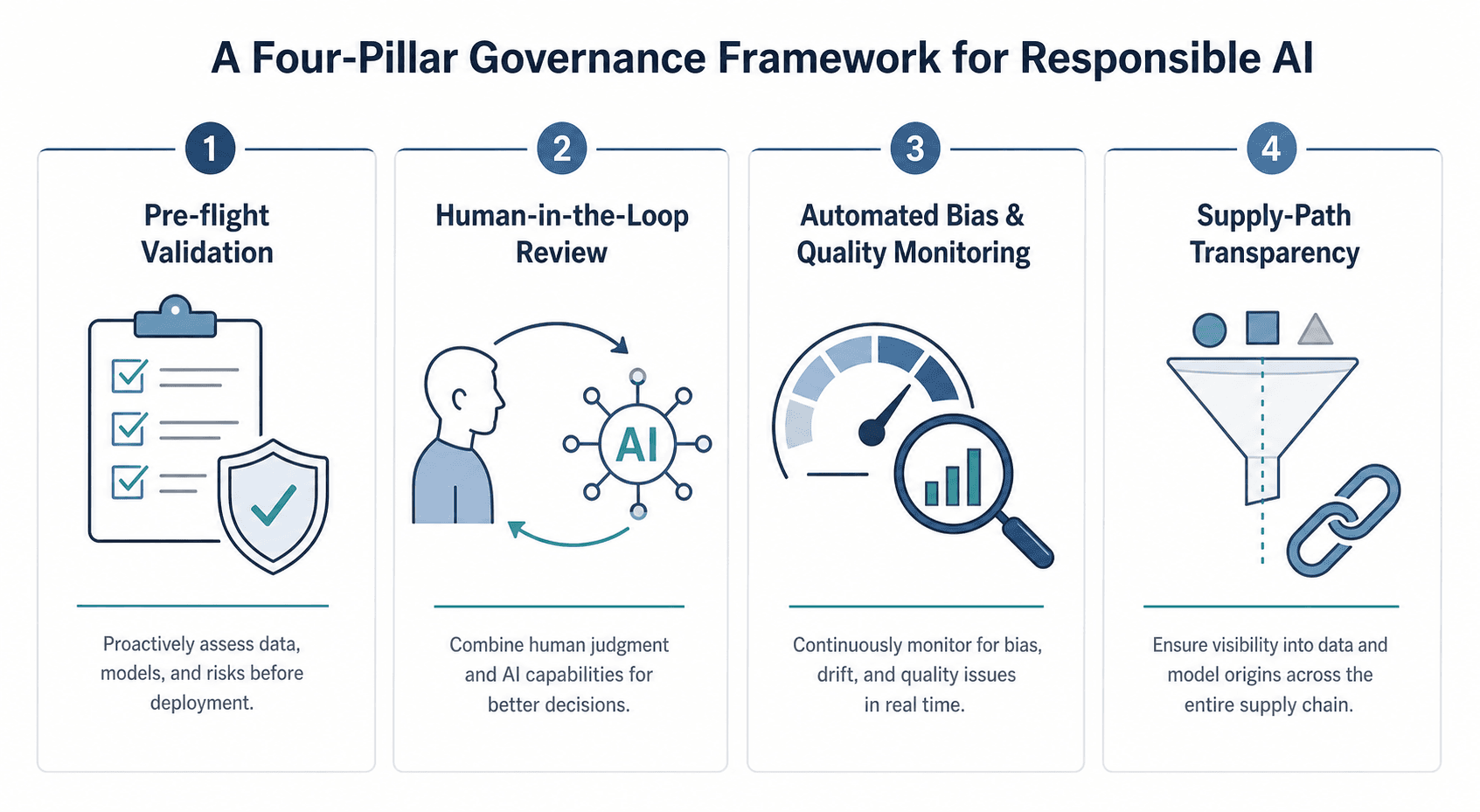
The Four-Pillar Governance Framework
Effective AI targeting governance requires a structured framework that operates before, during, and after campaign execution. The following four-pillar model addresses the five failure modes identified above and creates a closed-loop system for continuous improvement.
| Pillar | What It Does | Failure Modes Addressed | Key Tools / Practices |
|---|---|---|---|
| 1. Pre-flight Validation | Automated checks on ad copy, audience segments, and targeting logic before campaigns go live | Hallucinations, biased segmentation, off-brand creative | Automated brand safety checks, sentiment analysis, demographic parity tests, rule-based targeting validators |
| 2. Human-in-the-Loop Review | Defined escalation points for flagged content or high-risk segments, with clear decision authority | All failure modes — serves as the final arbiter for ambiguous cases | Escalation workflows, risk-tiered review queues, documented decision logs |
| 3. Automated Bias & Quality Monitoring | Ongoing measurement of demographic parity, sentiment, and brand safety across placements during campaign flight | Biased segmentation, off-brand creative, frequency overexposure | Real-time dashboards, automated alerts, frequency capping controls, sentiment trend analysis |
| 4. Supply-Path Transparency | Tools and practices to audit the programmatic supply chain, reduce MFA and low-quality inventory | Opaque black-box optimization, wasted spend from low-quality inventory | Pre-bid verification, post-bid monitoring, supply-path optimization (SPO), MFA detection |
Pillar 1: Pre-flight Validation
Before any AI-generated ad or targeting rule reaches the market, it should pass through automated validation gates. These checks include: brand safety scoring of ad copy, sentiment analysis to catch tone-deaf language, demographic parity tests on audience segments, and rule-based validators that flag targeting logic that violates predefined boundaries. The IAB data shows that campaigns without pre-bid protection face fraud rates up to 15 times higher, according to the IAS 20th Media Quality Report. Pre-flight validation is the first line of defense.
Pillar 2: Human-in-the-Loop Review
Automation cannot catch everything. When a pre-flight validator flags a borderline case — an audience segment that is technically compliant but carries reputational risk, or ad copy that passes sentiment analysis but feels off in a specific cultural context — a human needs to make the final call. The key is to structure this review so it does not become a bottleneck. Define risk tiers: low-risk content passes through automatically, medium-risk content goes to a single reviewer, and high-risk content requires manager approval. Document every decision to build an audit trail.
Pillar 3: Automated Bias and Quality Monitoring
Governance does not stop at launch. During campaign flight, automated monitoring systems should track demographic parity across audience segments, measure sentiment trends in ad engagement, and enforce frequency capping at the user level. Real-time dashboards give teams visibility into whether the AI is drifting into problematic territory. The goal is to detect issues while they are still small enough to correct without a campaign pause.
Pillar 4: Supply-Path Transparency
The programmatic supply chain is where AI targeting meets the real world — and where a significant portion of budget is lost to low-quality inventory, made-for-advertising (MFA) sites, and invalid traffic. The ANA Q1 2025 Programmatic Transparency Benchmark found that only 41% of programmatic budgets reach effective impressions, leaving a 37.8% TrueCPM optimization gap — approximately $21.6 billion in efficiency upside. Pre-bid verification and post-bid monitoring tools are essential for closing this gap. The good news is that MFA spend has already dropped from 15% in 2023 to 0.4%, according to the same ANA report, showing that transparency practices work when implemented.
How Governance Ties Directly to ROI
Governance is often framed as a cost center — a necessary but unglamorous expense. The data tells a different story. Teams with structured oversight face dramatically lower incident rates, which means less wasted spend on pulled campaigns, fewer brand-damage crises, and higher effective budget utilization.
Consider the direct financial impact of the governance gap:
- Brand damage. Over a third of marketers have already experienced brand damage or PR fallout from an AI incident, according to the IAB survey. The cost of a single brand crisis — lost customer trust,公关 fallout, executive distraction — far exceeds the investment in preventive governance.
- Wasted spend. The ANA's 37.8% TrueCPM optimization gap represents approximately $21.6 billion in efficiency upside across the programmatic ecosystem. For an individual advertiser, that gap translates directly into budget that is reaching low-quality inventory or non-viewable impressions instead of real audiences.
- Campaign disruption. Forty percent of marketers have had to pause or pull ads due to AI incidents. Each pause means lost momentum, wasted creative production, and the operational cost of diagnosing and fixing the issue.
- Missed optimization. AI-driven PPC bid management can reduce wasted ad spend by approximately 37% and increase ad ROI by about 50% (Zebracat, cited by Adobe). But these gains are only realized when the AI is operating within a well-governed framework. Without guardrails, optimization algorithms can optimize toward the wrong metrics or exploit loopholes in the bidding system.
The broader AI marketing ROI picture — where 88% of marketers report using AI but only a fraction see measurable returns — is covered in a separate analysis. The governance dimension is a distinct but compounding factor: even when the technology is capable, the absence of oversight erodes the returns.
Actionable Recommendations for Building an AI Governance Practice
Building a governance practice does not require a massive upfront investment. The following steps are ordered by priority and can be implemented incrementally.
- Conduct an AI risk audit of current campaigns. Map every AI-driven decision point in your targeting workflow — audience selection, bid optimization, creative generation, placement decisions. For each point, identify what could go wrong (using the five failure modes as a checklist) and whether you have any controls in place. This audit alone will reveal gaps.
- Implement pre-bid verification and post-bid monitoring. These are the highest-impact, lowest-effort governance tools available. Pre-bid verification blocks ads from appearing on low-quality or brand-unsafe inventory before the bid is placed. Post-bid monitoring provides a second check and generates data for supply-path optimization. The IAS data shows that campaigns without these protections face fraud rates up to 15 times higher.
- Establish a human-in-the-loop escalation protocol. Define what constitutes a low, medium, and high-risk targeting decision. Assign clear ownership for each tier. Document the escalation path and the decision criteria. Test the protocol with a tabletop exercise before you need it in a real incident.
- Invest in bias testing and demographic parity monitoring. Run regular audits of your audience segments and ad delivery data to check for systematic exclusion or overrepresentation of any demographic group. Several third-party tools now offer automated bias testing; the IAB survey found that over 90% of organizations would consider a third-party solution to evaluate AI risks.
- Build a cross-functional governance team. AI targeting governance is not solely a marketing or a legal responsibility. It requires input from paid media, brand, compliance, data science, and executive leadership. Formalize a governance working group that meets monthly to review incident reports, audit findings, and policy updates.
The landscape is moving fast. The IAB Outlook Study shows that among buyers already aware of agentic AI for ad buying, 93% are already using it or likely to use it for performance analysis, 91% for creative testing and optimization, and 82% for budget allocation. As agentic AI becomes the norm, the volume and speed of targeting decisions will increase by orders of magnitude. Governance is not a one-time project — it is an ongoing practice that must evolve with the technology.
For a broader view of AI adoption benchmarks across the marketing industry, see the 2026 AI Marketing Adoption Benchmarks and Statistics reference. The governance data in this article is a specific slice of that larger picture — one that, if ignored, will undermine every other AI investment your team makes.

Comments
Join the discussion with an anonymous comment.