
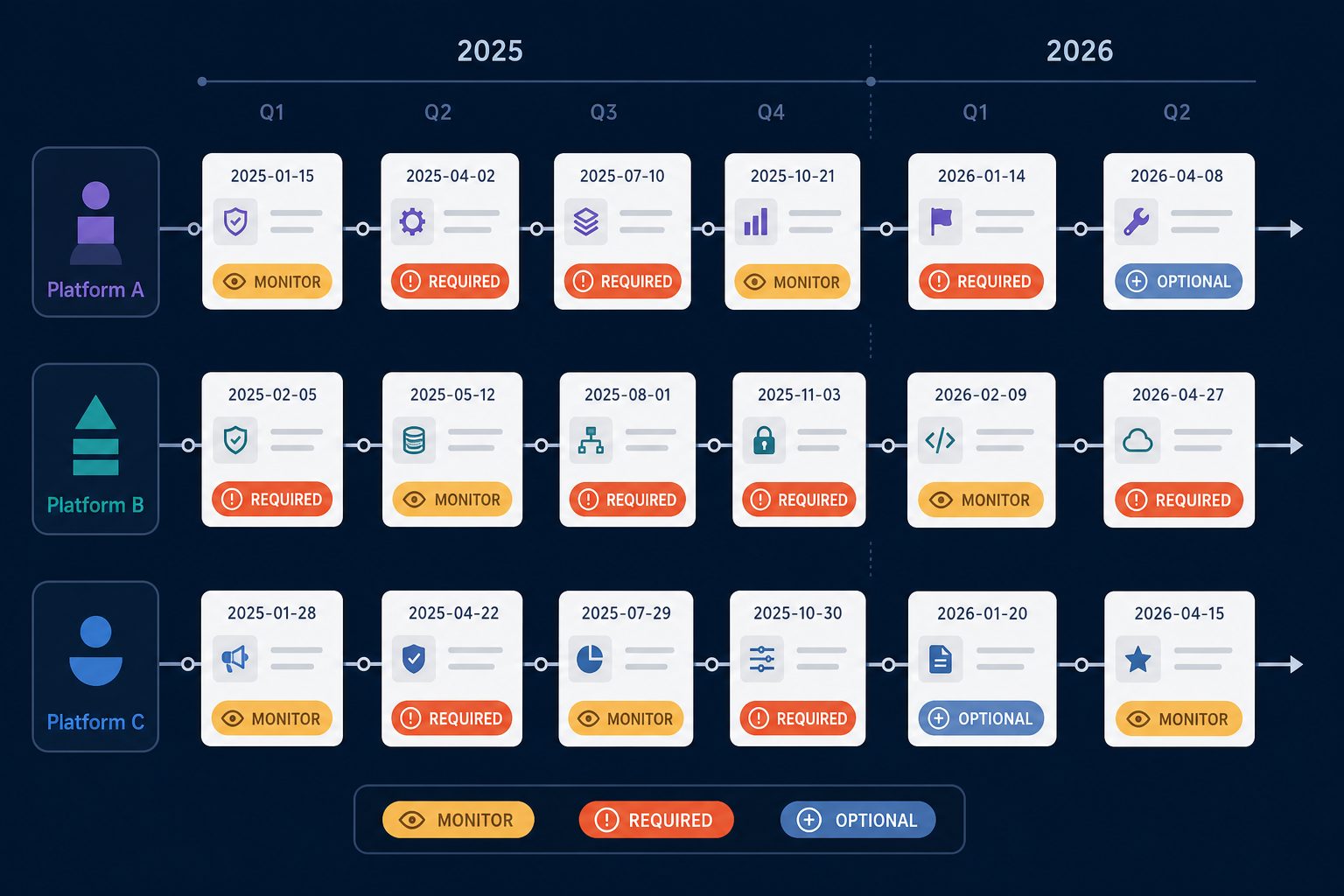
Cross-Platform ML Changelog: Google Ads, Meta, and HubSpot 2025–2026
A dated practitioner changelog documenting confirmed machine-learning-driven behavior changes across Google Ads, Meta, and HubSpot in 2025–2026 — covering what changed, when, the ML mechanism involved, and whether action is required.
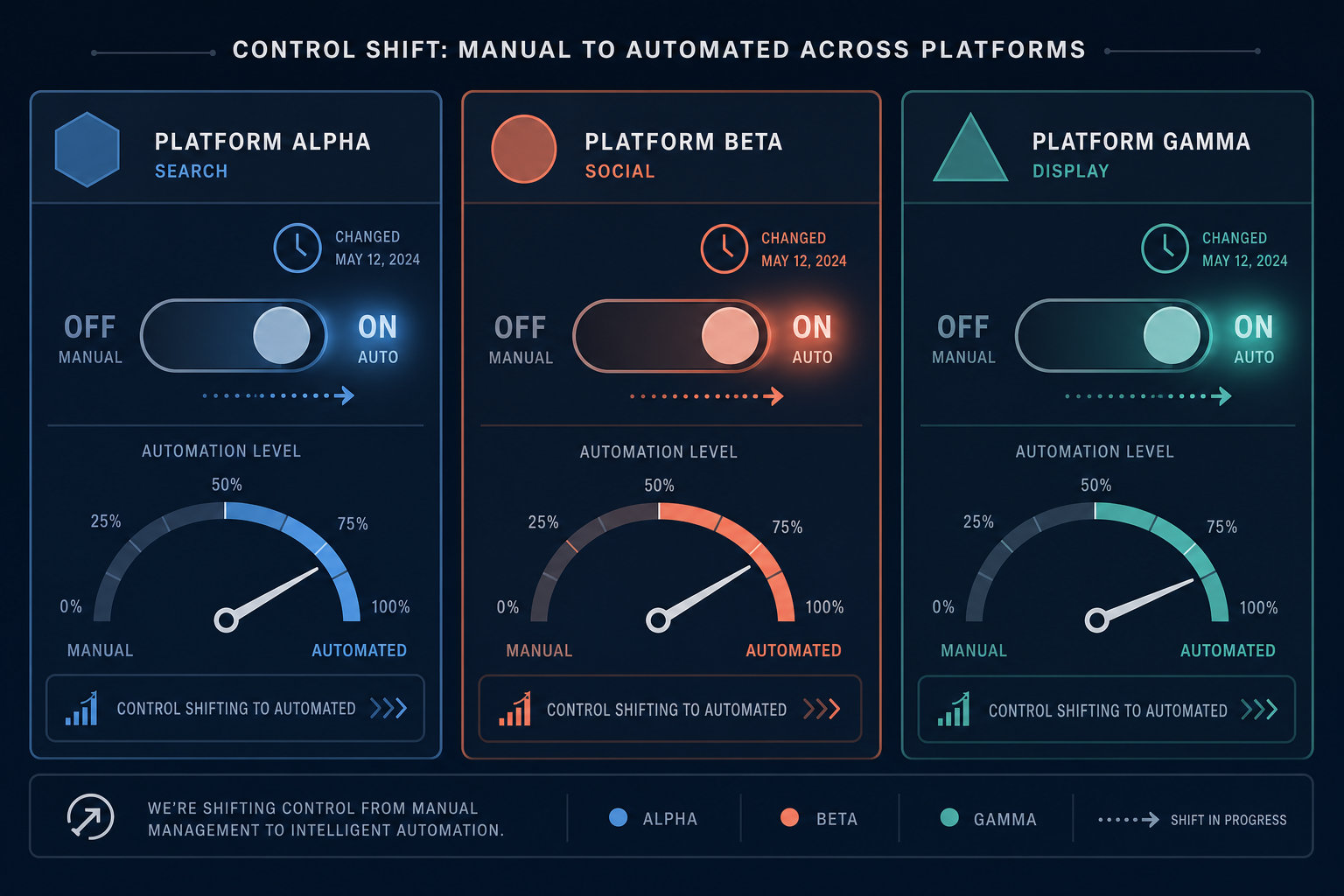
The Cross-Platform Pattern: Opt-Out-by-Default ML
What makes the 2025–2026 period worth documenting as a cross-platform record is not that any single platform changed — it's that all three moved in the same structural direction at roughly the same time. In each case, the ML change shipped as the new default state, with practitioners who took no action accepting the new behavior automatically.
Google Ads auto-upgraded campaigns to AI Max. Meta restructured campaign creation so Advantage+ is the starting path, and rolled out Pixel AI enrichment with a 30-day opt-out window. HubSpot deprecated its legacy scoring system with no automatic migration. In each case, the highest-risk posture for a practitioner was passive non-action.
Practitioners who track only one platform are likely to have caught one of these changes. This record is for those who need the full picture across all three.
Google Ads
Performance Max: First-Party Audience Exclusions and Full Demographic Reporting
| Field | Detail |
|---|---|
| Date | January 9, 2026 |
| Change type | New feature |
| Action status | Optional — new steering controls to configure |
| Source | Google Business, January 9, 2026 |
Building on the 2024 Performance Max updates documented in the Google Ads Performance Max AI Features: 2024 Changelog, January 2026 added two new steering controls that were not available at any point in 2024.
- First-party audience exclusions: Advertisers can now exclude specific customer lists from Performance Max campaigns. The practical use case is budget focus — preventing spend on re-engaging already-converted customers when the goal is new customer acquisition.
- Full demographic audience reporting: Detailed performance breakdowns by age range and gender are now available within Performance Max. Budget reporting is also accessible directly within the campaign interface, and network segmentation was added to placement reporting.
These are opt-in configuration choices, not forced changes. Teams that want to restrict Performance Max from re-targeting existing customers now have the mechanism to do so. Teams that were previously flying blind on demographic performance within PMax now have data to act on.
Dynamic Search Ads → AI Max: Forced Upgrade (Upcoming — September 2026)
| Field | Detail |
|---|---|
| Announcement date | April 15, 2026 |
| Auto-upgrade date | September 2026 (confirmed, not yet occurred as of June 1, 2026) |
| Change type | Forced migration |
| Action status | Required — voluntary upgrade available now; auto-upgrade begins September 2026 |
| Source | Google Blog, April 15, 2026 |
Starting in September 2026, campaigns using Dynamic Search Ads (DSA), automatically created assets (ACA), and campaign-level broad match will automatically upgrade to AI Max. New DSA campaign creation via Google Ads, Google Ads Editor, and the Google Ads API will also end in September 2026.
Google states that AI Max for Search campaigns sees an average of 7% more conversions or conversion value at a similar CPA/ROAS when using the full feature suite compared to search term matching alone (Google Blog, April 15, 2026). After auto-upgrade, all three AI Max features — search term matching, text customization, and final URL expansion — will be enabled. Legacy URL controls are preserved for advertisers migrating from DSA.
For a full feature breakdown of AI Max capabilities — including how search term matching, URL expansion, and creative generation work — see the Google Ads AI Max Campaigns: Feature Breakdown for Paid Search Practitioners. This entry documents the migration timeline and scope, not the feature mechanics.
Voluntary upgrades are open now, and Google has rolled out upgrade tools to help port historical settings. Teams with significant DSA or ACA campaign infrastructure should run voluntary upgrades before September rather than accepting auto-migration, which preserves less configuration flexibility.
Meta Ads
Andromeda Algorithm: Full Rollout
| Field | Detail |
|---|---|
| Date | Fully live by late 2025 (engineering blog: December 2, 2024; third-party confirmation of full rollout: Q4 2025) |
| Change type | Core ML system replacement |
| Action status | Monitor — delivery-side change, not directly configurable |
| Primary source | Meta Engineering, December 2, 2024 |
Andromeda is Meta's replacement for its prior ad retrieval system. The engineering blog published December 2, 2024 describes the core shift: the system selects from tens of millions of ad candidates down to a few thousand using deep neural networks — with the ML system, not the advertiser, controlling which ads are matched to which users.
Reported metrics from Meta Engineering (December 2, 2024): 10,000x increase in model capacity; 100x improvement in feature extraction latency and throughput (GPU-based vs. prior CPU-based); +6% recall improvement to the retrieval system; +8% ad quality improvement on tested segments; end-to-end model inference throughput improved by over 3x.
The structural implication for practitioners: advertiser targeting inputs now function as suggestions rather than constraints. The ad creative has become the primary signal Andromeda uses to determine audience matching. Social Media Examiner (December 18, 2025) notes that during beta testing in Q2 2025, Andromeda delivered a 5% increase in ad conversions on Instagram; by Q3 2025, that efficiency improvement had doubled. Broad targeting — entire country, no age/gender/interest selection — now frequently outperforms manual interest-based targeting under this system.
Advantage+ as Default Campaign Path and Targeting Control Removal
| Field | Detail |
|---|---|
| Date | 2025 (multiple changes throughout the year) |
| Change type | Interface restructure + feature removal |
| Action status | Monitor — configuration review recommended |
| Source | Dataslayer, April 15, 2026 (citing Meta platform changes) |
- Meta restructured the campaign creation interface to make Advantage+ the default starting path for new campaigns.
- Detailed targeting exclusions were removed and enforced in 2025. Advertisers can no longer exclude specific interest segments from Advantage+ campaigns.
- The Existing Customer Budget Cap was removed in February 2025. Previously, advertisers running Advantage+ Shopping campaigns could cap the percentage of budget allocated to existing customers.
- Easy access to manual targeting controls was eliminated from the standard campaign creation flow.
These changes are not individually reversible. Advertisers who relied on detailed targeting exclusions for audience separation (e.g., suppressing existing customers from prospecting campaigns) no longer have that mechanism in Advantage+ campaigns. The Andromeda rollout and the Advantage+ default-path restructure are related: Andromeda's design assumes advertisers feed it creative variety, while the platform controls audience matching.
Engaged-View Attribution Threshold Change
| Field | Detail |
|---|---|
| Date | 2025 |
| Change type | Measurement modification |
| Action status | Monitor — affects conversion reporting baselines |
| Source | Dataslayer, April 15, 2026 |
The engaged-view attribution threshold dropped from 10 seconds to 5 seconds for video ad views. A conversion is now attributed to an ad when a user watches at least 5 seconds of video (down from 10) before converting. This change inflates engaged-view conversion counts relative to prior reporting periods. Teams comparing 2025 conversion data to 2024 baselines on video campaigns should account for this threshold shift when interpreting performance trends.
Pixel AI Enrichment: 30-Day Opt-Out Window
| Field | Detail |
|---|---|
| Announcement date | April 15, 2026 |
| Activation | Default-on after 30-day notification window in Events Manager |
| Change type | New feature — opt-out-by-default |
| Action status | Required — review Events Manager notification within 30-day window |
| Source | Segwise, April 17, 2026 (reporting on Meta's April 15, 2026 announcement) |
Meta's AI-enhanced Pixel automatically attaches product names, availability, and business details to pixel events using ML — removing the need for developers to manually maintain that metadata. The feature activates by default after a 30-day notification window that appears in Events Manager. Advertisers who take no action within that window have the feature enabled automatically.
The opt-out, once applied, is persistent and does not reactivate automatically. Meta reports that advertisers with Conversions API for web events saw an average 17.8% lower cost per result versus those without (Segwise, April 17, 2026, citing Meta). That figure is for CAPI adoption broadly, not specifically for AI enrichment.
One-Click Meta-Enabled CAPI
| Field | Detail |
|---|---|
| Date | April 15, 2026 |
| Change type | New feature |
| Action status | Optional — no-code, no-cost server-side tracking setup |
| Source | Segwise, April 17, 2026 |
Meta introduced a one-click, no-code, no-cost setup path for the Conversions API where Meta handles the server-side infrastructure. For advertisers who have avoided CAPI adoption due to engineering overhead, this removes the primary barrier. The 17.8% lower cost per result figure cited above applies to CAPI-enabled advertisers generally — the one-click setup delivers the same signal improvement as a custom CAPI implementation.
HubSpot
Legacy Scoring Properties: Creation Disabled, Then Stopped Updating
| Date | Event | Action status |
|---|---|---|
| May 1, 2025 | New custom score property field types cannot be created | Monitor — no new scoring builds on legacy system |
| August 31, 2025 | Existing scores stop updating when records meet scoring rules; workflows dependent on score property changes also stop triggering | Required — migrate to new Lead Scoring tool |
| Q4 2025 onward | Scores periodically deleted from portals if not used in an asset | Required — audit and migrate any remaining score dependencies |
Teams that had not built equivalent scores in the new Lead Scoring tool before August 31, 2025 lost real-time lead scores on that date — with no automatic migration path. HubSpot's official community post (February 18, 2025) states explicitly: 'the new scoring tool significantly surpasses the old one, making migration quite challenging.' There is no automated conversion of legacy score rules to the new tool.
If you are reading this after August 31, 2025 and have not yet migrated: check whether any active workflows still reference score property change triggers. Those workflows stopped firing on that date. The new Lead Scoring tool is available to Marketing Professional and Enterprise customers; Service Hub Professional and Enterprise customers can use health scores in the customer success workspace.
Breeze-Powered Calculation Properties
| Field | Detail |
|---|---|
| Date | April 2026 (public beta, opt-in required) |
| Change type | New feature |
| Action status | Optional — requires opt-in from Product Updates screen |
| Source | HubSpot Community, May 6, 2026 (April 2026 Industry Edit) |
Breeze AI can now generate formula syntax for calculated properties from plain-language descriptions. A user can describe the metric they want — for example, 'days from signup to activation' — and Breeze generates the formula syntax for the calculated property. This removes the requirement to know HubSpot's formula syntax manually.
The feature is in public beta as of April 2026 and requires opt-in from the Product Updates screen. It does not affect existing calculated properties. For ops teams who have avoided calculated properties due to syntax complexity, this is worth evaluating — particularly for teams building post-migration scoring logic in the new Lead Scoring tool.
Cross-Platform Summary
| Platform | Change | Effective Date | ML Mechanism | Action Status |
|---|---|---|---|---|
| Google Ads | Performance Max: first-party audience exclusions + full demographic reporting | Jan 9, 2026 | Audience steering controls for PMax delivery | Optional |
| Google Ads | DSA → AI Max forced upgrade | Sept 2026 (upcoming) | Search term matching, URL expansion, creative generation | Required before Sept 2026 |
| Meta | Andromeda algorithm full rollout | Late 2025 (Q4) | ML-controlled ad retrieval replacing advertiser-controlled targeting | Monitor |
| Meta | Advantage+ as default; targeting exclusions removed; Customer Budget Cap removed | 2025 (multiple) | Automated audience creation and budget allocation | Monitor — review campaign configuration |
| Meta | Engaged-view attribution threshold: 10s → 5s | 2025 | Attribution window modification | Monitor — review video conversion baselines |
| Meta | Pixel AI enrichment: opt-out-by-default after 30-day window | Apr 15, 2026 | ML-generated product metadata attached to pixel events | Required — check Events Manager now |
| Meta | One-click Meta-enabled CAPI | Apr 15, 2026 | Server-side event tracking, Meta-managed infrastructure | Optional |
| HubSpot | New score property creation disabled | May 1, 2025 | Legacy scoring system deprecation | Required — build in new Lead Scoring tool |
| HubSpot | Existing scores stopped updating | Aug 31, 2025 | Legacy scoring system deprecation | Required — migrate; audit workflow dependencies |
| HubSpot | Breeze-powered calculation properties (beta) | April 2026 | LLM-generated formula syntax from plain-language input | Optional — opt-in from Product Updates |
Practitioner Audit Checklist
Use this checklist to confirm your accounts are current as of June 2026.
Google Ads
- Have you reviewed Performance Max campaigns for first-party audience exclusion opportunities? (Available since January 9, 2026)
- Have you pulled demographic reporting from Performance Max to identify any age/gender segments performing significantly above or below average?
- Have you identified all campaigns running DSA, ACA, or campaign-level broad match that will auto-upgrade in September 2026?
- Have you decided whether to run voluntary AI Max upgrades now (with more configuration control) or accept auto-migration in September?
Meta
- Have you checked Events Manager for a Pixel AI enrichment notification? If the 30-day window is active, you need to make an explicit decision — not a default.
- If you are in a regulated vertical, have you audited which data categories Pixel AI enrichment is attaching to events before accepting or opting out?
- Have you reviewed any campaign performance comparisons that cross the 2024/2025 boundary on video campaigns? The engaged-view attribution threshold change (10s → 5s) affects those baselines.
- If you have not yet implemented CAPI, have you evaluated the one-click Meta-enabled setup path?
- Have you reviewed prospecting campaigns that previously relied on detailed targeting exclusions for audience separation? Those controls no longer exist in Advantage+ campaigns.
HubSpot
- Have you confirmed that all lead scoring logic has been rebuilt in the new Lead Scoring tool? Legacy scores stopped updating August 31, 2025.
- Have you audited all workflows that previously triggered on score property changes? Those workflows stopped firing on August 31, 2025.
- Have you checked whether any scores are at risk of periodic deletion in Q4 2025 onward (scores not used in an active asset)?
- If you are on Marketing Professional or Enterprise, have you opted into Breeze-powered calculation properties from the Product Updates screen to evaluate the beta?
Comments
Join the discussion with an anonymous comment.