
Starbucks, Progressive, Grammarly, Netflix
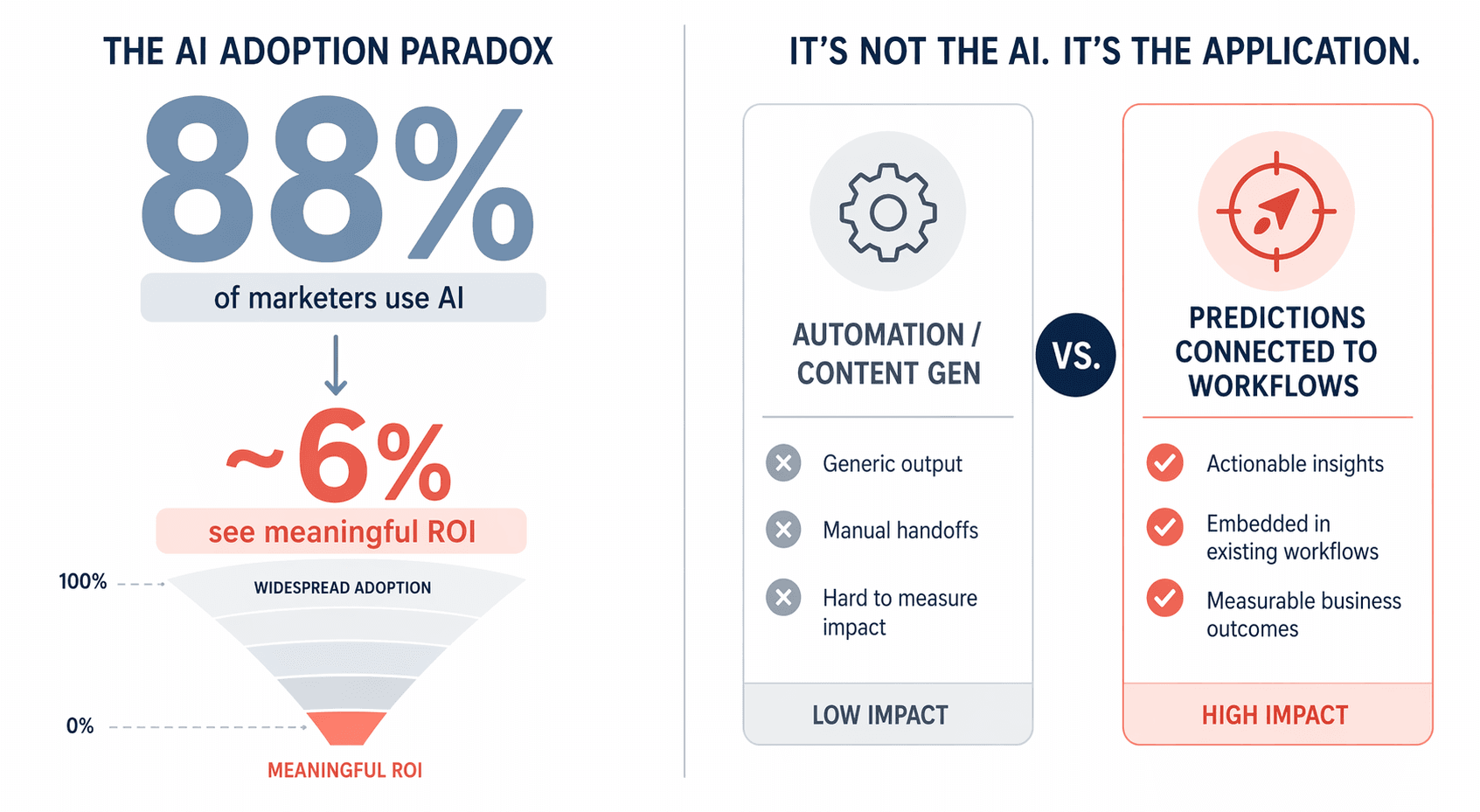
McKinsey's 2025 State of AI report reveals a stark gap: 88% of marketers use AI, but only ~6% see meaningful financial returns. This article analyzes the four workflow patterns that separate the winners from the rest, with evidence from Starbucks, Progressive, Grammarly, and Netflix, and provides a practical audit framework for marketing leaders.
Outcome
McKinsey 2025 State of AI report: only ~6% of organizations see meaningful financial returns from AI, despite 88% adoption; winners focus on predictions connected to redesigned workflows.
This outcome is independently verified via the primary source linked above.
The 88% Adoption Rate vs. the 6% ROI Reality
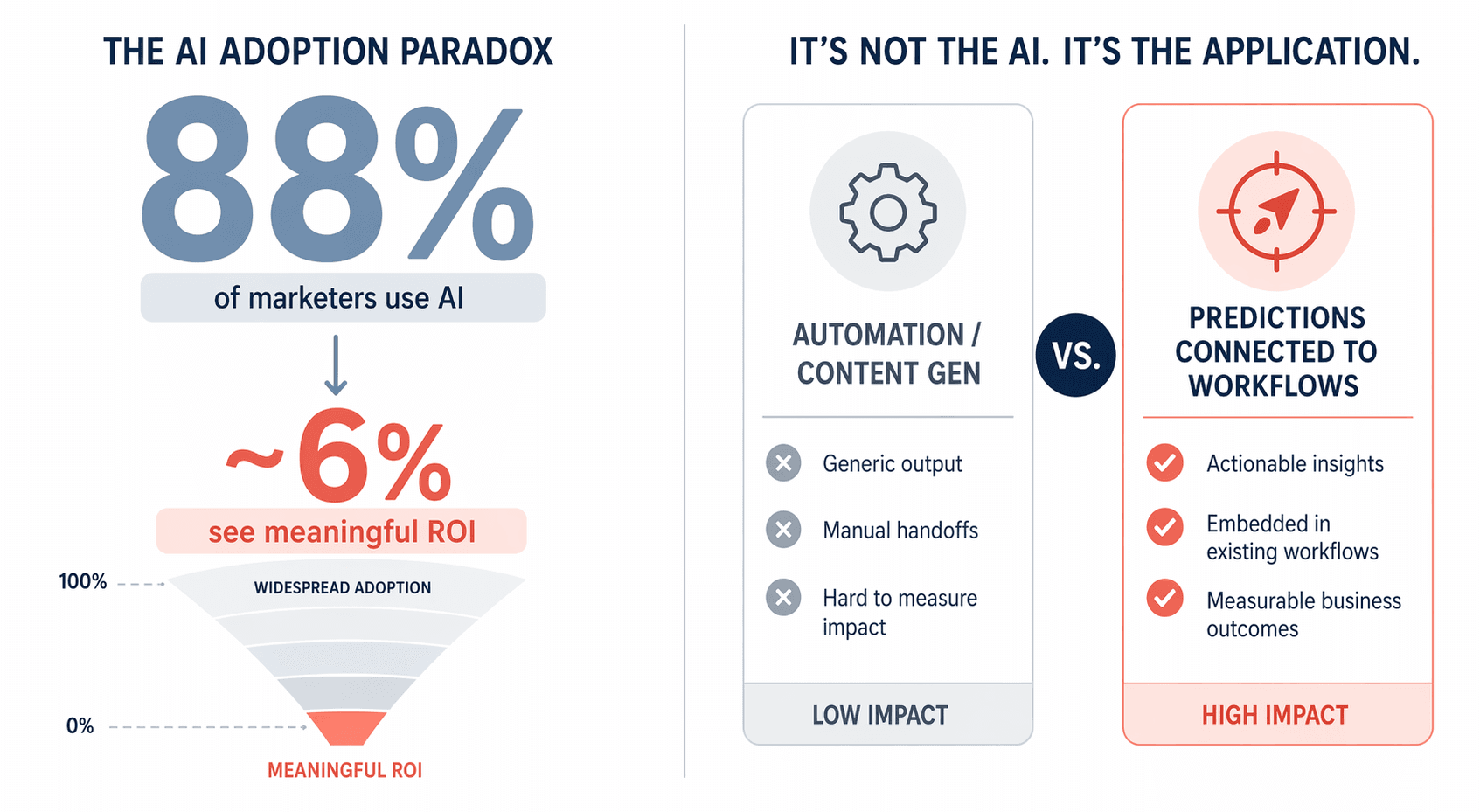
Here is a number that should stop any marketing leader mid-stride: 88% of organizations now regularly use AI in at least one business function, according to McKinsey's 2025 State of AI survey of nearly 2,000 participants across 105 nations. Yet only about 6% of those organizations qualify as "AI high performers" — meaning they attribute EBIT impact of 5% or more to AI and report seeing "significant" value from their investments.
The gap between adoption and return is not just wide — it is widening. The Jasper 2026 State of AI in Marketing report, which surveyed 1,400 marketers, found that only 41% can prove AI ROI this year, down from 49% in 2025. Adoption rose sharply, but the ability to demonstrate financial value actually declined. More teams are using AI; fewer can say it is paying off.
This article is not another list of AI use cases with ROI figures. That angle is well covered elsewhere. Instead, it examines a more specific question: what are the roughly 6% of organizations doing differently? The answer, drawn from McKinsey's data and supported by documented brand examples, is not about which tools they chose. It is about how they chose to use them.
The four patterns that separate the winners are consistent, observable, and replicable. They are also counterintuitive for teams that have been told that AI is primarily a content acceleration or cost-reduction technology.
Pattern 1: Focus on Predictions, Not Automation
The most common use of AI in marketing is content generation. Drafting blog posts, writing ad copy, producing social captions — these are the tasks that 87% of marketers now use generative AI for, per Salesforce's State of Marketing 2026 report. And these tasks do deliver measurable efficiency: the average marketer saves 6.1 hours per week, according to HubSpot's AI Trends 2026 data.
But efficiency gains alone rarely produce the kind of financial returns that move an EBIT needle. The high performers are not ignoring content AI — they are layering a different capability on top of it: predictive analytics.
Consider Progressive. The insurer deployed machine learning-powered propensity modeling to identify which prospects were most likely to convert and which existing customers were at risk of switching carriers. The model achieved roughly 90% lead identification accuracy. The result: $2 billion in new premiums attributed to ML-driven targeting. That is not a content efficiency gain. It is a revenue outcome driven by a forward-looking prediction — "which person should we talk to, and when" — rather than a backward-looking automation of an existing task.
Progressive is not alone in shifting toward prediction. Twilio Segment's 2025 CDP Report found that predictive analytics usage among marketing teams surged 57% year over year. The companies that are seeing outsized returns are not asking "How can AI write faster?" They are asking "What will happen next, and how do we act on it?"
Pattern 2: Connect Predictions to Actions
A prediction with no downstream action is an interesting data point. A prediction connected to an automated action is a revenue engine. This is the second pattern that separates the 6% from the rest: winners do not stop at generating insights — they wire those insights directly into workflows that execute without manual intervention.
Grammarly provides a clear example. The company deployed Salesforce Einstein predictive lead scoring to identify which accounts were most likely to upgrade from free to paid tiers. But the key was not the scoring model itself — it was what happened next. High-scoring accounts were automatically routed to prioritized sales outreach, while mid-scoring accounts received targeted in-app upgrade prompts. The result: an 80% increase in account upgrades and a 50%+ reduction in sales cycle length.
The table below shows how different companies connect predictions to specific automated actions. The pattern is consistent across industries.
| Company | Prediction Type | Connected Action | Reported Outcome |
|---|---|---|---|
| Grammarly | Lead upgrade propensity | Automated sales routing + in-app prompts | 80% increase in upgrades, 50%+ shorter sales cycle |
| Progressive | Conversion and churn propensity | Targeted ad spend and retention offers | $2B in new premiums |
| Starbucks | Next-purchase likelihood | Personalized push offers via Deep Brew | 30% ROI uplift, 14% check size increase |
| Netflix | Content preference and retention risk | Personalized recommendation engine | $1B+ saved annually in retention |
The common thread is not the sophistication of the AI model. It is the existence of a closed loop: prediction triggers action, action generates outcome, outcome feeds back into the model. Teams that stop at a dashboard of predictions — "here are the accounts that might churn" — are leaving the value on the table.
Pattern 3: Start with Business Questions, Not Technology
A common failure mode in AI adoption is technology-first thinking: a team hears about a new tool, acquires a license, and then looks for problems to apply it to. The high performers invert this sequence. They start with a specific, measurable business question and then evaluate whether AI can help answer it.
Starbucks offers a textbook case. The business question was not "What can AI do for us?" It was "How do we increase average check size while maintaining personalization at scale?" That question led to the development of Deep Brew, Starbucks' proprietary AI platform, which analyzes purchase history, local weather, time of day, and inventory data to generate personalized offers pushed through the mobile app.
The results are concrete: a 30% ROI uplift globally from Deep Brew-driven campaigns and a 14% increase in average check size. These numbers did not come from adopting a generic AI writing tool. They came from defining a business problem first and then building or selecting the AI capability that addressed it.
This pattern is becoming more critical as the technology landscape evolves. Gartner reported in January 2026 that 60% of brands will use agentic AI for one-to-one customer interactions by 2028. Agentic AI — systems that can autonomously plan and execute multi-step tasks — amplifies the importance of starting with the right question. A poorly defined question fed into an autonomous agent will produce poorly targeted actions at scale.
Pattern 4: Close the Loop — Redesign Workflows Around AI Outputs
This is the pattern that most sharply separates the 6% from the rest. McKinsey's data is explicit: AI high performers are nearly three times as likely as others to say their organizations have fundamentally redesigned individual workflows around AI outputs, rather than bolting AI onto existing processes.
Netflix is the most dramatic example. The company's AI-driven recommendation system does not sit alongside the content discovery workflow — it is the workflow. Recommendations drive 80% or more of content discovery on the platform. The financial impact is enormous: Netflix saves an estimated $1 billion or more annually through AI-driven retention, because the recommendation engine keeps subscribers engaged and reduces churn. And the system's ability to predict which original content will succeed — with a roughly 93% success rate on original content versus an industry average of about 35% — required a complete redesign of how content is produced, marketed, and surfaced.
Most teams do not need to redesign at Netflix's scale. But the principle applies at any level. A team that adds an AI content brief generator to an existing editorial workflow that still requires three rounds of manual review has not redesigned anything. A team that restructures the editorial process so the AI brief is the starting point, with human editors focused on strategic refinement rather than first-draft creation, has redesigned the workflow.
Use the following checklist to audit whether your team's workflows are redesigned or merely augmented.
- Does the AI output directly enter the production pipeline without manual reformatting or re-entry?
- Have you removed or reduced steps in the workflow because AI handles them?
- Are humans reviewing AI outputs for strategy and quality, not for basic structure and grammar?
- Does the AI system receive feedback from outcomes to improve future outputs?
- Is the workflow faster or cheaper than before, not just different?
Common Failure Modes: Where Most Teams Go Wrong
If the four patterns describe what winners do, the failure modes describe what everyone else does. These are not technology failures — they are strategy and execution failures. And they are remarkably consistent across organizations.
- Treating AI as a content generation tool only. Content AI delivers a 3.2x ROI on average, per McKinsey's Global AI Survey. That is real value. But it is efficiency value, not strategic transformation value. Teams that stop at content generation leave the predictive and workflow-redesign value on the table.
- No measurement framework. Only 41% of marketers can prove AI ROI in 2026, down from 49% in 2025. Adoption outpaced measurement. Among teams that did adapt their measurement approach, 60% report returns of 2-3x or higher, according to Jasper's 2026 data. The teams that cannot measure cannot improve.
- No governance or designated roles. While 65% of marketing teams now have designated AI roles, that leaves 35% without anyone responsible for AI strategy, tool evaluation, or outcome tracking. One-third of marketers have absorbed AI governance into their existing roles with no additional support or authority.
- Failing to redesign workflows. This is the most consequential failure. McKinsey found that high performers are 3x more likely to have redesigned workflows around AI. The rest bolt AI onto existing processes and wonder why the ROI does not materialize.
Practical Audit Framework: Is Your Team Set Up to Be in the 6%?
The following framework is designed for marketing ops leads, CMOs, and senior managers who need to assess their current AI strategy and identify the biggest gaps. Each question maps to one of the four patterns. Score one point for each "yes."
| Audit Question | Pattern | Diagnostic Signal |
|---|---|---|
| Are you using AI for forward-looking predictions (churn, conversion, LTV) or only for content generation and automation? | Pattern 1: Predictions | If only content gen, you are capturing efficiency value but not strategic value |
| Are your AI predictions connected to specific automated actions (routing, offers, prompts) rather than sitting in a dashboard? | Pattern 2: Actions | If predictions require manual export and action, the loop is broken |
| Did your AI initiative start with a specific business question or with a tool purchase? | Pattern 3: Business questions | If you bought a tool first and are now looking for problems, you are in the 94% |
| Have you redesigned any workflows around AI outputs, or did you add AI to existing processes? | Pattern 4: Workflow redesign | If the workflow looks the same as before AI, you have not redesigned it |
| Can you prove AI ROI with your current measurement approach? | Measurement | If you cannot cite a specific financial or operational metric, you cannot improve |
For teams that score 0-2, the priority is not acquiring new tools. It is establishing a measurement framework and identifying one specific business question to pursue. For teams that score 3, the next step is workflow redesign — look for one process where AI output can replace a manual step rather than supplement it.
For deeper guidance on measurement, see our AI Sales & Marketing ROI Reality Check article, which covers measurement frameworks in detail. For the full data context behind the 88% adoption stat and other benchmarks, the 2026 AI Marketing Adoption Benchmarks and Statistics reference provides a multi-source compilation.
The Bottom Line: The Tool Doesn't Determine Success — The Workflow Does
The 6% of organizations seeing meaningful financial returns from AI are not using fundamentally different tools than everyone else. They are using AI differently. They prioritize predictions over automation. They connect those predictions to specific actions. They start with business questions rather than technology. And they redesign workflows around AI outputs rather than bolting AI onto existing processes.
The gap between the 6% and the rest is likely to widen. Predictive analytics usage surged 57% year over year. Gartner forecasts that 60% of brands will use agentic AI for one-to-one interactions by 2028. Teams that have not built the workflow infrastructure to act on AI predictions will find themselves further behind as the technology becomes more autonomous.
The question is not whether your team is using AI. The question is whether your team is using AI in a way that is wired for return.


Comments
Join the discussion with an anonymous comment.