
The AI for Sales and Marketing ROI Reality Check: What the Data Actually Says About Adoption, Performance Gaps, and Where the Real Value Is
This article provides a data-driven ROI reality check for marketing and sales leaders. It contrasts near-universal AI adoption (94%) with the stark reality that only ~25% of companies capture tangible value, and outlines what separates the top-performing quartile from the rest.
The Adoption Headline vs. The Value Gap
The headline numbers are hard to ignore. By mid-2026, roughly 94% of marketers report using AI in at least one workflow, and 88% of businesses have deployed it across at least one function. If you scan the vendor press releases and LinkedIn hot takes, you might conclude that the AI-in-sales-and-marketing question has been settled: everyone is doing it, and it is working.
The data beneath that headline tells a different story. According to Boston Consulting Group, only about one in four companies (25%) has moved beyond pilot projects to generate tangible, measurable value from AI. Deloitte's research puts the struggle even higher: 74% of enterprises report difficulty achieving and scaling value from AI initiatives. The gap between adoption and realized ROI is not a minor implementation hiccup. It is the defining characteristic of the current market.
This article is written for the marketing and sales leaders — CMOs, VP Sales, revenue operations heads — who need defensible benchmarks to justify AI investment to their leadership team or board. The core argument is straightforward: the difference between the 25% that capture real value and the 75% that do not is not about which tools they bought. It is about how they organize people, process, and measurement around those tools.

What the Top Performers Do Differently: The 10-20-70 Rule
BCG's research on AI transformation across industries produced a framework that maps cleanly onto the sales and marketing divide. They call it the 10-20-70 rule. Organizations that successfully capture value from AI allocate their effort and investment in a specific ratio: 10% on algorithms, 20% on technology and data infrastructure, and 70% on people and process change.
The typical organization that falls into the 75% that does not see tangible ROI inverts this ratio. They spend heavily on the latest model access or tool subscriptions (the algorithm layer), buy a data platform (the technology layer), and assume the people and process piece will sort itself out. It does not.
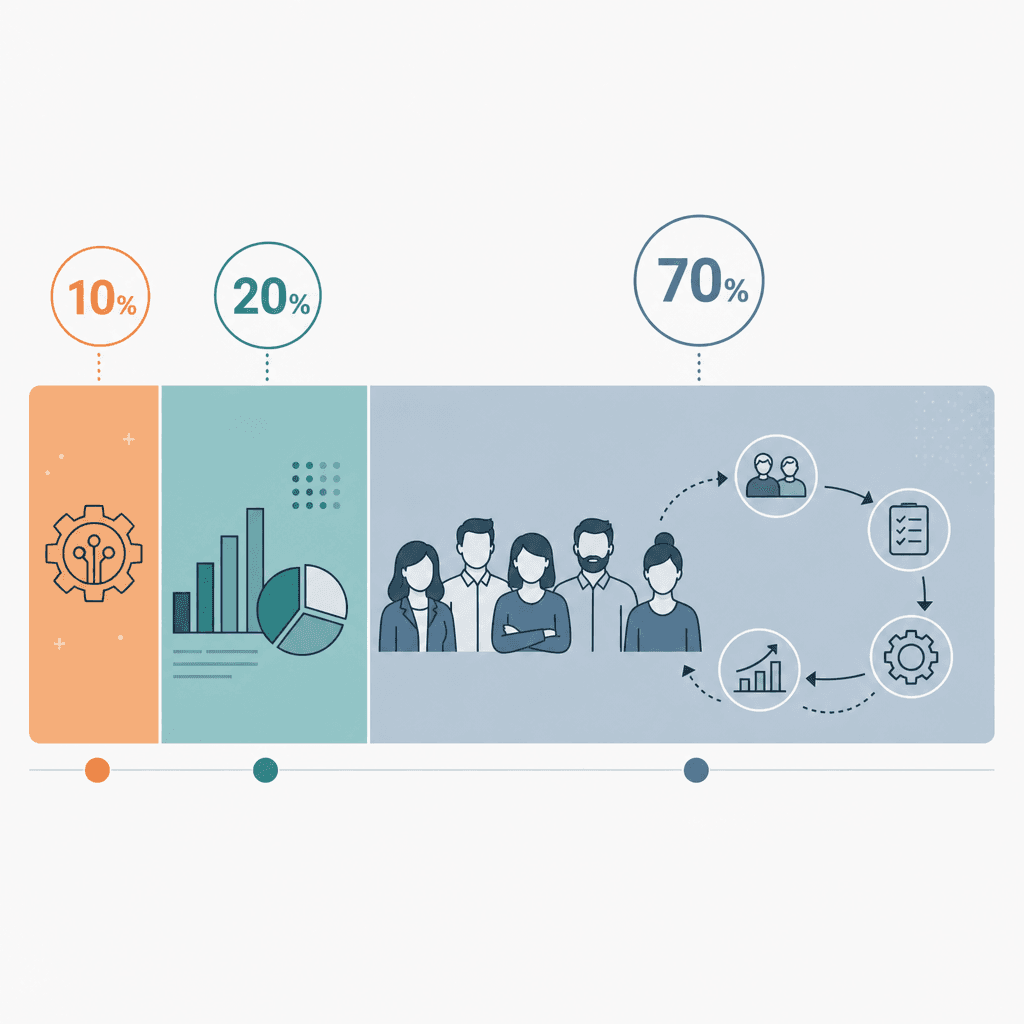
What does the 70% look like in practice for a sales and marketing organization? It includes:
- Defining clear workflows for how AI-generated content, lead scores, or outreach sequences get reviewed before they reach customers or prospects.
- Building feedback loops where sales reps can flag low-quality leads surfaced by AI models, and marketing can adjust scoring criteria accordingly.
- Investing in formal training programs — not one-hour lunch-and-learns, but structured upskilling. Organizations that trained employees in AI reported a 43% higher success rate in deploying AI projects, according to data cited by Information Week.
- Creating cross-functional ownership of AI initiatives so that marketing automation, CRM data quality, and sales process changes are managed as a single program, not three separate projects.
The 10-20-70 rule is not a theoretical model. It is a diagnostic. If your organization's AI budget and attention are not roughly aligned with that ratio, the most likely outcome is not failure — it is the 74% outcome: spending money on AI without being able to point to a clear return.
Hard ROI Breakdowns by Function
When we separate the data by function, the ROI picture becomes more specific — and more useful for building a business case. The table below compiles the most frequently cited, sourced benchmarks for sales and marketing AI investments as of mid-2026.
| Metric | Sales | Marketing | Source |
|---|---|---|---|
| Average ROI uplift from deep AI investment | 10–20% improvement | 300% average (up to 748% for content marketing) | McKinsey (via Sopro, Iterable); SQ Magazine |
| Share of teams reporting positive ROI within first year | 86% | 83–93% of CMOs report clear GenAI ROI | Sopro; SAS (via The Rank Masters) |
| Campaign speed improvement | N/A (pipeline acceleration varies) | 75% faster campaign launches | Sopro |
| Click-through rate improvement | N/A | 47% better CTRs on AI-driven campaigns | Sopro |
| Productivity impact | 2h15m saved per day (sales-specific) | 81% of marketing leaders say AI significantly improved team productivity | SQ Magazine |
| Revenue impact from automation | 61% of top-performing sales teams use automation | AI-powered marketing automation yields ~544% ROI | HubSpot; SQ Magazine |
The sales-side data is particularly instructive. McKinsey's research, cited by multiple secondary sources, found that organizations investing deeply in AI for sales and marketing see sales ROI improve by 10–20% on average. That range is not a home run — it is a solid, defensible return that compounds over time. The 86% of sales teams reporting positive ROI within the first year (from Sopro's survey of over 1,000 sales professionals) suggests that the risk of negative returns is relatively low when deployment is intentional.
The marketing-side numbers are more dramatic on a percentage basis, but they come with a wider variance. The 300% average ROI figure and the 748% content marketing ROI figure (from SQ Magazine) reflect the experience of teams that have optimized their AI workflows over time. A team that simply publishes AI-generated blog posts without review, strategy, or distribution will not see those numbers.
Where the Biggest Gaps Are: Training, Review, and Strategy
If the 10-20-70 rule explains why top performers succeed, the gap data explains why everyone else stalls. Three specific gaps recur across every major survey conducted in 2025 and 2026.
Gap 1: Only 27% of organizations systematically review AI-generated content before use
Sopro's data shows that just 27% of organizations have a systematic review process for AI-generated output. The remaining 73% are publishing, sending, or acting on AI-generated material with inconsistent or no human oversight. In a sales context, that means AI-generated outreach sequences going out without accuracy checks. In marketing, it means AI-written ad copy, blog posts, and email campaigns reaching audiences without editorial review. The result is not just quality risk — it is brand safety risk, compliance exposure, and a direct drag on ROI because poor output undermines the performance of the campaigns themselves.
Gap 2: 70% of employees report their employer does not provide AI training
Both Sopro and SQ Magazine report the same figure: 70% of employees say their employer does not provide formal generative AI training. This is the most direct violation of the 70% people-and-process rule. When teams are handed AI tools without training, they default to one of two behaviors: they either use the tool superficially (generating generic content that adds no value) or they avoid it entirely. Neither behavior produces ROI.
The data on training impact is clear. Information Week, cited by Iterable, found that organizations that trained employees in AI reported a 43% higher success rate in deploying AI projects. Training is not a soft HR initiative — it is a direct lever on project success rates.
Gap 3: 43% of marketers do not know how to extract maximum value from their AI tools
Sopro's survey found that 43% of marketers admit they do not know how to extract maximum value from the AI tools they already have. This is not a tool-selection problem. It is a strategy and enablement problem. These marketers have access to the same models and platforms as the top quartile, but they lack the workflow design, the measurement framework, or the organizational support to turn tool access into business outcomes.
This gap connects directly to the failure to scale pilots. Gartner's data, cited by Iterable, shows that only about 54% of AI projects made it past the pilot phase in 2023. When teams do not know how to extract value, pilots stall, momentum is lost, and the organization concludes that AI does not work — when the real issue is that the conditions for it to work were never put in place.
An Actionable Framework for Measuring AI ROI in Six Months
The single biggest obstacle to capturing AI value is not technical — it is measurement. Most sales and marketing teams cannot answer the question: "What was the incremental revenue or cost saving directly attributable to our AI investment?" Without that answer, the board sees a cost line, not an investment.
The following framework is designed to produce a defensible ROI number within six months. It is built for organizations that are currently in the 75% — running pilots, spending on tools, but unable to point to a clear return.
Month 1: Establish Baselines and Select One Metric per Function
Do not try to measure everything. Choose one primary metric for sales and one for marketing that your organization already tracks reliably.
| Function | Recommended Primary Metric | Why This Metric |
|---|---|---|
| Sales | Lead-to-opportunity conversion rate | Directly measures whether AI-assisted lead scoring or outreach is improving pipeline quality. Most CRMs already track this. |
| Marketing | Cost per qualified lead (CPQL) | Captures both efficiency (cost) and effectiveness (quality). AI should reduce CPQL by improving targeting or content relevance. |
| Both | Time spent on manual tasks per week | Easy to measure via a simple team survey before and after AI deployment. Directly ties to the productivity gains cited in the data. |
Record the current value of your chosen metric. Use at least three months of historical data to establish a reliable baseline. If you do not have three months of clean data, spend Month 1 cleaning it — dirty baselines produce useless ROI calculations.
Month 2: Define the AI Intervention and Set Up Attribution
Choose a single, bounded AI use case per function. For sales, this might be AI-powered lead scoring applied to inbound leads. For marketing, it might be AI-generated email subject line A/B testing. The key constraint: the intervention must be isolatable so you can compare performance before and after.
Set up your attribution approach. For most B2B organizations, a combination of multi-touch attribution (MTA) for digital touchpoints and media mix modeling (MMM) for aggregate channel impact provides the most complete picture. If you do not have the data infrastructure for MTA, a simple pre/post comparison with a control group is more honest than a complex model built on bad data.
Months 3–5: Run the Intervention and Track the Data
Run the AI intervention for a minimum of 90 days. This is long enough to smooth out weekly variance and short enough to maintain organizational focus. Track your primary metric weekly, but do not make decisions based on the first 30 days — early data is noisy as teams adjust to new workflows.
During this period, also track the secondary metrics that support the ROI story:
- Hours saved per week (via team time tracking or survey)
- Volume of output (emails sent, content pieces published, leads processed)
- Error or rework rate (how often AI output required significant human correction)
Month 6: Calculate ROI and Build the Narrative
Calculate ROI using the standard formula: (Net Gain from Investment − Cost of Investment) / Cost of Investment. Net gain includes both hard savings (reduced spend, headcount reallocation) and revenue impact (incremental conversions, faster pipeline velocity).
Present the result alongside the industry benchmarks from this article. If your sales team achieved a 12% improvement in lead-to-opportunity conversion, that sits within the 10–20% range McKinsey identified. If your marketing CPQL dropped 25%, you are outperforming the average. If your numbers fall short, the gap analysis — training, review processes, strategy clarity — tells you exactly where to invest next.
The six-month timeframe is not arbitrary. It aligns with the typical budget cycle for most marketing and sales organizations. A six-month measurement program produces a result you can take into the next planning cycle with confidence — not because the data is perfect, but because it is specific, sourced, and tied to a defined intervention rather than a vague belief that AI is working.
The Real ROI Question Is Organizational, Not Technological
The data from 2025 and 2026 tells a consistent story. AI adoption in sales and marketing is no longer a competitive advantage — it is table stakes. The advantage goes to the organizations that can answer three questions: Are we investing in people and process at the same rate we invest in technology? Do we have a measurement framework that can actually isolate AI's impact? And are we willing to stop the pilots that are not working rather than letting them drain resources?
The 25% of companies capturing tangible AI value did not get there by buying better tools. They got there by treating AI adoption as an organizational change program that happens to involve software. That distinction is the difference between a line item on next year's budget and a measurable contribution to revenue growth.


Comments
Join the discussion with an anonymous comment.