
AI in B2B Demand Generation: What Works, What's Broken, and What's Overhyped in 2026
A critical, data-grounded assessment for senior demand gen marketers. This article cuts through the hype to show which AI use cases are genuinely delivering (chatbots, trends analysis, AI-assisted lead scoring) and which are declining or eroding buyer trust (video generation, synthetic outreach, personalization at scale). Includes channel-specific benchmarks, the real cost of hallucination protection, and actionable Monday steps.
The AI Demand Gen Narrative Has a Quality Problem
The conversation around AI in B2B demand generation has reached a point where the noise-to-signal ratio is dangerously high. Vendor webinars, LinkedIn thought-leadership posts, and tool-comparison articles all converge on the same vague promise: AI will transform your pipeline. But the data tells a more complicated story — one where the flashiest applications are already losing steam while unglamorous operational tools are quietly becoming indispensable.
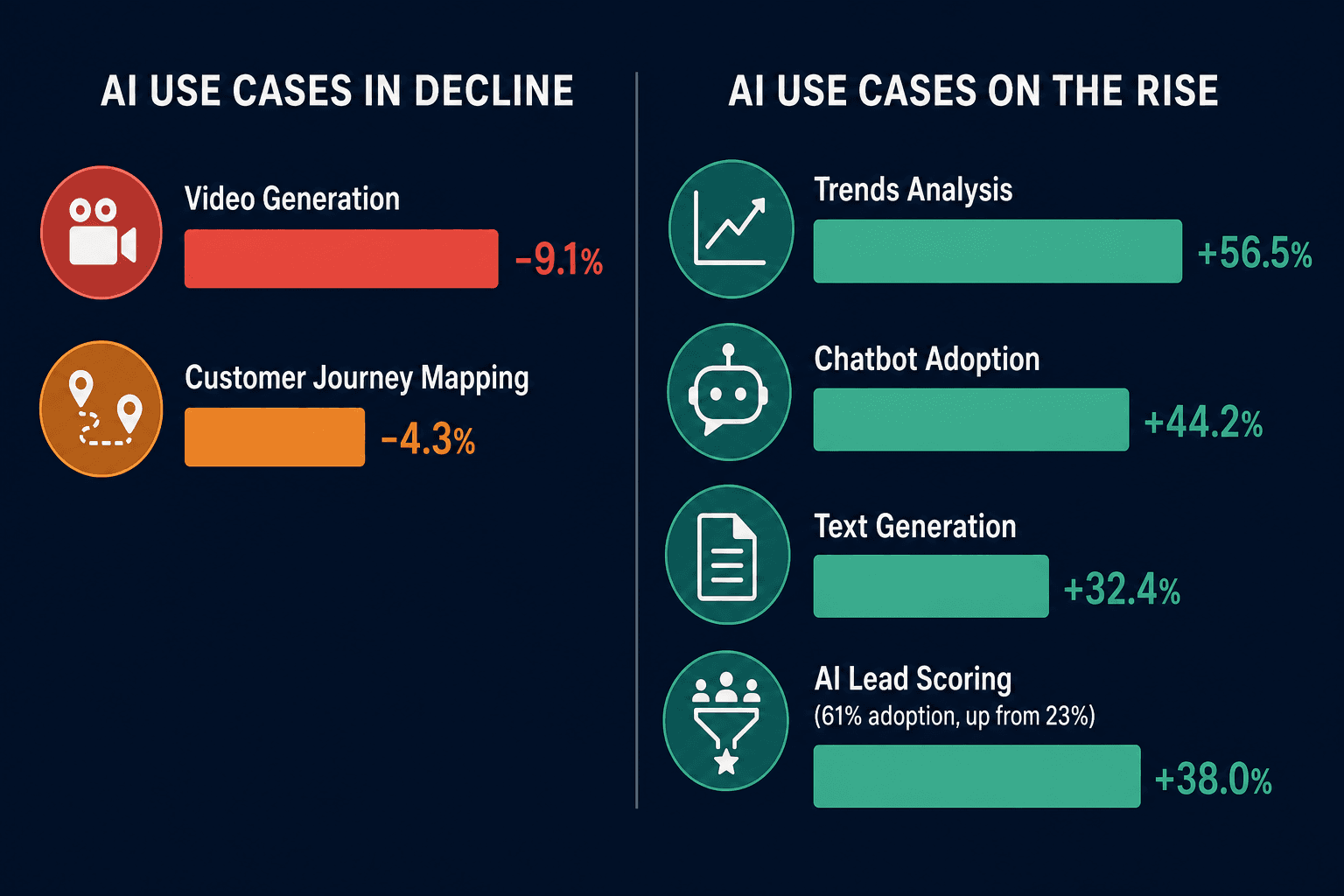
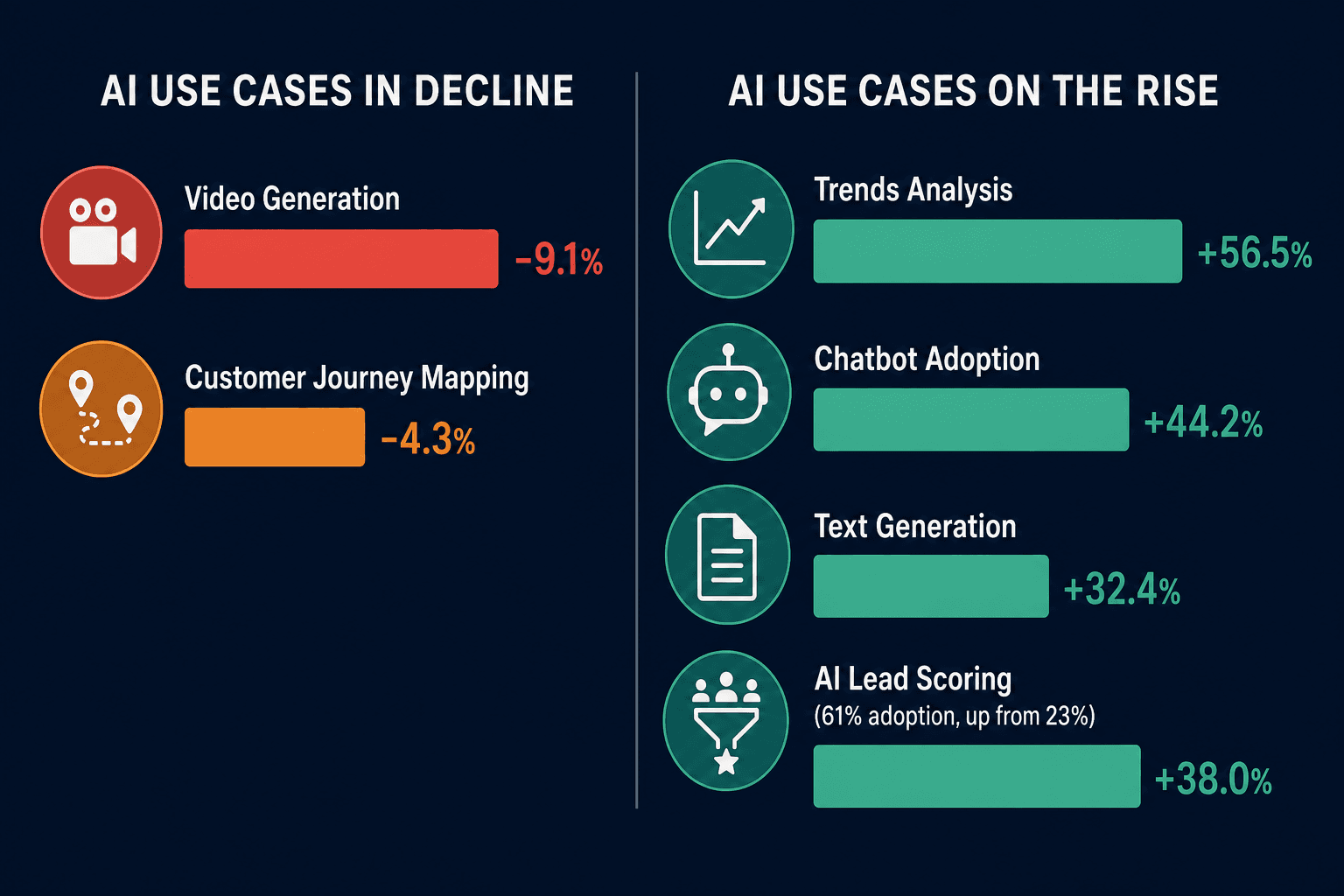
Gartner placed generative AI in the Trough of Disillusionment on its 2025 Hype Cycle, and the B2B demand gen landscape is a case study in why. A SAS/Chiefmartec study of 300 marketers, cited by Prospeo, found that video generation adoption dropped 9.1% year-over-year and customer journey mapping fell 4.3%. Meanwhile, chatbot adoption surged 44.2% to reach 62% of teams, text generation grew 32.4% to 45%, and trends analysis jumped 56.5% to 36%. The pattern is clear: the market is voting for boring, reliable automation over ambitious but brittle use cases.
This article is not a neutral survey. It is a critical, data-grounded assessment for senior demand gen marketers and agency professionals who need to separate genuine capability from vendor narrative. We will walk through each major channel with specific benchmarks, flag the traps that are actively costing pipeline, and offer concrete Monday-morning actions. If you need the broader operational overview of how AI applies to each channel, our existing channel-by-channel guide covers that ground. Here, we focus on what works, what is broken, and what is overhyped.
Channel-by-Channel: Where AI Actually Delivers (and Where It Backfires)
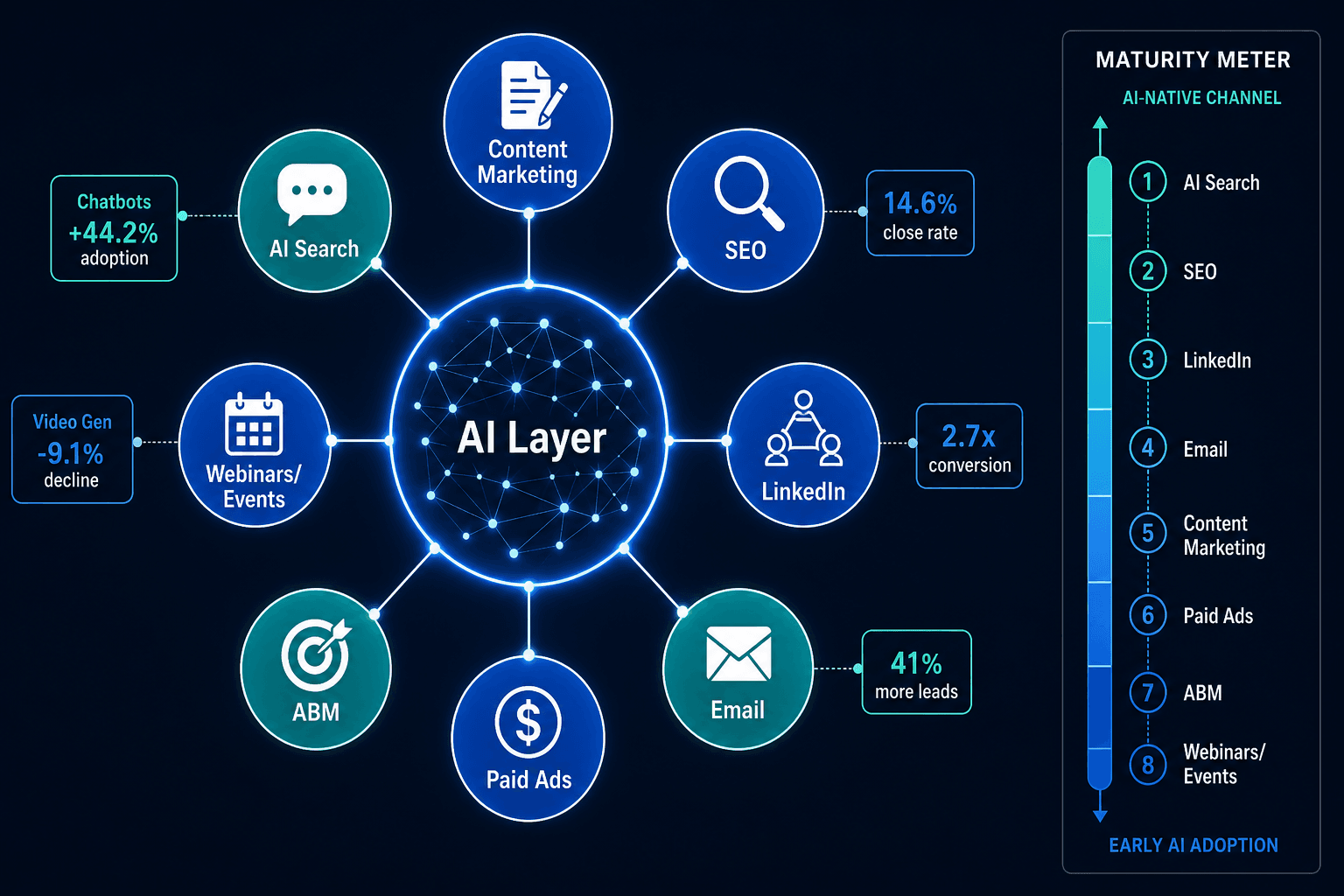
The following analysis covers the seven channels that dominate B2B demand generation budgets. For each, we present the AI use case, the available data on effectiveness, and the known limitations or risks. The table below provides a scannable summary; the sections that follow offer deeper context.
| Channel | Key AI Use Case | Benchmark / Data Point | Risk / Limitation |
|---|---|---|---|
| Content Marketing | AI-assisted creation & optimization | 96% of B2B teams use AI for content creation; quality/voice is #1 challenge for 39% | Volume up 68% YoY, but only 32% report proportional quality improvement |
| AI-powered nurture sequences | Nurture generates 41% more leads at 48% lower cost; 95% of outbound gets zero engagement | AI volume has destroyed cold email channels; synthetic outreach erodes trust | |
| Sponsored content + AI targeting | 2.7x higher conversion vs. organic; drives 80% of B2B social leads | 45% of buyers less likely to consider a vendor if initial outreach feels synthetic | |
| SEO | Content optimization & AI Overviews | 14.6% close rate; generates 76% of trackable B2B traffic | AI Overviews creating zero-click searches; lead volume may decline |
| Paid Ads | AI bidding & creative testing | Blended median CPL is $214, up 11% YoY | CPL inflation outpaces efficiency gains; channel control features still emerging |
| AI Search | Answer engine optimization (AEO) | Ahrefs: 12% of signups from AI search; Vercel: from <1% to 10% | Early channel; measurement standards not yet established |
| ABM | AI intent data + account scoring | Fastest growing share (+3 pts since 2024); 91% use intent data | Only 24% report exceptional ROI from intent data; 'why' remains opaque |
Content Marketing: Volume Is Up, Quality Is Not Keeping Pace
The Demand Gen Report 2026 B2B Trends survey of over 300 marketers found that 96% of B2B teams now use AI for content creation. That number is so high it has become meaningless as a differentiator. The more telling figure is that 68% of B2B marketers report increasing lead volume year-over-year, but only 32% say lead quality has improved proportionally, according to Landbase. The gap between volume and quality is the central tension of AI-assisted content marketing.
Maintaining brand voice and content quality is the number-one challenge for 39% of marketers, per the same Demand Gen Report survey. Content marketing remains the most widely used channel — 83% of B2B teams rely on it — but the ease of generating large volumes of text has not translated into proportionally better outcomes. Teams that treat AI as a volume multiplier without investing in editorial oversight are seeing their content blend into the statistical average.
Email: The Channel AI Broke — and the One AI Can Fix
The email channel presents the starkest example of AI's dual nature. On one side, AI-generated volume has made cold outbound nearly untenable: 95% of all outbound B2B sales and marketing messages receive zero engagement, according to data cited at B2BMX 2026. The channel has been flooded to the point of dysfunction.
On the other side, AI-powered nurture sequences are delivering some of the strongest ROI in demand generation. Landbase reports that email nurturing generates 41% more leads at 48% lower cost compared to traditional approaches. Forrester (2026) found that companies using AI-powered lead nurture see 25% higher conversion rates than traditional drip sequences. Madison Logic's 2026 benchmarks show that companies excelling at lead nurture generate 50% more sales-ready leads at 33% lower cost per lead.
The distinction is critical: AI works for nurturing existing relationships and responding to buyer signals. It fails when used to generate unsolicited volume at scale. For deeper benchmark context on email ROI, see our AI Email Marketing ROI Benchmark Data 2024.
LinkedIn: High Conversion, High Trust Risk
LinkedIn remains the dominant social platform for B2B, driving 80% of B2B social media leads. Landbase reports that sponsored content delivers 2.7x higher conversion than organic posts. The platform's targeting capabilities, enhanced by AI, make it effective for reaching specific buyer personas and account lists.
However, the synthetic outreach problem is acute here. Demand Gen Report's coverage of B2BMX 2026 states that 45% of B2B buyers are less likely to consider a vendor if the initial outreach feels synthetic. On a platform built on professional relationships, AI-generated connection requests and InMails that lack personalization are actively damaging brand perception. The data on trust erosion is worth examining in detail — see our analysis in Consumer Trust in AI-Labeled Marketing Content.
SEO: Highest Close Rate, but AI Overviews Are Reshaping the Game
SEO continues to deliver the highest close rate among demand gen channels at 14.6%, according to Landbase, compared to 1.7% for cold outbound. It also generates 76% of trackable B2B website traffic, per Hey Sid's guide citing industry data. These numbers explain why SEO investment remains strong even as other channels face scrutiny.
But Google's AI Overviews are introducing a structural shift. UnboundB2B notes that AI Overviews create zero-click search experiences, forcing marketers to optimize for context and authority rather than clicks. Lead quality may shift toward higher-intent but lower-volume prospects as AI-mediated pre-qualification becomes the norm. Teams that have not adapted their content strategy to answer engine optimization (AEO) are already seeing traffic declines. For tactical guidance on this shift, see our AEO Tactics for Marketers.
Paid Ads: CPL Inflation Is the Story
Digital Applied's 2026 benchmark dataset of 1,500 B2B teams reports a blended median CPL of $214, up 11% year-over-year. Paid search now accounts for 22% of channel mix, down 3 points since 2024. AI bidding and creative testing tools are helping teams manage efficiency, but they are not reversing the macro trend of rising costs.
The challenge is that AI optimization within paid platforms operates within the platform's own data environment. As more advertisers adopt similar AI bidding strategies, the marginal advantage diminishes. The real leverage is not in the bidding algorithm but in creative differentiation and audience segmentation — areas where AI can assist but cannot replace human judgment.
AI Search: The New Channel with Early Data
AI search engines — including ChatGPT, Perplexity, and Google's AI Overviews — are emerging as a distinct demand gen channel. Prospeo cites that Ahrefs attributes 12% of its signups to AI search referrals, and Vercel reported its AI search traffic share grew from under 1% in September 2024 to 10% by April 2025. These are early-stage data points from vendor blog posts, not third-party audited research, but they signal a channel that demand gen teams cannot ignore.
The implication is that content must now be optimized for both traditional search engines and AI answer engines. Structured data, authoritative sourcing, and direct answers to buyer questions become more important than keyword density or backlink counts.
ABM: Fastest Growing Share, AI Intent Data Integration
Account-based marketing has gained 3 percentage points in channel mix share since 2024, reaching 7%, according to Digital Applied's dataset. The growth is driven by AI-powered intent data platforms that help teams identify accounts showing buying signals before they engage.
The intent data market reached $4.49 billion in 2026, with 91% of B2B marketers using it. However, only 24% report exceptional ROI, per Prospeo's analysis of the SAS/Chiefmartec study. The gap between adoption and satisfaction suggests that intent data is a necessary but insufficient condition for ABM success. Perspective AI's guide notes that intent platforms like 6sense, Demandbase, and ZoomInfo can infer which accounts are researching but cannot capture why — a limitation that requires layering first-party conversational research on top of intent signals.
The AI Traps That Are Costing You Pipeline
Beyond the channel-level dynamics, there are structural traps in how AI is being deployed across demand generation. These are not edge cases — they are documented patterns that are eroding pipeline performance for teams that do not recognize them.
Trap 1: The Personalization-at-Scale Myth
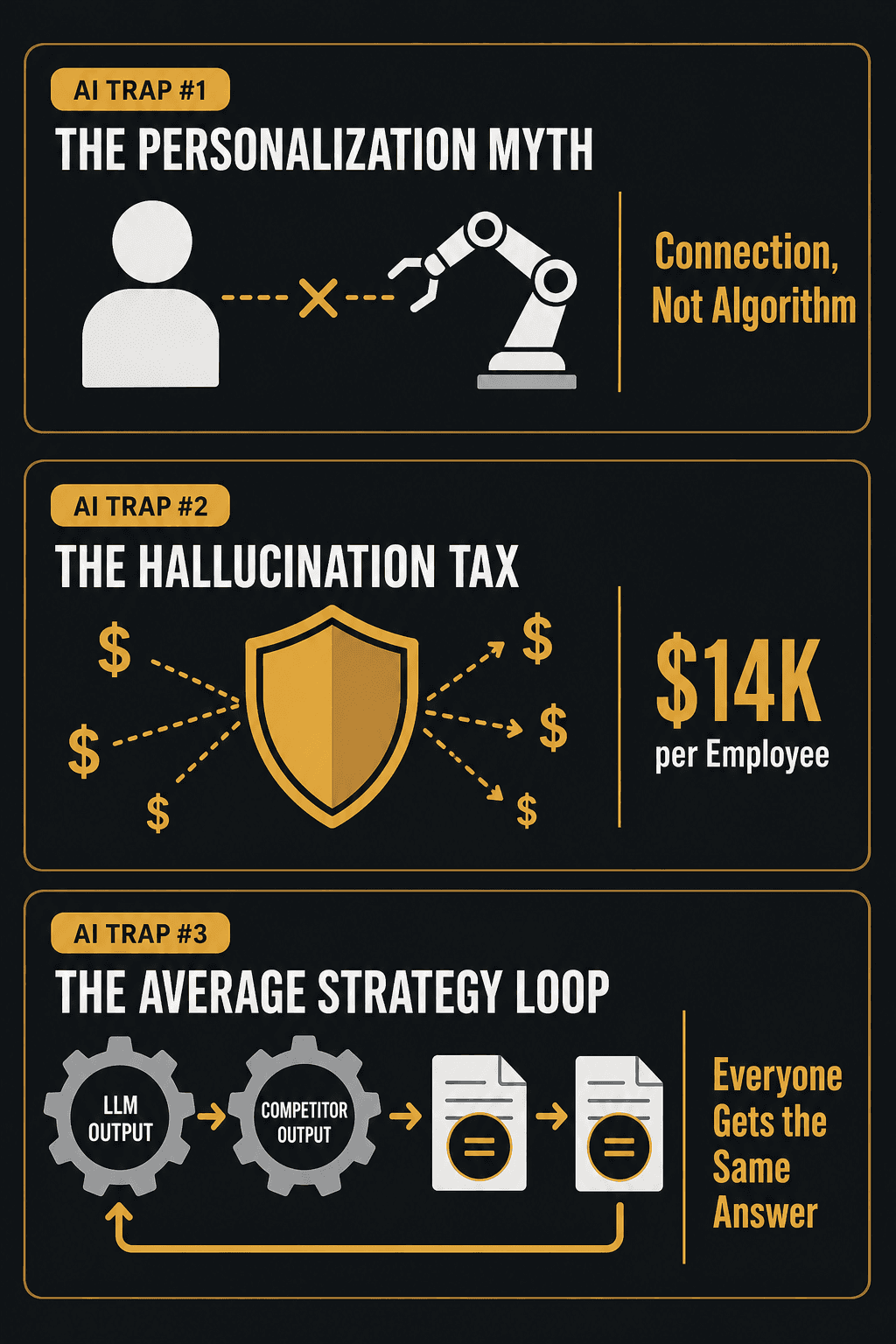
The most persistent vendor narrative in B2B demand gen is that AI enables personalization at scale. The evidence suggests otherwise. Chris Rack's B2BMX 2026 session, covered by Demand Gen Report, made the case bluntly: personalization at scale is a myth because it requires connection, not an algorithm. AI can insert a prospect's name, company, and industry into a template, but it cannot replicate the contextual understanding that makes a message feel genuinely personal.
The data backs this up. HubSpot's 2025 marketing statistics show that dynamic email personalization can deliver up to a 44% lift in generated leads — but that is personalization within an existing relationship, not cold outreach. The 45% of buyers who say they are less likely to consider a vendor after synthetic outreach are responding to the gap between algorithmic personalization and genuine connection.
Trap 2: The Hallucination Tax
Enterprise AI adoption comes with a hidden cost that rarely appears in vendor ROI calculators. Demand Gen Report's B2BMX 2026 coverage states that companies spend approximately $14,000 per employee on hallucination protection — the systems, processes, and human review layers required to catch and correct AI-generated errors before they reach customers.
For a demand gen team of ten, that is $140,000 annually in overhead that does not generate a single lead. This cost is not optional: in a channel where 95% of outbound messages already receive zero engagement, sending hallucinated content would accelerate trust erosion. The hallucination tax is the price of maintaining quality in an AI-assisted workflow, and it must be factored into any realistic ROI calculation.
Trap 3: The Average Strategy Loop
Large language models are trained on public data. When you ask an LLM to generate a demand generation strategy, it produces a statistical average of everything it has ingested — which means your competitors, using the same tools, receive the same advice. Demand Gen Report's B2BMX 2026 coverage warns that LLMs aggregate public data so everyone gets the same strategy advice, and differentiation requires doing the opposite of the AI-generated average.
This is not a theoretical concern. If every B2B SaaS company in your category uses AI to generate their content calendar, their LinkedIn outreach sequences, and their email nurture flows, the market experiences a homogenization of messaging. Buyers encounter the same frameworks, the same value propositions, and the same CTAs from every vendor. The result is not better demand generation — it is a noisier, less differentiated market where no single message stands out.
Trap 4: Synthetic Outreach Destroying Buyer Trust
The cumulative effect of the first three traps is a measurable decline in buyer trust. The 45% figure from B2BMX 2026 is not an isolated data point — it is a signal that the market is developing antibodies against AI-generated outreach. Buyers have become adept at identifying synthetic messaging, and their response is to disengage.
This is particularly dangerous for demand gen teams because it creates a negative feedback loop. As more teams use AI to scale outreach, buyers become more skeptical. As skepticism rises, response rates drop. As response rates drop, teams increase volume to compensate, which further entrenches buyer distrust. Breaking this loop requires a deliberate decision to prioritize quality and relevance over volume — a choice that runs counter to the operational logic of most AI tools.
What the Top-Quartile Teams Are Doing Differently
The performance gap between top-quartile and median B2B demand gen teams is widening, and AI is a primary driver. Digital Applied's 2026 benchmark dataset of 1,500 B2B teams reports that top-quartile MQL-to-SQL conversion stands at 28%, compared to a median of 13%. The gap has expanded from 15 percentage points in 2024 to 22 points in Q1 2026.
| Metric | Median Team | Top-Quartile Team | Change Since 2024 |
|---|---|---|---|
| MQL → SQL conversion rate | 13% | 28% | Gap widened from 15 to 22 points |
| AI lead scoring adoption | 61% | ~85% (estimated) | Up from 23% overall in 2024 |
| MQL rejection rate at scoring layer | ~10% | ~30% | Top teams reject more aggressively before SDR touch |
| Blended median CPL | $214 | Below median (estimated) | Up 11% YoY overall |
The widening gap is attributed to two factors: AI-assisted lead scoring and tighter SDR/AE handoff SLAs. Digital Applied notes that top-quartile teams reject roughly 30% of MQLs at the scoring layer before any SDR touch. They are using AI not to generate more leads, but to filter more aggressively — a counterintuitive approach that prioritizes quality over volume.
The adoption of AI for lead scoring has accelerated dramatically: 61% of B2B teams now use it, up from 23% in 2024, according to both Digital Applied and Perspective AI's guides. This means AI is no longer a differentiator for lead scoring — it is table stakes. The teams that win are those that combine AI scoring with human judgment and operational discipline, not those that deploy AI in isolation.
What to Do Monday: Three Actions That Actually Move the Needle
The analysis above can feel overwhelming. The following three actions are designed to be implemented this week, without a budget increase or a new tool purchase.
- Audit your CRM bounce rate. Prospeo's guide states that if your CRM bounce rate is above 10%, no AI tool will save you. Dirty data amplifies when fed into AI systems — bad contact information produces bad scoring, bad targeting, and bad personalization. Spend the first week of any AI initiative cleaning your CRM. Remove duplicates, update stale contacts, and standardize field formats. This is unglamorous work, but it is the single highest-ROI action you can take.
- Pick one AI use case and commit to it for 90 days. The temptation is to deploy AI across all channels simultaneously. Resist it. Choose the channel where you have the cleanest data and the clearest measurement framework — likely email nurture or lead scoring — and focus your AI investment there. Measure pipeline velocity and conversion rates, not just volume. After 90 days, evaluate whether the use case is delivering against the benchmarks in this article before expanding.
- Let data quality be the foundation. Before layering on AI tools, invest in the infrastructure that makes them effective. This means structured first-party data, clear ICP definitions, and a documented lead scoring model. Prospeo recommends starting with a functional stack under $500 per month — tools like Prospeo (~$0.01/email), Clay ($134–$149/month), and Apollo (free tier) — before committing to enterprise platforms like 6sense that cost $60,000–$300,000 per year. The expensive tools will not compensate for poor data foundations.
For deeper context on measuring AI's impact on pipeline, see our guide on AI Marketing Attribution Models in 2026. Moving beyond vanity metrics to pipeline velocity and revenue influence is essential for justifying AI investment to leadership.
The Bottom Line: AI Is the Cost of Entry, Not the Differentiator
The data in this article points to a single conclusion: AI in B2B demand generation has passed the point where it can function as a competitive advantage. When 96% of teams use AI for content creation, 61% use it for lead scoring, and 91% use intent data, the tools themselves are no longer differentiating. What differentiates is how teams deploy them.
The teams that win in 2026 and beyond will be those that use AI for operational efficiency — chatbots, lead scoring, trends analysis, nurture automation — while actively avoiding the traps of synthetic outreach, generic strategy, and volume-for-volume's-sake. They will invest in data quality before tooling. They will reject the AI-generated average in favor of differentiated positioning. And they will measure success not by lead volume but by pipeline velocity and revenue influence.
AI is not the answer to demand generation. It is the infrastructure on which better answers are built. The judgment, the data discipline, and the willingness to do the opposite of what the algorithm recommends — those are still human responsibilities.


Comments
Join the discussion with an anonymous comment.