
AI Marketing Trust Gap Analysis
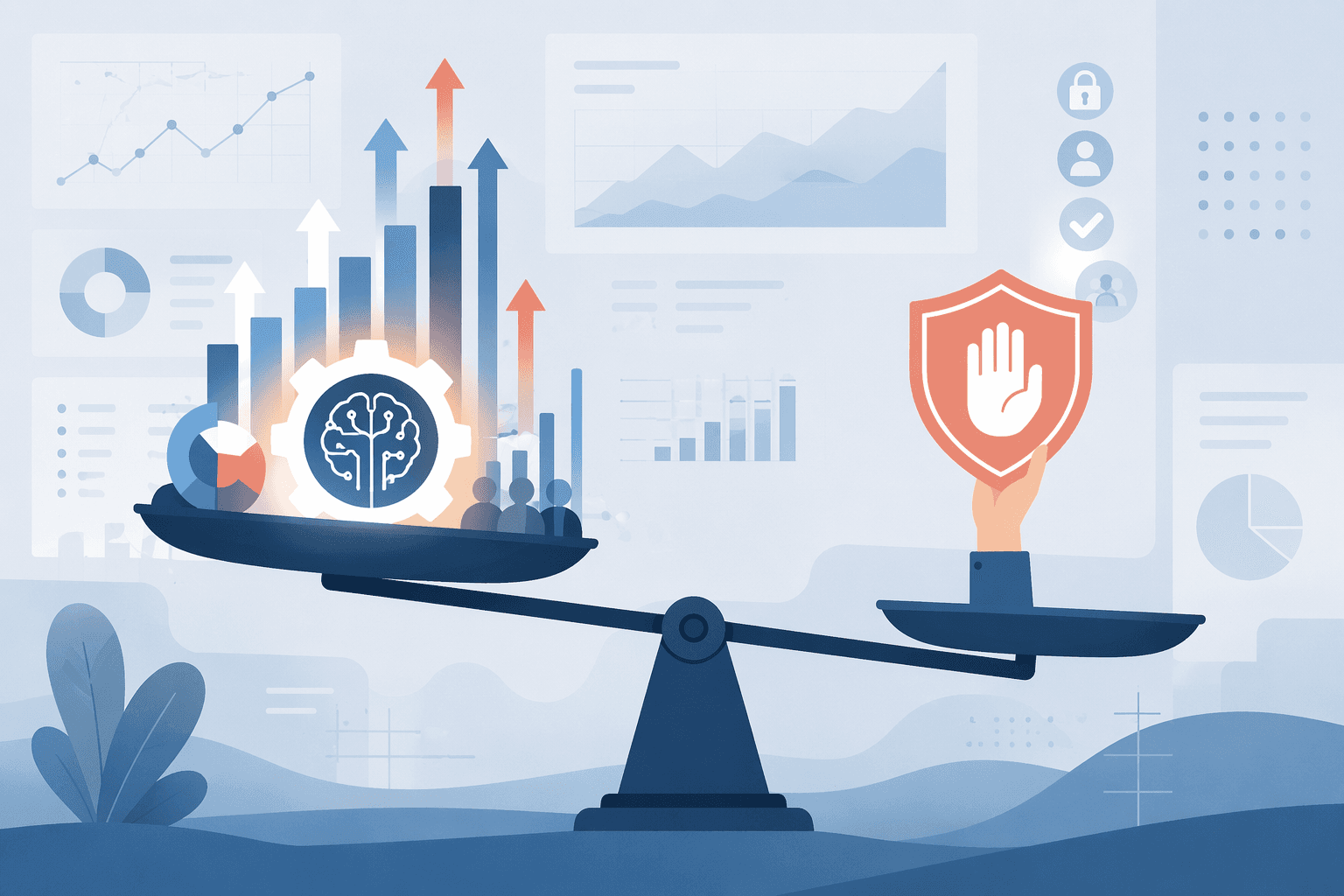
This data-driven article for senior marketers and brand strategists explores the paradox of soaring AI adoption (88% of marketers use AI daily) against collapsing consumer trust (42% trust AI-driven brand experiences, down from 58%). It provides a practical framework for using AI transparently with clear human oversight to rebuild credibility.
Marketing Categories
The Paradox: AI Adoption Soars While Consumer Trust Collapses
The numbers tell two conflicting stories. On one side, AI has become the default operating mode for marketing teams. McKinsey reports that 88% of organizations now use AI regularly in at least one business function. HubSpot's 2026 State of Marketing report finds that 80% of marketers use AI for content creation and 75% use it for media production. The efficiency gains are real: ActiveCampaign data shows AI saves marketers an average of 13 hours per week, and ZoomInfo puts the productivity lift at 44%.
On the other side, the audience these marketers are trying to reach is pulling away. Salesforce's State of the Connected Customer survey reveals that consumer trust in businesses using AI ethically has dropped to 42%, down from 58% in 2023. That is not a small fluctuation — it is a 16-point decline in two years. The same survey found that 71% of customers want human validation of AI outputs before they trust brand communications, and 71% say they trust companies less than they did a year ago.
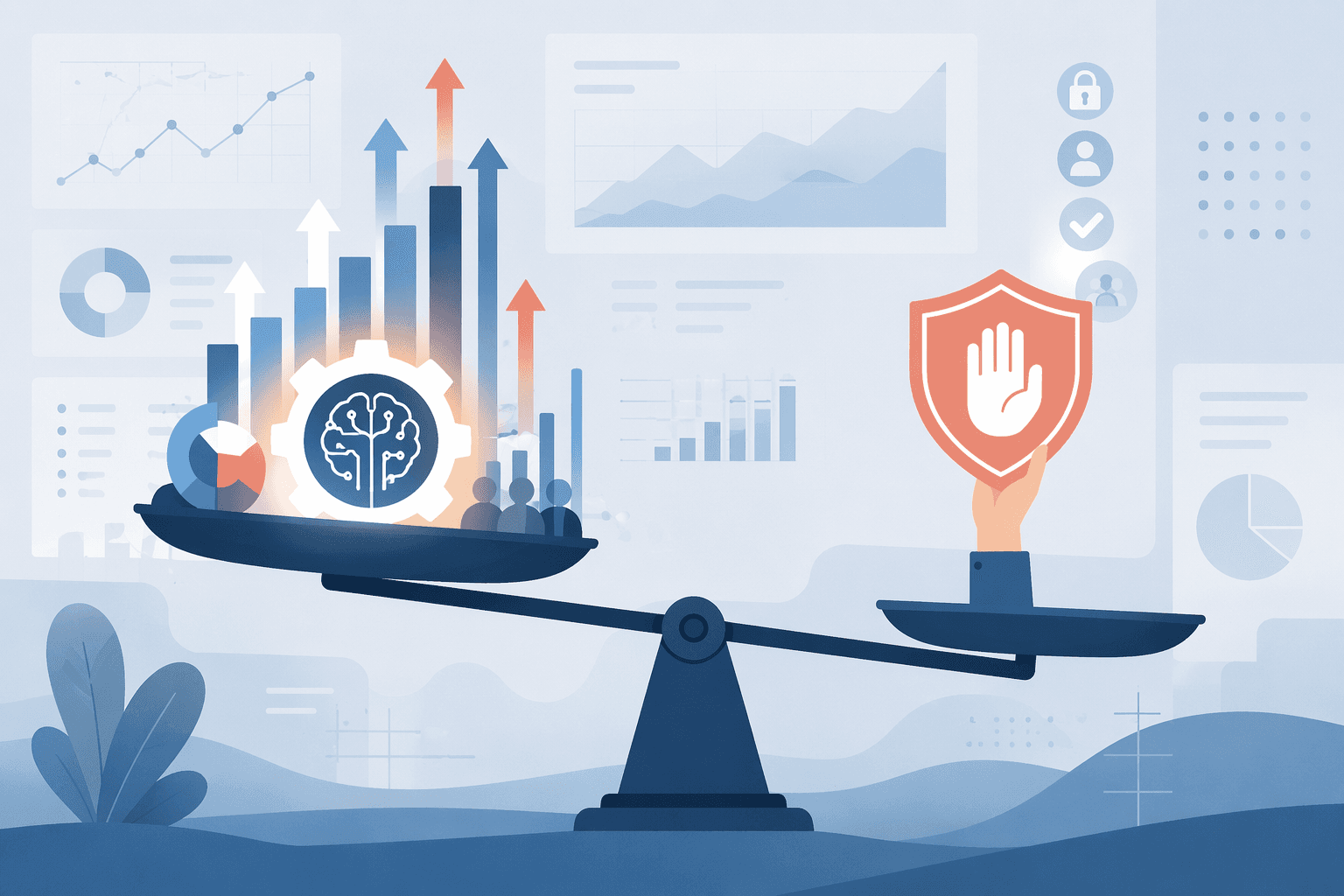
This is the central tension of AI marketing in 2026: the tools are embedded, the workflows are dependent, but the audience is skeptical. For senior marketers and brand strategists, the question is no longer "should we use AI?" — that decision has been made. The real question is how to use it without accelerating the trust decline.
Why Trust Is Dropping: Content Flood, Personalization Failures, and Hallucinated Claims
The trust decline is not a vague sentiment shift. It is driven by three measurable problems that marketers have created — or at least exacerbated — with AI.
The AI Content Flood
The volume of AI-generated content has reached a level where it is actively degrading the information environment. According to Adobe and Ahrefs data, 74% of new webpages now include some form of AI-generated content. Even more striking, 91% of pages cited in AI Overviews contain some level of AI-generated content. On social media, Forbes reports that 71% of images shared are now AI-generated or AI-edited.
When every brand publishes more, faster, the signal-to-noise ratio collapses. Readers cannot distinguish which content is trustworthy, and they increasingly assume the worst. HubSpot's SVP of Marketing, Kieran Flanagan, put it directly in the 2026 State of Marketing report: "Today, more content is generated by AI than by humans. But it's mostly average. Consumers seek human-created content, and will tune out brand and AI-generated content."
Personalization Failures from Dirty Data
AI-powered personalization only works when the underlying data is clean and unified. Salesforce's data shows that only 31% of marketers are fully satisfied with their data unification ability. The other 69% are operating with fragmented, inconsistent customer data. When AI personalization engines run on dirty data, the results are jarring: recommending products the customer already bought, addressing them by the wrong name, or serving irrelevant offers. Each error is a small trust erosion event, and they accumulate.
The consequences are severe. Salesforce also reports that 74% of shoppers will abandon a brand after three or fewer bad experiences. In a world where personalization errors compound daily, three bad interactions arrive quickly.
Hallucinated Claims and Accuracy Concerns
AI hallucinations are not just a technical footnote — they are a brand liability. WebFX reports that 43% of businesses are put off by the inaccuracies or biases of AI content. When a brand publishes AI-generated copy that contains a fabricated statistic, a misattributed quote, or a factual error, the damage is not limited to that piece of content. It calls into question everything the brand publishes.
These three forces — content volume, personalization errors, and accuracy failures — create a compounding trust deficit. Each one individually is manageable. Together, they explain why 64% of customers express concern that companies are reckless with customer data (Salesforce), and why 53% of consumers now distrust AI-powered search results (Gartner, cited by Shopify).
The 30% Rule: Why Human Oversight Is Non-Negotiable
One of the most practical frameworks emerging from the 2026 data is what Shopify's research team calls the "30% rule." It is not a formal standard — it is an observed guideline from organizations that have managed to scale AI without destroying trust. The rule states: AI can handle approximately 70% of the production workload — drafting, data analysis, segmentation, and initial creative generation — but a minimum of 30% must remain human-led. That human portion covers final editing, strategic oversight, ethical judgment, and brand voice calibration.
The table below breaks down how the 70/30 split applies across common marketing functions:
| Marketing Function | AI-Led (70%) | Human-Led (30%) |
|---|---|---|
| Content creation | First draft, research summaries, headline variants | Final edit, fact-checking, tone alignment, strategic framing |
| Email marketing | Segmentation, subject line generation, send-time optimization | Campaign narrative, audience empathy check, A/B test design |
| Ad creative | Ad copy variants, image generation, audience targeting | Brand safety review, creative direction, channel-specific nuance |
| Data analysis | Data aggregation, pattern detection, report drafting | Insight interpretation, strategic recommendations, caveat identification |
| Personalization | Rule-based recommendations, dynamic content assembly | Data quality validation, ethical boundary setting, exception handling |
The 30% rule aligns directly with the Salesforce finding that 71% of customers want human validation of AI outputs. Consumers are not rejecting AI outright — they are rejecting AI that operates without accountability. When a brand signals that a human has reviewed and approved the output, it communicates that the brand stands behind the content.
The Hybrid Content Advantage: Human-Edited AI Outperforms Pure AI
The data is unambiguous about the performance gap between pure AI content and human-edited AI content. Research cited by Marketing Mary finds that human-edited AI content performs 127% better in search rankings than unedited AI content. Additionally, human-written content still delivers 5.44× more organic traffic than pure AI content.
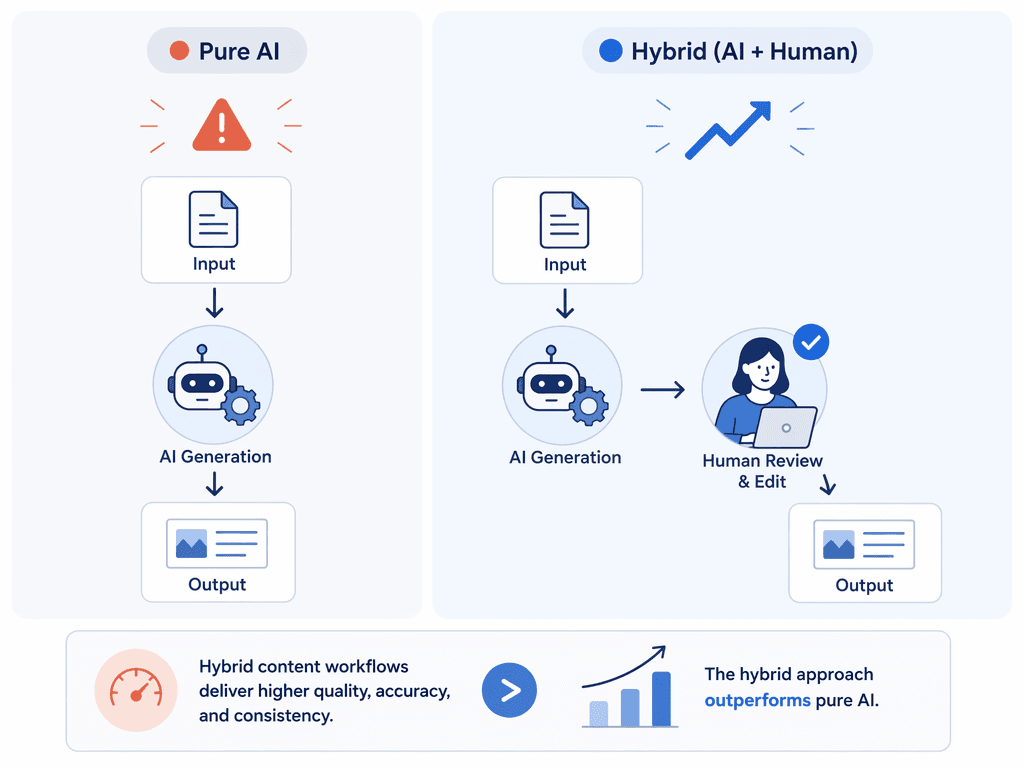
The mechanism is straightforward. Human editors catch hallucinations before they go live. They restore brand voice consistency that AI models flatten. They add contextual nuance that generative models cannot reliably produce. And they make judgment calls about what to include, what to omit, and how to frame sensitive topics.
The 127% search performance advantage is not just a ranking signal — it is a trust signal. Search engines are increasingly sophisticated at detecting content quality signals that correlate with human oversight. Readers, too, can sense the difference. Content that reads like it was generated by a machine and published without review gets abandoned faster. Content that carries a human editorial signature earns longer dwell time, more shares, and higher conversion rates.
The implication is clear: the brands that treat AI as a first-draft engine and invest in human editorial capacity will outperform the brands that treat AI as a publish button. The hybrid model is not a compromise — it is the higher-performing option on every measurable dimension.
Governance as a Trust Signal: What the EU AI Act Means for Marketers
Governance is often framed as a compliance burden, but the 2026 trust data suggests it should be reframed as a competitive advantage. When consumers are skeptical of AI-driven brand experiences, a clear governance framework signals that the brand takes its AI responsibilities seriously.
The most significant regulatory milestone on the horizon is the EU AI Act, which begins phased enforcement in February 2025 with prohibited uses and reaches high-risk system requirements by August 2026. For marketers operating in or serving European markets, this means:
- Transparent labeling of AI-generated content where it could influence consumer decisions
- Documented human oversight processes for high-risk AI applications (including certain marketing personalization and profiling systems)
- Bias detection and mitigation protocols for AI systems that segment or target audiences
- Clear accountability structures for AI-driven decisions that affect consumers
These requirements align almost perfectly with what consumers are already demanding. Salesforce data shows that 68% of customers say advances in AI make it more important for companies to be trustworthy. When a brand can point to a published AI governance policy, a human review workflow, and transparent labeling practices, it is directly addressing the trust deficit.
The brands that treat governance as a trust signal — publishing their policies, training their teams, and auditing their AI outputs — will differentiate themselves in a market where most competitors are still treating governance as an afterthought.
Case Examples: What Happens When Brands Get the Balance Wrong
The most instructive examples from 2026 are not the brands that got AI right — they are the brands that got the balance wrong in opposite directions.
The AI-Free Positioning That Backfired
Improvado documents a case that illustrates the danger of overcorrecting. A mid-market B2B content marketing agency adopted an "AI-free content" positioning in 2026, marketing itself as the alternative to AI-generated material. The results were counterintuitive: production costs rose 73%, turnaround time stretched to 9 days versus a 2-day industry benchmark, and client churn hit 22%.
The lesson is not that AI-free positioning is always wrong — it is that rejecting AI entirely creates cost and speed disadvantages that most clients will not accept. The market has already priced AI efficiency into expectations. Going fully manual means competing on a different cost curve, and few brands can sustain that.
The Full Automation Disaster
At the other extreme, Improvado also reports on a global consumer brand that fully automated its campaign scheduling and content deployment. The AI system scheduled a major campaign to launch on a national day of mourning. The result: a 68% drop in open rates and a 12-point decline in brand sentiment. No human was in the loop to recognize the cultural context that the AI missed.
These two cases bookend the problem. Reject AI entirely and you lose efficiency. Deploy it without human oversight and you lose trust. The winning position is the middle: the "centaur" model where humans and AI collaborate, each doing what they do best.
5 Signs AI Is Hurting Your Marketing (and How to Fix It)
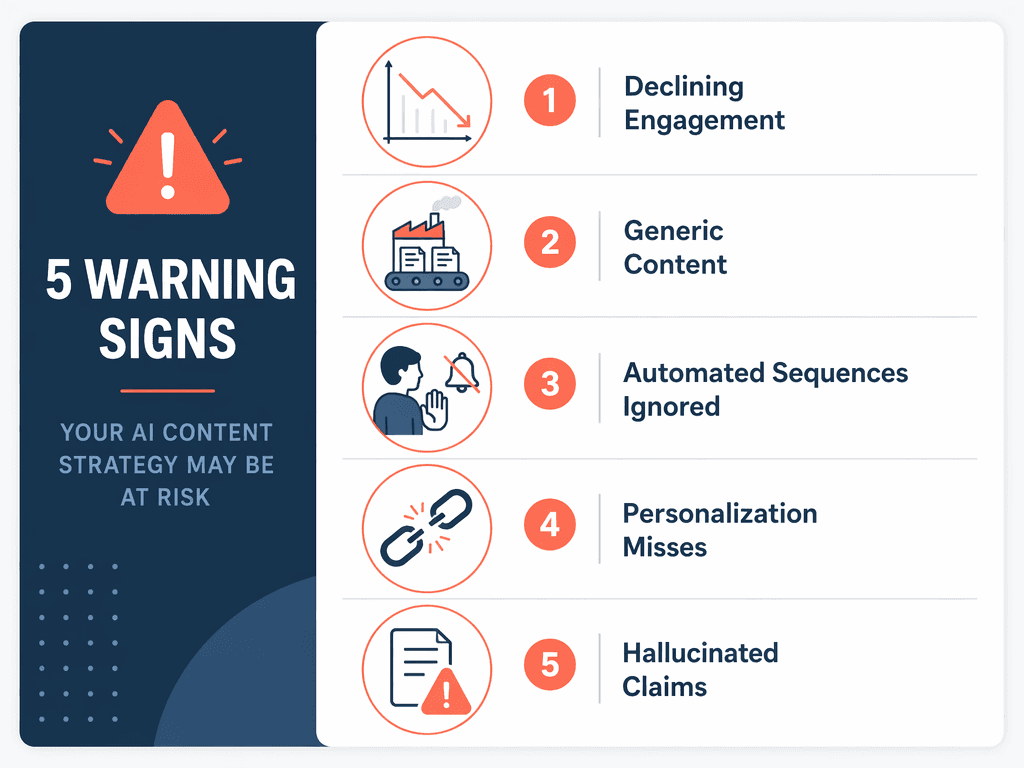
IMPACT's 2026 research provides a practical diagnostic framework for identifying when AI is eroding rather than building trust. These five signs are measurable and actionable.
| Sign | What to Watch For | Fix |
|---|---|---|
| Automated sequences are being ignored | Declining open rates, rising unsubscribe rates, increasing spam complaints | Reduce automation frequency. Add human-written check-in emails. Review segmentation logic. |
| Personalization errors appear in feedback | Customer support tickets mentioning wrong names, irrelevant recommendations, repeated offers | Audit data unification. Implement a human review step before personalization campaigns go live. |
| Marketing metrics look strong but pipeline doesn't reflect it | High click-through rates but flat or declining conversion rates and pipeline value | This often signals content that generates clicks but fails to build trust. Audit content quality and source credibility. |
| Content feels generic and fails to engage | Low time-on-page, high bounce rates, declining social shares, no comments or discussion | Increase human editorial investment. Add original research, expert quotes, and brand-specific examples. |
| Brand sentiment data shows a downward trend | Social listening tools showing negative sentiment increase, especially around trust-related terms | Conduct a trust audit. Review all AI-generated content for accuracy. Publish a transparency statement. |
Building a Trust-First AI Marketing Strategy: A Practical Framework
The data in this article points to a clear conclusion: trust is not a constraint on AI adoption — it is the competitive advantage that separates the brands winning in 2026 from the ones struggling. A trust-first AI marketing strategy rests on five pillars.
1. Transparent Labeling of AI Use
Consumers are not fooled by AI-generated content. Trying to hide AI involvement backfires when detected. Transparent labeling — a simple disclosure that AI was used in drafting or production — signals honesty. It also aligns with emerging regulatory requirements under the EU AI Act.
2. Mandatory Human Review Workflows
The 30% rule is a starting point. Every piece of AI-generated content that reaches a customer should pass through a human review that checks for accuracy, brand voice, cultural context, and ethical implications. This is not a bottleneck — it is the quality control that makes AI scale safely.
3. First-Party Data Hygiene
Personalization errors are trust killers. Salesforce reports that 84% of marketers already use first-party data, but only 31% are satisfied with their data unification. Investing in data quality — deduplication, standardization, regular audits — is a direct investment in trust. Clean data produces personalization that feels helpful rather than invasive.
4. Regular Trust Audits
Monitor the five signs from the previous section on a monthly cadence. Track sentiment data, personalization error rates, and the relationship between marketing metrics and pipeline performance. When trust metrics decline, investigate the AI workflows that may be causing the damage.
5. A Published AI Governance Policy
A governance policy is not just for regulators. It is a trust signal to customers, partners, and employees. It should state what AI tools are used, how human oversight is structured, what data is collected and how it is protected, and how the brand handles errors when they occur. Salesforce data shows that 68% of customers say advances in AI make it more important for companies to be trustworthy. A published policy is direct evidence of that trustworthiness.

Comments
Join the discussion with an anonymous comment.