
The AI Ad Perception Gap: Why Marketers Think Consumers Love AI Ads (And Why They Don't)
Senior marketers and brand strategists will learn about the widening disconnect between advertiser optimism and consumer sentiment around AI-generated ads, backed by fresh IAB data, and get a practical disclosure playbook to rebuild trust.
The 37-Point Gap: What the Data Shows
In January 2026, the IAB and Sonata Insights published the second wave of their study on AI in advertising, and the headline number should worry every brand strategist and agency leader. When asked whether Gen Z and Millennial consumers feel positive about AI-generated ads, 82% of ad executives said yes. Only 45% of those consumers agreed. That is a 37-point gap — and it widened from 32 points in 2024.
The study surveyed 505 US Gen Z and Millennial consumers and 104 US ad executives between October 2025 and January 2026. While the consumer sample is modest, the two-wave design — identical methodology in 2024 and 2026 — gives the trend line real weight. The gap is not a statistical blip; it is a structural disconnect that is getting worse.
The divergence shows up across multiple measures. The percentage of consumers who feel "very" or "somewhat" positive about AI ads decreased slightly from 2024 to 2026, while negative sentiment grew by 12 points. Meanwhile, advertiser optimism remained high — 83% of ad executives have now deployed AI in their creative process, up from 60% in 2024. The more the industry invests in AI ad production, the more out of step it becomes with the audience it is trying to reach.
Why the Gap Matters: The Trust Problem
This perception gap is not an abstract measurement problem. It signals a real erosion of consumer trust in AI-driven brand experiences — a trend that predates the IAB study and is corroborated by multiple independent data sources.
Consider the trajectory of consumer comfort with AI in advertising. According to Statista data cited by both StackAdapt and SEO.com, nearly 60% of consumers were comfortable with brands using AI in ads in 2023. By 2024, that figure had dropped to 46%. That is a 14-point decline in a single year, and the IAB's 2026 data suggests the trend has not reversed.
The underlying mechanism appears to be what researchers call the "uncanny valley" problem for AI creative. Kantar research, referenced in the StackAdapt analysis, found that AI-generated ads evoke stronger emotional reactions than non-AI ads — but net positivity is lower. The ads grab attention, but the response is often unease rather than engagement. Nearly two-thirds of US adults report feeling uneasy about AI-generated ads, according to an eMarketer survey from September 2024.
This is the core tension that the perception gap captures. Ad executives see efficiency gains, cost reductions, and production speed — and they assume consumers see the same value. But consumers are reacting to the output, not the process. They see ads that feel slightly off, that lack the subtle signals of human craft, and that trigger an instinctive skepticism about whether the brand is being transparent with them.
The Gen Z Factor: Inauthentic, Disconnected, Unethical
The perception gap is not uniform across age groups. Gen Z consumers are nearly twice as likely as Millennials to feel negative about AI-generated ads — 39% versus 20%, according to the IAB data. This is the cohort that advertisers are spending the most to reach, and it is the cohort that is most skeptical of the medium.
The IAB study asked consumers to choose words that describe brands using AI in advertising. The results for Gen Z are striking:
| Descriptor | Gen Z | Millennials |
|---|---|---|
| Inauthentic | 30% | 13% |
| Disconnected | 26% | 8% |
| Unethical | 24% | 8% |
| Innovative | 28% | 38% |
| Creative | 22% | 35% |
The asymmetry is stark. Gen Z is roughly as likely to call an AI-using brand "innovative" (28%) as "inauthentic" (30%). Millennials lean heavily positive — 38% say "innovative" versus 13% "inauthentic." For brands targeting younger consumers, the risk is not just that AI ads underperform. It is that the association with AI actively damages brand perception, creating a liability that compounds with every impression served.
This generational split has practical implications for campaign strategy. A brand running AI-generated creative on TikTok or Instagram Reels — channels where Gen Z is the primary audience — faces a fundamentally different trust equation than a brand running the same creative on LinkedIn or connected TV. The channel matters, but the audience's baseline skepticism matters more.
How Disclosure Flips the Script
The most counterintuitive finding in the IAB study — and the one with the most direct practical application — is about disclosure. When Gen Z and Millennial consumers were asked how knowing an ad used AI would affect their purchase likelihood, 73% said it would either increase or not change their likelihood to buy. Only 27% said it would decrease it.
This finding directly contradicts the fear that many advertisers hold: that labeling an ad as AI-generated will tank performance. The data suggests the opposite. Consumers are not inherently opposed to AI-generated ads. They are opposed to feeling deceived. When disclosure is present, the trust penalty largely disappears.
The mechanism is straightforward. Consumers have become more aware of AI in advertising — 71% now believe they have seen an AI-generated ad, up from 54% in 2024. Awareness is rising faster than comfort. Disclosure bridges that gap by giving consumers information they can use to calibrate their expectations. Without it, they default to suspicion.
A Practical Disclosure Playbook for 2026
The IAB's AI Transparency Framework provides a risk-based approach to disclosure that is more nuanced than a blanket "label everything" mandate. The framework prioritizes disclosure based on consumer expectations and the degree of AI involvement. Here is how to apply it in practice.
What to Disclose
The IAB study asked consumers which types of AI-generated content they most wanted disclosed. The answers create a clear priority order:
- AI-generated video — highest consumer demand for disclosure
- AI-generated images — second-highest priority
- 100% AI-generated ads — consumers want to know when no human creative input was involved
- AI-edited or AI-enhanced content — lower priority, but still relevant for video and images
- AI-assisted copywriting or text generation — lowest consumer concern for disclosure
The pattern is clear: the more realistic and immersive the medium, the higher the consumer demand for transparency. A fully AI-generated video featuring a synthetic spokesperson triggers far more skepticism than an AI-written headline on a display banner.
Where to Place Disclosures
Placement matters as much as content. The IAB framework recommends disclosures that are:
- Visible without requiring user interaction — not buried in a "Learn More" dropdown or terms page
- Proportional to the ad format — a disclosure on a 300x250 display banner will necessarily be shorter than one on a 30-second video pre-roll
- Contextually relevant — a disclosure on a social media post should appear in the caption or overlay, not in the profile bio
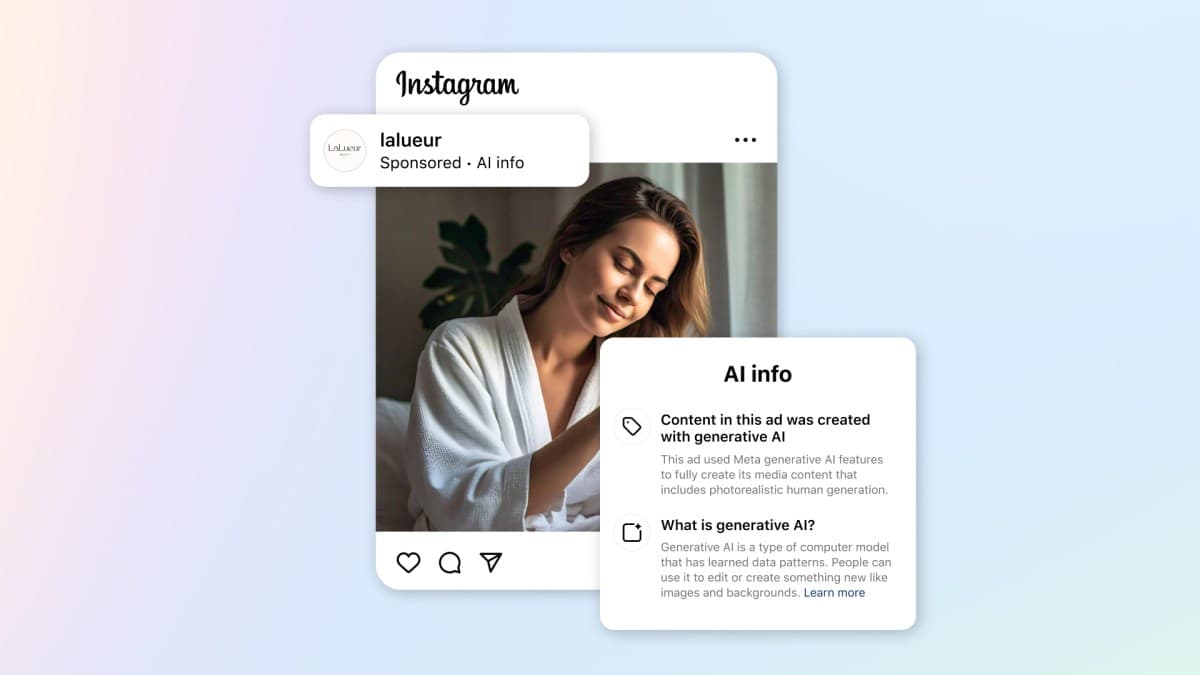
- Platform-native — use the disclosure tools each platform provides, such as Meta's "AI info" labels for ads
How Brands Are Handling It
Two examples from the IAB report illustrate the range of current practice. Coca-Cola's "Create Real Magic" campaign used generative AI for creative development but disclosed the AI involvement prominently in campaign materials, framing it as a creative collaboration rather than a secret production shortcut. Kalshi, the prediction market platform, ran an AI-generated ad during the NBA Finals — a high-visibility placement that cost approximately $2,000 for the AI-produced creative — and included disclosure language in the ad itself.
Both approaches share a common principle: treat disclosure as a feature of the creative, not an afterthought. When disclosure is integrated into the ad's narrative — "this ad was created with the help of generative AI" — it signals transparency and confidence. When it is buried in fine print or omitted entirely, it signals the opposite.
For a deeper look at the regulatory landscape behind these decisions, see our guide on FTC AI Disclosure Requirements for Advertising and Marketing, which covers the three risk areas marketers must understand in 2026.
What This Means for Your Next Campaign
The perception gap between advertisers and consumers on AI-generated ads is real, widening, and measurable. But it is not inevitable. The data points to a clear path forward that combines two complementary actions.
First, invest in disclosure as a trust-building mechanism, not a compliance checkbox. The IAB data shows that 73% of younger consumers either welcome or are neutral toward disclosure. That is a strategic opportunity, not a liability. Brands that lead with transparency can differentiate themselves in a market where most advertisers are still treating AI use as something to hide.
Second, address the quality dimension. The uncanny valley problem — stronger emotional reactions but lower net positivity — suggests that current AI-generated creative is not good enough to earn trust on its own merits. The solution is not to stop using AI. It is to invest in higher-quality AI production workflows, human oversight, and creative direction that avoids the homogenized, slightly-off aesthetic that triggers consumer skepticism. Our article on The Sameness Trap explores this creative quality challenge in depth.
Closing the perception gap requires more than better technology. It requires a shift in how brands think about their relationship with the audience — from "can we use AI?" to "how do we use AI in a way that respects the consumer's intelligence and skepticism?" The brands that answer that question honestly will be the ones that earn the trust that the 37-point gap currently represents.

Comments
Join the discussion with an anonymous comment.