
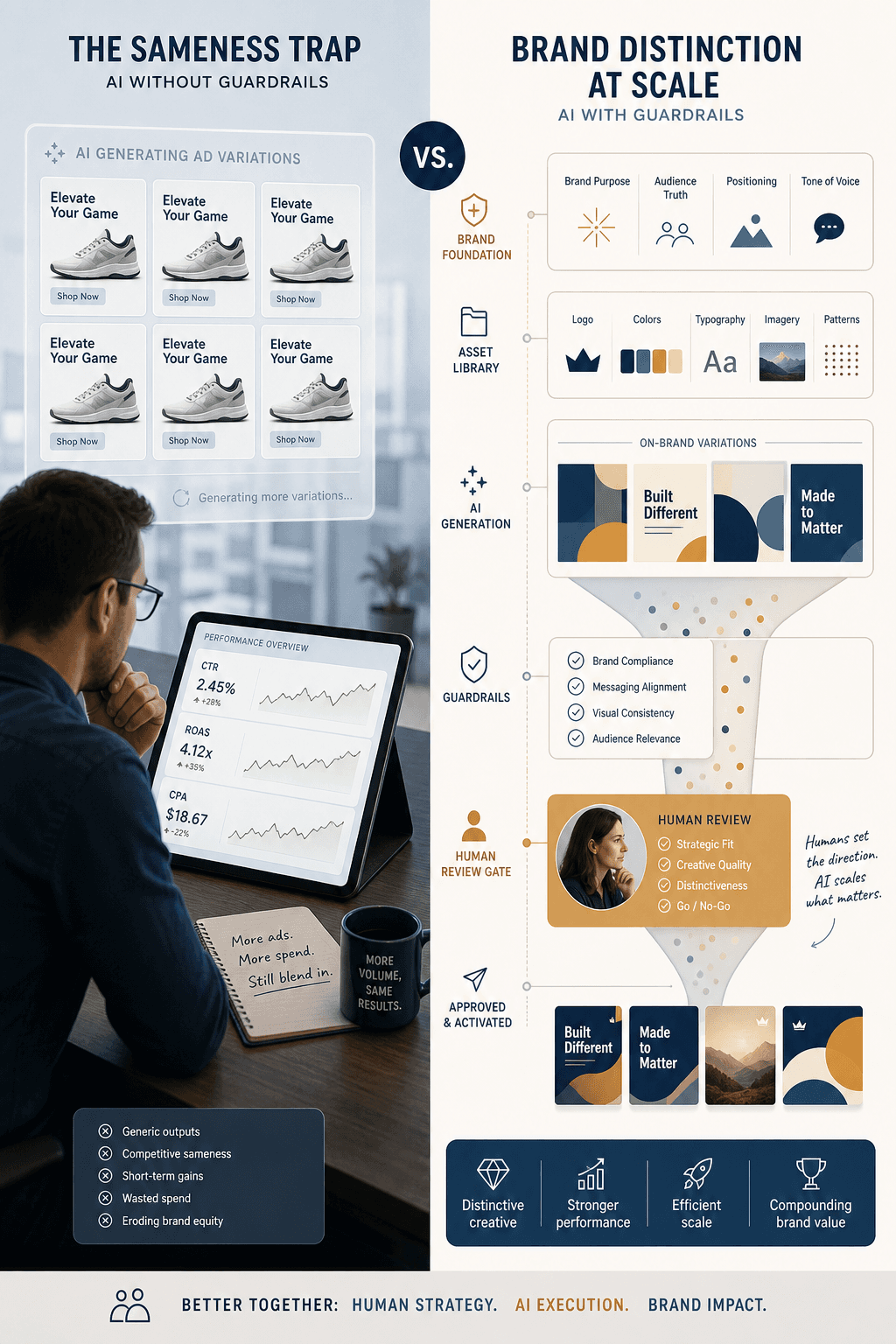
The Sameness Trap: Why Most AI-Generated Ads Look Alike and How to Fix It
Three in four marketers worry AI creative makes brands indistinguishable. This article explains why brand homogenization is the real risk in AI advertising, and provides a governance framework — built on proprietary source material, brand guardrails, human review gates, and defined use cases — to maintain brand voice at scale.
The Sameness Crisis in AI Advertising
The dominant narrative around AI-generated ad creative has been about performance: higher ROAS, lower CPA, faster production. But a quieter, more consequential problem has been building beneath those metrics. Brands are beginning to sound and look alike, and the data suggests this is not a niche concern.
Smartly's 2026 Digital Advertising Trends Report, built from a survey of 450 marketing leaders worldwide, found that three in four respondents (75%) are concerned that AI-generated creative risks making brands indistinguishable. Even more striking: 86% have already seen AI outputs that resemble content from competitors. This is not a hypothetical future risk — it is a present-day operational reality for the vast majority of marketing teams scaling AI creative.
The sameness problem is compounded by a parallel decline in consumer trust. According to data cited in StackAdapt's 2025 analysis, consumer comfort with brands using AI dropped from nearly 60% in 2023 to 46% in 2024. By late 2024, nearly two-thirds of U.S. adults reported feeling uneasy about AI-generated ads, with skepticism highest among Gen X and Baby Boomers. When the output looks generic and trust is eroding simultaneously, the brand damage compounds.
The implication for senior marketers and agency leaders is uncomfortable but clear: the biggest risk in AI advertising is not that the technology underperforms — it is that it performs exactly as designed, producing vast quantities of competent, on-brief, but fundamentally interchangeable creative that erodes the distinctiveness your brand spent years building.
Why the Uncanny Valley Problem Matters for Brands
The concept of the uncanny valley is most often applied to humanoid robots or CGI characters — the point at which something looks almost human but triggers a sense of unease. A similar dynamic is emerging in AI-generated advertising: content that is grammatically correct, visually coherent, and on-brief, yet somehow feels off. It lacks the idiosyncratic choices, the unexpected phrasing, the small inconsistencies that signal a human author.
This matters because consumers are increasingly sensitive to the difference. The trust data cited above — a 14-point drop in comfort with AI-driven brand experiences between 2023 and 2024 — suggests that audiences are not indifferent to the provenance of the content they see. They may not articulate it as "this ad was generated by AI," but they register the subtle flatness. Over time, repeated exposure to uncanny-valley creative erodes the emotional connection that brand advertising is supposed to build.
A 2024 global survey from eMarketer found that 54% of marketing decision-makers worry that overreliance on AI could erode human creativity. This concern is often framed as a creative quality issue — will the work be less original? — but it is equally a brand safety issue. When every brand in a category uses the same foundation models with similar prompts, the output converges. The uncanny valley becomes a brand graveyard where distinctiveness goes to die.
What Winning Campaigns Do Differently: The Governed System
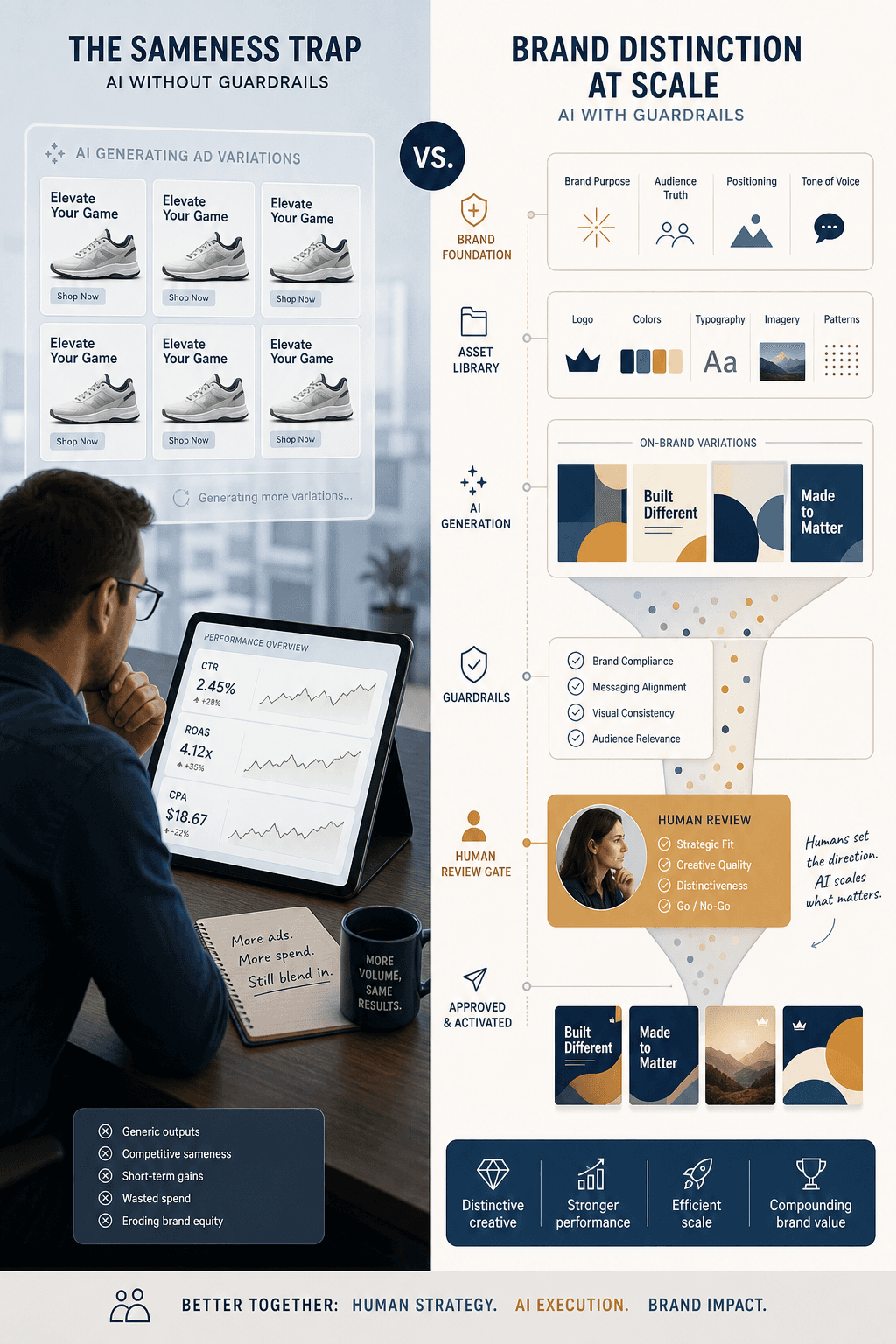
The brands that are avoiding the sameness trap are not the ones generating the most volume. They are the ones building what might be called a governed creative system — a structured approach that constrains AI within brand boundaries rather than letting it free-produce. Analysis of several high-profile campaigns reveals a consistent pattern.
Coca-Cola's "Create Real Magic" platform, built in partnership with OpenAI and Bain, combined GPT-4 and DALL-E capabilities with a curated library of the brand's assets, characters, and design elements. The AI operated within defined brand guardrails, and a human curation layer selected standout work for official brand use. The technology was powerful, but the governance — the asset library, the guardrails, the human gate — was what made the output recognizably Coca-Cola rather than generic festive imagery.
L'Oréal's Beauty Genius platform took a similar approach. It combined proprietary product and formulation data with large language models to deliver personalized recommendations. The key design decision was using proprietary product data as the source material for the AI. That data — ingredient lists, shade ranges, dermatological claims — is unique to L'Oréal. No competitor can prompt their way to the same output because the underlying source material is not available to them.
Virgin Voyages' Jen AI assistant, described in the Pragmatic Digital analysis of best AI advertising campaigns, followed the same pattern: proprietary source material, structured workflows, and human oversight. The consistent elements across all three cases are worth naming explicitly.
- Proprietary source material as the foundation — not generic web data or public model training
- Brand standards and guardrails built directly into the workflow, not applied as a post-production review
- Human review as a strategic quality gate, not a proofreading pass
- AI applied to a defined, bounded use case rather than open-ended creative generation
These are not technology choices. They are governance choices. And they are the difference between creative that reinforces brand distinctiveness and creative that erodes it.
Four Pillars of Governed AI Creative
The governed system pattern can be distilled into four operational pillars. Each addresses a specific failure mode of ungoverned AI creative, and each requires deliberate investment — not just a prompt engineering workshop.
| Pillar | Ungoverned Approach | Governed Approach | Why It Matters |
|---|---|---|---|
| Proprietary source material | AI generates from its training data or generic briefs | AI is grounded in brand asset libraries, product data, tone-of-voice guides, and past campaign archives | The output is unique to your brand because the input is unique to your brand |
| Brand guardrails | Prompts include vague instructions like "stay on brand" | Structured inputs define permitted vocabulary, visual palette, messaging hierarchy, and exclusion zones | Reduces the probability of off-brand output before generation, not after |
| Human review gate | AI output goes directly to production or minor proofreading | A human with strategic authority evaluates output against brand criteria before it reaches production | Catches the uncanny-valley problems that automated quality checks miss |
| Defined use cases | AI is used for all creative tasks because it is faster | AI is assigned to specific, bounded tasks (e.g., A/B test variants, localized versions, performance creative) while humans lead high-stakes brand work | Prevents mission creep that dilutes brand voice across channels |

Comments
Join the discussion with an anonymous comment.