

The AI-Targeted Advertising Trap: Why 70% of Marketers Have Already Had an AI Incident (and What to Do About It)
AI adoption in advertising is surging, but governance is dangerously behind. This guide for senior marketers and agency leaders examines the data on AI incidents, the governance gap, and a concrete four-pillar framework for responsible AI targeting.

The Adoption-Speed Problem: AI Targeting Is Running Ahead of Its Safety Infrastructure
The pace at which advertisers are embedding AI into their targeting and creative workflows has reached a velocity that few organizations are equipped to manage safely. According to the IAB's 2026 Outlook, five of the top six buyer focus areas are AI-related, and nearly two-thirds of buyers are concentrating on agentic AI for ad buying. The same research found that 93% of buyers aware of agentic AI are already using it or likely to use it for performance analysis, with 91% applying it to creative testing and 82% to budget allocation.
This is not a future scenario. It is the operating reality of Q2 2026. A BCG analysis from January 2026 reported that shopping-related generative AI use grew 35% in 2025 alone, and 53% of organizations now allocate budget to conversational AI advertising, referencing Forrester data. Meanwhile, OpenAI began testing ads inside ChatGPT in February 2026, and Walmart opened its retail media network to ads inside its AI assistant, Sparky. The infrastructure for AI-powered ad targeting is expanding faster than the checks and balances designed to govern it.
For senior marketers and agency leaders, the question is no longer whether to adopt AI targeting. It is whether the organization has the governance, measurement, and brand safety frameworks in place to absorb the risks that come with that adoption. The data suggests most do not.
The Incident Data: 70% of Marketers Have Already Had an AI Problem
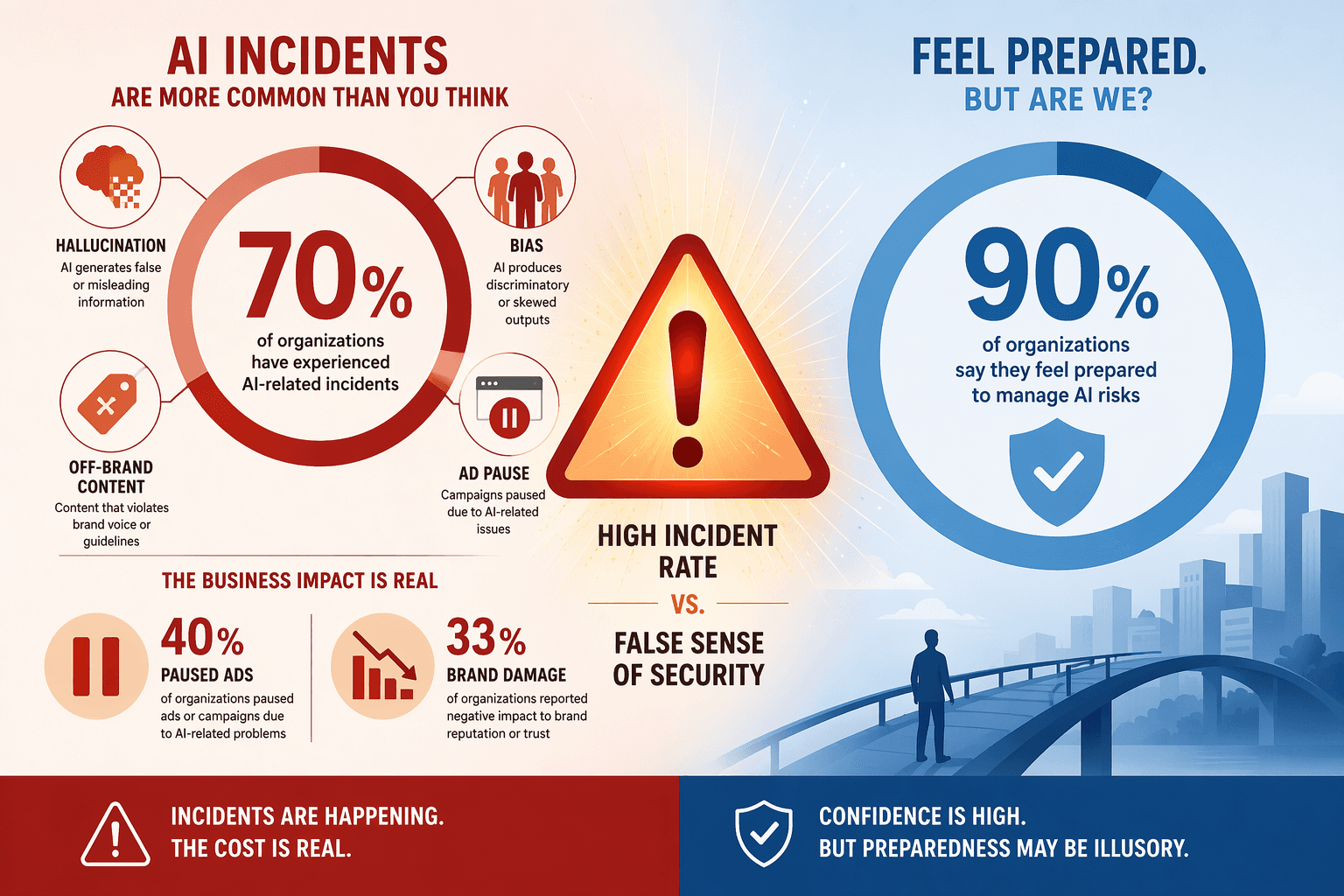
The most striking finding from the IAB and Aymara survey of 125 US ad industry executives, conducted in July 2024, is this: over 70% of marketers reported encountering at least one AI-related incident. These incidents included hallucinations, algorithmic bias, and off-brand or inappropriate content generated by AI systems.
The consequences were not minor. The survey found that 40% of affected organizations had to pause or pull ads entirely. More than a third dealt with brand damage or public relations issues. Nearly 30% conducted internal audits as a direct result of an AI incident.
| Impact of AI Incidents | Percentage of Affected Marketers |
|---|---|
| Had to pause or pull ads | 40% |
| Experienced brand damage or PR issues | 33% |
| Conducted internal audits | 29% |
Perhaps more concerning than the incident rate itself is the gap between experience and perception. Despite 70% of marketers having encountered an AI problem, nearly 90% reported feeling prepared to catch issues before they launch. This is a textbook false sense of security — and it is the single biggest governance risk facing advertisers today.
The Governance Gap: Why Only 36% of Organizations Have a Formal AI Framework
The disconnect between AI usage and formal governance is stark. Knostic data cited by Taboola in their 2026 AI marketing trends report found that while 75% of organizations now have some form of AI usage policies in place, only 36% have a formalized AI governance framework. That means nearly two-thirds of organizations are operating AI advertising systems without a structured governance structure to manage risk.
The Marketing AI Institute's 2025 survey reinforces this picture: only 38% of marketing teams report having formal generative AI policies. The IAB data adds another dimension — 10% of organizations do nothing at all or simply do not know what their AI governance status is.
| Governance Metric | Percentage |
|---|---|
| Organizations with AI usage policies | 75% |
| Organizations with formal AI governance framework | 36% |
| Marketing teams with formal genAI policies | 38% |
| Organizations that do nothing or don't know | 10% |
This governance gap is not just an internal compliance issue. It has external consequences. The same IAB survey found that over 60% of marketers support labeling AI-generated ads, suggesting that even practitioners recognize the need for transparency that their own organizations have not yet implemented. Meanwhile, 36% of US public companies now disclose AI as a separate risk factor in their SEC filings, according to a 2025 analysis by the Harvard Law School Forum on Corporate Governance. The market is beginning to demand what internal teams have not yet built.
What Marketers Want: Audits, Transparency, Privacy, and IP Protections
The IAB survey also asked marketers what specific governance features they want from their AI advertising tools and platforms. The responses reveal a clear hierarchy of concerns.
- Regular AI audits for bias and integrity. Marketers want systematic, recurring checks — not one-time assessments — to ensure AI models are not producing biased or harmful outputs.
- Transparency in AI decision-making. When an AI system decides to serve a particular ad to a particular user, marketers want to understand why. Black-box targeting is increasingly unacceptable.
- Data privacy protections. As first-party data becomes the primary fuel for AI targeting, marketers need assurances about how that data is collected, stored, and used by AI platforms.
- IP safeguards. Concerns about copyright and ownership of AI-generated creative content remain unresolved, and marketers want clear policies from their technology partners.
These demands are not coming from a vacuum. Consumer sentiment is already shifting. A Smartly/BCG study found that 69% of consumers feel manipulated when brands use AI for advertising without disclosing it. As AI targeting becomes more sophisticated — and less visible to the end user — the risk of eroding consumer trust grows in direct proportion to the opacity of the system.
The Four Pillars of Responsible AI Targeting
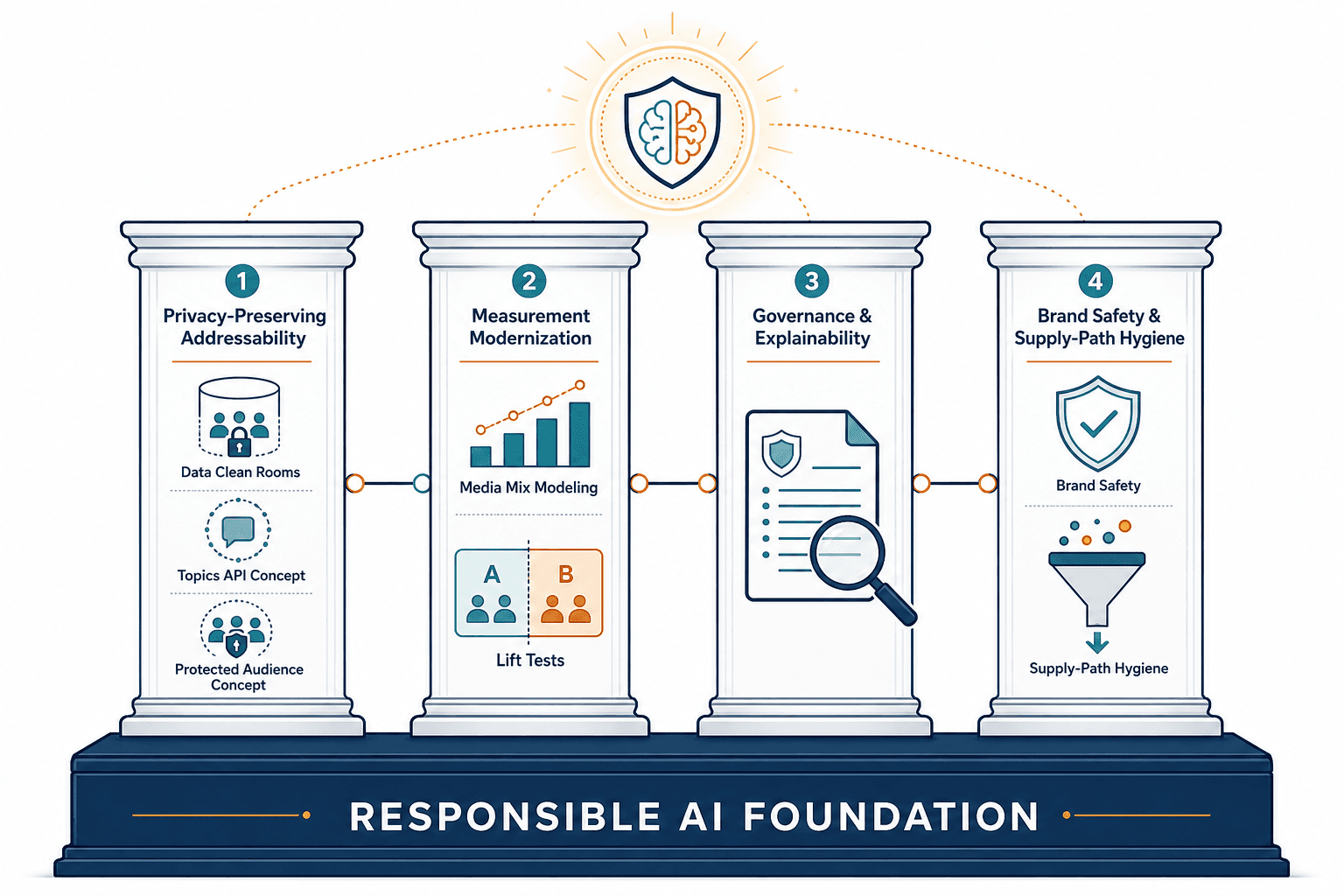
Building a responsible AI targeting operation requires more than a policy document. It requires a structured approach across four interconnected domains. These pillars are drawn from the emerging consensus across industry bodies, research organizations, and practitioner experience.
1. Privacy-Preserving Addressability
AI targeting depends on data. But the era of unfettered third-party cookie collection is over. Responsible AI targeting relies on privacy-preserving infrastructure: data clean rooms, the Topics API, Protected Audience API, and other signal-based approaches that allow targeting without exposing individual user data. The StackAdapt guide on AI advertising targeting emphasizes signal orchestration — combining first-party, contextual, commerce, platform, and performance signals — as the foundation for AI targeting that respects user privacy.
2. Measurement Modernization
When AI systems optimize toward a metric, they will find the fastest path to that number — whether or not it aligns with business outcomes. The ANA's Q1 2025 Programmatic Transparency Benchmark found that only 41% of programmatic budgets reached effective impressions, though this was an improvement from 36% in 2023. The same report identified a 37.8% TrueCPM optimization gap, representing $21.6 billion in efficiency upside across the industry. Modern measurement requires a shift from last-click attribution to a combination of marketing mix modeling (MMM) and lift tests that can isolate the true incrementality of AI-driven campaigns.
3. Governance and Explainability
The NIST AI Risk Management Framework provides a structured approach to governing AI systems, including those used in advertising. Key practices include maintaining model cards that document training data, known limitations, and testing results; establishing human-in-the-loop review processes for high-risk targeting decisions; and conducting regular bias audits. The IAB data shows that 3 in 5 businesses now monitor AI systems for fairness, bias, and transparency — but that still leaves 40% that do not.
4. Brand Safety and Supply-Path Hygiene
AI targeting can place ads in contexts that damage brand reputation if not properly governed. The IAS Media Quality Report found that campaigns without pre-bid fraud protection face fraud rates up to 15 times higher than those with protections. As AI systems automate more of the media buying process, the risk of programmatic waste and fraud scales with the automation. Supply-path optimization — ensuring every dollar flows through transparent, verified channels — becomes a governance requirement, not a procurement preference.
| Pillar | Key Action | Relevant Data Point |
|---|---|---|
| Privacy-Preserving Addressability | Implement clean rooms and signal-based targeting | Retail media exceeded $62B in 2025 (IAB) |
| Measurement Modernization | Adopt MMM + lift tests over last-click | $21.6B efficiency upside identified (ANA) |
| Governance & Explainability | Adopt NIST AI RMF, conduct bias audits | Only 36% have formal governance (Knostic) |
| Brand Safety & Supply-Path Hygiene | Enable pre-bid fraud protection | 15x higher fraud rates without protection (IAS) |
A Concrete Action Plan: From Awareness to Audit
Knowing the data is not the same as acting on it. For senior marketers and agency leaders who need to move from awareness to action, here is a four-step plan that can be executed over a quarter.
Step 1: Assign Ownership
AI governance cannot be a side project for an already overworked compliance team. Assign a named owner — a head of ad operations, a marketing technology lead, or a dedicated AI governance officer — with clear responsibility for auditing AI systems, maintaining documentation, and escalating incidents. Without ownership, governance is a document, not a practice.
Step 2: Build Best Practices in Layers
Start with human review of all AI-generated ad creative and targeting decisions. This is the minimum viable governance layer. From there, introduce automated pre-launch audits that check for brand safety violations, bias signals, and compliance with internal policies. The Improvado guide notes that AI-driven campaigns require 60-70% less manual optimization time — the freed capacity should be redirected to oversight, not to running more campaigns.
Step 3: Bring in Expert Support
Few in-house teams have the specialized knowledge to audit AI systems for bias, hallucination risk, and data privacy compliance. Consider engaging external auditors or legal counsel with AI governance expertise. The IAB survey found that 29% of organizations that experienced an AI incident conducted internal audits afterward — proactive auditing is cheaper and less disruptive than reactive auditing.
Step 4: Lead with Transparency
Disclose AI use in advertising. The Smartly/BCG finding that 69% of consumers feel manipulated by undisclosed AI use is a clear signal that transparency is becoming a consumer expectation, not a nice-to-have. Over 60% of marketers already support labeling AI-generated ads. Brands that lead on disclosure will build trust advantage while others wait for regulation to force their hand.
| Step | Action | Timeline |
|---|---|---|
| Assign ownership | Name a governance lead with clear authority | Week 1-2 |
| Build layered practices | Human review → automated pre-launch audits | Month 1-2 |
| Engage expert support | External audit of AI systems and data flows | Month 2-3 |
| Lead with transparency | Implement AI disclosure in ad creative | Month 2-3 |
How to Audit Your Current AI Ad Targeting Stack for Risk
The following audit checklist is designed for a senior marketing leader or agency head to evaluate their current AI ad targeting setup. It covers four dimensions: data infrastructure, model explainability, brand safety controls, and measurement validity.
Data Infrastructure
- Is your first-party data unified across channels, or is it siloed in separate platforms?
- Do you have a data clean room in place for privacy-safe targeting?
- Are you collecting and storing consent signals properly for AI model training?
- The Improvado guide notes that the #1 failure mode is activating AI optimization without the data infrastructure to support it. If your data is fragmented, your AI targeting will be unreliable.
Model Explainability
- Can your AI ad platform explain why it served a particular ad to a particular user?
- Do you have model cards or documentation for the AI systems you use?
- Have you tested your AI systems for bias across demographic segments?
- If the answer to any of these is no, you are operating a black-box targeting system — and that is a governance risk.
Brand Safety Controls
- Do you have pre-bid fraud protection enabled across all programmatic campaigns?
- Are you using supply-path optimization to verify where your ad dollars are going?
- Have you reviewed the IAS finding that campaigns without pre-bid protection face fraud rates 15x higher?
- Do you have a process for reviewing AI-generated ad creative before it goes live?
Measurement Validity
- Are you measuring incrementality, or are you relying on last-click attribution?
- Do you have MMM or lift test data to validate what your AI targeting is actually contributing?
- The ANA found that only 41% of programmatic budgets reached effective impressions — are you measuring effective impressions or just served impressions?
- Companies with unified cross-channel measurement report 15-25% CPA improvement, per the Improvado guide. If your measurement is fragmented, your AI optimization is optimizing toward the wrong target.
| Audit Dimension | Key Question | Red Flag |
|---|---|---|
| Data Infrastructure | Is first-party data unified? | Siloed data across platforms |
| Model Explainability | Can the platform explain decisions? | No model cards or documentation |
| Brand Safety Controls | Is pre-bid fraud protection enabled? | No protection in place |
| Measurement Validity | Are you measuring incrementality? | Relying solely on last-click attribution |
The data is clear: AI targeting is not coming — it is here, it is pervasive, and it is already producing incidents at a rate that should concern every brand advertiser. The organizations that will thrive in this environment are not necessarily those with the most sophisticated AI models. They are the ones that build the governance infrastructure to match their adoption speed. The gap between the 70% who have had an incident and the 90% who feel prepared is not a paradox. It is a warning.

Comments
Join the discussion with an anonymous comment.