
The AI Adoption Gap in B2B Marketing: Why 95% Use AI but Only 26% Execute Well
This article helps B2B marketing managers and demand gen leads understand why widespread AI tool adoption isn't translating into effective execution. It provides a three-stage maturity framework and a concrete 90-day sequence to move from experimental tool use to operational systems that deliver measurable results.
The Belief-Reality Gap in B2B AI Marketing
Walk into any B2B marketing department today and you will find AI tools in active use. The numbers confirm it: 95% of B2B marketers use AI at least weekly, and 65% use it daily, according to LinkedIn's 2025 B2B Marketing Benchmark. On the surface, that looks like a success story. The technology has crossed the adoption chasm. The tools are in the building.
But look beneath the usage numbers and a different picture emerges. The same LinkedIn survey found that only 32% of B2B marketers rate their AI expertise as "extremely good" — a figure that remained flat year over year. Among CMOs, the confidence level is only marginally higher at 38%. The gap between tool adoption and effective execution is not closing; it is becoming a structural feature of the market.
The Growth Syndicate's State of AI in B2B Marketing Report (November 2025, n=110 B2B marketing leaders) quantifies this disconnect precisely. The average belief in AI's potential among respondents sits at 8.8 out of 10 — 86% rated it 8 or higher. Self-reported knowledge averages 7.4 out of 10. But execution? That drops to 6.4 out of 10. Only 26% of teams rate their AI execution at 8 or above. The gap between what marketers believe AI can do and what their teams can actually make it do is more than two full points on a ten-point scale.
Meanwhile, the bar for proving impact is rising. G2's Spring 2026 Report found that the ability of marketing teams to demonstrate AI ROI fell from nearly 50% in 2025 to 41% in 2026. As more teams deploy AI, the initial low-hanging fruit has been picked, and the remaining gains require more sophisticated execution. The tools are not the bottleneck. The capability to use them well is.
Why Adoption Doesn’t Equal Effectiveness
If 95% of teams are using AI, why are only 26% executing well? The answer lies in what teams are actually doing with the tools. The data reveals a pattern: most teams are using AI as a faster typewriter, not as an operational system.
CXL's 2026 survey of B2B marketers found that 75% use AI for content production — emails, landing pages, social copy, and ad creative. That is the easy on-ramp. You paste a brief into ChatGPT, get a draft, edit it, and publish. The tool does the heavy lifting of generating text, and the human acts as editor.
But the same survey reveals a stark asymmetry in skill development. 49% of marketers already rate themselves as advanced at AI-assisted content production. Yet 65% rate themselves as beginners or below when it comes to AI systems — building workflows, connecting agents, and setting up automation. The skill distribution is inverted: teams are strong at the task level and weak at the system level.
| AI Application | Usage Rate | Skill Level (Advanced) |
|---|---|---|
| Content production (emails, landing pages, social copy) | 75% | 49% |
| Research synthesis | 42% | Not reported |
| Lead scoring | 31% | Not reported |
| Personalization | ~25% | Not reported |
| AI systems (workflows, agents, automation) | Not reported | Only 35% above beginner |
The Growth Syndicate data reinforces this pattern. 91% of respondents use AI for content creation, and 79% use it for productivity tasks. But only 31% use it for lead scoring, and roughly 25% use it for personalization. The applications that require integration with data systems, CRM pipelines, and structured workflows are the ones where adoption drops off a cliff.
The constraint is not financial. 60% of respondents cite skills gaps as the primary barrier to AI adoption, while only 25% cite budget limitations. Another 47% point to a lack of internal expertise. The problem is capability, not capital. Teams have the tools; they lack the operational knowledge to wire them into their marketing machinery.
There is also a growing awareness that more AI-generated content does not automatically mean better marketing. 63% of Growth Syndicate respondents say AI increases noise and reduces differentiation. When every team uses the same models to generate the same types of content, the output converges toward the middle. The competitive advantage does not come from having AI; it comes from having AI configured to your specific audience, data, and brand constraints.
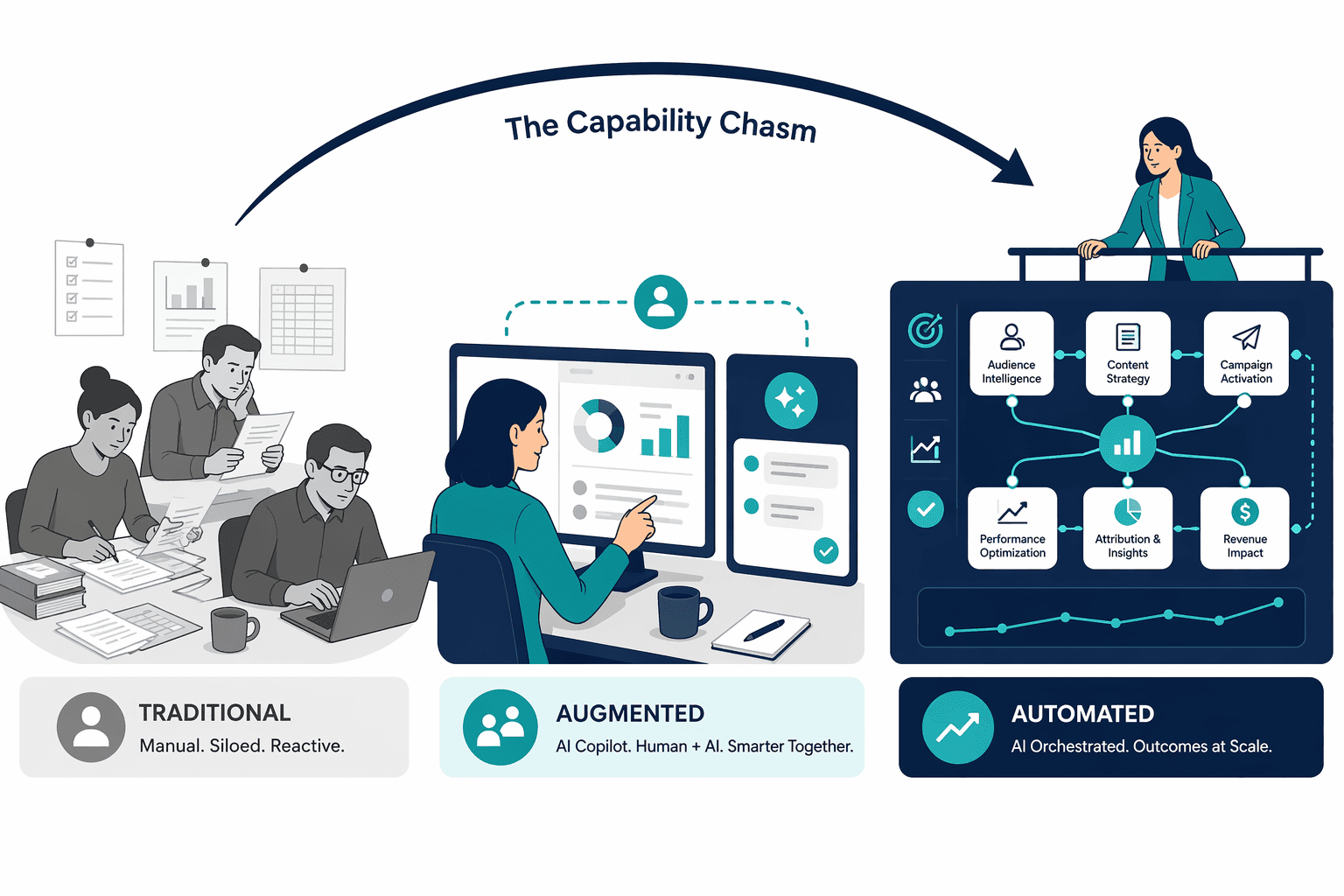
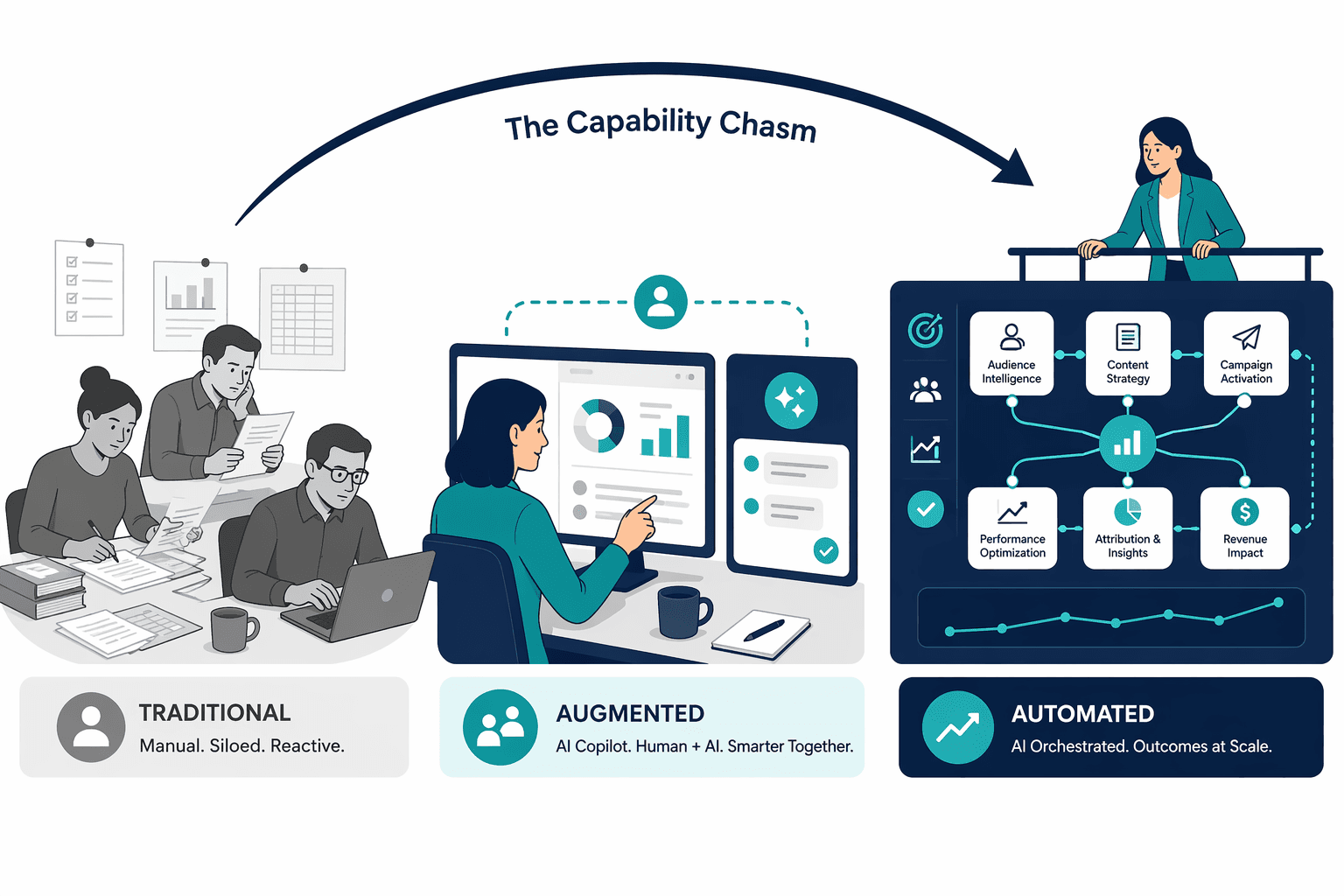
The Three Maturity Stages: Traditional, Augmented, Automated
To understand where your team sits and what the next step looks like, it helps to have a framework. The Growth Syndicate report, drawing on expert interviews, outlines a three-stage maturity model that maps how teams evolve in their use of AI.
This is not a validated academic model. It is a practical heuristic — a way to diagnose your current state and identify the most impactful next move.
| Stage | How Work Gets Done | Human Role | Typical Tools |
|---|---|---|---|
| Traditional | Humans execute every step end-to-end | Doer | Word processors, spreadsheets, email clients |
| Augmented | Humans execute with AI copilots assisting on specific tasks | Editor and prompter | ChatGPT, Claude, Jasper, Copy.ai |
| Automated | Systems handle execution of defined workflows; humans design, supervise, and intervene | Architect and supervisor | Custom GPTs, workflow automation, API-connected agents, orchestration layers |
Most B2B marketing teams today sit somewhere between Traditional and Augmented. They have adopted AI tools, but the workflow still centers on a human doing the work, with AI serving as an assistant that generates drafts, summarizes research, or suggests headlines. The human remains the primary executor.
The teams that report the highest-quality AI output, according to CXL's survey, have moved further into the Augmented stage and are experimenting with Automated. They have built persistent brand context systems — custom GPTs or knowledge bases that encode their brand voice, audience definitions, and content guidelines. They use layered review systems where AI generates, a human reviews, and then a second AI pass checks for consistency. They engage in
The critical insight is that moving from Augmented to Automated is not about buying a better AI tool. It is about redesigning the workflow so that the AI handles execution within defined boundaries and the human handles design, exception handling, and strategic oversight. That shift requires a different skill set — and that is where most teams get stuck.
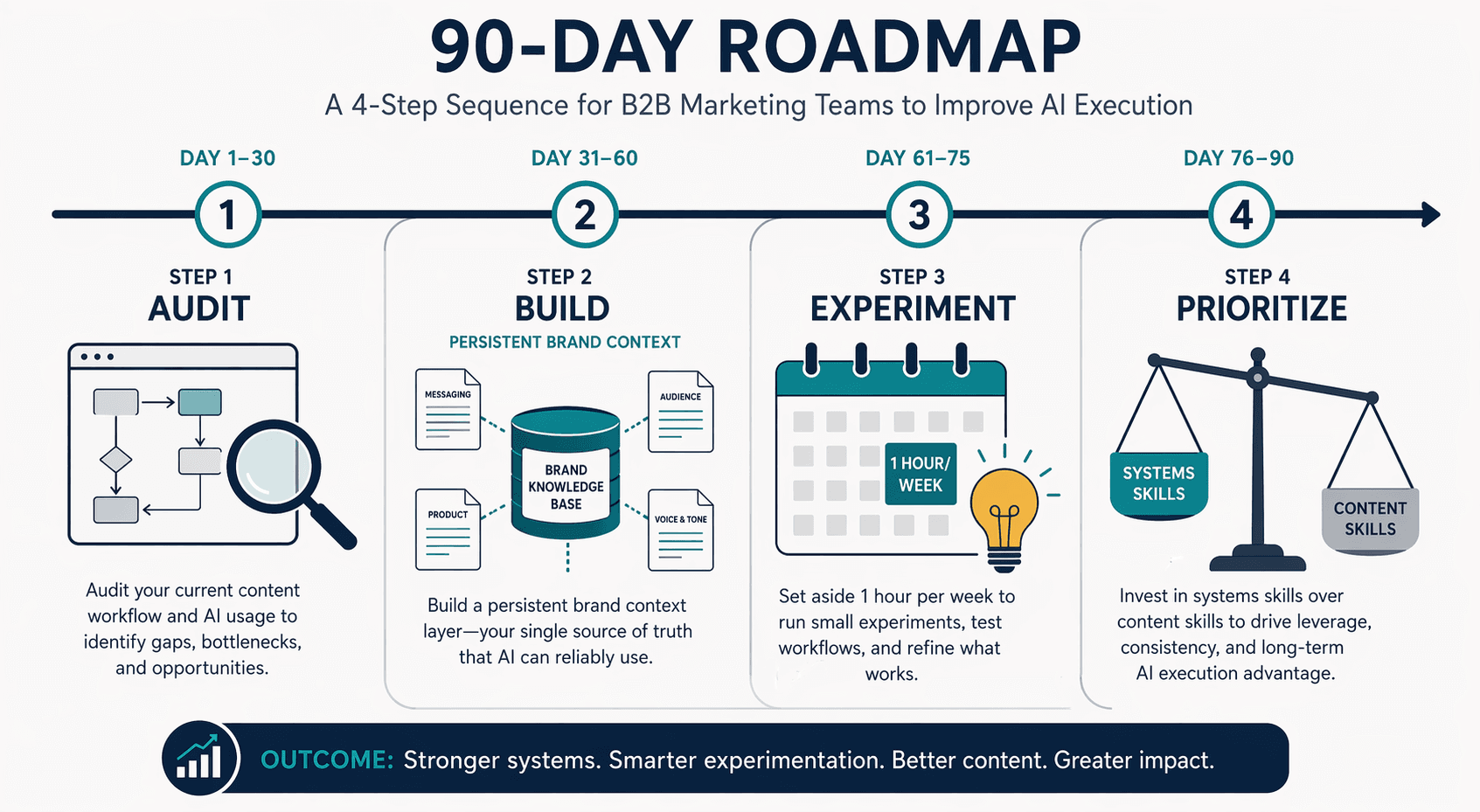
The 90-Day Sequence to Move Up the Capability Curve
Closing the gap between belief and execution does not require a massive transformation. It requires a deliberate sequence of small structural changes. Based on the patterns in the survey data and the practices of higher-performing teams, here is a 90-day sequence designed to move a team from the Traditional-Augmented boundary toward genuine operational capability.
Days 1–14: Audit One Recurring Content Workflow
Pick one workflow that your team executes at least monthly — a newsletter, a blog post series, a set of ad variations, or a nurture email sequence. Map every step from brief to publication. For each step, ask: Is a human executing this from scratch? Is AI assisting? Could this step be handled by an AI system with human supervision?
The goal is not to automate everything. It is to identify one or two steps where the human is doing work that an AI system could reliably handle within defined parameters. Most teams find that research synthesis, first-draft generation, and formatting are the easiest candidates.
Days 15–45: Build Persistent Brand Context
The CXL survey found that marketers reporting the highest-quality AI output had built systems for persistent brand context. This means creating a knowledge base — a custom GPT, a set of system prompts, or a structured document — that encodes your brand voice, audience personas, content principles, and editorial guidelines.
Without this context, every AI interaction starts from zero. The model generates generic output because it has no information about your specific constraints. A persistent context system ensures that every draft, every headline, and every email variant is grounded in your brand's actual positioning.
Days 46–60: Carve One Hour Per Week for Systems Experimentation
CXL's survey identified the primary blocker to AI skill development: 43% of marketers say lack of time is the main reason they are not building better AI capabilities. Another 24% are unsure which AI skills are worth learning. The solution is not to find more time — it is to protect existing time.
Block one hour per week on your calendar. No meetings, no urgent requests. Use that hour to experiment with one thing: connecting an AI tool to your CRM via API, building a simple automation that drafts social posts from a blog RSS feed, or testing whether a custom GPT can reliably generate first drafts of your most common content type. The goal is not to ship production-ready systems in week one. It is to build the muscle of thinking in systems rather than tasks.
Days 61–90: Prioritize Systems Skills Over Content Skills
The data is clear: your team likely already has strong content production skills. 49% of marketers are advanced at AI-assisted content. The deficit is in systems thinking. 65% are beginners at building workflows, agents, and automation. The Growth Syndicate report found that 42% of marketers would most want to master building AI agents.
Redirect your learning investment accordingly. Instead of another course on prompt engineering, invest time in understanding workflow automation tools, API connections, and how to structure data for AI consumption. The teams that scale are not the ones with the best prompts. They are the ones that have built the infrastructure for AI to operate within.
What Separates Teams That Scale from Teams That Stall
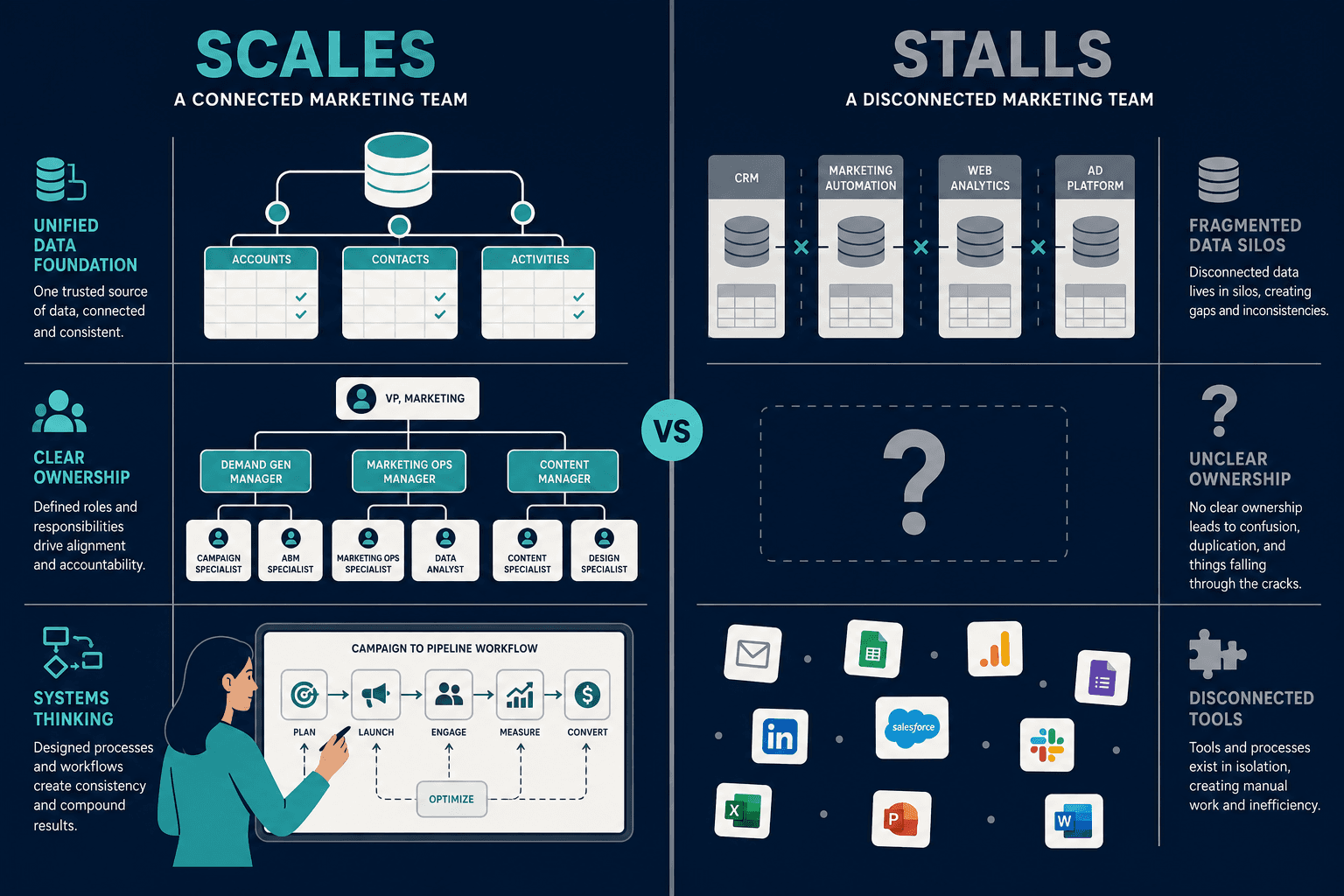
The 90-day sequence will move a team forward. But sustaining that progress requires three structural conditions that the survey data consistently identifies as differentiators between teams that scale their AI capability and teams that stall.
1. Systems Thinking Over Task-Level Prompting
The teams that report the highest AI output quality do not have better prompts. They have better systems. They have moved from asking "What can I get AI to write for me?" to "What workflow can I design where AI handles execution within defined boundaries and I handle the exceptions?" This shift from task-level thinking to orchestration-level thinking is the single biggest separator.
2. Data Readiness
AI systems are only as good as the data they operate on. The Adobe and Oxford Economics 2026 report (global survey of ~800 B2B organizations) found that only 41% have a unified customer data foundation to support AI at scale. Without that foundation, personalization, lead scoring, and predictive modeling remain out of reach. The same report found that 75% of organizations cite data integration and quality as their biggest struggle with agentic AI.
This is not a technology problem that a new tool can solve. It is an organizational data hygiene problem. Teams that scale invest in data unification before they invest in advanced AI applications.
3. Clear Ownership and Governance
The Growth Syndicate report found that roughly 50% of organizations lack formal AI policies, and approximately 20% have no clear owner for AI initiatives. When no one is responsible for AI capability building, it defaults to individual experimentation. That produces pockets of competence but no organizational capability.
Teams that scale assign clear ownership — a person or a small group responsible for AI systems, not just AI tool procurement. They establish basic governance: what data can be used with which tools, what review processes apply to AI-generated content, and how success is measured. 71% of Adobe/Oxford Economics respondents cite unclear ROI or business case as a key implementation barrier, and 51% have no measurement framework for generative or agentic AI. Clear ownership is the prerequisite for solving both.
| Structural Condition | Teams That Scale | Teams That Stall |
|---|---|---|
| Thinking mode | Orchestration-level: design workflows, supervise execution | Task-level: prompt for individual outputs |
| Data foundation | Unified customer data platform (41% have this) | Siloed data across tools and teams |
| Ownership | Named owner or team for AI systems and governance | No clear owner (~20%) or no formal policies (~50%) |
| Measurement | Framework in place for generative and agentic AI (49% have this) | No measurement framework (51% lack one) |
Where to Start Tomorrow Morning
The gap between 95% adoption and 26% effective execution is not going to close by itself. It will not close because a vendor releases a better model or a cheaper tier. It will close when individual teams make a deliberate choice to shift from using AI as a productivity hack to building AI as an operational system.
Here is one action you can take tomorrow morning:
- Pick one recurring content workflow that your team runs at least monthly.
- Map the steps from brief to publication. Identify one step where a human is currently executing work that an AI system could reliably handle within defined parameters.
- This week, design a simple system for that one step. It does not need to be perfect. It needs to be better than the current manual process.
- Next week, run it. Observe where it breaks. Fix those points. Run it again.
That is the pattern. Not a grand strategy. Not a new tool purchase. A single workflow, redesigned so that the human moves from doer to supervisor. Do that for one workflow, and you have moved from the Traditional stage to the Augmented stage. Do it for three, and you are building toward Automated.
The teams that close the capability gap are not the ones with the biggest AI budgets or the most advanced models. They are the ones that stopped treating AI as a faster typewriter and started treating it as a system they design, test, and improve. That shift is available to any team, starting tomorrow morning.


Comments
Join the discussion with an anonymous comment.