
Adidas, Nestlé, Sephora, L'Oréal, Amazon, P&G, Cadbury, Klarna, JPMorgan Chase
This article presents 10 brands with independently sourced AI marketing results, organized by application type, so marketing managers and senior practitioners can build internal business cases with real proof points. It covers the adoption-execution gap, why most experiments fail, and the common thread across winners.
Outcome
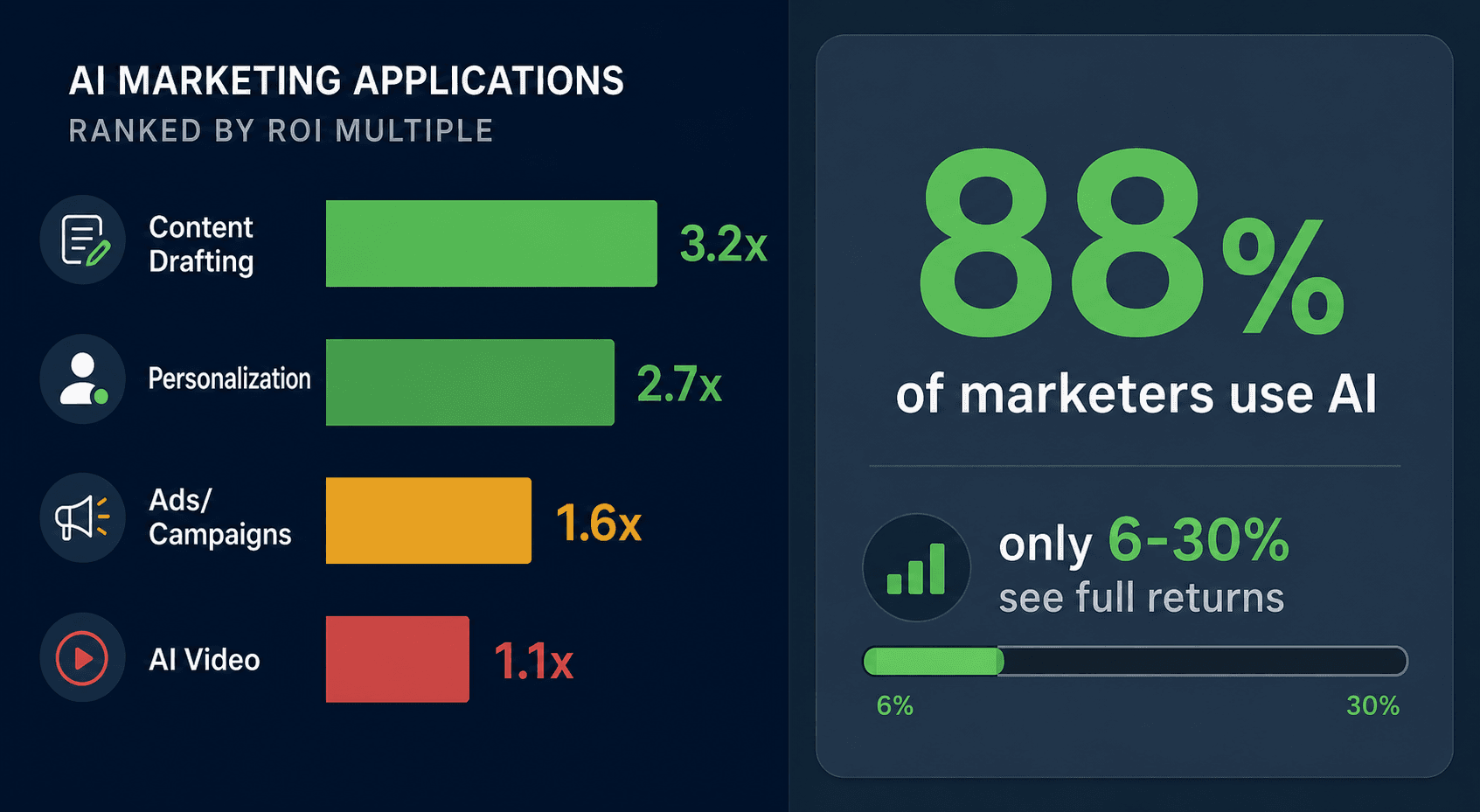
Adidas reduced personalized email creative costs by 91% while driving 37% sales increase — source: multiple independent sources, 2026.
This outcome is independently verified via the primary source linked above.
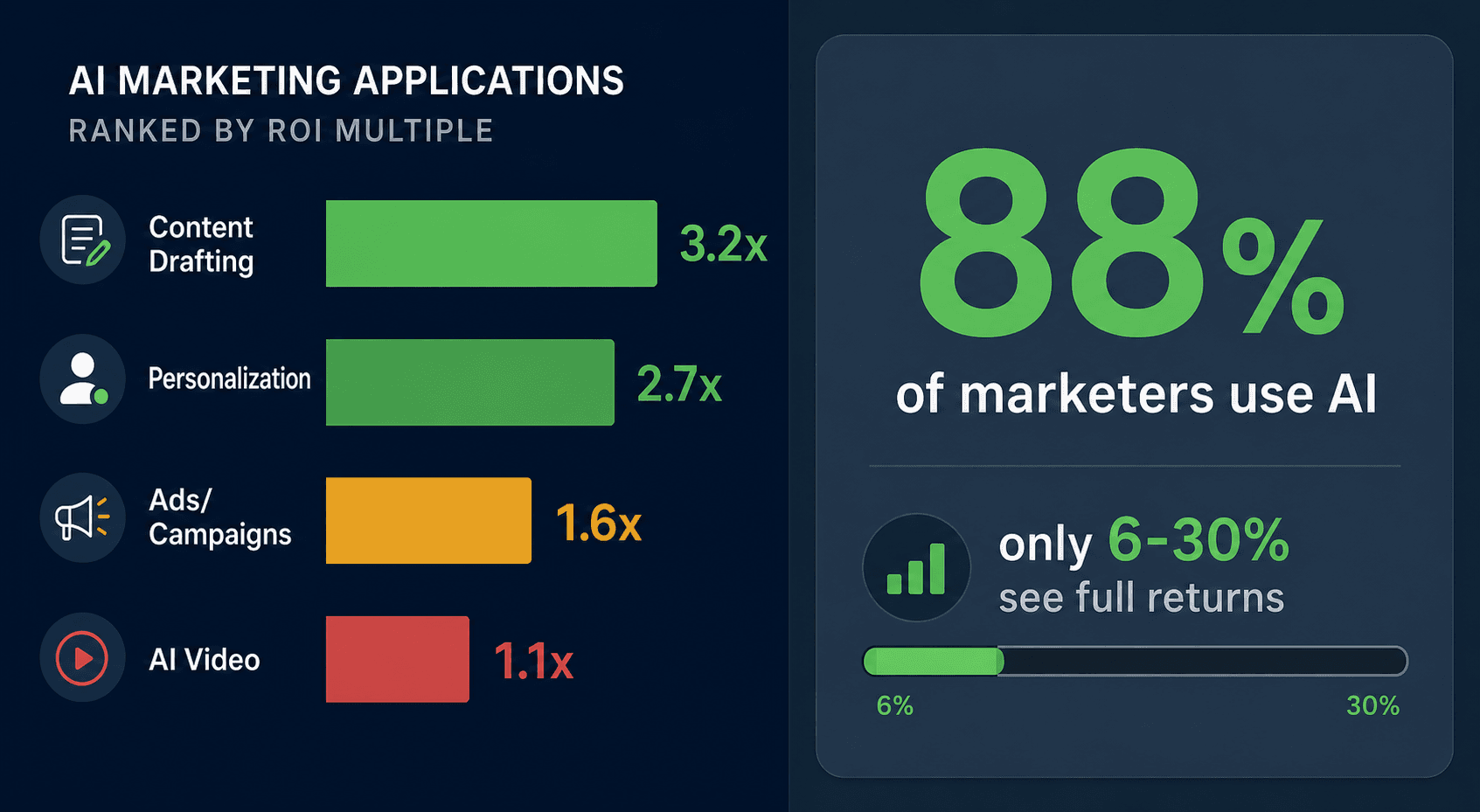
The Adoption-Execution Gap: 88% Use AI, But Only 6–30% See Full Returns
By mid-2026, the question is no longer whether marketing teams are using AI. According to HubSpot's survey of more than 1,500 global marketers, 86.4% of marketing teams now use AI in at least a few areas. Other estimates push that figure as high as 88%. The adoption wall has been scaled. What remains is a far more consequential gap: the distance between sporadic tool use and measurable, repeatable business impact.
Multiple surveys converge on a sobering range: only 6% to 30% of organizations have fully integrated AI across their marketing workflows. The wide spread reflects different definitions of "full integration" — some sources count full automation of entire workflows, while others measure AI embedded across three or more marketing functions. Either way, the majority of teams are stuck in a pilot-and-abandon cycle.
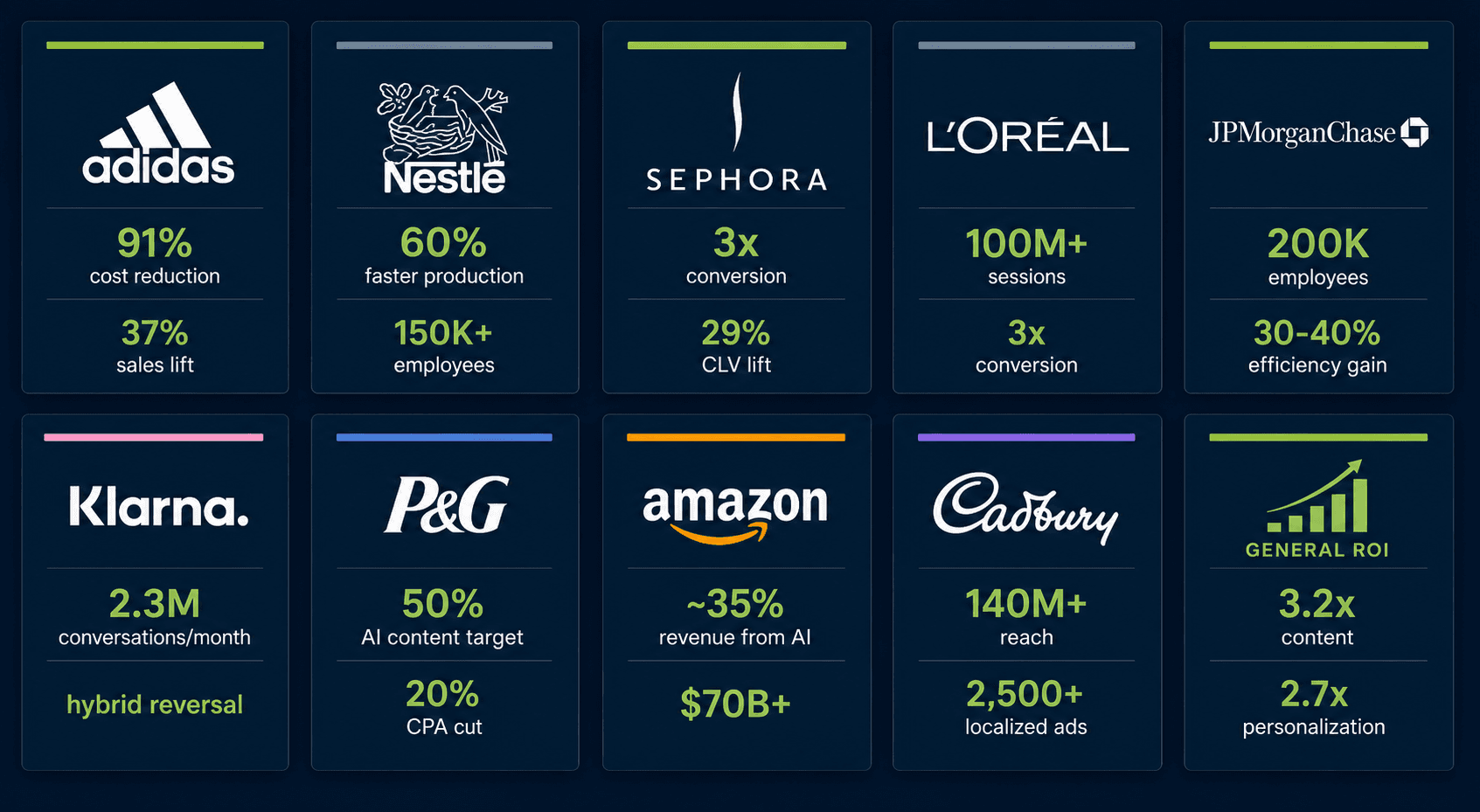
This gap matters because the ROI data is clear. McKinsey's Global AI Survey for 2026 reports that AI content drafting delivers a median 3.2x return on investment (interquartile range 2.4x–4.1x), personalization engines return 2.7x, and audience research tools return 2.4x. The median payback period on AI tooling has dropped to 4.2 months, down from 7.8 months in 2024. The financial case is not the bottleneck.
The real differentiator, then, is not which model a team uses. It is whether the team has built the operational layer — the governed, repeatable workflow — that turns a prompt into a reliable business outcome. The following case studies illustrate exactly what that looks like in practice.
Why Most AI Marketing Experiments Fail
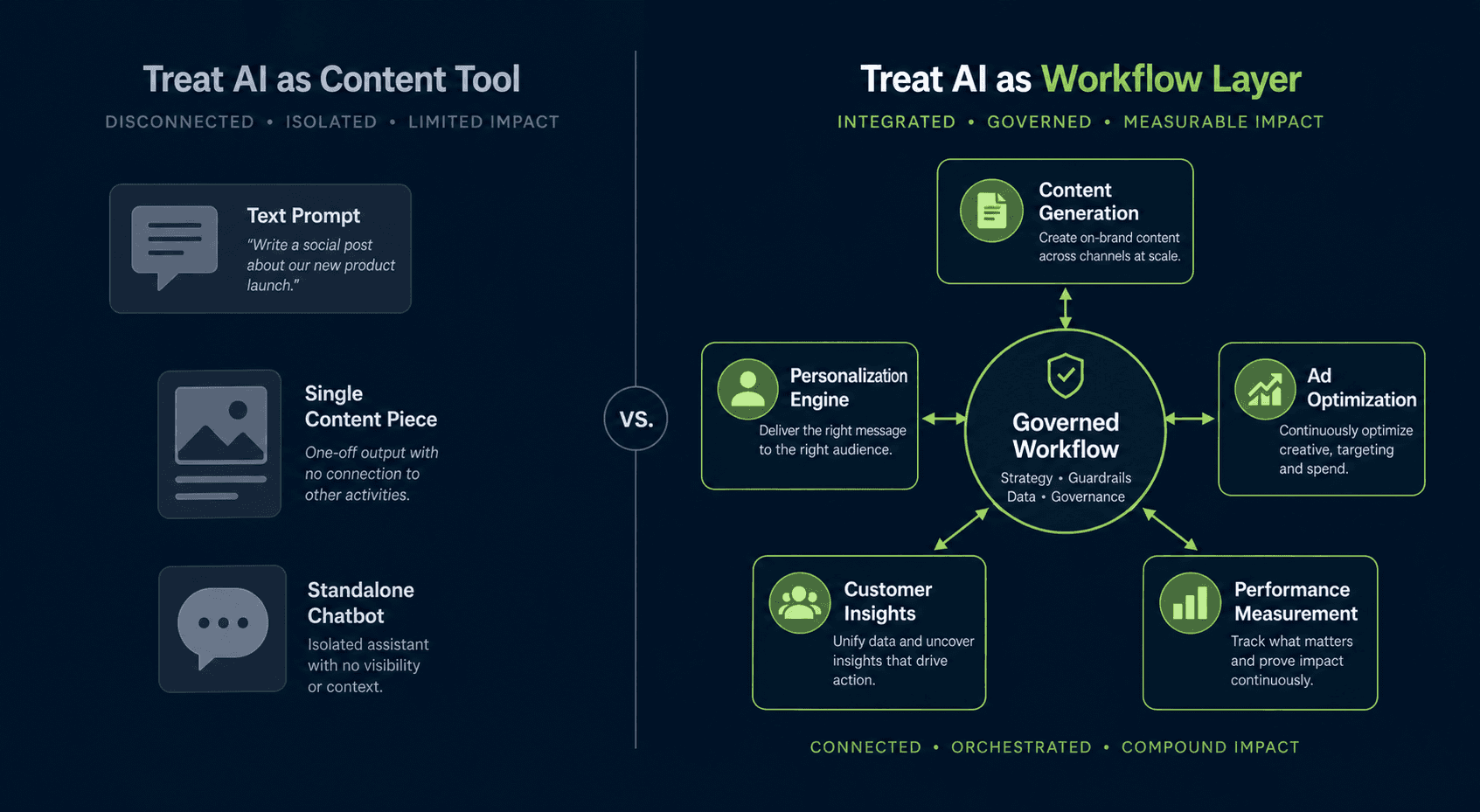
Before examining what works, it is worth understanding the dominant failure pattern. The most common mistake is treating AI as a standalone content generation tool — a faster typewriter — rather than embedding it into a governed workflow that includes validation, iteration, and performance measurement.
The data on agentic AI deployments is instructive. According to aggregated industry data, 29% of autonomous agent deployments are abandoned within 90 days. Meanwhile, 34% of enterprise marketing teams now run at least one autonomous agent in production, up from 14% in Q4 2025. The teams that succeed are the ones that start with a bounded, measurable task and build a human oversight layer before scaling.
The failure pattern typically follows three stages:
- Unbounded experimentation: Teams give AI tools broad mandates ("write our blog content") without defining tone, accuracy thresholds, or review processes. Output quality is inconsistent, and trust erodes quickly.
- No measurement framework: Teams cannot distinguish between AI-generated efficiency gains and normal variation. Without baseline metrics, they cannot prove ROI to leadership, and funding dries up.
- Abandonment after the first failure: A high-profile error — a hallucinated statistic in a published post, a tone-deaf ad variant — triggers a full retreat rather than a process fix. The tool is blamed, not the workflow.
The Klarna case, covered in detail below, is the most public example of this pattern. The company's AI chatbot handled 2.3 million conversations per month and delivered $40 million in profit improvement, but when satisfaction on complex queries dropped, Klarna reversed course and rehired human agents. The technology worked. The workflow for handling edge cases did not.
The brands that follow demonstrate the opposite approach: they start with a specific, bounded task, build a governance layer, measure outcomes rigorously, and iterate based on what the data tells them.
10 Brands With Sourced AI Marketing Results
The following case studies are organized by AI application type. Each entry includes the brand context, the specific challenge, the AI solution deployed, the sourced outcome, and a leader takeaway. All results are drawn from publicly available sources or independently verified aggregations.
Content & Personalization
1. Adidas: 91% Cost Reduction, 37% Sales Lift From Personalized Email
Adidas faced a common challenge in ecommerce: producing personalized email creative at scale for diverse customer segments. Traditional production methods made it prohibitively expensive to tailor imagery and copy to individual preferences.
The brand deployed a generative AI system that dynamically created personalized email creative based on customer browsing and purchase history. The results, documented across multiple sources, are striking: a 91% reduction in creative production costs alongside a 37% increase in sales from the AI-powered email campaigns.
Leader takeaway: Adidas did not use AI to write generic email copy faster. It used AI to solve a specific production bottleneck — personalized creative at scale — and measured the outcome against a clear baseline. The 91% cost reduction made the economics obvious to leadership.
2. Nestlé: 60% Faster Content Production With 150,000+ Employees on NesGPT
Nestlé took an internal enablement approach. The company built NesGPT, a proprietary internal AI tool, and rolled it out to more than 150,000 employees. The tool was designed to assist with content creation, data analysis, and routine communication tasks across the organization.
The impact on content production was dramatic: NesGPT cut content production time by 60%. By embedding the tool into existing workflows and providing training on effective prompting, Nestlé avoided the common failure mode of giving employees access to a tool without a process.
Leader takeaway: Nestlé's approach treats AI as an internal capability multiplier, not a content outsourcing mechanism. The 150,000-employee deployment signals that enterprise-wide AI adoption is achievable when the tool is purpose-built for the organization's specific needs and integrated into existing workflows.
3. Sephora: 3x Conversion, 29% CLV Lift, 200M+ Virtual Try-Ons
Sephora's Virtual Artist is one of the most documented AI applications in retail marketing. The tool uses AI-powered facial analysis combined with augmented reality to let customers try on makeup products virtually before purchasing.
The results, consistent across multiple independent sources, include: a 3x higher purchase completion rate for customers who used the virtual try-on, a 29% increase in customer lifetime value, a 47% increase in cross-category purchases, and a 38% reduction in content production costs. The tool has powered more than 200 million virtual try-ons. Sephora's broader "Beauty OS" platform, which integrates AI across personalization, inventory, and content, drives a 25% increase in average order value from AI-powered recommendations.
Leader takeaway: Sephora's results span multiple outcome types — conversion, CLV, cost reduction, and cross-sell. This is not a single-metric win. The AI layer is embedded across the customer journey, from discovery to purchase to retention.
4. L'Oréal: 100M+ Annual Sessions, 3x Conversion, 30% In-Store Lift
L'Oréal's ModiFace and SkinConsult AI platforms represent the most scaled AI personalization effort in the beauty industry. ModiFace crossed 100 million sessions in a single year, representing 150% year-over-year growth. Users who engage with the AI-powered virtual try-on convert at 3x the baseline rate. Stores that deployed ModiFace saw approximately 30% sales increases. The technology has driven over 1 billion virtual try-ons cumulatively and delivered more than 20 million personalized skincare diagnostics.
Leader takeaway: L'Oréal's scale — 100 million sessions in a single year — demonstrates that AI personalization is not a niche tactic. When the experience is frictionless and the recommendation quality is high, customers engage at mass-market volume.
5. Amazon: ~35% of Revenue ($70B+) From AI Recommendations
Amazon's recommendation engine is the most financially significant AI marketing application in existence. Multiple analyses estimate that AI-powered product recommendations drive roughly 35% of Amazon's total revenue, a figure that translates to more than $70 billion annually. The engine uses collaborative filtering, purchase history, browsing behavior, and real-time session data to surface products customers are statistically likely to buy.
Leader takeaway: Amazon's recommendation system is the existence proof that AI personalization works at internet scale. The key architectural decision was to make recommendations a core platform feature, not a bolt-on campaign tactic. Every product page, email, and search result is a recommendation surface.
Advertising & Creative
6. P&G: 50% AI-Generated Content Target, 20% CPA Reduction
Procter & Gamble set a public target: 50% of its content would be AI-generated by 2025. The company simultaneously deployed AI-powered media buying optimization across its digital advertising portfolio. The combined effect: cost per acquisition dropped by 20% as AI systems optimized both creative production and media placement in a unified loop.
Leader takeaway: P&G's approach connects creative production to media performance. Many brands optimize creative and media in separate silos. P&G's 20% CPA improvement came from treating them as a single AI-driven system where creative variants are tested and scaled based on real-time media performance data.
7. Cadbury: 140M+ Reach With 2,500+ Unique Localized Ads
Cadbury's "Not a Cadbury Ad" campaign in India is a landmark example of generative AI applied to local advertising at scale. The campaign featured Bollywood star Shah Rukh Khan in more than 2,500 unique localized video ads, each tailored to specific regional audiences with localized language, cultural references, and store information. The campaign reached over 140 million people and drove a 32% engagement spike.
Leader takeaway: Cadbury solved the fundamental tension of local advertising — the need for cultural relevance versus the cost of producing hundreds of unique creative assets. Generative AI made the economics of hyper-local advertising viable. The 32% engagement lift proved that relevance at scale outperforms one-size-fits-all creative.
Customer Service & Conversational AI
8. Klarna: 2.3M Conversations/Month, Then the Reversal
Klarna's AI chatbot is simultaneously the most impressive and the most instructive case in this collection. At its peak, the AI handled 2.3 million customer conversations per month, equivalent to the work of 700 full-time agents. Repeat inquiries dropped 25%, and the company reported approximately $40 million in profit improvement from the AI deployment.
Then the reversal came. By 2026, customer satisfaction on complex queries dropped enough that Klarna shifted to a hybrid model and rehired human agents. The AI excelled at routine inquiries — order status, refund tracking, basic troubleshooting — but struggled with nuanced edge cases that required judgment, empathy, or cross-system coordination.
Leader takeaway: Klarna's case is not an argument against AI customer service. It is an argument for honest capability boundaries. The AI handled 2.3 million conversations per month that would otherwise have required 700 human agents. The mistake was not deploying AI — it was treating AI as a complete replacement rather than a tier-one triage system with human escalation paths for complex cases.
Internal Enablement & Efficiency
9. JPMorgan Chase: 200,000 Employees, 30–40% Efficiency Gains
JPMorgan Chase's LLM Suite deployment is the largest documented enterprise AI rollout in the financial sector. The bank made the tool available to approximately 200,000 employees, covering functions from marketing content creation to data analysis to internal communications. Users reported 30–40% efficiency gains on routine tasks and saved 3–6 hours per week.
Leader takeaway: JPMorgan's scale — 200,000 employees — demonstrates that enterprise AI adoption is a change management problem, not a technology problem. The bank invested in training, governance, and use-case identification before rolling out the tool broadly. The 3–6 hours per week saved per employee compounds into massive organizational productivity gains.
10. General ROI Benchmarks: 3.2x Content, 2.7x Personalization
Beyond individual brand cases, the aggregate data from McKinsey's 2026 Global AI Survey provides a useful benchmark for what marketing teams should expect. The survey, based on self-reported executive data, ranks AI applications by ROI multiple:
| AI Application | Median ROI Multiple | IQR Range | Typical Payback Period |
|---|---|---|---|
| Content drafting | 3.2x | 2.4x–4.1x | 3–5 months |
| Personalization engines | 2.7x | 2.0x–3.5x | 4–6 months |
| Audience research | 2.4x | 1.8x–3.1x | 2–4 months |
| Ad copy generation | 2.3x | 1.7x–3.0x | 3–5 months |
| AI video creation | 1.1x | 0.8x–1.6x | 6–9 months |
The average marketer now saves 6.1 hours per week through AI tools, according to HubSpot's 2026 trends data, with senior practitioners saving 8–10 hours and junior staff saving 3–4 hours. AI-driven campaigns overall deliver 22% higher ROI, 32% more conversions, and 29% lower acquisition costs compared to traditional methods.
Comparative Analysis: Which AI Applications Deliver the Highest ROI?
The case studies above span five application categories. The following table provides a side-by-side comparison to help readers match use cases to their organizational context and budget.
| Application Category | Example Brand | Headline Metric | ROI Multiple | Integration Complexity | Best For |
|---|---|---|---|---|---|
| Content drafting & production | Nestlé, Adidas | 60% faster production, 91% cost reduction | 3.2x | Low–Medium | Teams with high content volume and repetitive formats |
| Personalization & recommendations | Amazon, Sephora, L'Oréal | 35% of revenue, 3x conversion, 29% CLV lift | 2.7x | Medium–High | Ecommerce and retail with customer data infrastructure |
| Advertising creative & media | P&G, Cadbury | 20% CPA reduction, 140M+ reach | 2.3x | Medium | Brands with multi-market or multi-segment ad portfolios |
| Customer service / conversational AI | Klarna | 2.3M conversations/month (then reversal) | 1.6x–2.0x | High | High-volume customer service with clear tier-1/tier-2 boundaries |
| Internal enablement | JPMorgan Chase | 30–40% efficiency, 3–6 hrs/week saved | 2.0x–2.5x | Medium | Large organizations with distributed content and data tasks |
A few patterns emerge from this comparison. Content drafting and personalization deliver the highest ROI multiples with relatively lower integration complexity, making them natural starting points for most teams. AI video creation, despite the hype, delivers the lowest ROI multiple at 1.1x — barely above breakeven for most organizations. Customer service AI offers significant volume gains but carries the highest integration complexity and the most documented failure cases.
The Common Thread Across Winners: Workflow, Not Technology
Across all 10 cases, a consistent pattern emerges. The brands that delivered measurable results did not have access to better AI models than their competitors. They built better systems around the models.
The common elements across winning implementations:
- Governed workflows: Every successful case had a defined process for how AI output was created, reviewed, approved, and measured. Nestlé's NesGPT was not a free-for-all — it was a tool embedded in a structured content production pipeline. Sephora's Virtual Artist did not replace human product experts; it augmented the discovery phase of the customer journey.
- Cross-functional integration: The highest-impact cases connected AI output to other business systems. Amazon's recommendations are not a standalone feature — they are integrated into search, email, product pages, and advertising. P&G connected AI creative production to AI media buying in a single optimization loop.
- Human-in-the-loop validation: The Klarna reversal is the cautionary tale that proves this rule. The AI handled 2.3 million conversations per month, but the absence of a robust human escalation path for complex queries created a satisfaction problem that eventually forced a partial retreat. Every successful case maintained human oversight at critical decision points.
- Bounded task scope: The most effective AI deployments solve a specific, measurable problem. Adidas did not ask AI to "do marketing better." It asked AI to generate personalized email creative at scale. Cadbury did not ask AI to "make better ads." It asked AI to produce 2,500 localized video variants of a proven creative concept.
The contrast with the failure mode is stark. Teams that treat AI as a content generation tool — give it a broad prompt, publish the output, move on — consistently underperform. Teams that treat AI as a workflow layer — define the task, build the process, measure the outcome, iterate — consistently outperform.
How to Turn These Case Studies Into Action
If you are a marketing manager or senior practitioner building an internal business case for AI investment, the case studies above provide the proof points. The following action plan translates those proof points into a repeatable process.
Step 1: Identify Your Highest-ROI Application Match
Use the comparative analysis table above to match your team's biggest bottleneck to the AI application with the highest ROI multiple and lowest integration complexity. For most teams, content drafting (3.2x ROI) or personalization (2.7x) is the natural starting point. If your team produces high volumes of repetitive content, start with content drafting. If you have customer data infrastructure and an ecommerce or subscription model, start with personalization.
Step 2: Start With a Bounded Pilot
Define a single, measurable task. Do not try to transform your entire marketing operation in one quarter. Adidas started with personalized email creative. Cadbury started with one campaign in one market. Define the scope, the success metric, and the time frame before you write a single prompt.
Step 3: Define Measurement Criteria Upfront
Before deploying the pilot, establish baseline metrics. What is your current cost per piece of content? Current conversion rate? Current time to produce a campaign asset? Without a baseline, you cannot prove ROI. The brands in this article succeeded in part because they measured before and after.
Step 4: Build a Governance Layer
Define who reviews AI output, what the accuracy thresholds are, and how edge cases are escalated. The Klarna case demonstrates what happens when governance is an afterthought. The Nestlé and JPMorgan cases demonstrate what happens when it is built in from the start.
Step 5: Plan for Human Oversight
Every successful case in this article maintained human involvement at critical decision points. AI handled the volume; humans handled the judgment calls. Document your escalation path before you need it.
The data is clear: 88% of marketers are using AI, but only 6–30% are seeing full returns. The gap is not a technology gap. It is a workflow gap. The brands that close that gap — Adidas, Nestlé, Sephora, L'Oréal, Amazon, P&G, Cadbury, JPMorgan Chase, and even Klarna in its instructive failure — all demonstrate the same lesson. The model is not the product. The system around the model is the product.


Comments
Join the discussion with an anonymous comment.