
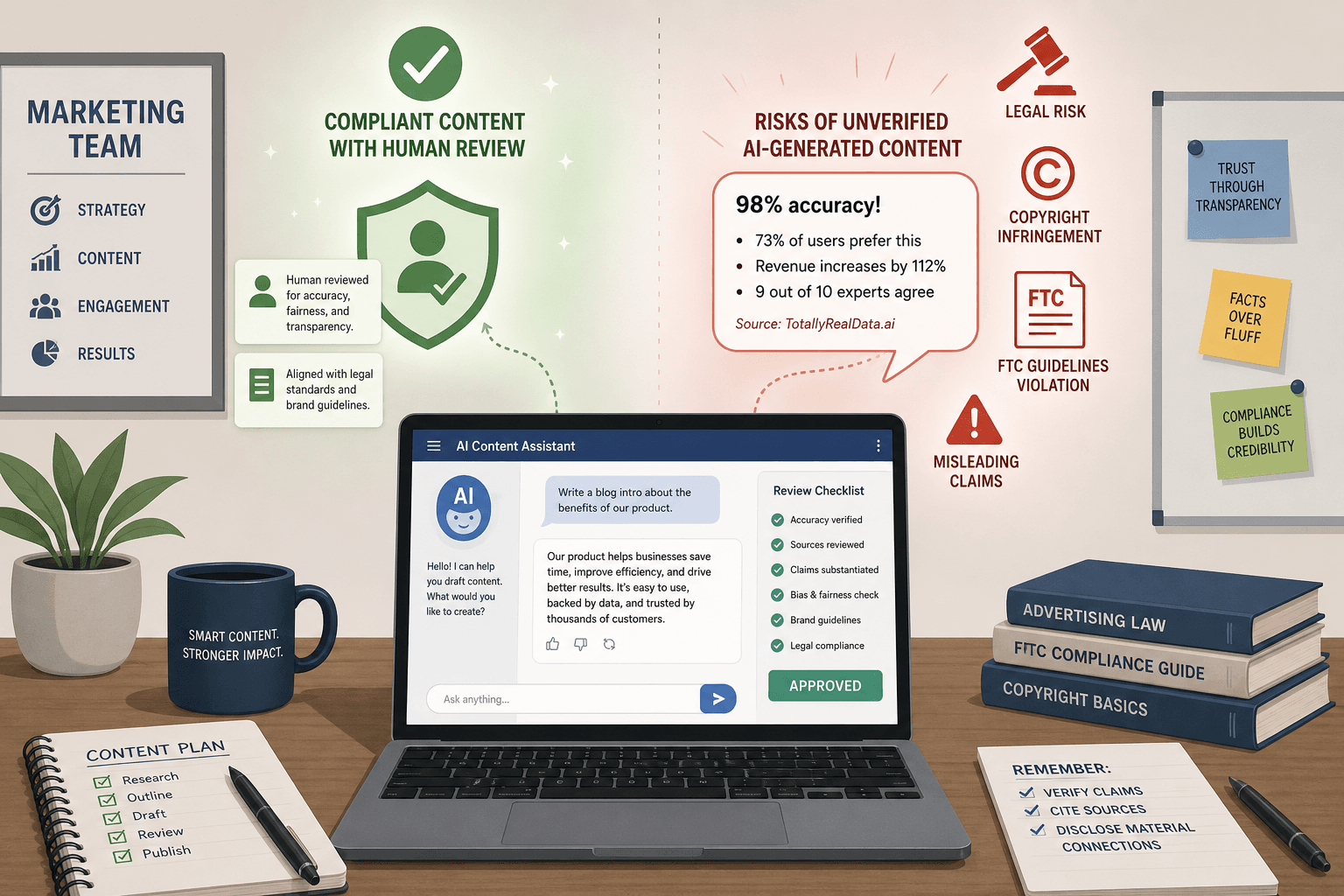
AI-Generated Content Legal Risk Guide: How Hallucinations Create Liability for Your Brand
This guide explains how AI hallucinations in marketing content create direct legal liability for brands—including defamation, false advertising, and FTC enforcement—and provides a verification framework to mitigate these risks. Written for marketing managers and content strategists who need to understand their exposure.
What Are AI Hallucinations and Why They Create Legal Liability
An AI hallucination occurs when a large language model generates information that is factually wrong but presented with complete confidence. The model does not distinguish between truth and fabrication — it produces text that looks plausible regardless of underlying accuracy. For marketers, the danger is not that the output might be wrong, but that it mimics the authority of a reliable source, making it easy to publish without scrutiny.
The critical legal principle that most marketing teams overlook is this: when a hallucination makes it into published content, liability attaches to the brand that published it, not to the AI tool vendor. Courts do not accept “the AI made an error” as a defense. As attorneys from Kelley Kronenberg have stated, the human or business that publishes the content bears full legal responsibility. The same point is reinforced by Keystone Law, which notes that regulatory bodies such as the ASA hold businesses accountable for AI-generated advertising, regardless of how the copy was produced.
This is not hypothetical speculation. Federal copyright infringement can carry statutory damages of up to $150,000 per work (Kelley Kronenberg). Defamation lawsuits can result in expensive settlements and reputational harm. And the Federal Trade Commission has shown it will intervene aggressively when AI-generated claims are unsubstantiated, as we will examine in detail below.
Real Risk Scenarios: When Hallucinations Become Legal Problems
AI hallucinations are not limited to trivial errors. They can produce statements that directly violate advertising law, defame a competitor, or mislead investors. The following scenarios represent the most common ways hallucinated content creates legal exposure for marketing teams.
- Fabricated statistics in reports and white papers. The model invents a data point or research finding, cites a plausible-sounding source, and the marketer publishes it as fact. If the statistic is used in a sales deck or investor material, the consequences can escalate to securities fraud liability.
- False statements about a competitor. A hallucinated claim that a competitor’s product contains a dangerous ingredient or performs below a benchmark can trigger a defamation or product disparagement lawsuit. Keystone Law identifies this as a primary risk area.
- Hallucinated product features or capabilities. AI-generated descriptions of what a product can do may be entirely fabricated. Presenting those claims in advertising or on a packaging label opens the brand to false advertising charges under Section 5 of the FTC Act.
- Made-up testimonials or endorsements. The model may generate a quote attributed to a real person who never said it. The Emerson Thomson Bennett IP firm warns that this can lead to liability for defamation or invasion of privacy, and in some cases, passing-off or misrepresentation when a celebrity is falsely endorsed.
For a detailed catalog of actual brand incidents involving these failure modes, see our companion article AI Hallucination in Marketing Content: Documented Failure Cases and What They Cost. That piece documents real-world examples and their financial consequences without repeating them here.
Legal Exposure Categories: Defamation, False Advertising, and Beyond
Each type of hallucination maps to one or more legal exposure categories. Understanding these categories helps marketing teams determine when AI-generated content requires elevated review.
| Exposure Category | When It Applies | Potential Consequence | Relevant Authority |
|---|---|---|---|
| Defamation (libel or slander) | AI generates a false statement of fact about a person or company that harms their reputation | Lawsuit for damages; legal fees; reputational harm to your brand | Keystone Law; Kelley Kronenberg |
| False advertising (FTC Act §5) | AI makes an unsubstantiated or deceptive claim in ad copy, product description, or social post | FTC enforcement action; consent order; corrective advertising; consumer class action | Benesch Law (Operation AI Comply); Kelley Kronenberg |
| Securities fraud | Hallucinated data or projections appear in investor materials, earnings releases, or pitch decks | SEC investigation; shareholder lawsuits; criminal penalty in severe cases | Inferred from general fraud liability; §10(b) of Exchange Act |
| Product disparagement / trade libel | AI generates false negative statements about a competitor’s product or service | Civil suit; damages; potential injunction against repeated statements | Emerson Thomson Bennett; common law tort |
| Copyright infringement | AI output is substantially similar to a copyrighted work; hallucinated attribution of authorship can also create risk | Statutory damages up to $150,000 per work (Kelley Kronenberg); takedown demands | Kelley Kronenberg |
The table is not exhaustive. New liability theories are still being tested in courts — for example, privacy violations from AI-generated personal data. The key takeaway for marketing leaders is that every piece of AI-generated content should be classified by the highest-risk category it could trigger, not by how likely the hallucination appears.
The FTC’s Position: ‘The AI Made an Error’ Is No Defense
The Federal Trade Commission has made its stance unequivocal: substantiation requirements apply regardless of whether a claim originated with a human copywriter or a generative AI model. Through its ongoing Operation AI Comply initiative, the agency has pursued multiple actions — with more expected — targeting false or unsubstantiated claims produced by or promoted through AI systems.
It is important to distinguish three distinct risk areas within FTC enforcement:
- Disclosure obligations — whether the use of AI must be disclosed to consumers (covered separately in our FTC AI disclosure guide).
- Substantiation requirements — whether the factual claims in the content can be supported by evidence, regardless of their origin.
- Deception risks — whether the overall impression created by the content is likely to mislead a reasonable consumer.
For a full breakdown of current disclosure requirements, including the June 9 and August 2, 2026 compliance deadlines for New York and the EU AI Act, refer to our FTC Disclosure Requirements for AI-Generated Content: A Marketer’s Reference.
Case Study: Workado’s 98% Accuracy Claim vs. FTC’s 53% Finding
A concrete illustration of how AI-generated performance claims attract regulatory scrutiny is the Workado case. The company marketed AI-powered detection software and claimed it achieved 98% accuracy. When the FTC investigated, it found that the actual accuracy rate was only 53% — essentially a coin flip. Workado escaped a monetary penalty but entered into a consent order requiring it to stop marketing the accuracy claim and to submit to ongoing compliance monitoring.
Note that the FTC did not need to prove that Workado’s claim was generated by AI — the issue was that the claim was false and unsubstantiated. The enforcement action demonstrates three practical lessons for marketers:
- Even without monetary penalties, a consent order carries significant compliance costs, legal fees, and reputational damage.
- Performance claims in AI marketing materials are a high-priority FTC target under Operation AI Comply.
- The burden of proof is on the company making the claim, not on the regulator to disprove it.
Another Operation AI Comply case involved Click Profit, which promised customers an “automated, AI-powered system” to generate passive income. The FTC found that 20% of customers earned nothing, and another third made under $2,500. The result: over $20 million in judgments against the company’s founders.
Building a Human-in-the-Loop Verification Framework
The most effective defense against hallucination liability is not better AI detection — it is a structured human-in-the-loop verification process that treats AI output as a raw draft requiring legal-grade review. This framework should operate at three stages:
- Source-checking. Every factual claim generated by AI — statistics, dates, citations, quotes — must be traced to an independent, verifiable source. If the model cites a study, locate the original paper. If it attributes a quote to a named person, confirm the quote exists in a reliable transcript or publication.
- Claim substantiation. Any assertion about product performance, competitive positioning, or customer results must have documented evidence that would satisfy a reasonable substantiation standard — the same standard the FTC applies to advertising claims. Claims without evidence should be flagged and removed before publication.
- Legal review triggers. Define clear thresholds that automatically route content to legal counsel: any content containing competitor names, earnings or revenue projections, medical or safety claims, or testimonials from named individuals. These are high-risk categories where hallucination damage is most severe.
For detailed methods on how to detect hallucinations before they reach publication — including prompt engineering tactics and output validation techniques — see our guide AI Hallucination Detection and Prevention for Marketing Teams. The present article focuses on the legal exposure and the high-level verification architecture; that article covers the tactical detection workflow.
The Insurance Gap: Are You Covered for AI-Generated Claims?
Even with a robust verification framework in place, mistakes can still happen. When they do, many companies discover that their standard business liability insurance policies contain exclusions for claims arising from AI-generated content. Kelley Kronenberg specifically warns that business insurance may not cover defamation or false advertising claims triggered by AI-generated content, leaving companies financially exposed.
As AI-generated content becomes more prevalent in marketing, insurers are starting to add explicit exclusions. The landscape is rapidly evolving. Marketing leaders should add a policy review to their annual compliance agenda and ensure that the limits and scope of coverage match the actual risks their teams face.


Comments
Join the discussion with an anonymous comment.