
Why Most AI Marketing Strategies Fail (and How to Build One That Survives Production)
A diagnostic article for marketing operations leaders and heads of growth who have experimented with AI tools but hit roadblocks. It identifies four specific failure modes that derail 79% of AI marketing initiatives and provides a proven fix playbook to build a strategy that survives production.
The AI Adoption Paradox: 88% Use It, but Only 21% Reach Production Scale
If you are a marketing operations leader or head of growth, you have likely lived this contradiction: your team has experimented with AI tools, maybe even deployed a few, but the results feel scattered. A chatbot pilot that never made it past the test group. A content generation workflow that required so much manual editing it saved no time. A personalization project that stalled when IT flagged data privacy concerns six months in.
You are not alone. According to McKinsey data cited by Writer's CMO Diego Lomanto, 88% of companies now use AI regularly, yet only 21% have reached production scale with measurable returns. That gap — 67 percentage points — is not a technology problem. It is a strategy problem.
Most existing content on AI marketing is aspirational — lists of what AI can do, tool roundups, and generic roadmaps. This article takes a different approach. It is diagnostic. It names four specific failure modes that derail the majority of AI marketing initiatives, each supported by sourced evidence, and provides a fix playbook that operational leaders can apply without waiting for new technology. If you have read our function-by-function guide to AI in digital marketing, consider this the diagnostic companion — it explains why the tactics in that guide fail when the strategic foundation is missing.
Failure Mode 1: The Pilot-to-Production Chasm
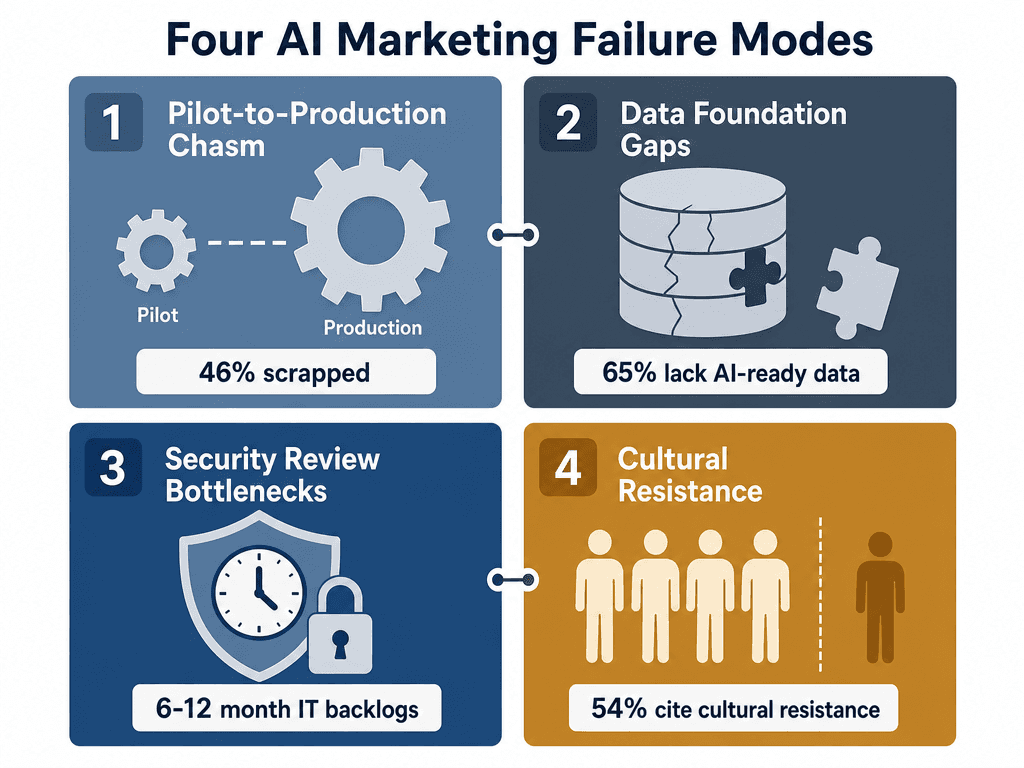
The most common failure pattern is also the most frustrating: a promising proof of concept that never becomes a working part of the marketing operation. S&P Global data from 2025, cited by Writer, found that 46% of AI pilots are scrapped between proof of concept and broad adoption. The same report noted that 42% of companies abandoned most of their AI initiatives in 2025, up sharply from 17% in 2024.
The symptoms are recognizable:
- Manual workarounds replace the AI output because the integration was never completed.
- The pilot team moves on to other projects, and no one owns the transition to production.
- Governance — who reviews output, how errors are handled, what data the tool accesses — was never defined, so the pilot runs indefinitely in a corner.
- The tool works on the clean demo dataset but fails when connected to the actual CRM, CMS, or ad platform.
The root cause is almost never the tool's capability. It is that the pilot was designed as a standalone experiment rather than as the first step in a production deployment. The team optimized for a successful demo — clean data, simple use case, no integration complexity — rather than for the conditions the tool would face in daily use.
Failure Mode 2: Data Foundation Gaps
AI models are only as good as the data they operate on. This is not a theoretical concern — it is the single most common technical reason pilots fail. Writer reports that 65% of organizations either do not have AI-ready data or are unsure if they do. Gartner projects that 60% of AI projects will be abandoned through 2026 when unsupported by AI-ready data.
What does "AI-ready data" mean in practice? It means data that is:
- Structured consistently across systems (the same customer field in your CRM and your email platform uses the same format and definitions).
- Accessible via API or direct integration, not trapped in spreadsheets or PDF exports.
- Clean enough that the AI does not amplify existing errors — because AI does not fix broken systems; it accelerates them, as Laura J. Bal notes in her Medium analysis of AI marketing failures.
- Governed by clear policies on what can be used for model training, what must remain private, and how data retention works.
The painful pattern is this: a team selects an AI tool, runs a successful demo on a curated dataset, then connects it to production data and watches performance collapse. The AI agent that handled customer queries perfectly in the test environment starts generating irrelevant or incorrect responses because the production data contains edge cases, missing fields, and inconsistent formatting that the demo never exposed.
Failure Mode 3: Security Reviews That Kill Momentum
Even when the pilot works and the data is ready, a third wall often appears: the IT and security review process. Enterprise AI pilots face integration and security hurdles that can stall deployment for 6 to 12 months. MIT research from 2025, cited by Writer, found that 95% of enterprise AI pilots fail due to integration gaps.
This is not a technology failure — it is a process failure. Marketing teams typically select an AI tool, build a pilot, and only then approach IT for the security review, data access approval, and integration work. By that point, the IT team has a backlog of similar requests, the tool may not meet data residency requirements, and the integration path the pilot assumed may not be feasible in the production environment.
The fix is straightforward but requires a shift in how marketing teams plan AI initiatives:
- Bring IT and security into the conversation during tool evaluation, not after selection.
- Use pre-vetted platforms that already meet your organization's security and compliance standards.
- Establish a governance framework early that defines data access, output review, and error handling — before the pilot starts.
- Understand regulatory requirements upfront. For teams operating in or serving European markets, the EU AI Act implications for marketing practitioners are particularly relevant — deployer obligations and Article 50 transparency rules can affect which tools are viable and how they must be configured.
Failure Mode 4: Cultural Resistance and Skills Gaps
The most underestimated barrier is human. Writer and McKinsey data indicate that 54% of executives cite cultural resistance as a top barrier to AI implementation. Only 40% of companies provide any formal AI training, and SQ Magazine reports that 70% of marketing professionals say their employer provides none.
Cultural resistance is not irrational. When a marketer hears "AI will handle content generation," they hear "your job is being automated." When a manager sees AI-generated ad copy that needs heavy editing, they conclude the tool is useless. When a team is told to adopt AI without training, they either ignore it or use it in ways that create more work.
The most effective counterargument is not a promise of future efficiency — it is a concrete breakdown of the current work week. Writer's analysis frames this as the 80/20 work split: research suggests that 60-70% of a marketer's time is spent on mechanical, repetitive tasks — formatting data, drafting routine copy, compiling reports — that AI can handle reliably. That leaves only 30-40% of time for strategic work: audience analysis, creative direction, campaign strategy, and judgment calls that require human context. AI does not eliminate the strategic role; it creates space for it.
The Common Thread: Treating AI as a Technology Project Instead of a Transformation Project
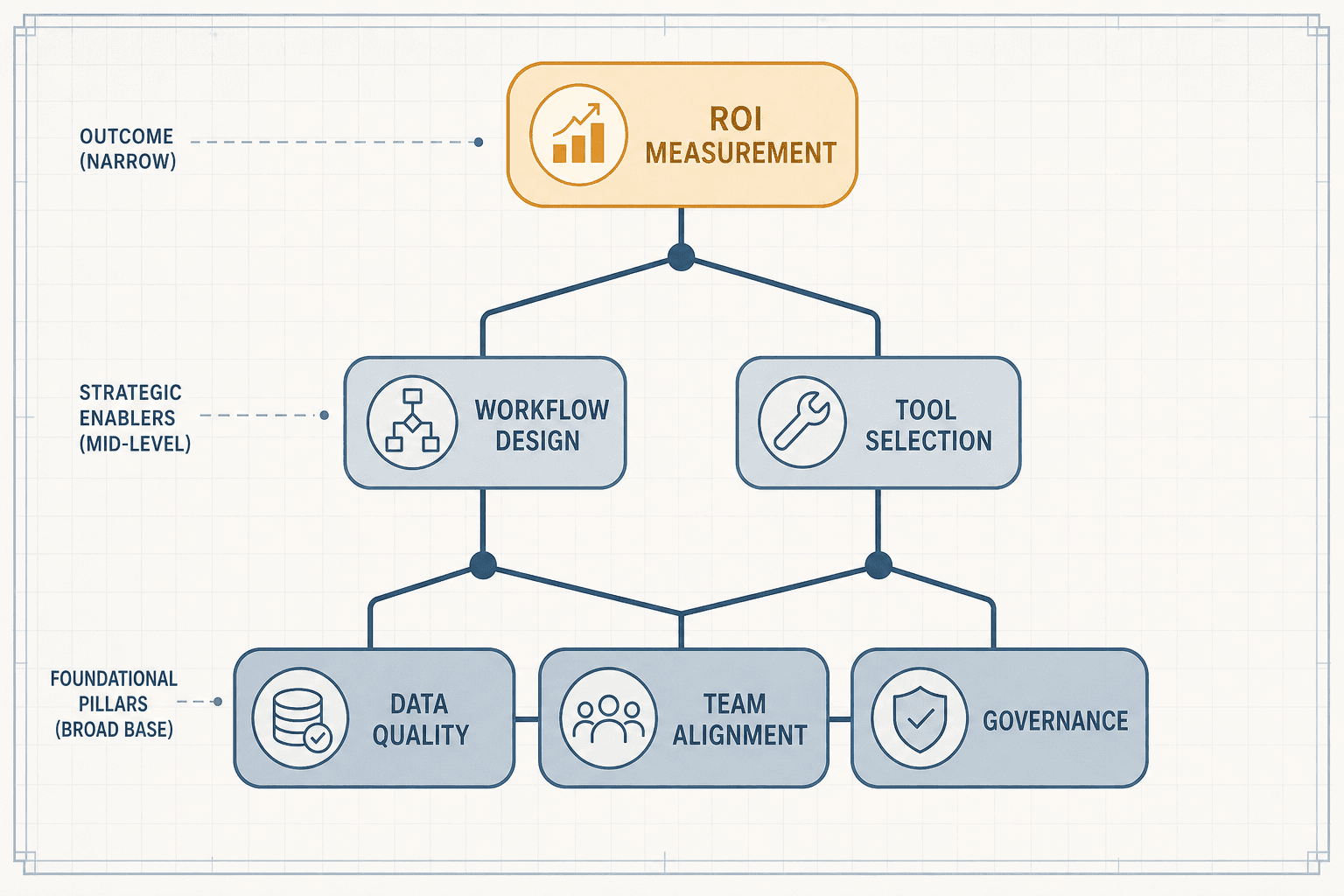
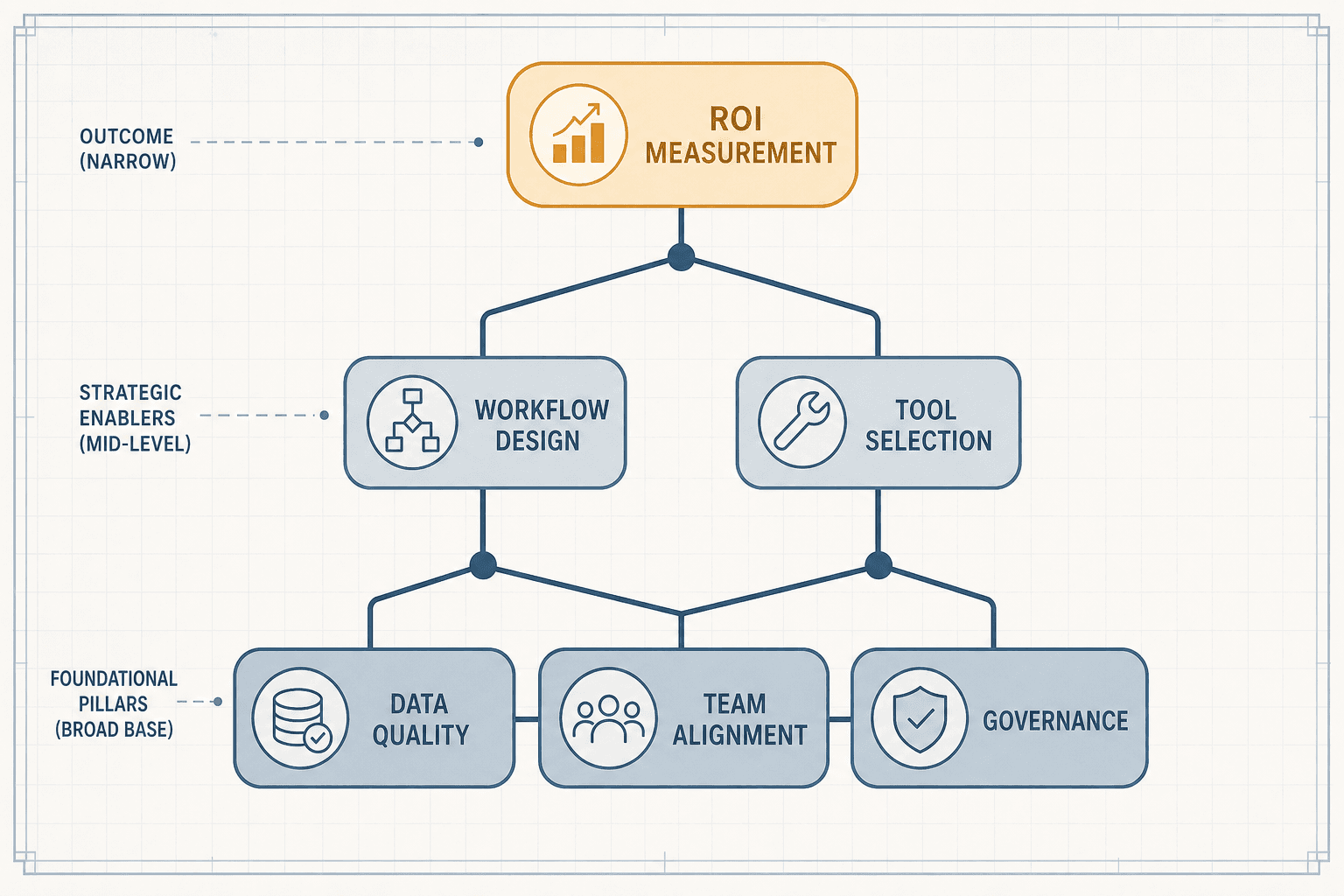
Look across the four failure modes, and a single pattern emerges. Organizations treat AI adoption as a technology implementation — pick a tool, run a pilot, measure ROI — when it is actually a cross-functional transformation that requires data readiness, governance, IT partnership, and cultural change. As Laura J. Bal writes in her Medium analysis, "AI doesn't fix broken systems — it accelerates them." The strongest AI strategies fix existing systems before introducing automation.
This is why the failure rate is so high and why it is rising. The 42% of companies that abandoned most AI initiatives in 2025 (up from 17% in 2024) did not suddenly lose faith in AI. They hit one or more of these four walls and did not have a framework for diagnosing and fixing the problem. They treated the symptom — stalled pilot, bad data, security delay, team pushback — as a reason to stop, rather than as a signal that their approach needed to change.
The Fix Playbook: Five Steps to Build a Strategy That Survives Production
Each failure mode has a known remedy. The following five-step playbook is designed for marketing operations leaders who need to reset a stalled AI initiative or build a new one that avoids these traps from the start.
Step 1: Audit data readiness before selecting tools
Before evaluating any AI tool, assess whether your data can support it. Map the data sources the tool will need — CRM, CMS, ad platform, email service — and check for consistency, accessibility, and cleanliness. If your data is not AI-ready, no tool will fix that. Fix the data first, or budget for the integration work as part of the AI initiative.
Step 2: Design for production from day one
A proof of concept that optimizes for a successful demo will fail in production. Instead, design the pilot with production constraints in mind: use real (or representative) data, include the integration work in the pilot scope, define governance and review processes, and assign ownership for the transition to production before the pilot starts. The Digital Applied planning guide notes that tools connecting seamlessly with existing systems deliver 2.3x better ROI than standalone solutions — integration is not an afterthought, it is a primary ROI driver.
Step 3: Partner with IT upfront and establish governance
Invite IT and security into the tool evaluation phase. Ask them: what are the data residency requirements? What integration paths are feasible? What security review process will this tool need to pass? Establish a governance framework that covers data access, output review cadence, error handling, and compliance with regulations like the EU AI Act before the pilot begins. This turns a 6-12 month bottleneck into a parallel workstream.
Step 4: Address cultural resistance directly with the 80/20 argument and training investment
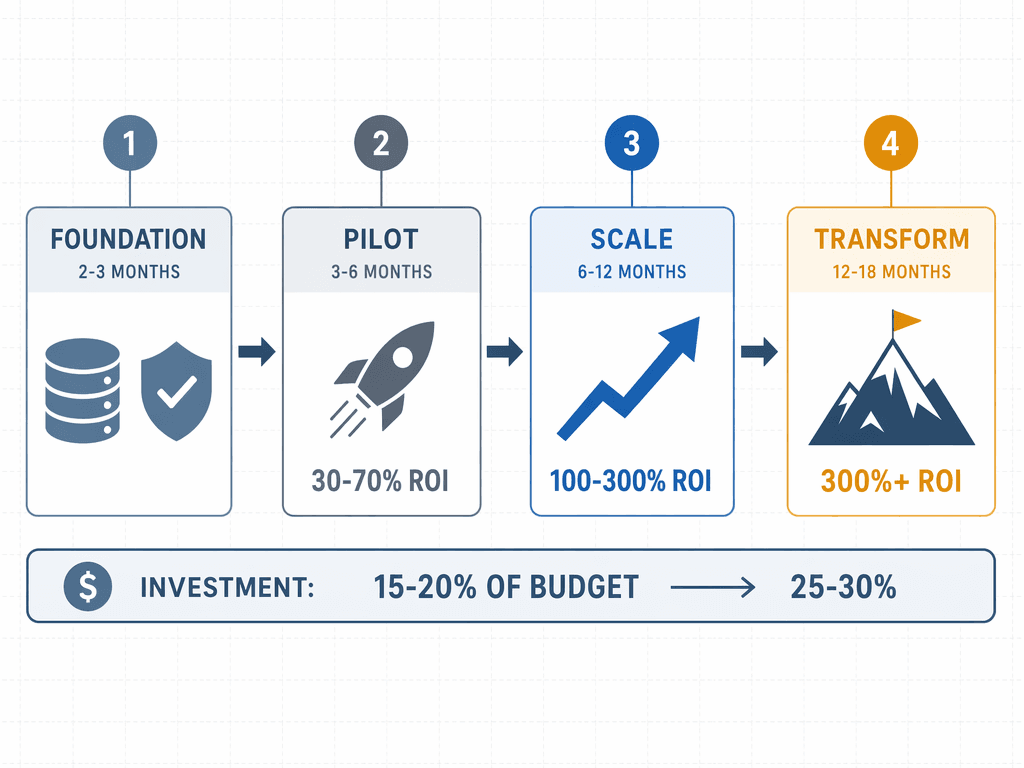
Do not assume that showing a successful demo will win over the team. Address the fear directly. Use the 80/20 work split framing to show how AI changes the role, not eliminates it. Then back it up with investment: Digital Applied recommends allocating 15-20% of the AI budget to training for early adopters, rising to 25-30% for mature programs. Given that 70% of marketing professionals receive no formal AI training, even a modest investment in structured learning will put your team ahead of most organizations.
Step 5: Start with one bounded use case and scale from proven success
The most common strategic error is implementing multiple AI tools simultaneously — Digital Applied calls this "tool overload" and identifies it as a primary pitfall. Instead, select a single, bounded use case where the data is clean, the integration is simple, and the success metric is clear. Prove the model works in production, document the process, and then scale to adjacent use cases.
Hashmeta's phased implementation roadmap provides a realistic timeline for this approach:
| Phase | Duration | Expected ROI Range | Key Activities |
|---|---|---|---|
| Foundation | 2-3 months | Minimal direct returns | Data audit, governance setup, tool selection, IT partnership |
| Pilots | 3-6 months | 30-70% | Single use case deployment, process documentation, team training |
| Scale | 6-12 months | 100-300% | Expand to 2-3 use cases, integrate with core workflows, measure ROI |
| Transform | 12-18 months | 300%+ | Full integration, cross-functional AI workflows, continuous optimization |
Realistic ROI Expectations: What Success Actually Looks Like
The ROI data in the AI marketing space is noisy. Different studies measure different things — time savings, revenue lift, cost reduction — and the best-case figures often dominate headlines while median outcomes go unreported. Here is what the available data actually says, with appropriate caveats.
Across multiple studies compiled by SQ Magazine, AI-optimized campaigns generally see ROI gains in the 15-40% range within the first year. This is the most reliable benchmark for a typical first-year deployment. The same source reports that AI-driven marketing automation yields about 544% ROI over three years ($5.44 for every dollar spent), and that AI-powered content marketing has delivered up to 748% ROI in some B2B scenarios.
More grounded mid-market success patterns emerge from the Digital Applied analysis:
| Success Pattern | Typical Results | Timeframe |
|---|---|---|
| Content acceleration | 3x content output, 40% time savings, 25% increase in organic traffic | 6 months |
| Personalization at scale | 87% higher email open rates, 175% higher click rates, 40% increase in email-attributed revenue | 3-6 months |
| Predictive lead scoring | 140% higher conversion rate, 35% shorter sales cycle, 50% more closed deals with same team | 6-12 months |
The common thread across these patterns is not the size of the ROI number — it is the consistency of the improvement. A 25% increase in organic traffic or a 40% reduction in content production time compounds over time. The organizations that succeed with AI are not the ones chasing the highest headline ROI; they are the ones that build a strategy that survives production, delivers measurable improvement quarter after quarter, and avoids the four failure modes that derail everyone else.
The Forbes analysis of the Constant Contact Q1 2026 Small Business Now report adds a final data point worth considering: 54% of small businesses already use AI marketing tools, and another 27% plan to start this year. By the end of 2026, more than 80% of small businesses will be using AI for marketing. The competitive advantage will not come from adopting AI — everyone will have done that. It will come from adopting AI correctly: with a strategy that survives production, avoids the four failure modes, and delivers results that compound over time.


Comments
Join the discussion with an anonymous comment.