

Why Your AI Marketing Tools Are Underdelivering (It's a Skills Problem, Not a Tool Problem)
Despite widespread AI tool adoption, most marketing teams lack the structured training needed to get consistent results. This article examines the data behind the skills gap and explains why investing in human capability — not just technology — is the highest-leverage move for 2026.
The uncomfortable part of AI powered digital marketing in 2026 is that most teams already have the software. The missing piece is the capability to use it well. In one widely cited survey, 88% of digital marketers said they use AI tools daily, but only 17% had received comprehensive, job-specific training, and 32% said they had received no formal training at all [1].
That gap explains why so many rollouts look good in a demo and then turn into cleanup work for the editor, the manager, or the strategist who has to publish the result. The tool is present. The judgment layer is not. Salesforce has also reported that 58% of marketers cite skills gaps as their top challenge, pointing to the same pattern: adoption has moved faster than skill-building, and the teams that can turn AI output into usable marketing work are still the exception, not the norm [2].
Why the rollout keeps underdelivering
A lot of teams confuse access with competence. Once everyone has a license, it is easy to assume the problem is solved. In practice, the first draft still needs brand checks, factual checks, audience checks, and channel-specific edits. That is why the same tool can produce a usable email subject line for one person and a generic, off-brand mess for another. The issue is not whether the model can generate text. It is whether the team knows how to direct, evaluate, and correct it inside a real workflow.
| What you are seeing | What it usually means | What training changes |
|---|---|---|
| Drafts still need heavy rewriting | The team can prompt a model, but cannot yet judge output against brand, audience, and format | Teach reviewers what good looks like and where to reject fast |
| Results vary by person | AI use is tribal instead of shared | Standardize prompts, examples, and escalation rules |
| Output is fast but inconsistent | There is no repeatable iteration habit | Build a review loop that improves prompts and prompts better questions |
That is also why channel-specific playbooks matter. A team using AI for email, paid social, or landing page iteration is not solving the same problem in each place. If you want to see how that shows up in practice, our guides on AI in Email Marketing and the AI-targeted advertising governance gap show the same split from different angles: the tool can assist, but the workflow still decides whether the work is publishable.
Training is the leverage point leadership keeps underfunding
The strongest practical proof point in the current materials is that organizations investing in employee AI training report 43% higher success rates in deploying AI projects [3]. That figure comes from a vendor source, so it should be read as directional rather than universal, but the managerial lesson is clear: the return on AI does not come from tool access alone. It comes from making more of the team capable of using the tool in a disciplined way.
That matters because the cost of bad AI use is rarely dramatic. It usually shows up as slow cleanup, inconsistent voice, shallow personalization, recycled claims, or a strategist having to rewrite what looked fine in the preview window. Those are not edge cases. They are the normal failure modes of untrained adoption.
- Role-specific prompting: not generic prompt tips, but examples tied to the actual work the person publishes.
- Review standards: what must be checked before AI output can leave a draft state.
- Iteration habits: how to test, compare, and refine output instead of accepting the first pass.
- Escalation rules: when a human should override the model, especially on claims, compliance, or brand voice.
That is the kind of training that changes output quality. Not a one-hour demo. Not a feature tour. A working system for the people who actually have to ship the work.
A useful mental model: Editor, Engineer, Iterator
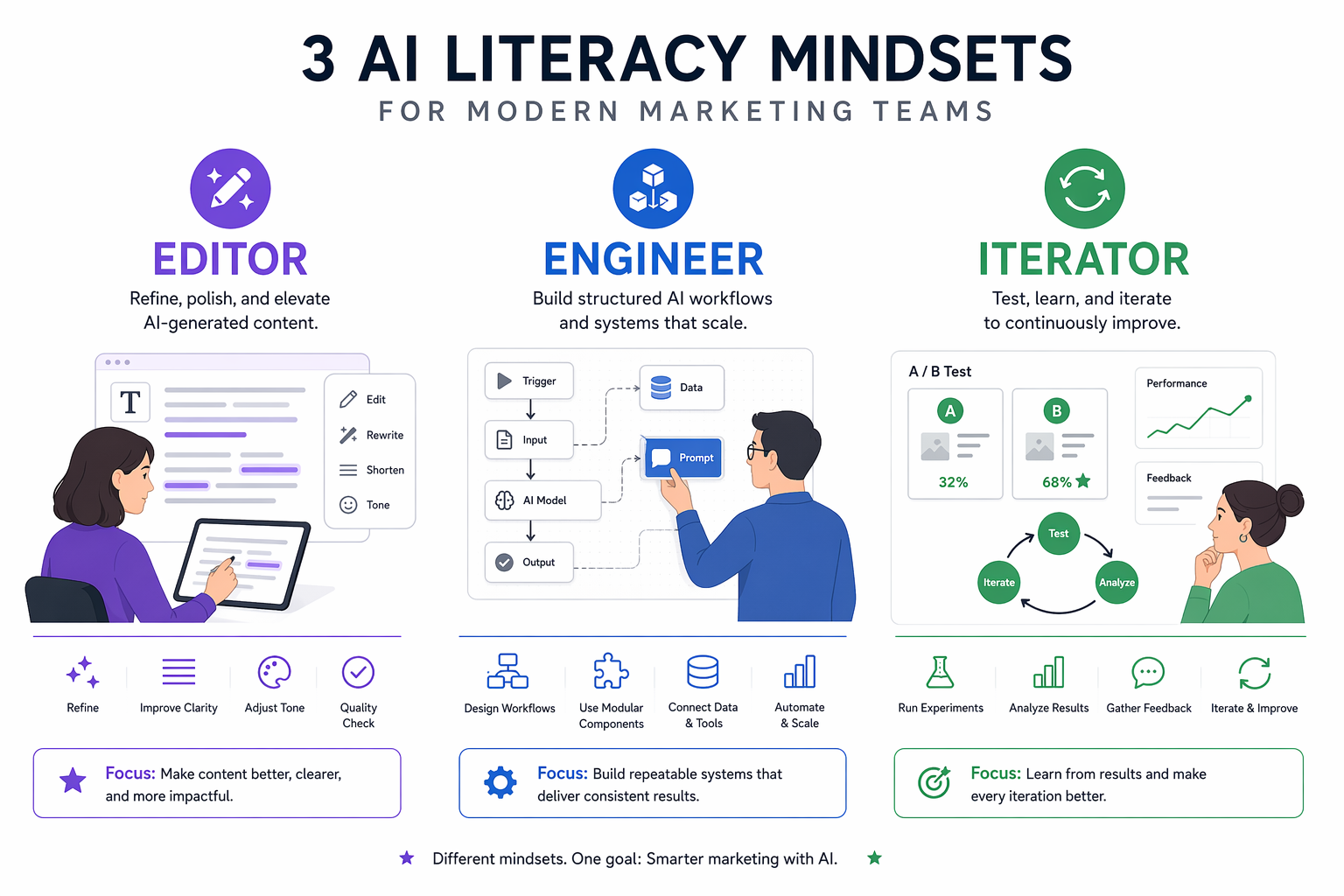
One practical framework splits AI literacy into three working mindsets: Editor, Engineer, and Iterator [4]. The value of the model is not the label itself. It is the reminder that strong AI use requires more than asking for output. Someone has to edit for quality, design the workflow, and keep testing what improves results.
That lines up with the simpler 10-20-70 rule used in some AI marketing discussions: roughly 10% algorithms, 20% technology infrastructure, and 70% people and processes [5]. It is a useful correction to the common mistake of treating AI as a software purchase. Better models help, but better habits change the day-to-day output.
For a manager, the point is not to memorize a framework. It is to assign the work correctly. The editor decides whether the draft is usable. The engineer decides how the team will repeat the result. The iterator keeps the system from freezing into one mediocre prompt that everybody reuses forever.
What trained teams can do that untrained teams usually cannot
The best evidence here is not a fantasy about one platform solving everything. It is the pattern that shows up when AI is embedded into a real workflow. In one case study, Vector trained AI on an executive voice and used it to produce four to five posts per week, which the vendor says drove four times more demo requests [6]. In another, Adore Me used an AI agent system and reported a 36% reduction in time spent on stylist notes [6].
Those are brand-published examples, so they should be treated as selective rather than definitive. Still, they illustrate the right question. The gain did not come from a generic content generator sitting on a desktop. It came from training, constraints, and a workflow that made the output usable for a specific job.
That distinction matters if you are comparing tools. A team that is not clear on review criteria, voice rules, or iteration habits can buy another platform and still get the same disappointing output. A trained team can often get more out of the tools it already owns.
The labor market is making the gap harder to ignore
The same pressure is showing up in hiring. LinkedIn has reported that marketing job listings requiring AI skills have increased 71%, that AI-proficient professionals command 20-30% salary premiums, and that professional AI marketing certification enrollment has increased 300% since 2023 [7]. Salesforce has also reported that 81% of companies plan to increase AI training spend in 2026 [2]. These signals are not a reason to chase every certificate. They are a warning that AI fluency is becoming part of the job, not an optional side skill.
The expensive mistake is treating AI as a procurement problem
That is why the next budget question should be about capability, not just subscriptions. If the team already has AI tools and the results are inconsistent, the most likely constraint is not vendor selection. It is that the people using the tools have not been trained against their actual jobs, their actual review standards, and their actual publishing risks.
In 2026, the most rational move is to put structured training ahead of another tool swap. Start with the workflows that carry the most rework, the most embarrassment, or the most revenue impact. Train the people who touch those workflows. Make the standards explicit. Then measure whether drafts get cleaner, turnaround gets shorter, and the editor has less to rescue.
References
- 1. AI Marketing Statistics — Vsurge Media / DemandGen Report
- 2. Salesforce Marketing Trends — Salesforce
- 3. Iterable AI training success rate statement — Iterable
- 4. AI for Marketing — IMPACT Plus
- 5. AI marketing trends and the 10-20-70 rule — Improvado
- 6. AI Marketing Case Studies — Visme
- 7. LinkedIn AI skills demand and certification growth data — LinkedIn

Comments
Join the discussion with an anonymous comment.