

AI Marketing Cloud
With AI features now table stakes across major platforms, choosing a marketing cloud requires comparing data architecture, channel strengths, and real costs. This guide helps mid-market and enterprise teams evaluate Salesforce, HubSpot, Braze, Adobe, and Klaviyo based on what actually affects performance and budget.
Key Integrations
Marketing Categories
⚠ Notable Limitations
Requires strong data ownership and governance; costs can escalate with add-ons and volume; implementation and admin overhead vary significantly
Last reviewed: June 25, 2026.
The hardest part of buying an ai marketing cloud in 2026 is that the demos have started to sound interchangeable. Salesforce has Agentforce. HubSpot has Breeze. Klaviyo has K:AI. Braze and Adobe have their own AI layers across orchestration, personalization, and decisioning. Nearly everyone can talk about predictive scoring, send-time optimization, generated content, next-best-action logic, and some version of agentic campaign assistance.
That does not mean the platforms are the same. It means the useful comparison has moved down a layer. The buying question is no longer “which vendor has AI?” It is: where does customer data need to live, which channels carry the business, what costs appear after the license, and who will keep the system working after implementation.
| Platform | Best fit | Data model to scrutinize | Cost and setup watchout | Team reality |
|---|---|---|---|---|
| Salesforce Marketing Cloud / Agentforce | Enterprise teams already deep in Salesforce CRM that need governance, orchestration, and agentic workflows | Full value depends heavily on Salesforce CRM, Data Cloud, and the broader Salesforce ecosystem | Agentforce 1 starts around $550/user/month; Data Cloud can add $65K–$175K/year; implementation can range from $10K to $500K+ depending on complexity | Works best with admin, CRM, and martech engineering capacity |
| HubSpot Marketing Hub / Breeze | SMB and mid-market teams that value fast launch, usability, and all-in-one CRM-marketing workflows | Native HubSpot CRM model; easier to operate when HubSpot is already the commercial system of record | Marketing Hub Pro is cited at $890/month with a mandatory $3,000 onboarding fee; contact tiers and agentic add-ons can change the economics | Realistic for lean teams without dedicated martech engineering |
| Braze | Mobile-first and consumer lifecycle teams that need real-time, event-triggered messaging | Event-driven architecture; no mandatory CDP add-on in the comparison materials | Pricing is typically enterprise/custom, so the operational question is event volume, channels, and integration scope | Needs teams that can design event taxonomies and lifecycle logic |
| Adobe Experience Cloud | Large enterprises standardizing around Adobe’s experience, analytics, content, and data stack | Adobe Experience Platform and related products reward centralized enterprise data and experience orchestration | Contracting and implementation tend to be enterprise-scale; public evidence supports positioning more than precise cost benchmarking | Best suited to organizations with established digital experience and data teams |
| Klaviyo / K:AI | Ecommerce retention teams, especially Shopify and BigCommerce merchants | Commerce-native customer and event data, with strong native ecommerce integrations | K:AI features are described as built into existing tiers; setup cost is often zero or minimal in the cited analyses | Fastest fit when the job is lifecycle revenue from ecommerce audiences |
Why the 2026 buying environment feels so noisy
There is a good reason every leadership team is asking about this category. Salesforce reports that 76% of organizations use AI in marketing in 2026, up from 29% in 2021.[1] TechnologyChecker places the AI-in-marketing market at $62.21 billion in 2026 and cites Gartner’s projection that 40% of enterprise applications will feature task-specific AI agents by the end of 2026, up from less than 5% in 2025.[2]
Those numbers explain the boardroom pressure. They do not decide the platform choice. Improvado cites a $47.32 billion AI marketing market in 2025, which is lower than TechnologyChecker’s 2026 figure and likely reflects a different scope: one may count a narrower category of AI marketing software, while the other may include a broader set of AI-influenced marketing spend.[3] Treat market sizing as atmosphere, not as procurement logic.
The more useful market fact is operational, not promotional: marketers actively use only 49% of their martech stack’s capabilities, while martech consumes roughly 22% of the marketing budget, according to Gartner’s 2025 CMO Spend Survey.[4] That is the caution sign hanging over every AI marketing cloud purchase. More capability is not the same as more usable capability.
For a broader role-by-role view of the AI tool landscape, the AI marketing tools by role guide is a better starting point. This article stays narrower: marketing clouds that manage customer data, audience logic, journeys, and owned-channel execution.
The real split is data architecture
AI personalization only performs as well as the data model underneath it. If the profile is incomplete, stale, duplicated, or governed by three teams with different definitions of “active customer,” the AI layer mostly accelerates confusion.
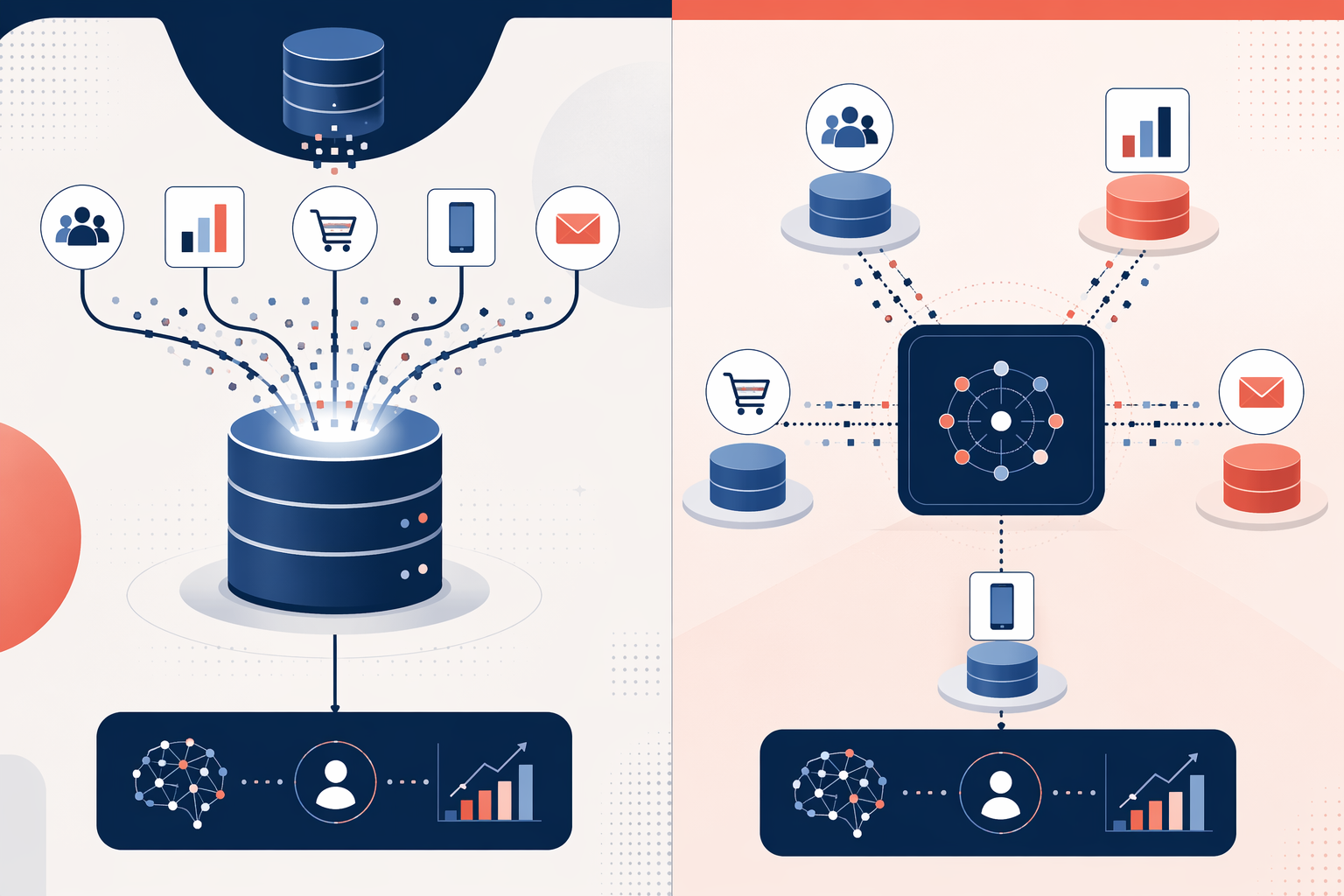
Blueshift’s buyer guide frames the comparison around where data lives, which channels matter, and how quickly the system processes events, rather than around surface-level AI feature lists.[5] That is the right starting point because the same “AI journey orchestration” claim behaves differently in a centralized enterprise data model than it does in an event-driven lifecycle platform or a commerce-native retention tool.
Salesforce: powerful when the company is already organized around Salesforce
Salesforce Agentforce is most compelling when Salesforce CRM is already the commercial center of gravity. In that environment, the promise is not just message personalization. It is the ability to connect sales, service, marketing, and customer profile data into governed workflows that can support enterprise orchestration.
Cloud4Good’s Salesforce-versus-HubSpot comparison argues that Salesforce outpaces HubSpot for AI marketing when an organization already uses Salesforce CRM and needs enterprise-scale agentic orchestration.[6] That condition matters. Without it, a buyer may be purchasing a system whose best capabilities depend on data, process, and administrative maturity the team does not yet have.
The Data Cloud implication should be visible early in evaluation, not discovered after the steering committee signs off. Cloud4Good and related pricing analyses place Data Cloud in a broad $65K–$175K annual range for full agent functionality, while Agentforce 1 is cited at $550 per user per month.[6] TechnologyChecker also cites Salesforce implementation costs ranging from $10K to $500K+ depending on complexity.[2] Those figures are directional rather than contractual, but they are large enough to change the business case.
There are credible upside signals. Rawlings reported 75% faster campaign creation in a Salesforce-cited case covered by SalesforceBen.[7] That is a meaningful result, but it is still a case result, not a default outcome. The buyer’s version of the question is: do we have the Salesforce foundation, admin ownership, data model, and implementation budget that made that kind of result possible?
Adobe: enterprise orchestration for companies already investing in the experience stack
Adobe belongs in the enterprise shortlist when the organization is already serious about experience management, analytics, content operations, and governed customer data. Its strongest case is not “we also have AI.” Its case is orchestration across a broader digital experience stack.
The available evidence supports treating Adobe as an enterprise contender, not turning this into a full Adobe implementation guide. The practical evaluation point is whether Adobe Experience Platform and the surrounding Adobe stack are already part of the company’s operating model. If they are, Adobe can be a logical consolidation path. If they are not, the buyer needs to account for the same enterprise realities that apply to any large suite: data work, governance, implementation services, and specialized administration.
Braze: event-driven lifecycle work, not a generic B2B automation replacement
Braze should be evaluated through the lens of real-time consumer lifecycle marketing. The cited comparisons describe Braze as processing user events in real time with no data-sync lag and as strongest for mobile-first mid-market brands, especially in consumer and retail contexts.[5][8]
That architecture matters for teams where the trigger is the product behavior itself: app session, cart action, content view, subscription state, location signal, or other first-party event. In those cases, the useful unit of marketing operations is not a quarterly segment refresh. It is whether an event can become the right message while the customer is still in the moment.
Braze is less attractive if the team mainly needs a sales-led CRM workflow, a light newsletter tool, or a simple ecommerce email program. It asks for lifecycle thinking, event design, and close coordination between marketing, product, and data teams. That is not a flaw; it is the operating model.
Klaviyo: ecommerce retention with less setup drag
Klaviyo’s clearest fit is ecommerce retention. The cited analyses describe K:AI as purpose-built for ecommerce, with deep Shopify and BigCommerce native integration, minimal or zero setup cost, and AI features built into existing tiers rather than priced as a separate add-on.[8][9]
That matters because ecommerce teams often do not need an abstract customer 360 project before they can create value. They need abandoned cart, post-purchase, replenishment, winback, browse, segmentation, SMS, and email flows that work against commerce data that is already structured around products, orders, and customers.
For ecommerce examples adjacent to this decision, see the AI ecommerce email personalization case studies. Klaviyo should not be stretched into a universal enterprise orchestration answer, but when ecommerce retention is the job, its native data posture is a real advantage.
HubSpot: the speed-to-value option, with contact economics attached
HubSpot’s advantage is not that Breeze has the most exotic AI branding. It is that many teams can actually use the system quickly. HubSpot is easier to justify when marketing, sales, forms, CRM data, landing pages, email, reporting, and automation already sit close together in the same operating environment.
Averi’s cost analysis cites HubSpot Marketing Hub Pro at $890 per month with a mandatory $3,000 onboarding fee, and notes that Breeze is included while agentic orchestration comparable to Agentforce is a separate add-on.[9] The same source and comparison materials flag contact-tier escalation as the place where HubSpot can become less lightweight than the first quote suggests.[8][9]
For teams without dedicated martech engineering support, that trade may still be rational. A platform that launches in weeks and gets used every day can beat a more powerful system that spends six months waiting on integrations, field mapping, and governance decisions. The danger is buying HubSpot as if it will behave like a deeply customizable enterprise orchestration layer. It is usually strongest when the company accepts the HubSpot way of working rather than trying to rebuild a complex enterprise architecture inside it.
TCO is where the AI demo gets honest
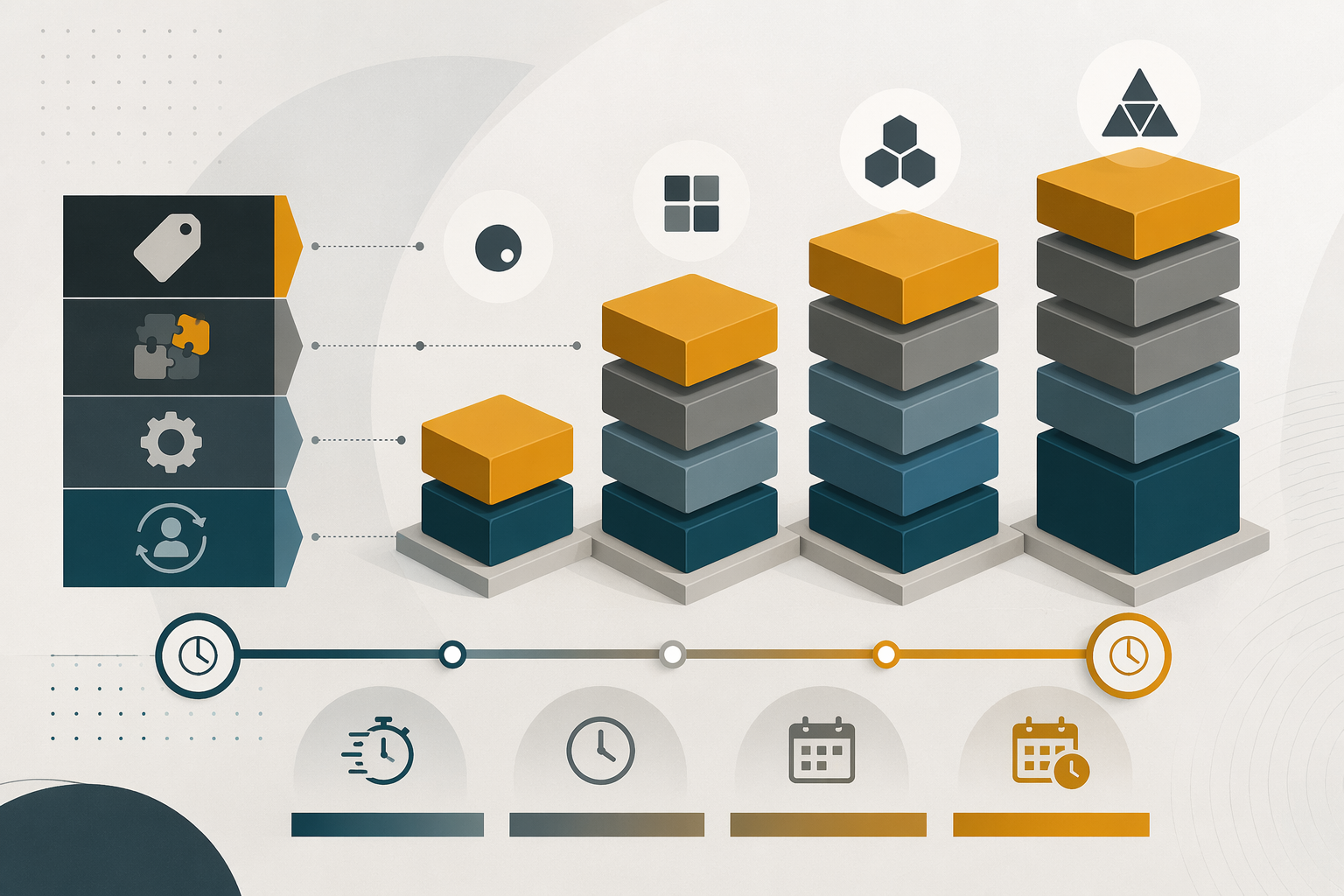
The sticker price is rarely the full cost of an AI marketing cloud. The practical budget usually has four layers: license, mandatory platform components, implementation, and ongoing administration.
| Cost layer | What to ask before signing |
|---|---|
| License and seats | Which users need paid seats, and does AI access change the seat model? |
| Contacts, profiles, or events | Does price rise with contacts, customer profiles, event volume, messages, or data storage? |
| Mandatory add-ons | Is a CDP, data cloud, onboarding package, premium AI module, or orchestration add-on required for the use case shown in the demo? |
| Implementation | Who maps data, configures journeys, handles identity resolution, migrates assets, and validates reporting? |
| Ongoing administration | Does the team need a CRM admin, lifecycle operator, data engineer, agency partner, or platform specialist after launch? |
Salesforce is the clearest example of why this matters. A low-level comparison of AI features misses the cost of making the AI operational: CRM alignment, Data Cloud, identity work, permissions, object design, journey logic, testing, and ongoing admin. The economics can be justified in the right enterprise environment, but the buyer should compare the full operating cost against the full operating benefit, not against a campaign-generation demo.
HubSpot’s version of TCO is different. The implementation burden is usually lighter, but contact tiers and add-ons can make the platform more expensive as the database grows. Klaviyo’s version is different again: lower setup friction for ecommerce retention, but the buyer still needs to model list growth, message volume, and revenue attribution expectations. Braze pricing is less easily reduced to a public sticker figure, so the evaluation should focus on event volume, channel mix, real-time requirements, and integration scope.
This is also where executive consolidation pressure needs a fair hearing. A single vendor relationship can reduce procurement friction, simplify security review, and make accountability clearer. But consolidation only pays off if the operating team can implement and govern the suite. Otherwise, it creates a cleaner contract and a messier workweek.
Channel posture matters more than the AI label
Most platforms can now say something plausible about email, SMS, segmentation, personalization, and journey orchestration. The sharper question is which channel behavior the platform was built to support.
- If the business runs on enterprise account data, sales-service-marketing coordination, permissions, and governance, Salesforce deserves serious evaluation.
- If the business needs enterprise experience orchestration across content, analytics, and digital properties already connected to Adobe, Adobe belongs in the conversation.
- If the lifecycle program depends on real-time behavioral events across mobile, web, email, push, and SMS, Braze is closer to the center of the problem.
- If the revenue motion is ecommerce retention, Klaviyo’s commerce-native integrations are more important than broad enterprise suite depth.
- If the team needs CRM, forms, email, landing pages, reporting, automation, and AI assistance in one usable mid-market workspace, HubSpot is often the fastest path to value.
For teams specifically evaluating owned-channel AI, the AI in email marketing guide is useful background. But email capability alone should not decide a marketing cloud purchase unless email is genuinely the primary operating surface.
What these platforms do not automatically solve
A marketing cloud is not a cure for weak data ownership. If lifecycle, sales, product, support, and analytics teams do not agree on customer identity, lifecycle state, consent, and success metrics, AI orchestration mostly gives disagreement more places to travel.
The data foundation work is usually less glamorous than the platform search, but it is the part that determines whether the system becomes useful. The AI marketing adoption and data foundation roadmap goes deeper on that prerequisite.
Marketing clouds also do not replace every adjacent AI tool category. A content platform such as Jasper, covered separately in the Jasper AI agentic platform review, serves a different job from a customer journey platform. Paid media and acquisition creative have their own workflows as well; the AI digital advertising benchmark playbook is the better place for that operating model.
Soku’s comparison is useful on platform positioning and is consistent with other materials on several vendor-level claims, but its argument that the main gap is acquisition creative should be read as vendor framing rather than as a neutral category conclusion.[8] Acquisition creative may be a real gap for many teams. It is not the central buying criterion for every AI marketing cloud evaluation.
A practical selection path
Before comparing product pages, write down the job the platform must perform in the first year. Not the five-year transformation slide. The first-year job.
- Name the primary revenue motion: ecommerce retention, product-led lifecycle, sales-led demand generation, enterprise customer orchestration, or digital experience management.
- Map where customer data lives today and which system is allowed to become the customer profile source for marketing decisions.
- List the channels that actually drive business outcomes, not the channels the vendor can technically support.
- Model TCO using license, contacts or events, required add-ons, onboarding, implementation, migration, and ongoing admin time.
- Ask who will own the platform after launch: marketing ops, CRM admin, lifecycle marketing, data engineering, agency partner, or a combination.
- Require the demo to use your actual constraints: consent rules, messy fields, duplicate identities, regional requirements, current CRM structure, and realistic campaign volume.
This process tends to narrow the field quickly. A company already standardized on Salesforce with complex sales-service-marketing workflows should not pretend a lightweight tool will replace enterprise architecture. A lean ecommerce team should not buy a heavy enterprise suite because the AI assistant gave a better demo script.
Which AI marketing cloud should you choose?
Choose Salesforce when enterprise data unification, CRM depth, governance, and agentic orchestration justify the Data Cloud, implementation, and administration overhead. It is strongest when Salesforce is already the operating backbone.
Choose Adobe when the company is already building around Adobe’s experience, content, analytics, and data ecosystem, and when the goal is broader enterprise experience orchestration rather than a narrower lifecycle messaging tool.
Choose HubSpot when speed, usability, and an all-in-one CRM-marketing workspace matter more than deep customization. Watch contact-tier growth and agentic add-on costs before calling it the low-cost option.
Choose Braze when real-time, event-driven, cross-channel consumer lifecycle execution is the center of gravity. It is a stronger fit for teams that can manage events and lifecycle logic than for teams looking for a simple campaign tool.
Choose Klaviyo when ecommerce retention is the primary job and native Shopify or BigCommerce integration will reduce setup friction. Its AI layer is most persuasive when the commerce data model already matches the marketing work.
The platform names and agentic features will keep changing through 2026. The durable buying question is not whose AI sounds most advanced. It is which system your team can feed, govern, afford, and use.
References
- Marketing Statistics: 100+ Insights for 2026, Salesforce.
- AI in Marketing Statistics 2026: 35 Stats on Adoption, ROI and Trust, TechnologyChecker.
- 7 AI Marketing Trends for 2026, Improvado.
- Gartner AI Marketing Technology Forecast 2025: Adoption, Spend, and Stack Utilization, Signal & Convert.
- Best AI Marketing Agent Platforms (2026): A Buyer's Guide, Blueshift.
- Why Salesforce Marketing Cloud Outpaces HubSpot for AI Marketing, Cloud4Good.
- How Salesforce Is Rebuilding Marketing Cloud for the Age of AI, SalesforceBen.
- AI Marketing Cloud (2026): What It Is, the Best Platforms, and Where It Stops, Soku.
- What AI Marketing Software Actually Costs in 2026, Averi.

Comments
Join the discussion with an anonymous comment.