
AI in Digital Advertising: Where It Works, Where It Doesn't — The 2026 Benchmark-Driven Playbook
A data-driven guide for paid media managers evaluating AI ad tools in 2026. Covers the specific AOV thresholds where AI creative outperforms humans, the conversion gaps on high-consideration purchases, and a structured hybrid framework for allocating AI vs. human effort across campaigns.
The State of AI in Advertising in 2026
The adoption numbers for 2026 have settled the "should we use AI?" debate for most serious advertisers. According to the Digital Applied 2026 dataset, 67% of the top 500 advertisers now use AI-generated creative, 74% run Google Performance Max, and 68% use Meta Advantage+. The global AI-in-advertising market has reached $14.2 billion, embedded in a total digital ad spend of $740 billion.
The Smartly 2026 Digital Advertising Trends Report, surveying 450 marketing leaders across the US, UK, and Germany, found that 46% of marketers now use AI to scale creative, and 33% run AI across creative, media, and measurement simultaneously. The question has shifted from adoption to allocation: where does AI actually outperform human effort, and where does it create measurable drag on performance?
This article answers that question with a single framework built on the 2026 AI Ad Creative Benchmarks dataset — 50,000+ ad variations across Meta, Google, and TikTok — and provides a structured allocation model for paid media teams.
Where AI Wins: CTR, Speed, and Scale
The headline numbers from the Digital Applied 2026 benchmark dataset are unambiguous on three dimensions: click-through rate, production velocity, and creative volume.
| Metric | AI Advantage | Source / Context |
|---|---|---|
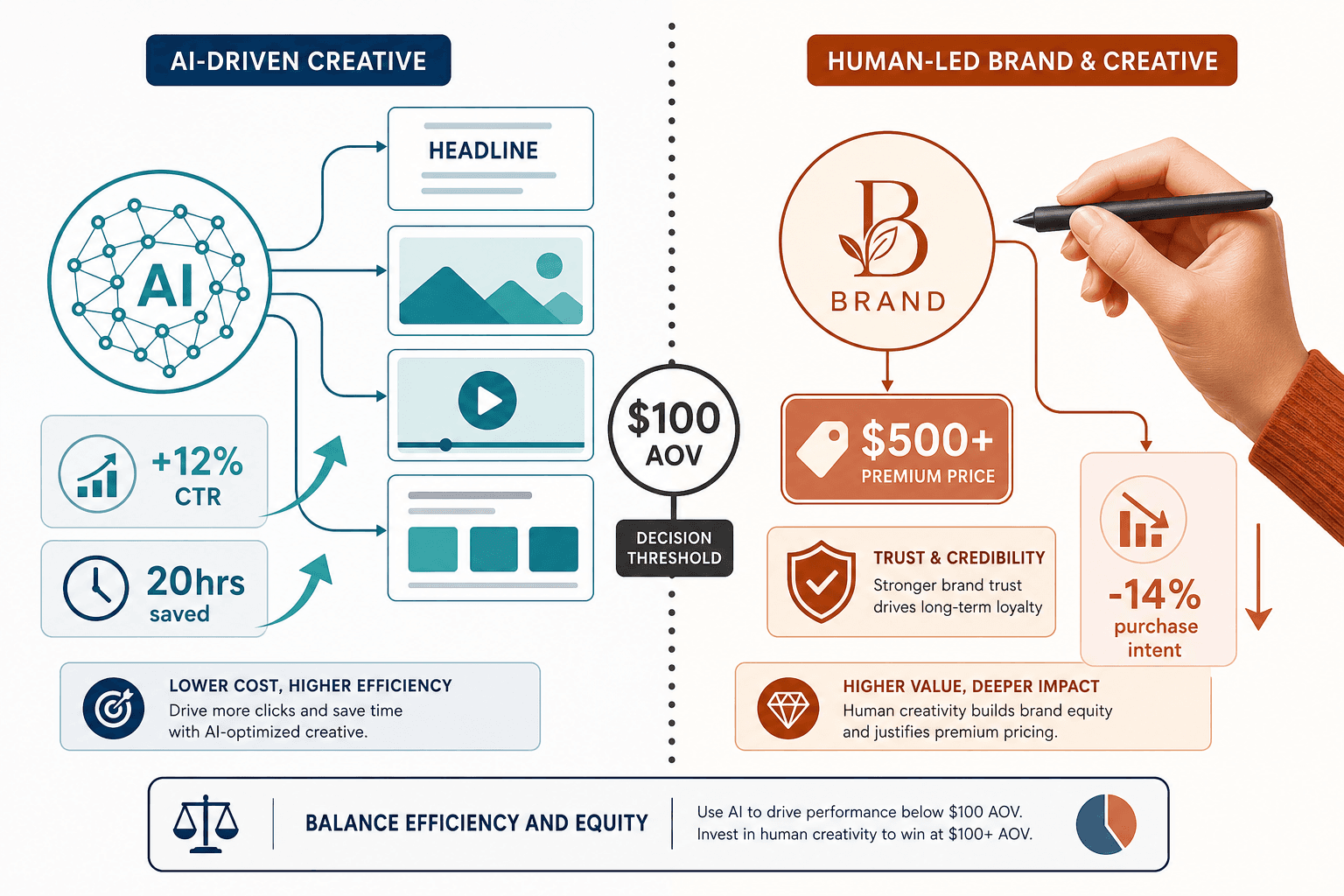
| CTR improvement (Meta) | +12% vs. human-created ads | Digital Applied 2026 Benchmarks (50,000+ variations) |
| CTR improvement (cross-platform) | +18% average with AI-optimized variants | Digital Applied 2026 dataset |
| Creative variants tested per campaign | 5.2x more with AI tools | Digital Applied 2026 dataset |
| Production time saved | ~20 hours/week per team | Industry estimate from multiple sources |
| Manual optimization reduction | 60-70% less time | Improvado 2026 guide |
| CPA improvement vs. rule-based automation | 15-30% | Improvado 2026 guide |
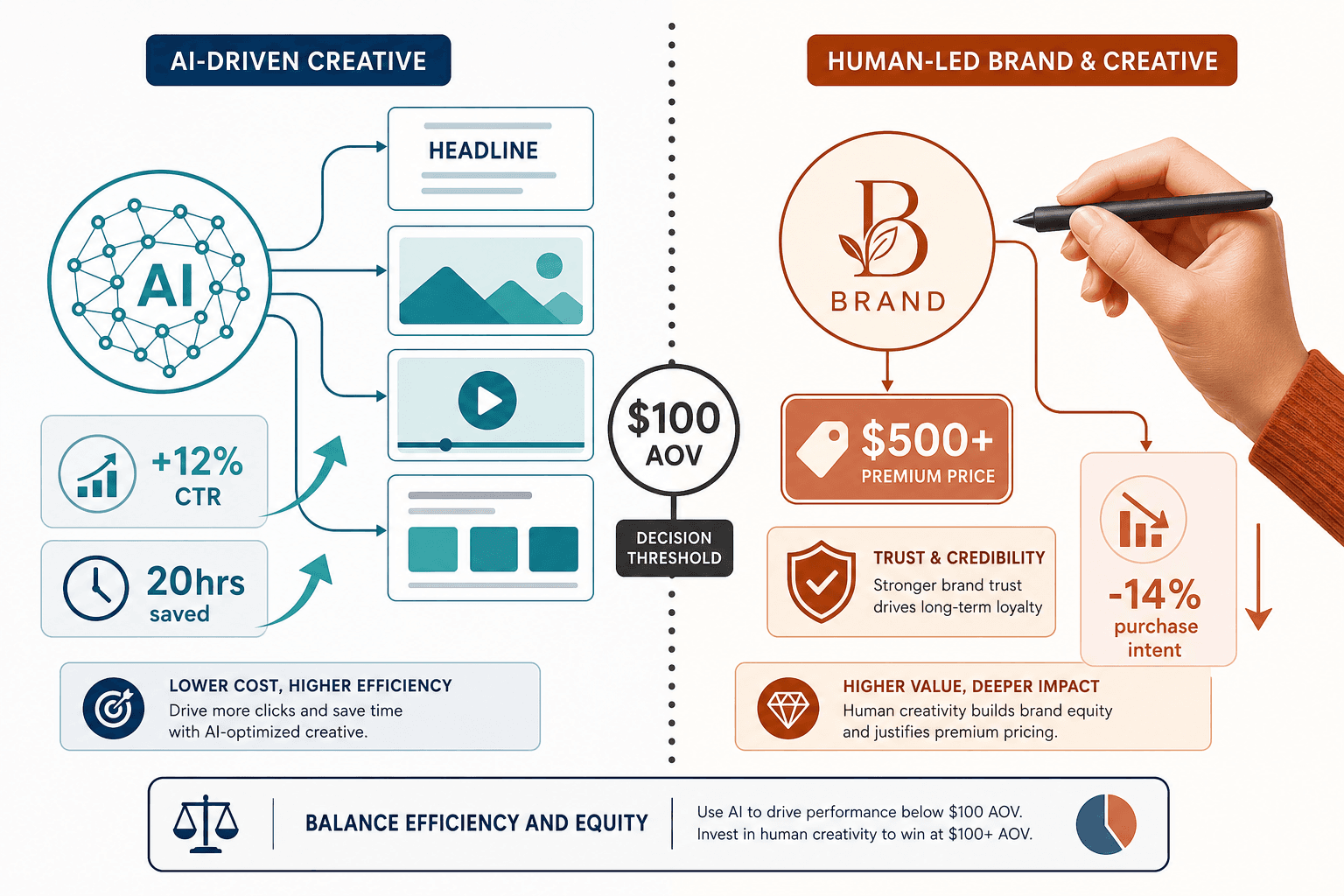
These advantages are most pronounced in direct-response campaigns with low average order values. When the purchase decision is simple, the product is familiar, and the price point is under $100, AI-generated creative consistently outperforms human-written copy on the metrics that matter most for volume-driven campaigns: CTR and CPA.
The scale advantage is also structural. Google reported that advertisers used Gemini to generate nearly 70 million creative assets inside AI Max and Performance Max campaigns in Q4 2025 alone — a 3x year-over-year increase. No human team can match that volume, and for low-consideration purchases, the volume itself drives statistical learning that improves bidding and targeting.
Where AI Loses: The Conversion Gap on High-AOV Purchases
The Digital Applied 2026 benchmark dataset reveals a consistent and significant conversion gap when AI-generated creative is used for higher-value purchases. This is the single most important data point for paid media teams deciding how to allocate AI vs. human creative effort.
| Purchase Threshold | Conversion Gap (AI vs. Human) | Source |
|---|---|---|
| Under $25 AOV | No significant gap (AI parity achieved early 2025) | Digital Applied 2026 Benchmarks |
| $100+ AOV | 8% conversion gap | Digital Applied 2026 Benchmarks |
| $500+ AOV | 14% conversion gap | Digital Applied 2026 Benchmarks |
| B2B lead generation | 18% conversion gap | Digital Applied 2026 Benchmarks |
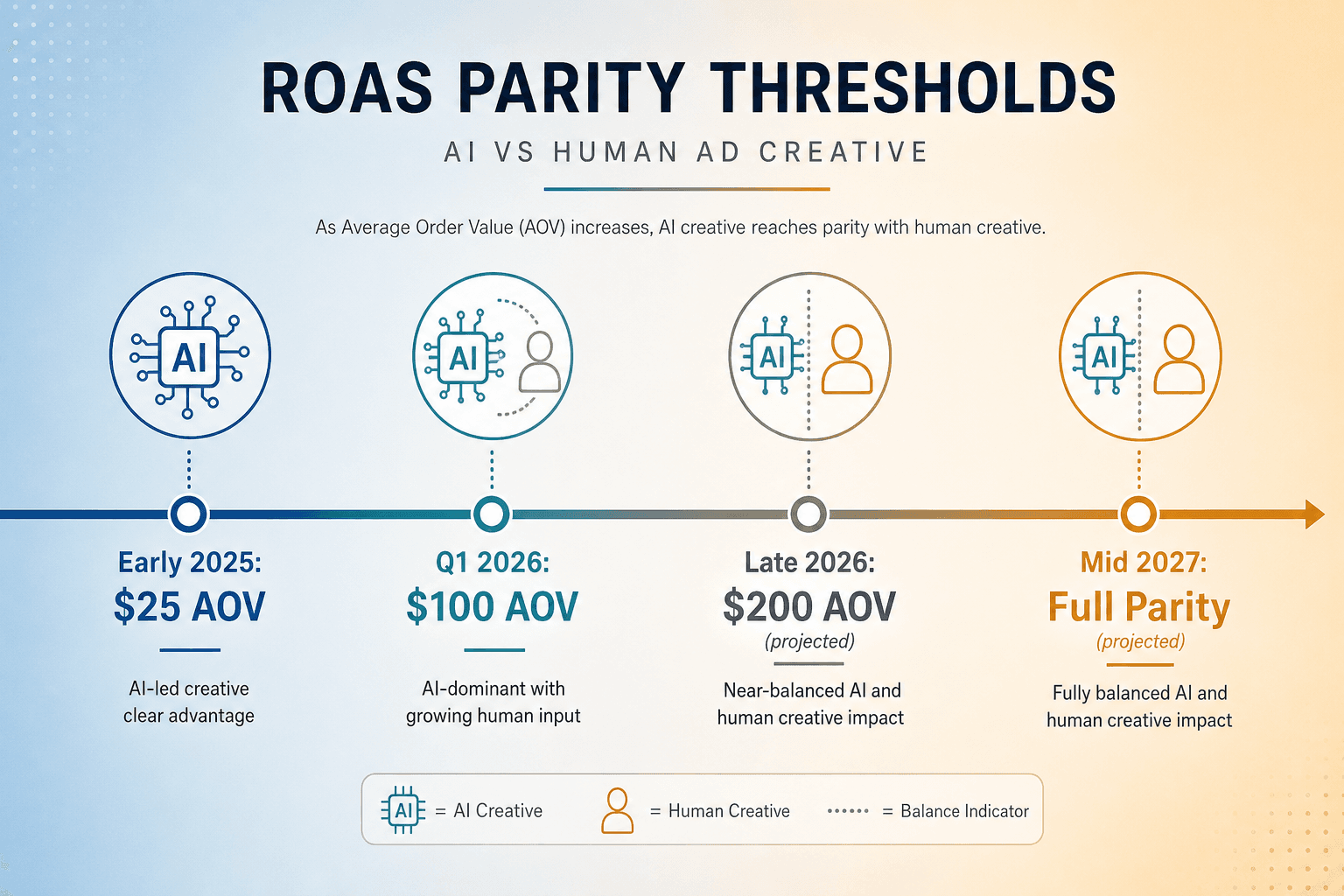
The ROAS parity threshold — the point at which AI-generated creative delivers the same return on ad spend as human-created creative — has been climbing steadily. It stood at $25 AOV in early 2025, reached $100 AOV by Q1 2026, and is projected to hit $200 AOV by late 2026, with full parity across all categories expected by mid-2027.
Why does this gap exist? High-consideration purchases require emotional resonance, brand trust signals, and nuanced value articulation — elements that current generative models handle inconsistently. A $500+ purchase or a B2B software evaluation involves multiple decision criteria that AI-generated copy often flattens into generic benefit statements. The 18% gap for B2B lead generation is particularly telling: B2B buyers are evaluating fit, credibility, and long-term value, not just features and price.
The Trust Problem: When Consumers Know It's AI
Beyond the conversion gap on high-AOV purchases, there is a perception penalty that applies across categories when consumers detect that an ad was generated by AI. The data from multiple sources converges on a consistent pattern: awareness of AI generation reduces key brand metrics.
| Metric | Decline When AI Is Detected | Source |
|---|---|---|
| Premium perception | -17% | StackAdapt / Klaviyo 2026 data |
| Inspiration / emotional connection | -19% | StackAdapt / Klaviyo 2026 data |
| Purchase intent | -14% | StackAdapt / Klaviyo 2026 data |
| Trust in brand (genAI content) | 32% trust brands less | Klaviyo 2026 AI Consumer Trends Report |
| Prefer brands avoiding genAI in customer-facing content | 50% of US consumers | Gartner 2026 |
The effect is not uniform. It is strongest in luxury, financial services, B2B, and healthcare — categories where trust and brand authority are primary purchase drivers. For low-consideration, high-frequency purchases (fast-moving consumer goods, entertainment, basic apparel), the perception penalty is smaller but still measurable.
This data does not mean AI-generated ads should be avoided. It means the decision to use AI creative must account for the brand context and the consumer's likely awareness of the ad's origin. For a deeper exploration of why marketers consistently overestimate consumer comfort with AI ads, see our dedicated analysis: The AI Ad Perception Gap: Why Marketers Think Consumers Love AI Ads (And Why They Don't).
The Hybrid Framework: A Structured Allocation Model
The benchmark data points toward a clear operational model: a structured hybrid that allocates creative production by campaign type and purchase complexity. The recommended split for 2026 is 60-70% AI-led creative for direct-response and low-AOV campaigns, and 30-40% human-led creative for brand-building and high-consideration purchases, with an AI-assisted human overlap zone in the middle.
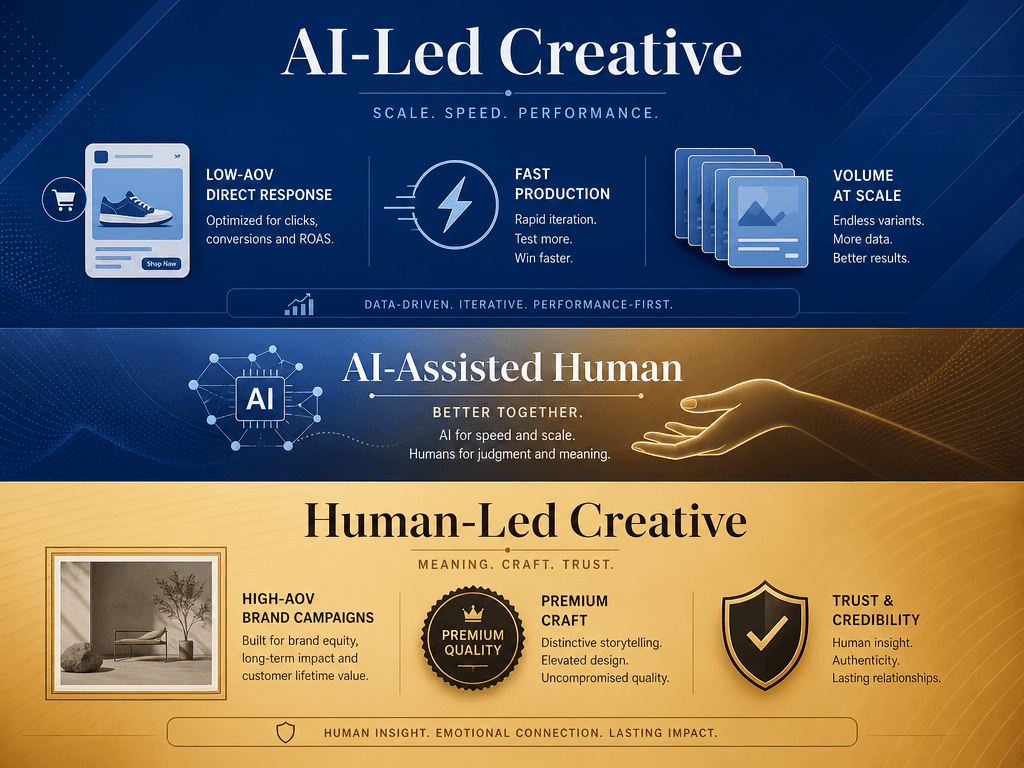
The decision logic for allocating creative production follows a simple matrix based on two variables: average order value and purchase consideration level.
| Campaign Type | AOV / Complexity | Recommended Approach | Allocation |
|---|---|---|---|
| Direct response / retargeting | Under $100, low consideration | AI-led (full automation) | 60-70% of creative volume |
| Standard e-commerce | $100-$500, moderate consideration | AI-assisted human (AI generates variants, human selects and refines) | Overlap zone |
| Premium / luxury / B2B | $500+, high consideration | Human-led (AI used for research and briefs only) | 30-40% of creative volume |
| Brand awareness / top-of-funnel | N/A (brand metrics) | Human-led with AI testing | Varies by brand sensitivity |
The AI-assisted human overlap zone is where most teams will find the highest marginal return. In this zone, AI generates 20-50 creative variants from a human-written brief, and a human editor selects, refines, and combines the best elements. This preserves the CTR advantage of AI-generated copy while layering in the brand nuance and emotional resonance that drives conversion on mid-range purchases.
Platform-Specific Guidance: Meta vs. Google vs. TikTok
The hybrid framework applies across platforms, but each platform's AI tools have different strengths and weaknesses that affect where the AI/human boundary should sit.
| Platform | AI Strength | AI Weakness | Best Hybrid Use |
|---|---|---|---|
| Meta (Advantage+) | Highest CTR improvement (+12%), strong creative variant generation, 68% advertiser adoption | Conversion gap on high-AOV purchases, creative sameness risk (86% of marketers see AI outputs resembling competitors) | AI-led for low-AOV DTC and retargeting; human-led for brand campaigns and luxury |
| Google (Performance Max / AI Max) | Massive scale (70M+ AI assets in Q4 2025), strong search intent matching, 74% advertiser adoption | Less creative differentiation, requires 30+ conversions in 30 days to exit learning mode | AI-led for standard e-commerce and lead gen; human oversight for high-value B2B and consideration campaigns |
| TikTok | Strong native creative formats, high engagement rates | Less mature AI creative tools, smaller benchmark dataset | AI-assisted human for most content; full AI for volume testing |
For a deeper dive into Meta's Advantage+ automation mechanics and how to maintain human control within the platform's AI tools, see our dedicated guide: Meta AI Advertising in 2026: What Advantage+ Automation Actually Does and Where to Keep Humans in Control.
Implementation Steps and Benchmarks to Track
Moving from the framework to execution requires a structured implementation process. The following steps are designed for paid media teams that already have some AI tools in place and need to optimize their allocation.
- Audit current campaigns by AOV and purchase complexity. Segment your campaign portfolio into three tiers: under $100 AOV (AI-led candidates), $100-$500 AOV (AI-assisted human candidates), and over $500 AOV or B2B (human-led candidates).
- Set up A/B testing between AI-led and human-led creative within each tier. Run tests for a minimum of two weeks or until each variant has at least 50 conversions — whichever comes later. Meta's Advantage+ recommends 50 conversions per week per ad set to exit learning mode.
- Track CTR and conversion rate separately. Do not use a blended ROAS metric as your primary decision signal. The CTR advantage of AI creative can mask a conversion gap, leading to misallocation.
- Monitor ROAS by AOV tier. Use the parity thresholds ($100 AOV in Q1 2026, projected $200 AOV by late 2026) as benchmarks against your own data. If your AI-led campaigns are underperforming the parity threshold for your AOV tier, shift more creative production to human-led or AI-assisted human.
- Establish a monthly review cadence. AI model capabilities and platform tools are evolving rapidly. The ROAS parity threshold is projected to reach $200 AOV by late 2026 and full parity by mid-2027. Revisit your allocation split quarterly to account for improvements in AI creative quality.
- Implement creative governance for AI-led campaigns. As AI creative scales, the risk of brand safety incidents and creative sameness increases. For guidance on managing AI incident risk and establishing governance processes, see our related article: The AI-Targeted Advertising Trap: Why 70% of Marketers Have Already Had an AI Incident (and What to Do About It).
The key benchmarks to track over time are: CTR by creative source (AI vs. human), conversion rate by AOV tier, ROAS parity threshold for your specific product categories, and brand perception metrics (particularly for premium and B2B campaigns). The teams that track these metrics separately — rather than blending them into a single ROAS number — will be the ones that make informed allocation decisions as the parity threshold continues to rise.

Comments
Join the discussion with an anonymous comment.