
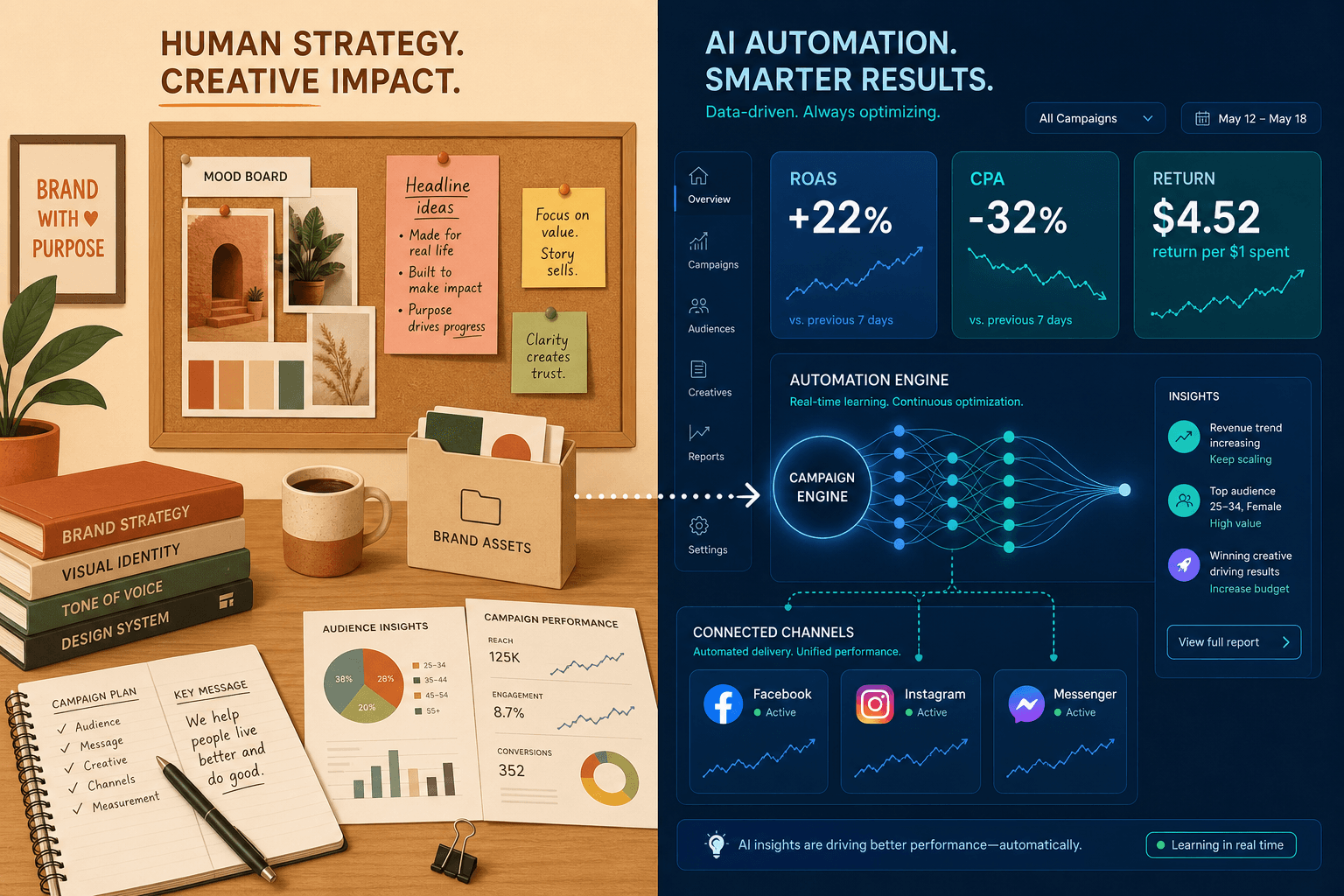
Meta AI Advertising in 2026: What Advantage+ Automation Actually Does and Where to Keep Humans in Control
A practical guide for performance marketers and media buyers navigating Meta's 2026 full-automation push. Covers what each AI tool (Advantage+, Lattice, GEM, generative creative) actually does, the real performance data from multiple sources, and a concrete two-category framework for deciding what to automate vs. keep human-led.
The State of Meta AI Advertising in Mid-2026
If you manage paid social spend, you have likely already noticed that Meta’s advertising interface looks different than it did two years ago. That is not an accident. By early 2026, 65% of all Meta advertisers already run campaigns through Advantage+, according to reporting from Forbes. The platform’s stated goal is end-to-end automation by the end of 2026 — a “goal-only” ad system where you set an objective, drop in a URL or image, and Meta’s AI builds, targets, and optimizes the campaign from there.
The scale of investment behind this push is hard to ignore. Meta confirmed a $14–15 billion investment in Scale AI and introduced 11 new AI advertising tools at Cannes Lions 2025. The combined revenue run-rate of its video generation tools hit $10 billion in Q4 2025, growing nearly three times faster than overall ads revenue, per Meta’s own newsroom. Advantage+ campaigns now represent 62% of e-commerce ad spend on the platform.
For performance marketers and media buyers, this creates a practical tension. The data suggests real gains: higher ROAS, lower CPAs, better click-through rates. But handing over campaign control to a black-box system also introduces risks — off-brand creative, opaque decision-making, and a creeping homogeneity across competing ads. The question is not whether to use Meta’s AI tools. It is which ones to use, for what, and where to draw the line.
What Each Meta AI Tool Actually Does
Meta’s AI advertising suite is not a single product. It is a collection of distinct capabilities that handle different parts of the campaign lifecycle. Understanding what each one does — and does not do — is the first step toward deciding where to apply automation.
| Tool / Capability | What It Does | What It Changes in Your Workflow |
|---|---|---|
| Advantage+ Audience | Uses conversion data and Pixel/CAPI events to find audiences dynamically, replacing manual interest and lookalike targeting. | You stop building audience segments. The AI decides who sees the ad based on real-time conversion signals. |
| Advantage+ Creative | Generates image, video, and copy variants from your source assets. Includes automated brand consistency (logos, fonts, colors) and AI-generated product highlights. | You provide base creative assets. The AI produces multiple variations and tests them automatically. |
| Advantage+ Sales Campaigns | A fully automated campaign type that handles audience, creative, placement, and budget allocation for purchase objectives. | You set the objective, budget, and creative inputs. The AI manages everything else. Early tests showed an average 9% lower cost per action for this format. |
| Meta Lattice | A next-generation ML architecture trained on trillions of signals. Enables smarter audience discovery without preset targeting parameters. | Consolidates learning across all campaigns. Meta reports a 12% increase in ads quality from Lattice consolidation. |
| GEM (Google-scale Engine for Meta) | The ads ranking model that determines which ads to show. Doubled its GPU capacity in Q4 2025. | Drives a 3.5% lift in ad clicks on Facebook and more than a 1% gain in conversions on Instagram. A new run-time model increased conversion rates by 3%. |
| Andromeda | An advanced AI retrieval engine that improves ad relevance matching. | Showed a 6% increase in recall and 8% higher ad quality in testing. |
| Opportunity Score | Provides personalized recommendations for campaign optimization based on your account data. | Advertisers following AI recommendations saw an average 5% drop in cost per result in early tests. |
The key takeaway from this list is that Meta’s AI tools are not equally mature. Audience targeting and bidding optimization are well-established. Generative creative is newer and carries more risk. The ranking models (GEM, Lattice, Andromeda) operate entirely behind the scenes — you cannot turn them off, and you should not want to. The tools you actively choose to use or disable are Advantage+ Audience, Advantage+ Creative, and the full Advantage+ campaign type.
The Performance Data: What the Numbers Say
Meta’s AI tools come with a set of performance claims that are impressive on their face. The table below compiles the most frequently cited figures from multiple sources. But a word of caution is necessary before you take these numbers to your next budget meeting.
| Metric | Value | Source | Context / Caveat |
|---|---|---|---|
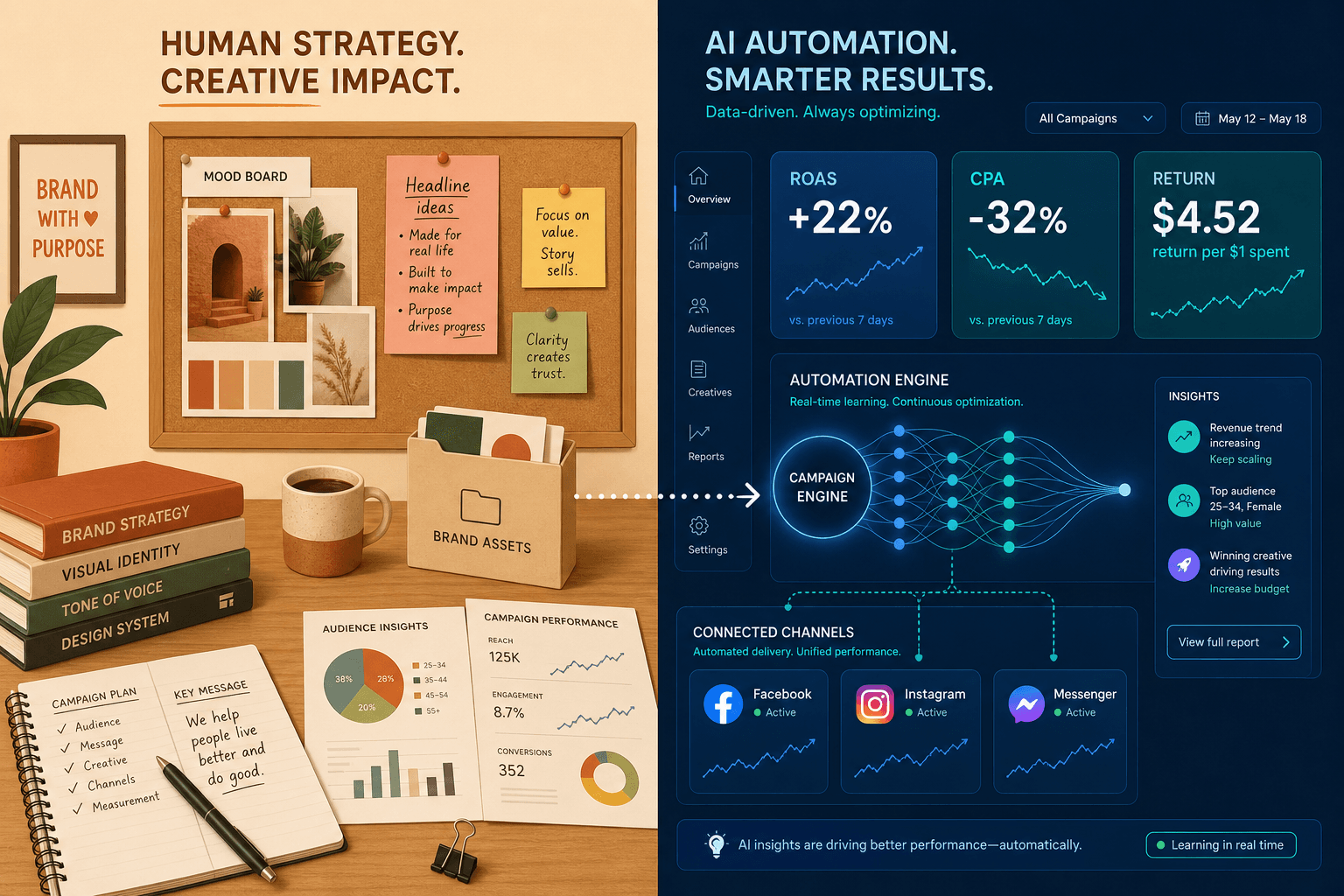
| Revenue per $1 spend (Advantage+) | $4.52 | Meta (via Coinis) | Meta-reported. Attribution methodology is not fully transparent and may favor Advantage+. |
| ROAS lift (Advantage+ vs. manual) | +22% | Meta (via Coinis, VXTX) | Consistent across multiple sources citing Meta’s internal data. |
| CPA reduction (multi-campaign Advantage+ advertisers) | 32% | Forbes (citing Meta) | Applies to advertisers running multiple campaigns through Advantage+, not single-campaign users. |
| CTR improvement (AI-generated creatives) | +11% | Meta (via Coinis) | Based on advertisers using AI-generated creative vs. traditional static ads. |
| Cost per result reduction (Opportunity Score) | 5% | Meta (via Coinis) | Early test results. Individual results vary by account and campaign structure. |
| Conversion lift (GEM run-time model) | +3% | Meta Newsroom | Incremental gain from a new run-time model deployed in Q4 2025. |
| Ads quality increase (Lattice consolidation) | +12% | Meta Newsroom | Measured by Meta’s internal ad quality metrics. |
| Cost per action reduction (Advantage+ Sales) | 9% | Meta (via Coinis) | Early test results for the new Sales campaign format. |
That said, the consistency across multiple sources — Forbes, Coinis, VXTX, and Meta’s own newsroom — suggests the direction of the effect is real, even if the exact magnitude varies. The more relevant question for practitioners is not “does AI improve performance?” but “under what conditions does it improve performance, and for which campaign objectives?”
Where Automation Works — and Where It Hurts
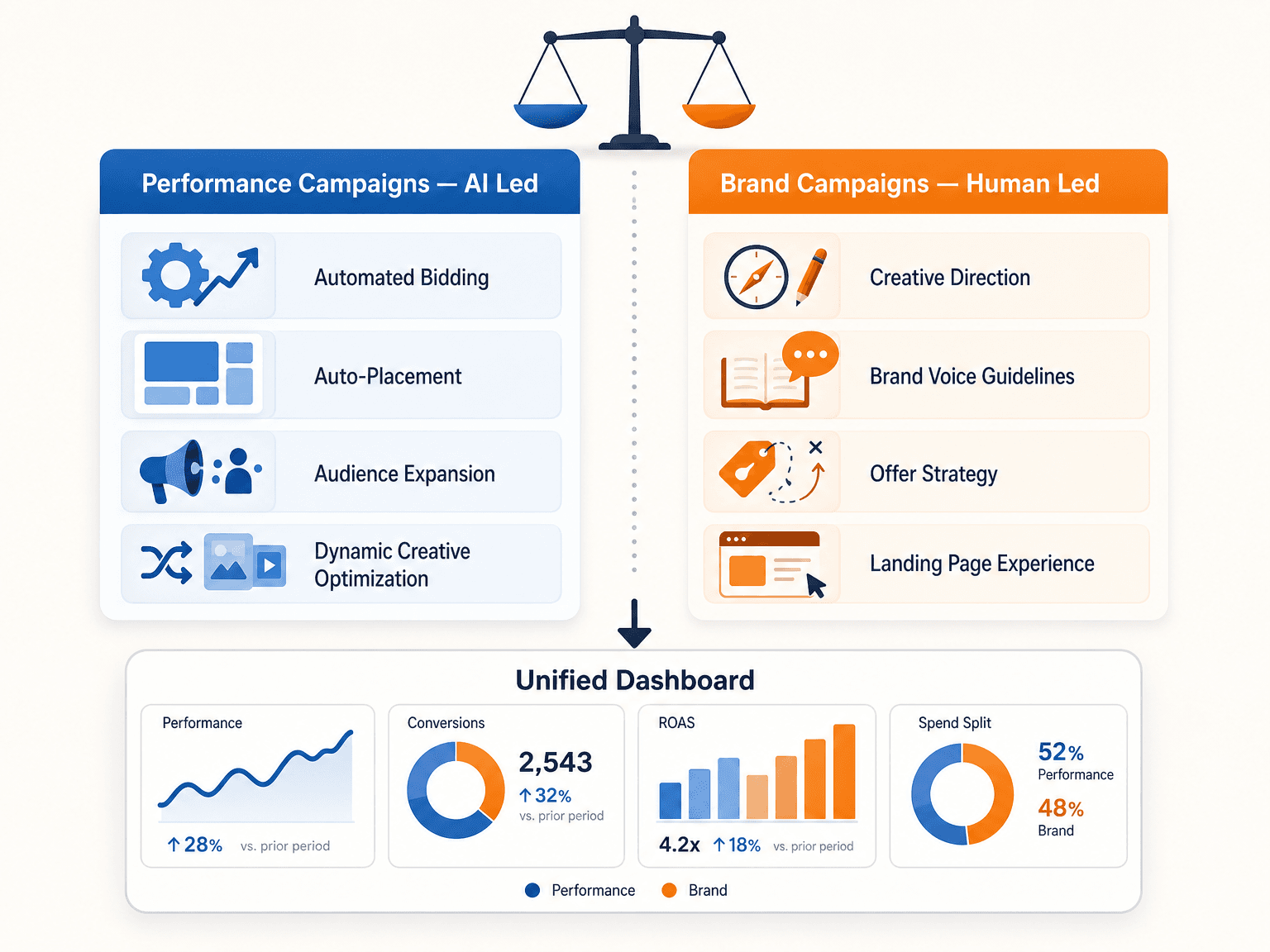
Meta’s AI excels at tasks that are data-intensive and rules-based. Bidding, placement optimization, audience expansion, and budget pacing all involve processing large volumes of real-time signals and making probabilistic decisions. These are areas where a machine learning model trained on trillions of signals will almost always outperform a human media buyer making manual adjustments once or twice a day.
The areas where AI struggles are the ones that require context, taste, and strategic judgment. Creative direction, brand voice, offer strategy, and landing page experience are not optimization problems — they are communication problems. An AI model can tell you which headline variant got the most clicks, but it cannot tell you whether that click built long-term brand trust or attracted a one-time buyer with low lifetime value.
- AI handles well: bid management, placement optimization, audience expansion, budget pacing, A/B testing at scale, creative variant generation.
- Humans still handle better: creative direction and concept, brand voice and tone, offer strategy, landing page experience, customer lifetime value analysis, long-term brand building.
The ‘Race to the Middle’ Risk
One of the most significant risks of full automation is what Forbes columnist TerDawn DeBoe calls the “race to the middle.” When every advertiser on the platform uses the same AI campaign management tools, trained on the same optimization objectives, the resulting ads begin to look and sound alike. The same layouts, the same headline structures, the same call-to-action patterns. Brand differentiation erodes.
This is not a hypothetical concern. Meta’s AI creative tools have already generated over 15 million ads, used by more than one million advertisers, according to Coinis. When a million brands are drawing from the same generative models, the output converges. The AI optimizes for what works on average, but average is not where brand equity lives.
There is also a structural risk around customer quality. AI-driven targeting optimized for conversions tends to bring in one-time buyers rather than repeat purchasers, which can reduce customer lifetime value even as ROAS looks healthy on the surface. If your business depends on recurring revenue or high average order values, a pure AI-optimized campaign may deliver volume without quality.
A Practical Framework: The Two-Category Campaign Split
Rather than treating automation as an all-or-nothing decision, separate your campaigns into two categories based on objective. This framework, recommended by multiple practitioners and analysts, lets you apply AI where it adds value and retain human control where it matters most.
| Dimension | Performance Campaigns (AI-Led) | Brand Campaigns (Human-Led) |
|---|---|---|
| Primary objective | Purchases, sign-ups, downloads, leads | Awareness, trust, differentiation, consideration |
| Automation level | Full Advantage+ (audience, creative, placement, budget) | Manual or partial Advantage+ (audience only, creative disabled) |
| Creative control | AI generates variants from your assets; human reviews and approves | Human creates and approves all creative; AI handles placement only |
| Success metric | ROAS, CPA, conversion rate, revenue per spend | CPM, reach, frequency, brand lift, share of voice |
| Budget allocation | 60–70% of total ad spend (for most e-commerce and lead-gen accounts) | 30–40% of total ad spend |
| Creative refresh cadence | Every 7–14 days (AI exhausts winning audiences faster) | Every 3–4 weeks (brand messaging needs consistency) |
The logic behind this split is straightforward. Performance campaigns are optimization problems: you have a clear conversion event, a measurable cost, and a direct revenue line. These are exactly the conditions under which AI outperforms manual management. Brand campaigns are communication problems: you are building associations, trust, and preference over time. These require human judgment about tone, imagery, and cultural context.
The 60/40 budget split is a starting point, not a rule. Accounts with strong brand equity and high repeat purchase rates may shift more toward brand. Accounts with tight ROAS targets and short sales cycles may push 80% into performance. The important thing is to measure each category separately and resist the temptation to optimize brand campaigns on CPA.
Action Checklist: Implementing Selective Automation
The following checklist is designed to be implemented over a 30–60 day period. It assumes you already have active Meta campaigns and are looking to introduce AI automation selectively rather than rebuilding from scratch.
- Audit your creative assets and brand guardrails. Before turning on Advantage+ Creative, ensure you have a clear brand style guide (logos, fonts, colors, tone of voice) that the AI can reference. Meta’s automated brand consistency features work best when you provide clean, high-resolution source files.
- Set brand consistency rules in Advantage+ Creative. Configure the tool to use your brand assets as constraints, not suggestions. Disable the option for AI to generate copy from scratch if your brand voice is distinctive. Use the “image-to-video” tool that turns up to 20 product photos into multi-scene video ads, but review the output before publishing.
- Install Conversions API (CAPI) alongside your pixel. Meta guidance indicates that advertisers implementing CAPI alongside the pixel see an average 13% improvement in cost per action. Clean, deduplicated conversion signals are the foundation of all AI optimization. Without them, the AI is learning from incomplete data.
- Run a 30-day A/B test. Duplicate your best-performing manual campaign and set the copy to run as an Advantage+ campaign with the same budget and objective. Measure ROAS, CPA, and average order value for both. Do not stop the test early — AI campaigns often underperform in the first 7–10 days while the model learns.
- Establish a creative refresh cadence. Segwise reports that the biggest threat to scaling in 2026 is creative fatigue, as Meta’s AI exhausts winning audiences faster. Plan to refresh performance campaign creative every 7–14 days. Use AI to generate 10–15 new variants from your winning elements, but have a human review and select before launch.
- Monitor for audience quality drift. Check your post-purchase data for repeat purchase rate and average order value by campaign source. If Advantage+ campaigns show lower LTV than manual campaigns, adjust your optimization event to a higher-funnel signal (e.g., add-to-cart instead of purchase) or reduce the automation level.
Meta’s AI advertising tools are not a fad. They are the direction the platform is moving, and the performance data suggests real gains for most advertisers. But the practitioners who get the best results will not be the ones who hand over full control. They will be the ones who understand exactly what each tool does, measure its impact on their specific objectives, and keep human judgment in the loop where it matters most — on the creative, the brand, and the strategy.

Comments
Join the discussion with an anonymous comment.