
Best AI for Marketing
This guide breaks down the best AI tools for each marketing role — content, SEO, paid media, email, and growth — so you can build a stack that fits your actual job instead of sorting through generic rankings.
Key Integrations
Marketing Categories
⚠ Notable Limitations
Requires human review; AI creative may underperform without human editing
You probably do not need the best AI for marketing. You need the best AI for the marketing job you are actually accountable for this quarter: publishing content, improving search visibility, managing paid spend, personalizing email, or keeping a small growth stack moving without adding five more subscriptions.
That distinction matters in 2026 because AI adoption is already high across marketing roles, but the work patterns are not the same. Salesforce-reported adoption signals cited in Digital Applied put content marketers at 96%, SEO specialists at 93%, and demand generation marketers at 89%; McKinsey-cited ROI signals in the same 2026 roundup show content drafting at 3.2x ROI, personalization at 2.7x, and ad copy at 2.3x.[1] Those numbers are useful as directional signals, not as permission to buy whatever tool has the loudest category page.
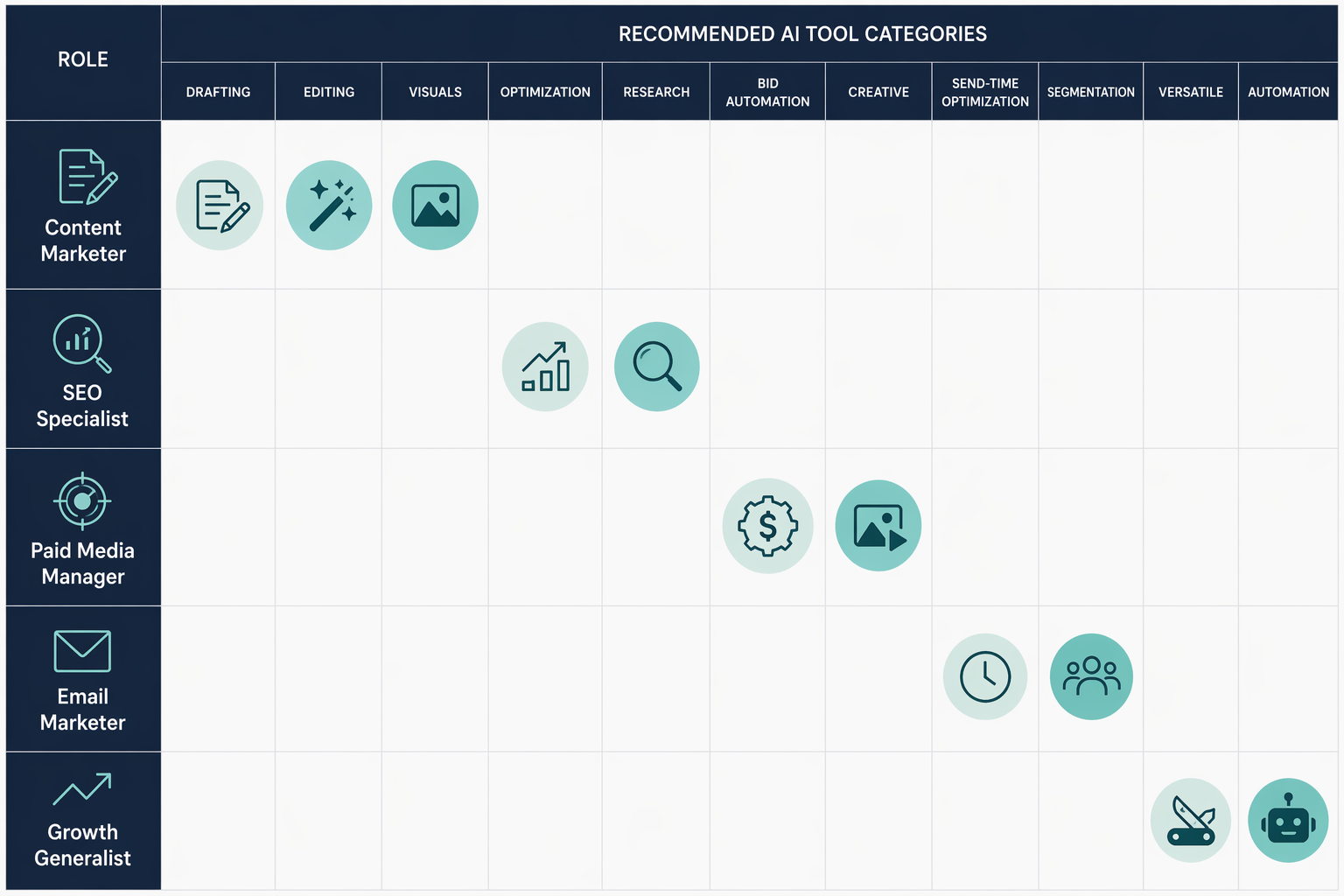
| Marketing role | Best-fit AI stack | Buy | Consider | Skip |
|---|---|---|---|---|
| Content marketer | Claude or ChatGPT for drafting; Grammarly for editing; Canva for visuals; Jasper when brand governance and scale matter | Claude/ChatGPT + Grammarly if your main bottleneck is draft-to-edit speed | Jasper if multiple writers need shared brand voice, approvals, and campaign-level governance | A generic AI writer sold as a complete content strategy replacement |
| SEO specialist | SurferSEO for on-page optimization; Semrush for keyword, competitor, and AI visibility work; Clearscope for content optimization | Semrush if research, competitive intelligence, and visibility tracking sit in one workflow | SurferSEO or Clearscope if the bottleneck is briefing and optimizing pages | Another blank-page writer that does not improve search workflow depth |
| Paid media manager | Hyper or Albert AI for autonomous bidding and budget optimization; Adzooma for multi-platform management | Automation for bids, budget pacing, and waste reduction when spend volume justifies oversight | Adzooma if you need lighter cross-platform management before a heavier autonomous system | Fully AI-generated creative with no human creative review |
| Email marketer | ActiveCampaign or Klaviyo for send-time optimization, predictive segmentation, and personalization workflows | The platform that already fits your CRM, commerce, or lifecycle data model | AI personalization once consent, segmentation, and QA are in place | Personalization that uses data your subscribers did not expect you to use |
| Growth/generalist | ChatGPT or Claude; Canva; Zapier | A lean starter kit under $150/month for broad execution support | A more formal strategy framework once the stack touches revenue reporting or customer data | Enterprise AI platforms before you know which workflow is actually constrained |
How to Read This Without Buying the Wrong Thing
The table starts with roles because roles expose the real workflow. A content lead needs throughput and voice control. An SEO specialist needs evidence, prioritization, and page-level guidance. A paid media manager needs fast budget decisions without turning every ad into synthetic sameness. Those are different jobs, even when vendors put them under the same "AI marketing platform" label.
Use four filters before taking any recommendation literally.
- Role fit: choose the tool that improves the work your role repeats every week, not the one with the longest feature list.
- Workflow depth: a strong SEO tool, email platform, or paid media optimizer usually beats a broad assistant pretending to do all three.
- Pricing reality: verify current plan limits, credits, seats, and usage caps before buying.
- Human review: keep one quality-control point where a practitioner can reject output before it reaches a customer, prospect, or search index.
Pricing deserves more attention than most tool roundups give it. Nearly 31% of AI vendors use hybrid seat-plus-credit pricing, and mid-market marketing teams' median AI tool spend rose from $1,200 per month in Q1 2025 to $3,400 per month in Q1 2026, according to figures cited by Digital Applied.[1] If your team has ever found three tools generating copy while no tool handles approval routing, you already know why "best" is partly a governance question.
If you prefer to choose by bottleneck rather than job function, the companion stack-based comparison of the best AI for marketing is the better starting point. This guide stays with the practitioner role.
Content Marketers: Draft Faster, Then Protect the Voice
For content marketers, the best AI stack is not one AI writer. It is a split workflow: one tool for drafting and idea expansion, one for editing and consistency, one for visuals, and sometimes one more for brand governance at scale.
The case for using AI in content is unusually strong, at least directionally. The 2026 statistics roundup cited above reports content drafting at 3.2x ROI, the highest among the listed AI marketing applications, and notes that teams publishing AI-assisted content with more than 20% human editing report 2.7x better organic traffic outcomes in a composite of 2026 HubSpot, Semrush, and Ahrefs studies.[1] The second number is not a universal law; it is a reminder that the editing layer is doing real work.
A practical content stack usually starts with Claude or ChatGPT. Use them for outlines, rough drafts, repurposing, comparison framing, interview synthesis, and alternate intros. The choice between them should be task-routed, not argued as a personality contest. If your team is deciding between the two, start with the Claude vs. ChatGPT B2B marketing copy comparison or the ChatGPT vs. Claude task-routing guide instead of asking which one is universally better.
Then add Grammarly where the work becomes publishable. That does not mean accepting every suggestion. It means using an editing layer for clarity, tone flags, consistency checks, and last-pass cleanup before a human editor makes the final call. For teams standardizing editorial review, the Grammarly Business AI writing tool profile is a more useful read than another list of generic writing assistants.
Canva fits the content stack because most content teams now ship more than articles. They need blog graphics, social cutdowns, webinar slides, newsletter images, and lightweight campaign assets. The value is not that Canva is the most advanced AI system in the stack. The value is that it removes the wait state between "we need a supporting visual" and "someone has to open a design ticket."
Jasper is the conditional buy. If one marketer is producing a few pieces a month, Jasper may be more process than the team needs. If a larger team needs campaign templates, brand voice controls, reusable messaging, and approval discipline across many contributors, the calculus changes. The Jasper AI agentic platform review is worth reading before treating it as just another AI writer.
The skip is simple: do not buy a writing tool because it promises to replace strategy, subject-matter input, editing, SEO judgment, and distribution. Good content AI reduces blank-page drag. It does not decide what your market needs to believe.
SEO Specialists: Choose the Tool That Matches the Search Workflow
SEO teams usually do not need another general-purpose AI writer. They need better research, prioritization, optimization, competitive visibility, and content refresh decisions. That is why SurferSEO, Semrush, and Clearscope belong in the conversation for different reasons.
Semrush's AI content marketing tools roundup includes Semrush, SurferSEO, and Clearscope among the tools relevant to AI-assisted content and SEO workflows.[2] Treat that as a category map, not an independent verdict that every SEO team needs all three.
- Use Semrush when keyword research, competitor analysis, technical context, and visibility monitoring need to live close together.
- Use SurferSEO when writers and SEO specialists need page-level optimization guidance during briefing and drafting.
- Use Clearscope when the team values content optimization, topical coverage, and editorially usable recommendations.
For many teams, Semrush is the system of record and SurferSEO or Clearscope is the content optimization layer. Smaller teams may not need both. Larger teams may use one for research governance and one for writer-facing briefs. If Semrush is already central to your workflow, the Semrush AI SEO tool profile will be more relevant than a generic AI tool comparison.
The buying mistake is stacking tools that all comment on the same draft while no one owns prioritization. Before adding another optimizer, identify the missing step: topic selection, SERP analysis, briefing, refresh decisions, internal linking, or performance review. The best AI for SEO is the one that tightens the weakest search operation, not the one that produces the most confident paragraph.
Paid Media Managers: Automate the Math, Keep Humans on Creative
Paid media is where the AI pitch can sound most seductive and most dangerous. Bidding, budget pacing, audience expansion, and waste reduction are machine-friendly problems. Creative judgment is not the same kind of problem, especially in social feeds where obvious AI creative can feel cheap before the first click is measured.
The directional efficiency case is strong. Hyper's 2026 comparison cites Zebracat AI figures reporting 50% higher ad ROI and 37% less wasted spend from AI-powered ad optimization.[3] Those figures should not be read as a guaranteed lift for every account. They do explain why paid media managers keep testing autonomous systems when budgets, bids, and placements are changing faster than a human can comfortably manage by hand.
Hyper or Albert AI makes the most sense when the account has enough spend and conversion data for automation to learn from. If your team is still validating offer-market fit, an autonomous optimizer can give a false sense of precision. If you are managing mature campaigns across channels with clear conversion events, the machine can help with bid pressure, budget reallocation, and waste reduction while the human manager watches constraints and business context.
Adzooma is the lighter consideration for teams that want multi-platform management without handing over as much autonomy. It is less about replacing paid media judgment and more about reducing the number of tabs, checks, and routine recommendations a manager has to process.
The creative side needs a harder line. Digital Applied notes 2026 agency-study concerns that obvious AI-generated paid social creative may underperform as major platforms update ranking systems.[1] The safest interpretation is narrow: do not assume AI-generated creative will be rewarded just because AI-generated bids are efficient. Ad platforms can optimize delivery, but your prospects still react to imagery, claims, tone, proof, and fatigue.
A workable paid media AI workflow looks like this: let automation propose bid and budget moves, require the manager to approve strategy-level changes, use AI to create creative variants and briefs, and keep final creative selection with a human who understands the market. The AI programmatic advertising guide and the performance marketing automation framework go deeper on where that handoff should sit.
Email Marketers: Personalize Where the Data Is Trustworthy
Email marketers should start with the platform that already understands their list, events, purchases, lifecycle stages, and consent model. That usually points to ActiveCampaign or Klaviyo rather than a disconnected AI copy tool.
Business Dasher figures cited by BizIQ report that AI-powered send-time optimization can produce up to 41% higher open rates.[4] "Up to" is doing important work there. Send-time optimization is a good test because it changes a specific operational decision: when a subscriber receives a message. It does not require pretending the machine understands your whole customer relationship.
ActiveCampaign is often the practical choice for lifecycle teams that need automation, segmentation, and CRM-adjacent workflows. Klaviyo is the obvious contender for ecommerce and B2C teams where product, purchase, and behavioral data drive campaigns. Both are better AI email bets when the team has clean segments, clear suppression rules, and someone reviewing generated content before it ships.
The trust boundary matters. Predictive segmentation can help decide who should receive which message, but personalization becomes brittle when it exposes data the subscriber did not expect you to use. If the recommendation feels like a helpful memory, it can work. If it feels like surveillance, the tool did its job and the strategy still failed.
For deeper execution, use the AI email marketing practitioner's guide and the B2C AI email personalization case study rather than trying to force email personalization from a general chat assistant.
Growth and Generalist Teams: Start Lean, Then Prove the Need for More
A growth generalist usually needs breadth before depth: landing page copy, campaign ideas, quick visuals, lightweight automation, audience research, sales enablement support, and reporting help. The best starting stack is correspondingly plain: ChatGPT or Claude, Canva, and Zapier.
Zapier's 2026 AI marketing tools guide supports the practical shape of that stack by covering general AI assistants, design tools, and automation tools as part of an AI marketing toolkit.[5] The appeal is not novelty. It is that a small team can cover drafting, asset creation, and workflow handoffs for under $150 per month if it keeps the stack disciplined.
- ChatGPT or Claude handles drafting, synthesis, research assistance, and internal planning support.
- Canva handles fast campaign visuals, presentation assets, and social variants.
- Zapier connects form fills, CRM updates, alerts, spreadsheets, content queues, and routine handoffs.
The caution is that a starter stack is not an enterprise AI strategy. Once AI touches attribution, lifecycle messaging, paid spend, customer data, or sales handoffs, the team needs clearer ownership and review rules. The AI marketing strategy framework is the next step when the question changes from "what can help me this week?" to "how do we govern this across the funnel?"
Where Generic AI Marketing Categories Fit
Chatbots, social media tools, analytics AI, AI research assistants, and sales enablement tools can all be useful. They do not deserve equal space in this decision unless they affect the role you are buying for.
If customer support owns the chatbot, it is not the first purchase for a content marketer. If analytics already lives in a BI workflow, buying a separate AI insights tool may add another dashboard instead of a decision. If a social media scheduler is mainly repackaging posts from the content team, it belongs downstream of the content workflow, not at the center of the AI marketing stack.
For examples organized by the work marketers actually do, the role-based AI marketing examples guide and the function-by-function AI in digital marketing guide are better companions than an encyclopedic category list.
The Buying Decision
Choose the AI stack that matches the work you are measured on. Content marketers should prioritize drafting speed, editing quality, visual support, and brand governance. SEO specialists should prioritize research and optimization depth. Paid media managers should automate bids and budget decisions while keeping humans close to creative. Email marketers should buy around trustworthy data and lifecycle execution. Growth generalists should start lean and add complexity only after the workflow proves it needs it.
Before signing, verify current pricing, seat limits, credit usage, integrations, data permissions, and approval controls. AI pricing changed often between March and June 2026 in the sources reviewed, and the hybrid pricing trend makes total cost easy to underestimate.[1] Be especially skeptical of any vendor pitch that says one AI platform can replace every marketing role. That usually means the platform is broad where your team needs depth.
References
- AI Marketing Statistics 2026, Digital Applied
- 10 Best AI Content Marketing Tools, Semrush
- Best AI Tools for Marketing 2026, Hyper FX
- AI in Marketing Statistics 2026, BizIQ
- The 17 best AI marketing tools, Zapier

Comments
Join the discussion with an anonymous comment.