

Your Content Automation Stack Is Too Big: A Marketer's Guide to Consolidation in 2026
Most content teams pay for 6–10 AI tools but only need 3–5. This guide helps you audit your content automation stack, identify redundancies, and consolidate to save money and reduce coordination overhead without sacrificing output.
Automated content creation was supposed to make the team faster. For a lot of content teams in 2026, it has also created a quieter second job: moving inputs, briefs, outlines, drafts, SEO notes, approval comments, and CMS edits across tools that were never designed to share ownership of the same article.
That is usually when the stack starts to feel too big. Nobody wants to cancel the wrong subscription and break a workflow that is barely holding together. But nobody wants to keep paying for duplicate AI writers, duplicate optimization scores, duplicate research assistants, and duplicate project spaces just because each one solved a real problem six months ago.
The budget signal is easy to spot. Averi’s 2026 comparison estimates that the average marketing team can spend $205 to $382 per month across six content tools before the team has actually produced anything, though that figure comes from a vendor comparison page and should be treated as directional rather than universal.[1] The time signal is harder to see because it hides inside Slack threads, copied docs, rebriefs, and “which version is final?” messages.
The goal is not to prove that AI tools are bad. The opposite is closer to the truth: the tools are useful enough that teams keep adding them. The problem is unmanaged adoption. AdAI News cites 2026 data that 42% of marketers use AI daily while teams still juggle 6 to 10 disconnected subscriptions.[2] That combination explains the awkward middle phase: AI is part of daily work, but the operating system around it has not caught up.
Start With The Workflow, Not The Vendor List
A content stack audit should not begin with a spreadsheet of renewal dates. That turns the conversation into a tool-by-tool defense: someone likes the brief generator, someone else trusts the SEO score, the editor hates the AI writing style but likes the commenting workflow, and the CMS owner quietly knows half the work still lands on their desk.
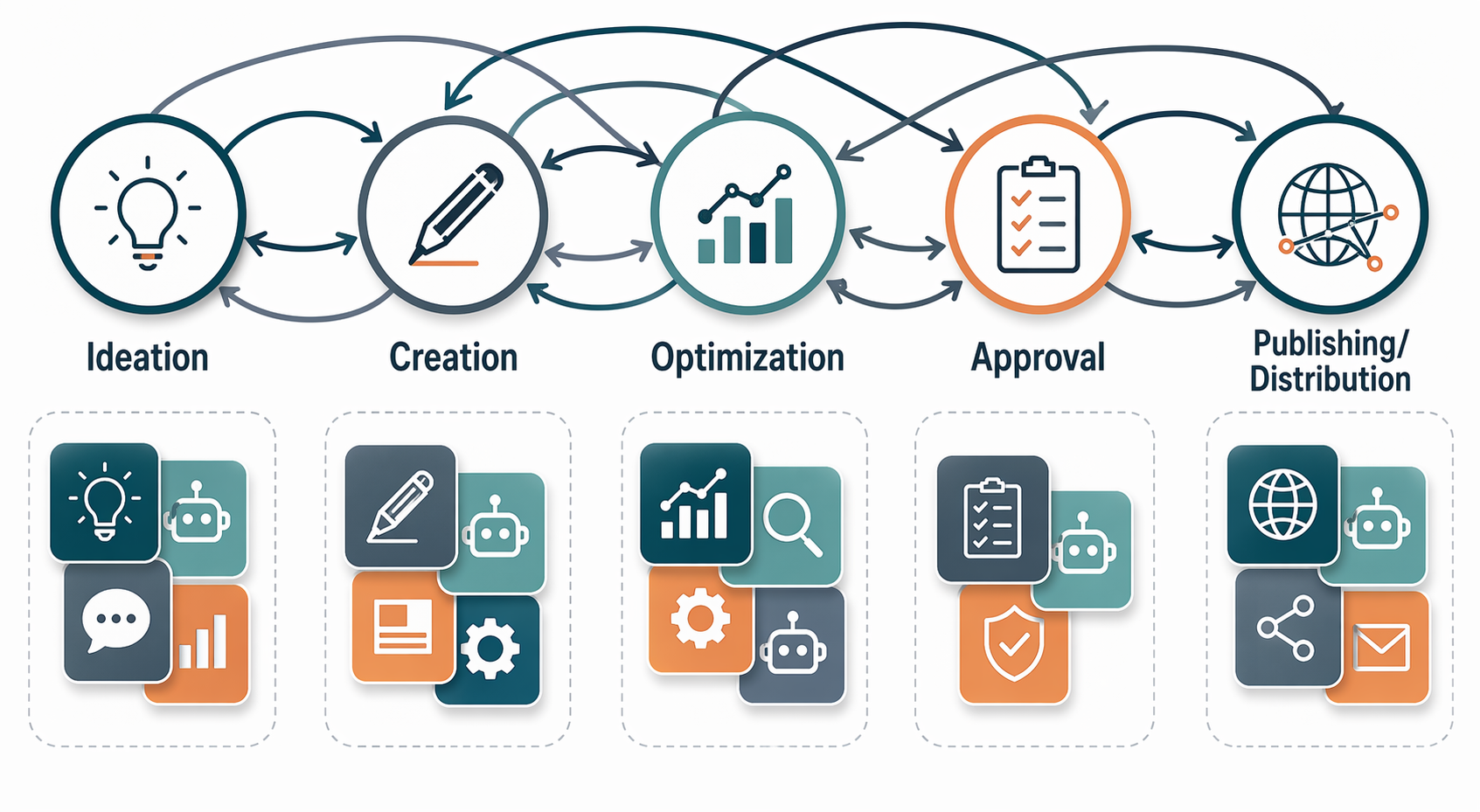
Begin with the lifecycle instead. If the team cannot see the whole path from idea to published page, it cannot make a defensible keep-cut-replace decision. A practical audit usually needs these stages:
| Workflow stage | What to map | Common stack problem |
|---|---|---|
| Planning and ideation | Topic intake, audience notes, campaign priorities, keyword opportunities | Ideas live in one tool while briefs are created somewhere else |
| Research and briefing | SERP review, source gathering, outline requirements, SME notes | Research outputs are copied manually into briefs and never updated |
| Drafting and expansion | First draft, section rewrites, examples, internal linking notes | Several AI writers produce drafts with different assumptions |
| Optimization | Search intent, keyword coverage, readability, internal links, metadata | SEO recommendations arrive after the draft is already approved |
| Review and approval | Editorial comments, compliance checks, brand review, stakeholder signoff | Approvals happen outside the place where the draft is edited |
| Publishing and refresh | CMS formatting, media, schema, updates, performance review | Final changes are recreated by the person closest to the CMS |
This is where the audit becomes more useful than a subscription cleanup. A tool that looks expensive may be carrying three high-friction stages. A cheap tool may be creating enough rework to cost more than it saves. A platform everyone complains about may still be the only place where ownership is clear.
If the lifecycle itself needs tightening first, use Beyond the First Draft: A Full Workflow Guide for AI Content Creation as the companion exercise. Consolidation works best after the team agrees what the workflow actually is, not while everyone is defending the tool that makes their own part less painful.
Inventory Every Tool Against The Stage It Actually Serves
The audit needs a blunt inventory. Not a wish list, not a procurement history, and not the official version of the process. List what the team actually opens during a normal content cycle.
- Tool name and owner: who pays for it, who administers it, and who knows how it works.
- Workflow stage: the stage where the tool is used most, not every stage the vendor claims it can support.
- Primary job: the reason the team would miss it next week if it disappeared.
- Output destination: where the work goes next and whether that handoff is automatic, manual, or improvised.
- Usage pattern: daily, weekly, campaign-specific, occasional, or legacy.
- Quality impact: whether it improves the final content, speeds coordination, or mainly adds another place to check.
The “actual stage” column matters. Most AI content products now describe themselves broadly. A writing tool adds SEO scoring. An SEO platform adds drafting. A project management tool adds AI summaries. A CMS adds rewriting suggestions. On paper, each one can touch half the workflow. In practice, the team may trust each tool for only one specific job.
That distinction keeps the audit honest. If your SEO lead only trusts a tool for SERP analysis and ignores its draft generator, do not classify it as both optimization and creation. If the editor uses an AI assistant only to tighten intros, do not treat it as a core writing platform. If the CMS has embedded AI but nobody uses it because approvals happen elsewhere, mark that gap clearly.
A Useful Stack Map Shows Overlap And Handoffs
Once the inventory is complete, mark two things in different colors: overlap and handoffs. Overlap means two or more tools are doing the same job for the same stage. Handoff means work has to move from one tool to another before the next person can act.
Overlap is not automatically bad. Two tools can overlap if they serve different standards. For example, a general AI writing assistant may help a content marketer expand a section, while a specialized SEO tool checks whether the piece actually satisfies search intent. That is not the same as paying for three draft generators whose outputs all need to be rewritten by the same editor.
Handoffs deserve more scrutiny because they create the work nobody budgets for. A draft that moves from an AI writer to a doc, from the doc to an SEO tool, from the SEO tool back to the doc, from the doc to a project management card, and from the card to the CMS may still look “automated” in a tool demo. Operationally, it is a relay race with copy-paste as the baton.
Classify Tools By Role Before You Decide Their Fate
After the map is visible, classify each tool by the role it plays in the system. This avoids a common mistake: cutting the loudest or most expensive tool first, then discovering it was the only thing preventing a worse bottleneck.
| Role | Keep if | Cut or replace if |
|---|---|---|
| System of record | It holds briefs, status, approvals, or source-of-truth content decisions | The team still recreates the same information somewhere else |
| Core production platform | It covers multiple high-volume stages with acceptable quality and clear ownership | It overlaps with another platform that now covers the same work |
| Quality gate | It catches issues the team would otherwise miss, such as search intent gaps, brand problems, or compliance risk | Its recommendations are routinely ignored or duplicated elsewhere |
| Point solution | It does one narrow job better than the broader platform and that job materially affects performance | It is used occasionally, by one person, or mainly because of habit |
| Embedded capability | It already exists inside the CRM, MAP, CMS, or project system the team uses | It is available but does not fit the real workflow or quality standard |
This role-based view is where consolidation becomes less emotional. A team may love a point solution and still decide it does not belong in the core stack. Another tool may be boring but essential because it owns approvals. A platform may be worth keeping not because it has the best AI feature, but because it reduces the number of places the team has to reconcile.
Heinz Marketing’s 2026 martech consolidation analysis makes the useful point that when one platform can handle 60% to 80% of a workflow, the argument for specialized point solutions gets weaker.[3] That does not mean every specialist tool should disappear. It means the specialist has to earn its place with a quality or performance advantage the broader platform cannot match.
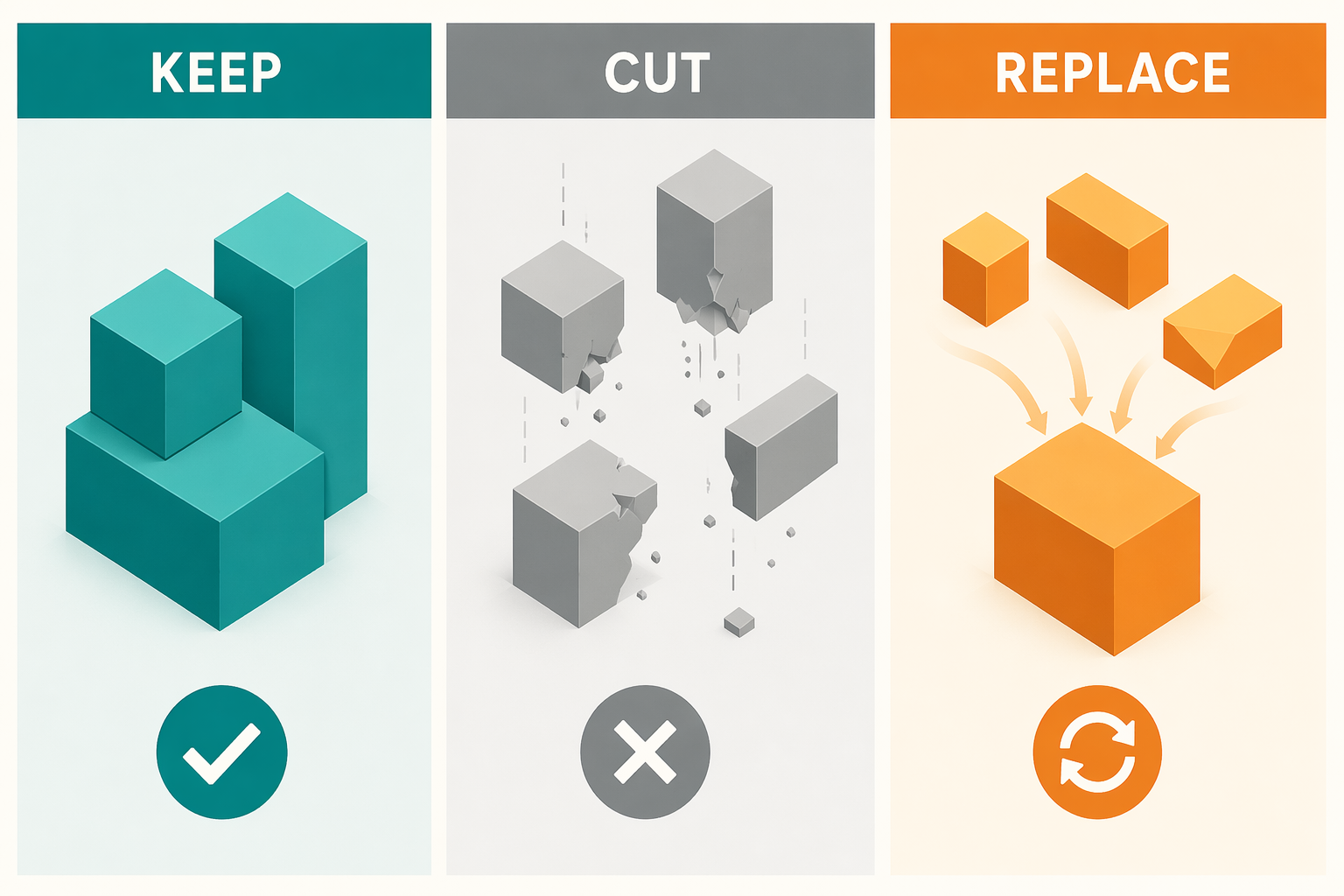
Use Four Tests For Keep-Cut-Replace Decisions
A smaller stack usually lands somewhere around three to five tools because that is enough to cover the content lifecycle without turning every stage into its own subscription category. The exact number matters less than the operating logic. A three-tool stack can still be messy if nothing integrates. A five-tool stack can be clean if each tool has a clear job and the handoffs are deliberate.
1. Coverage: Does This Tool Own A Meaningful Part Of The Workflow?
Coverage is not about feature count. It is about whether the tool supports a stage the team performs repeatedly and whether the output is usable by the next person in the chain. A platform that helps with ideation, briefing, drafting, and review may deserve more weight than a specialized tool that improves one small step but forces two extra handoffs.
Look for stages with no true owner. Many teams have tools for writing and SEO, but no reliable place for brief decisions, SME notes, or final editorial judgment. That gap creates rework. If a consolidation move removes duplicate drafting tools but leaves approvals scattered across comments, emails, and cards, the stack is smaller but not necessarily better.
2. Integration: Does Work Move Forward Without Manual Reconstruction?
The most expensive handoff is not always the one with the most clicks. It is the one that changes context. A keyword cluster becomes a brief, but the assumptions behind the cluster do not travel. A draft gets optimized, but the editor cannot tell which recommendations matter. A stakeholder approves a version, but the CMS entry is created from a different document.
For each tool, ask what arrives from the previous stage and what leaves for the next stage. If the answer is “someone copies it,” the tool may still be worth keeping, but the cost is no longer just the subscription fee. It is the coordinator, editor, or SEO lead acting as the human API between systems.
3. Usage: Is This A Core Habit Or A Legacy Subscription?
Usage needs to be measured by behavior, not enthusiasm. A tool may have a vocal champion and still appear in only one campaign per quarter. Another may be invisible because it is so embedded in the process that nobody talks about it. Pull login data where possible, but also ask team members which tools they used on the last three shipped pieces.
Be careful with “we might need it later.” That can be true for compliance, analytics history, or a specialized workflow tied to an important channel. It is less convincing for a second AI writer, a second summarizer, or a second keyword suggestion engine that nobody has opened since the trial ended.
4. Quality Impact: Would Cutting It Make The Work Worse?
Quality impact is the reason not to turn consolidation into a blunt cost-cutting exercise. Some tools are worth keeping because they prevent expensive mistakes: weak search intent matching, off-brand claims, missing internal links, inconsistent terminology, or poor handoff to publishing. If a point solution protects a standard the broader platform cannot protect, it may belong in the smaller stack.
The test is whether the tool changes the final asset, not whether it produces impressive intermediate output. A beautiful AI-generated outline that the writer always replaces is not a quality gate. An SEO recommendation set that changes the structure of a page before drafting may be.
Check Embedded AI Before Buying Another Standalone Tool
One reason stacks feel bloated in 2026 is that AI capabilities are no longer confined to standalone AI products. Heinz Marketing argues that AI is becoming an embedded layer inside existing CRMs, marketing automation platforms, and CMSs rather than a separate purchase category.[3] That matters because many teams are still buying a separate tool for a function their existing system has quietly added.
Embedded AI is not automatically better. A CMS rewriting assistant may be too shallow for editorial development. A CRM email generator may not understand your content strategy. A marketing automation platform may generate campaign copy but fail to support long-form review. Still, embedded capability deserves a real trial before the team renews a separate subscription that does the same narrow job.
The cleanest replacement candidates are usually low-risk, repeatable tasks: summarizing source notes, generating metadata variants, repurposing approved copy into channel snippets, drafting internal campaign descriptions, or formatting content for a known template. If the embedded tool performs those jobs inside the system where the work already lives, it can remove a handoff even when the AI itself is not more sophisticated.
Where Specialized Tools Still Earn Their Place
Consolidation should not flatten the stack into one general-purpose platform if that weakens the work. The teams that get into trouble are not the teams with one specialist tool. They are the teams with multiple tools claiming the same vague territory: AI writing, AI research, AI optimization, AI planning, AI repurposing.
A specialized tool has a stronger case when it meets at least one of these conditions:
- It protects a measurable performance channel, such as organic search, where weak recommendations can reduce visibility.
- It supports a regulated or high-risk review requirement that a general AI tool cannot safely handle.
- It contains workflow history, templates, or decision records that would be costly to migrate.
- It is used by multiple roles in the same stage, not just by one power user.
- It produces recommendations the team actually accepts and applies to published work.
This is also where manager judgment matters. A broad platform may cover most of the workflow, but “most” can hide the step that determines whether the article ranks, passes review, or accurately reflects a subject-matter expert’s input. Keep the specialist when it protects that step. Cut it when it mainly gives the team another version of work already being done elsewhere.
A Practical 3-To-5 Tool Content Automation Stack
A consolidated stack does not have to look identical across teams, but the categories should be easy to defend. For a content marketing team with shared process and shared accountability, the smaller system often looks like this:
| Stack slot | Purpose | What it should reduce |
|---|---|---|
| Planning and workflow system | Owns intake, assignments, deadlines, approvals, and status | Status meetings, scattered comments, unclear ownership |
| AI production workspace | Supports briefs, outlines, drafting, rewriting, and repurposing | Duplicate AI writers and disconnected generation histories |
| SEO or content intelligence tool | Guides search intent, competitive analysis, optimization, and refresh priorities | Late-stage SEO rewrites and unsupported keyword decisions |
| CMS or publishing system with embedded AI where useful | Handles formatting, metadata, publishing, and updates | Manual reconstruction between approved draft and live page |
| Specialized quality tool, if justified | Covers compliance, brand governance, localization, or another material quality gate | Review risk that broader platforms cannot cover |
The stack can be smaller if one platform genuinely covers multiple roles. It can be larger if the content program has regulated review, multiple markets, or complex localization. The point is not to force every team into the same count. The point is to stop treating every useful feature as a reason for another subscription.
There is a production upside when AI is integrated well. AdAI News cites Jasper’s 2025 claim that teams using AI produce 3 to 5 times more content without adding headcount.[2] The important caveat is that higher output does not come from tool count alone. If the team increases draft volume but keeps the same manual approval, optimization, and publishing bottlenecks, the stack has simply moved the pileup downstream.
Run The Consolidation Without Breaking Production
Do not cancel five tools on Friday and hope Monday’s content meeting becomes simpler. Consolidation should be staged around active workflows, especially if the team has campaigns, launches, or refresh work already in motion.
- Pick one representative content cycle: Choose a piece that includes planning, drafting, SEO review, editorial approval, and publishing.
- Map the actual path: Record every tool opened, every handoff, every copied output, and every approval point.
- Mark overlap and friction: Identify where two tools do the same job and where work slows because context does not travel.
- Test the replacement path: Move one workflow through the proposed smaller stack before canceling the old tools.
- Set a retirement date: Once the replacement path works, stop creating new work in the old tool and archive what must be preserved.
- Review after one month: Check whether production is faster, handoffs are fewer, and quality gates still happen at the right moment.
The one-month review should look at practical evidence: fewer draft versions in circulation, fewer tools opened per article, fewer late SEO rewrites, clearer approval ownership, faster movement from approved draft to CMS, and less time spent asking where the current version lives. If those signals do not improve, the consolidation may have reduced spend without reducing operational drag.
The Stack Is Right When The Team Stops Managing Around It
A content automation stack is too big when the team spends more energy reconciling outputs than improving the work. It is also too big when every stage has an AI feature but no one can explain which tool owns the next decision.
The better stack is usually less impressive in a demo and more useful on a Monday morning. It has a clear system of record, a production workspace the team actually uses, a quality layer that protects performance, and publishing paths that do not require someone to rebuild the article from scratch.
In 2026, the strongest automated content creation stack is not the one with the most AI capabilities. It is the smallest reliable system that covers the workflow, reduces handoffs, and leaves the team with more time and budget for actual content production.

Comments
Join the discussion with an anonymous comment.