
Salesforce Einstein vs HubSpot Predictive Scoring: Which AI Lead Scoring Tool Fits Your B2B Team?
A head-to-head comparison of Salesforce Einstein Lead Scoring and HubSpot Predictive Scoring for B2B RevOps managers. We break down how each platform's AI scoring works, data requirements, pricing, transparency, and which team profile each is best suited for.
Introduction: The AI Lead Scoring Landscape for B2B Teams
B2B revenue operations managers evaluating AI lead scoring in 2026 face a market that has matured significantly. The lead scoring software market reached $2.23 billion in 2025 and is growing at an 11.4% compound annual rate, according to industry data cited by Autobound. The promise is substantial: organizations using lead scoring achieve 138% ROI on lead generation compared to 78% without it, and machine learning models specifically deliver 75% higher conversion rates than rule-based scoring.
For teams already invested in a CRM platform, the natural question is whether the native AI scoring tool — Salesforce Einstein Lead Scoring or HubSpot Predictive Scoring — is sufficient, or whether a third-party specialist tool is necessary. Both platforms apply machine learning to historical CRM data to prioritize leads, but they diverge sharply on configurability, data requirements, pricing structure, and score transparency. This comparison is scoped specifically to lead scoring features, with concrete data thresholds and pricing breakdowns, so RevOps managers can make an informed decision without wading through broader AI suite marketing.
How Each Platform's AI Scoring Works
Salesforce Einstein Lead Scoring
Einstein Lead Scoring analyzes historical lead conversion data within Salesforce to identify which attributes — job title, company size, engagement level, lead source, and others — correlate most strongly with successful outcomes. As Synebo's January 2025 guide explains, "Einstein analyzes previous leads that converted into deals, identifying which attributes contributed to success." The model then assigns a score to each new lead based on how closely it resembles past converted leads.
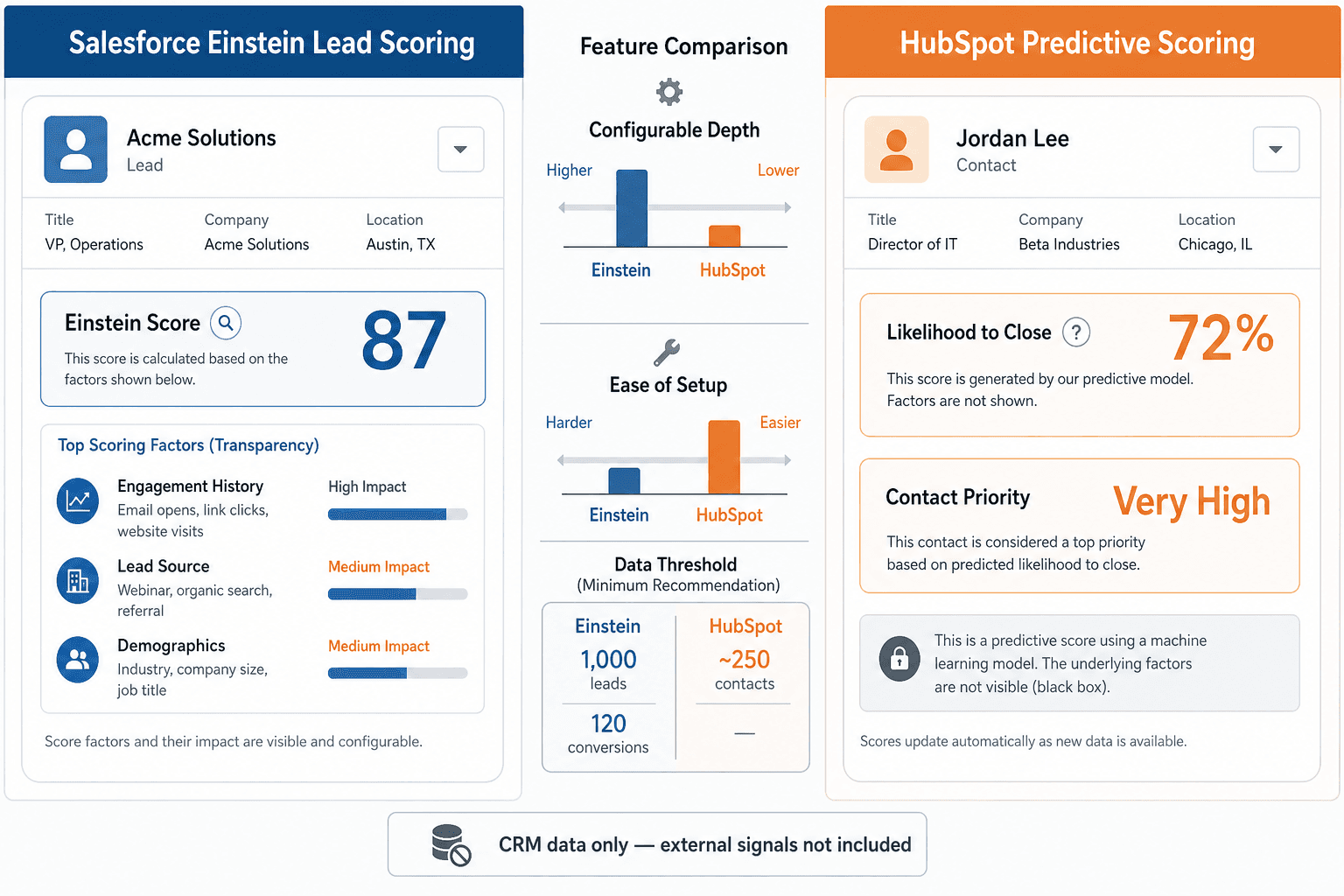
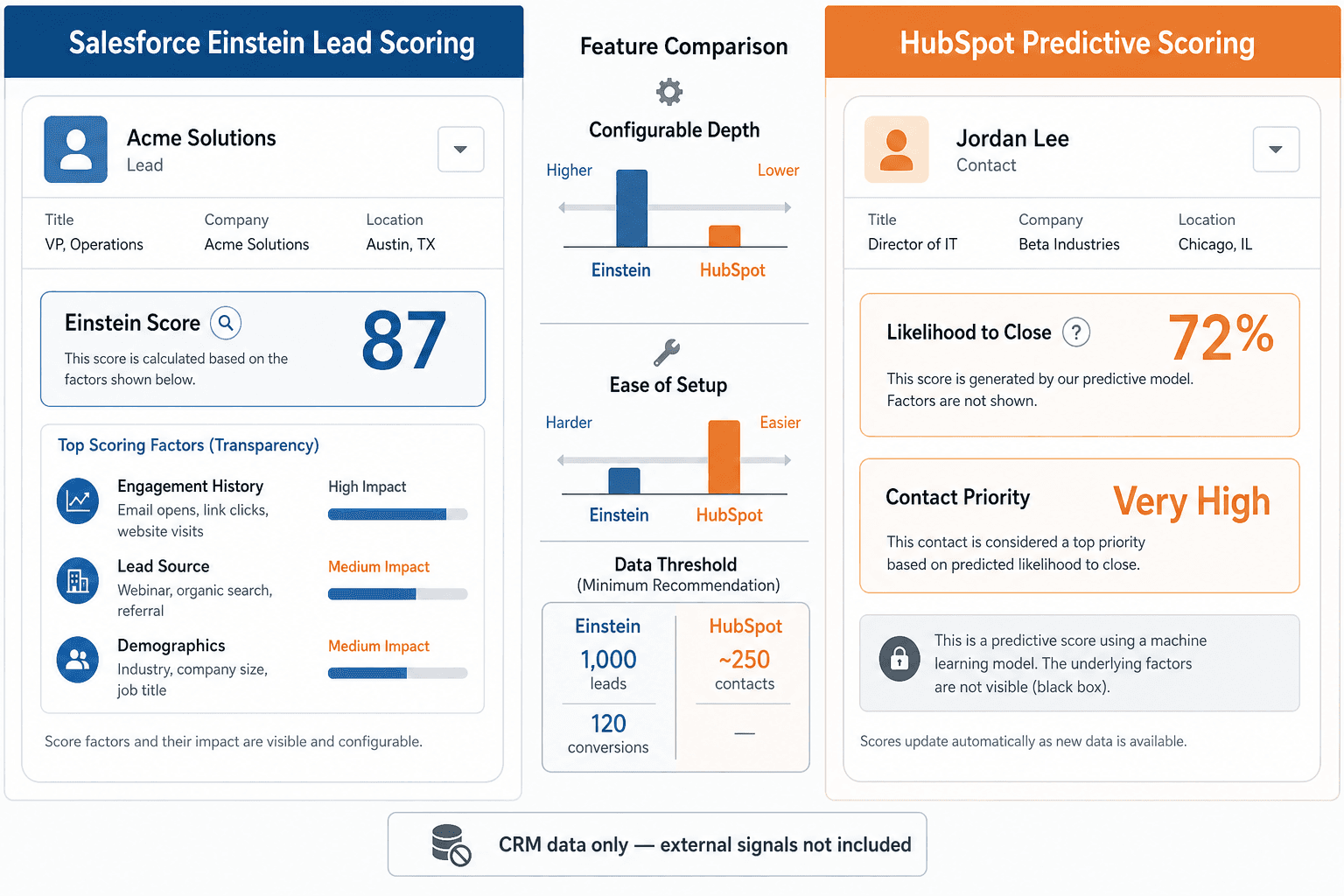
A key differentiator is Einstein's factor card transparency. The platform surfaces the top contributing factors for each score, giving sales teams visibility into why a lead scored the way it did. This is not full explainability — you see the factors, not the exact weightings — but it is significantly more transparent than a pure black-box output. Einstein also supports separate scoring models for different business units or product lines, which is valuable for enterprise organizations with diverse go-to-market motions.
HubSpot Predictive Scoring
HubSpot's predictive scoring, available in Marketing Hub Enterprise and Sales Hub Enterprise, uses machine learning to calculate two primary outputs: Likelihood to Close (the probability of a contact converting within 90 days) and Contact Priority (a four-tier ranking — Very High, High, Medium, Low — with roughly 25% of contacts in each tier). As HubSpot's official knowledge base states, "Using predictive machine learning algorithms, HubSpot analyzes your customers to determine the probability that your open contacts will close as customers within 90 days."
HubSpot underwent a substantial scoring overhaul in August 2025. The updated infrastructure introduced multi-model support — up to 25 different scoring systems per object — and score decay, which "automatically reduces an individual event's score based on how long ago a scored event occurred," with decay intervals settable to every 1, 3, 6, or 12 months. These changes narrowed the configurability gap with Einstein, though HubSpot's model remains fundamentally different in one critical respect: transparency.
Data Requirements: What You Need Before You Start
The single most common reason AI lead scoring fails in practice is insufficient or low-quality historical data. Both platforms have minimum thresholds, but the gap between "minimum to generate a score" and "minimum for reliable scoring" is wider than most vendors acknowledge.
| Requirement | Salesforce Einstein | HubSpot Predictive (Official) | HubSpot Predictive (Practitioner) |
|---|---|---|---|
| Minimum leads/contacts | ~1,000 leads | 50 contacts | 200–300 closed contacts |
| Minimum conversions | 120 conversions | 25 converted + 25 non-converted | 100+ won + 100+ lost |
| Time window | 200 days of historical data | Not specified | 6–12 months recommended |
| Data quality requirement | Well-structured CRM objects | Clean contact and deal records | Clean contact and deal records |
| Source | Autobound, Synebo | HubSpot Knowledge Base | ATAK Interactive |
Salesforce Einstein's requirements are higher and more specific. Multiple sources, including Autobound's 2026 comparison guide and Synebo's implementation guide, converge on a minimum of approximately 1,000 leads with at least 120 conversions over a 200-day window. Below this threshold, the model may generate scores, but the predictive signal is weak. For organizations with lower deal volumes or shorter CRM histories, Einstein may not be viable without supplementing with rule-based scoring.
HubSpot's official minimum is far lower: 50 contacts containing 25 converted and 25 non-converted. However, third-party implementation partners consistently recommend higher thresholds. ATAK Interactive's May 2026 practitioner guide states that "HubSpot recommends having at least 200-300 closed contacts (both won and lost) before predictive scoring becomes reliable." The gap between the official minimum and the practitioner recommendation reflects a real tension: the model will technically activate at 50 contacts, but the signal-to-noise ratio at that volume is poor, especially for B2B organizations with long sales cycles.
Scoring Accuracy and Transparency
Accuracy comparisons between CRM-native scoring tools are difficult to generalize because model performance depends heavily on the quality and volume of each organization's historical data. However, the transparency difference between the two platforms has practical implications for how sales teams use the scores.
| Attribute | Salesforce Einstein | HubSpot Predictive |
|---|---|---|
| Score visibility | Shows top contributing factors via factor cards | Outputs score only — no factor visibility |
| Model type | Partially explainable (factor-level) | Documented black-box |
| Customization | Configurable scoring models per business unit | Up to 25 scoring models (post-August 2025) |
| Score decay | Available | Available (configurable intervals) |
| External signal ingestion | Not natively supported | Not natively supported |
| Best for teams that need | Score justification to sales leadership | Quick prioritization without deep analysis |


Comments
Join the discussion with an anonymous comment.