
Brand Voice Governance for AI Content: A Practical Three-Layer Framework
A practical guide to implementing a three-layer brand voice governance system for AI content — structured brand rules, automated scoring, and a logged audit trail — that enforces consistency at generation time and provides traceability.
The failure usually does not look dramatic. An AI draft arrives polished, readable, and fast. It also uses the competitor’s category language, softens a compliance phrase legal already fought for, swaps the approved product descriptor for a friendlier one, and writes U.S. copy in a tone the U.K. team would never publish. Nobody can point to a broken step because the style guide technically exists. It lives in a PDF, a Notion page, a kickoff deck, or one senior editor’s memory.
That is the real problem brand voice governance for AI content has to solve. Not whether teams have guidelines, but whether those guidelines can be retrieved, applied, tested, and logged inside the production workflow. Glean cites research that 95% of companies have brand guidelines, while only 25-30% actively enforce them; the same source reports that 60% of marketing materials fail to conform to brand guidelines even when documentation exists.[1] A document can be correct and still be operationally useless.
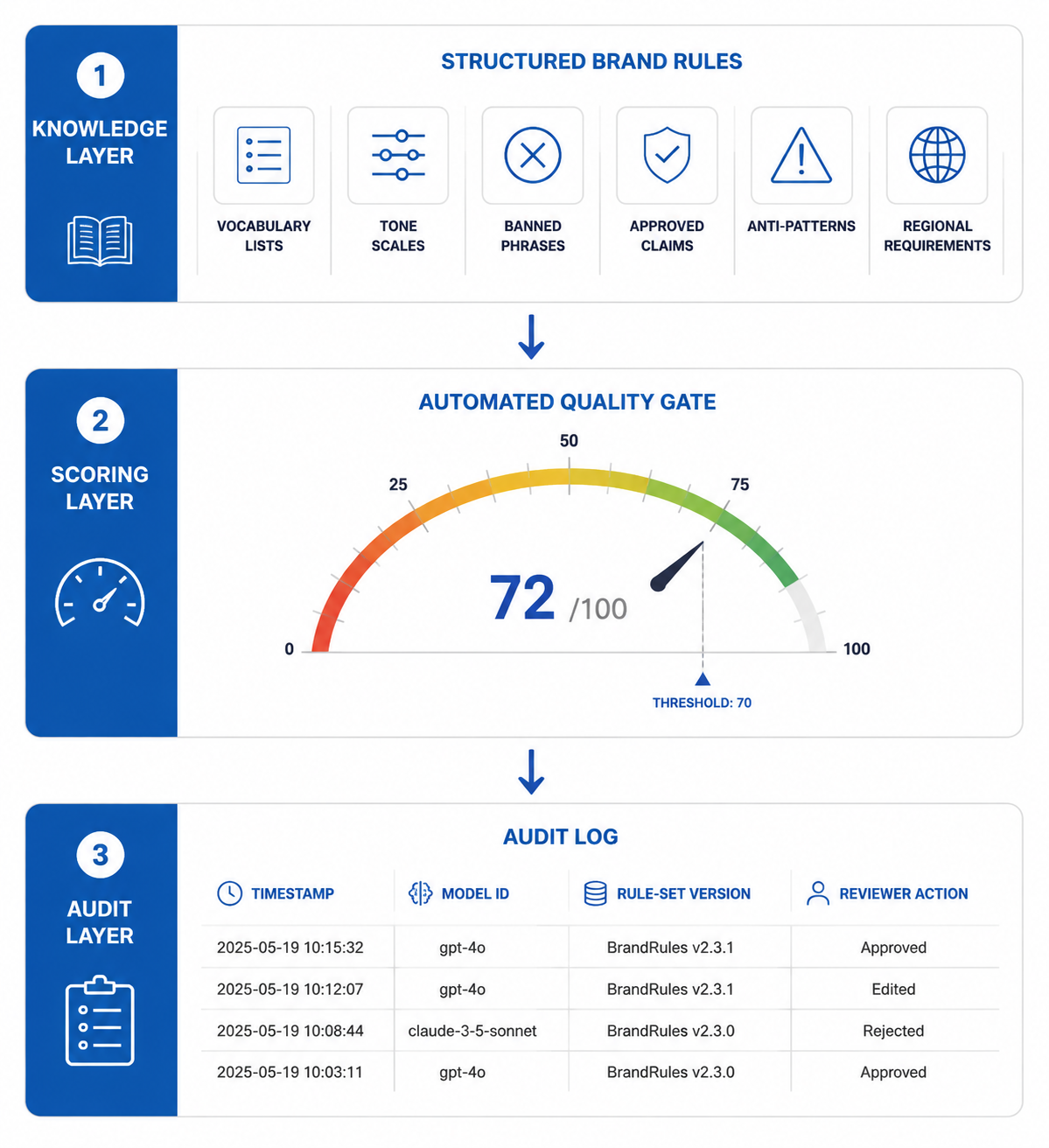
The system needs three layers: a knowledge layer that turns brand voice into structured AI-usable rules, a scoring layer that checks generated content before it enters the publishing queue, and an audit layer that records which rules, prompts, sources, models, and reviewers touched the asset. If one layer is missing, the final editor becomes the enforcement mechanism by memory and fatigue.
The Three-Layer System
| Layer | What It Controls | Operational Output |
|---|---|---|
| Knowledge layer | The rules the AI must use | Vocabulary lists, tone scales, banned phrases, approved claims, legal and regional requirements, examples, anti-patterns |
| Scoring layer | Whether the draft meets the rules | Automated quality score, pass/fail threshold, flagged violations, reroute logic |
| Audit layer | What happened to the asset | Prompt, model, rule-set version, sources, scores, reviewer actions, timestamps, approvals |
This is not a philosophical model. It is a production model. A writer, strategist, or AI operator should be able to request a draft and know which brand rules were available to the model. An editor should see why the draft failed, not merely that it “felt off.” A marketing operations lead should be able to answer, six weeks later, which version of the claims library and which approval path produced the final asset.
Speed only helps when the system does not push cleanup downstream. Inconsistent branding has been estimated to cost companies 10-20% of annual revenue on average in a Lucidpress/Marq survey of about 200 brand professionals, a useful directional warning rather than a universal benchmark.[1] The more immediate cost in AI workflows is easier to see: duplicated review, rewritten drafts, regional rework, and editors forced to police rules that should have been machine-readable before generation started.
Layer 1: Turn Brand Voice Into AI-Retrievable Rules
Most brand voice guides are written for humans who can infer context. AI systems need less elegance and more structure. “Sound confident but approachable” is not enough. The model needs to know which words signal confidence, which phrases become too casual, which claims are approved, which disclaimers are mandatory, and which regional variants change the acceptable wording.
Dotdigital’s guidance on making a brand voice guide usable by AI points in the right direction: define the voice with explicit traits, provide examples, identify words and phrases to use or avoid, and make the guidance specific enough for a tool to apply rather than merely admire.[2] The useful move is from descriptive prose to retrievable assets.
- Vocabulary rules: preferred product names, category terms, audience labels, spelling variants, capitalization, acronyms, and words the brand never uses.
- Tone scales: concrete ranges such as formal to conversational, assertive to cautious, technical to plain-language, with examples at each point.
- Behavioral constraints: when to explain, when to recommend, when to hedge, when to avoid urgency, and when to escalate to legal or subject-matter review.
- Approved claims: product capabilities, proof points, customer outcomes, comparison language, required qualifiers, and source requirements.
- Anti-patterns: phrases that look on-brand at a glance but violate positioning, compliance, category strategy, or audience expectations.
- Regional and legal requirements: market-specific terminology, regulated statements, disclosure language, and review triggers.
The examples matter more than teams usually admit. A tone label without paired examples still leaves the model guessing. A usable rule set should show acceptable and unacceptable language side by side. For example, a hypothetical B2B security company might allow “reduce manual review time” but ban “eliminate compliance risk” unless a specific approved source and qualifier are attached. The important part is not the phrase itself; it is that the constraint is retrievable before the model drafts the sentence.
Static Guidance Has To Become Active Constraint
Typeface describes Arc Graph as a way to transform brand PDFs and other documents into governance that can apply formatting, language, brand-specific, regional, and legal requirements during generation.[3] That is the right architectural direction: the guide is no longer a file someone may remember to open. It becomes part of the generation environment.
Teams do not need to start with a full knowledge graph to make progress this quarter. They can begin by extracting the most frequently violated rules and turning them into structured assets. Pull the last 50 edited AI drafts. Mark every edit that corrected vocabulary, tone, claim strength, legal wording, product naming, audience fit, or regional language. Those edits are the first governance backlog because they show where the PDF has already failed.
| If The Current Guide Says | Convert It Into |
|---|---|
| We are expert, warm, and practical. | A tone scale with examples of acceptable expert language, too-casual language, and overclaiming. |
| Avoid hype. | A banned phrase list and replacement patterns for words such as revolutionary, game-changing, effortless, guaranteed, and risk-free. |
| Use approved product messaging. | A claims library with approved statements, required qualifiers, source links, and expiry or review dates. |
| Write for enterprise buyers. | Audience rules that specify assumed knowledge, buying-stage cues, role-specific pain points, and terms to define. |
| Follow regional requirements. | Market-specific rule sets for spelling, terminology, regulatory phrasing, and mandatory review routing. |
The knowledge layer should also carry versioning. A brand rule that changed after a repositioning project should not silently coexist with the old rule. If the system cannot tell which rule set applied to a draft, the team cannot know whether a bad output came from a bad prompt, an outdated rule, or a reviewer overriding the system.
Connect The Rules To Generation, Not Just Review
A common half-step is to build a good rules library and then ask editors to check against it after generation. That is cleaner than a PDF, but it still waits too long. The rules need to be available when prompts are assembled, when source material is selected, and when the first draft is generated.
In practice, the workflow can be simple. A content request identifies asset type, audience, region, product, funnel stage, and distribution channel. Those fields retrieve the relevant rule set before generation. A product launch email should not receive the same tone constraints as a technical implementation guide. A paid social variation for one market should not inherit claims approved only for another.
- Classify the request by asset type, audience, region, product, channel, and risk level.
- Retrieve only the brand rules, claims, examples, and legal requirements relevant to that request.
- Assemble the generation prompt with the retrieved constraints and approved source material.
- Generate the draft with rule references preserved for scoring and review.
- Send the draft to automated scoring before a human editor spends time polishing it.
This is where vague prompt habits cause damage. If one team member writes “make it sound premium,” another writes “use our usual tone,” and a third pastes an old campaign brief, the model is not operating under governance. It is improvising around whoever happened to prompt it that day.
Layer 2: Score Drafts Before They Reach The Publishing Queue
The scoring layer turns brand review from a taste argument into a quality gate. It does not replace editors. It keeps editors from wasting time on drafts that should never have reached them.
CrawlQ’s BRAND Score is a concrete example of how this can be structured. Its framework scores AI content across five dimensions: Fidelity, Reasoning Depth, Audience Alignment, Novelty, and Deliverability, with each dimension scored from 0-100 and rolled into a weighted aggregate.[4] That methodology is proprietary and vendor-defined, not independently validated, so it should not be treated as a universal standard. It is still useful as an operational pattern: score the draft against named dimensions, set a threshold, and route the asset based on the result.
| Scoring Dimension | What It Should Catch |
|---|---|
| Brand fidelity | Wrong vocabulary, banned phrases, off-tone language, unapproved product names, positioning drift. |
| Claim discipline | Unsupported outcomes, missing qualifiers, exaggerated comparisons, legal or regional phrasing problems. |
| Audience alignment | Wrong assumed knowledge, wrong buying stage, wrong role emphasis, generic pain points. |
| Source grounding | Claims not tied to approved sources, invented proof points, outdated messaging. |
| Channel fit | Draft length, structure, CTA style, formatting, and level of detail inappropriate for the asset type. |
A useful score is not just a number. It should show which rule failed, where it failed, and what happens next. A draft that scores below the threshold for banned phrases can be automatically regenerated. A draft that fails on a regulated claim should route to legal or a designated reviewer. A draft that passes brand fidelity but fails audience alignment may go back to the strategist, not the copyeditor.
Set Thresholds By Risk, Not By Optimism
A single pass score for every asset type is usually too blunt. A low-risk internal social post draft can tolerate a different review path than a regulated product landing page. The threshold should reflect the consequence of failure.
| Asset Risk | Example Routing Rule |
|---|---|
| Low | If the draft passes brand and channel checks, send to normal editorial review. |
| Medium | If the draft fails audience or claim checks, regenerate once, then route to strategist if it still fails. |
| High | Require brand, claim, source, and regional checks to pass before legal or compliance review begins. |
The threshold itself should be calibrated against human review. Take a sample of recent AI drafts, have editors mark the real violations, then compare those decisions with the automated score. If the scoring layer passes drafts editors consistently reject, the rule set is too weak or the scoring prompt is too forgiving. If it blocks drafts editors consistently approve, it is probably overfitting to surface features of the voice.
Vendor-reported results are worth reading after the mechanics are clear. Averi reports that companies with comprehensive AI governance see 62% fewer compliance review cycles and 31% better brand consistency, but this is enterprise customer data from a vendor rather than a published third-party audit.[5] Typeface reports customer approval cycles becoming 40-60% faster after governance implementation, moving from 5-7 revision rounds to 2-3.[3] Those figures are useful as workflow signals: the gains come from preventing bad drafts from consuming review time, not from asking editors to move faster.
Route Failures Instead Of Dumping Them On The Editor
A failed score should trigger a specific path. Without routing, automated scoring becomes another dashboard everyone learns to ignore. The point is not to produce a red number. The point is to decide who acts next.
| Failure Type | Likely Cause | Next Action |
|---|---|---|
| Banned phrase or wrong vocabulary | Rule missing from prompt or model ignored constraint | Regenerate with the rule highlighted; log repeat failures. |
| Unsupported claim | Approved source not attached or claim library incomplete | Block from editorial queue; route to strategist or product marketer. |
| Regional language violation | Wrong market rule set retrieved | Correct classification; regenerate under the right regional rules. |
| Tone drift | Tone scale too vague or examples too sparse | Add acceptable and unacceptable examples; rescore. |
| Legal phrasing issue | Mandatory qualifier missing or outdated | Route to legal/compliance; update rule-set version after resolution. |
This routing table is where governance becomes merciful to the people doing the work. The copyeditor should not be responsible for diagnosing whether a claim library is stale. The strategist should not have to re-edit every tone violation caused by an underspecified scale. The operations owner should see recurring failure types and fix the system, not send another reminder to “follow the guide.”
Atom Writer’s Adore Me case study reports 98.3% faster product description generation with governance-controlled AI.[6] That kind of result should be read as a case example, not proof that every team will see the same lift. Product descriptions are also a favorable use case for governance because the structure, attributes, and allowable language can often be constrained tightly. The lesson travels better than the exact number: repeatable content types benefit when the rules are explicit enough for the system to enforce.
Layer 3: Keep A Record That Can Survive Questions Later
The audit layer is not the most glamorous part of brand voice governance, which is probably why it gets postponed. It should not be. Once AI-generated content is part of the publishing process, the team needs to know what happened after the fact.
- The original request, including asset type, audience, region, channel, product, and risk level.
- The prompt or prompt template used to generate the draft.
- The model or tool used, including version or configuration when available.
- The brand rule-set version, claims library version, and source materials retrieved.
- The automated scores, failed checks, regeneration attempts, and routing decisions.
- The human reviewers, their actions, timestamps, approvals, and overrides.
This record is useful even before regulators or auditors ask for it. It helps the team debug. If a batch of drafts keeps failing on regional language, the log may show that the wrong market was selected at intake. If legal keeps correcting the same phrase, the claims library may be outdated. If one tool produces more overrides than another, the issue is not “AI quality” in general; it is a workflow configuration that can be isolated.
Traceability also matters because AI transparency obligations are still moving. The EU AI Act’s Article 50 transparency obligations are part of the regulatory backdrop, and related Code of Practice material was in draft form in January 2026 rather than final.[7] The practical response is not to wait for every detail to settle. It is to build the habit of marking, logging, and retrieving AI content decisions now.
A Build Order For This Quarter
The clean version of this system can sound bigger than it needs to be at the start. Build it in the order that removes the most rework first.
- Audit recent edits: collect AI drafts and final versions, then label the edits by vocabulary, tone, claim, audience, legal, regional, and channel issues.
- Structure the highest-frequency rules: convert the recurring edits into lists, scales, examples, banned phrases, approved claims, and review triggers.
- Attach rules to intake fields: make asset type, audience, region, product, channel, and risk level determine which rules are retrieved.
- Add a scoring gate: test drafts against the retrieved rules before they move to editorial review.
- Define routing: decide what happens when a draft fails each type of check, including regeneration, strategist review, legal review, or rule-set update.
- Log the process: preserve prompts, model details, rule versions, sources, scores, reviewer actions, and approvals.
Do not begin by trying to encode the entire brand book. Start with the rules whose failure creates the most expensive review. In many teams, that means approved claims, banned phrases, product naming, tone examples, and regional requirements. The rest can follow once the first governed workflow is producing fewer preventable edits.
The first production test should be narrow. Pick one repeatable asset type, one market, one audience, and one approval path. Run the system on a small batch. Compare the automated score with human review. Track which failures were real, which were false alarms, and which rules were missing. Then adjust the rule set and threshold before expanding to more content types.
What “Working” Looks Like
A working brand voice governance system does not depend on one editor remembering every exception. It makes the current rules available at generation time. It checks the draft before handoff. It routes failures to the person who can actually fix them. It leaves enough of a record for the team to reconstruct what happened.
The style guide still matters, but it is no longer the system. It is an input to the system. Brand voice governance for AI content is working only when every AI-generated asset can be checked against structured rules while it is being created and traced after it moves through review.
References
- How to create a brand voice guide for AI tools, Glean
- How to create a brand voice guide that AI can actually use, Dotdigital
- Content Quality Control and Brand Governance with AI, Typeface
- Brand Governance for AI Content — A Framework for Defensible Output, CrawlQ
- The AI Marketing Governance Framework Enterprise Teams Actually Use, Averi
- Brand Voice AI Case Studies: Real Results from Real Brands, Atom Writer
- AI governance stats for 2026, Optro

Comments
Join the discussion with an anonymous comment.