

HubSpot Breeze AI and Salesforce Einstein
This article provides a 3-year total cost comparison of HubSpot Breeze AI and Salesforce Einstein (Agentforce) across team sizes from 10 to 200 users, revealing hidden costs often omitted from vendor pricing.
Marketing Categories
At 50 users, the cleanest HubSpot AI vs Salesforce Einstein comparison is not close on three-year cost: roughly $324,000 for HubSpot versus about $900,000 to $1.5 million for Salesforce with Agentforce, depending on configuration and usage assumptions.[1] That 3.4x gap is useful because it resets the buying conversation. It is also incomplete unless the buyer can explain what is inside it.
The part that matters is not whether one vendor has a sharper demo. It is which line items become recurring obligations after procurement is done: Data Cloud, implementation work, admin coverage, and AI usage models that someone in RevOps has to defend to finance.
| Team size | HubSpot AI CRM 3-year TCO | Salesforce + Agentforce 3-year TCO | What the gap usually means |
|---|---|---|---|
| 10 users | Lower cost floor; typically driven by licenses, light setup, and limited admin overhead | Higher fixed-cost exposure once implementation, Data Cloud, and admin work enter the model | Salesforce overhead is hardest to justify unless workflows are already complex |
| 25 users | HubSpot Professional is cited around $20,400/year before AI usage | Salesforce Enterprise is cited around $49,500/year before AI add-ons | A $29K+ annual license gap appears before Data Cloud, Agentforce, services, or admin salary |
| 50 users | Approximately $324K over 3 years | Approximately $900K–$1.5M over 3 years | The headline 3.4x gap is driven mainly by hidden operating layers, not seat price alone |
| 200 users | Still materially simpler to operate if the CRM process remains mid-market in shape | More defensible when the organization needs enterprise orchestration, deeper customization, and high-volume autonomous interaction | The capability ceiling starts to matter more, but only if the company can staff it |
The 25-user license comparison shows why spreadsheet theater starts early. Salesforce Enterprise at about $49,500 per year versus HubSpot Professional at about $20,400 per year creates a $29,000-plus annual gap before AI add-ons are even in the room.[2] But the real separation does not come from that first row. It comes from the layers that appear underneath it.
The Cost Stack Behind the AI CRM Decision
A useful TCO model for AI CRM should separate six cost categories: base CRM licensing, AI add-ons, required data infrastructure, implementation, internal administration, and metered AI usage. Vendor pages tend to make the first category easy to see and the rest easier to postpone. That is how a platform that looked comparable in month one becomes a staffing plan by month six.
Base CRM Licensing Is Only the Opening Bid
HubSpot’s cost case usually starts with a lower license floor and fewer operational prerequisites. Salesforce’s cost case starts higher, but that alone is not the problem. A company can rationally pay more for Salesforce if it needs territory complexity, custom objects at scale, multi-cloud orchestration, heavy approval logic, or a broader Salesforce environment.
The trap is treating the license delta as the delta. At 25 users, the cited $29,000-plus annual license difference is already material.[2] At 50 users, it becomes only one part of a much larger gap because Agentforce does not sit on top of Sales Cloud as a frictionless AI toggle.
Data Cloud Changes the Salesforce Math
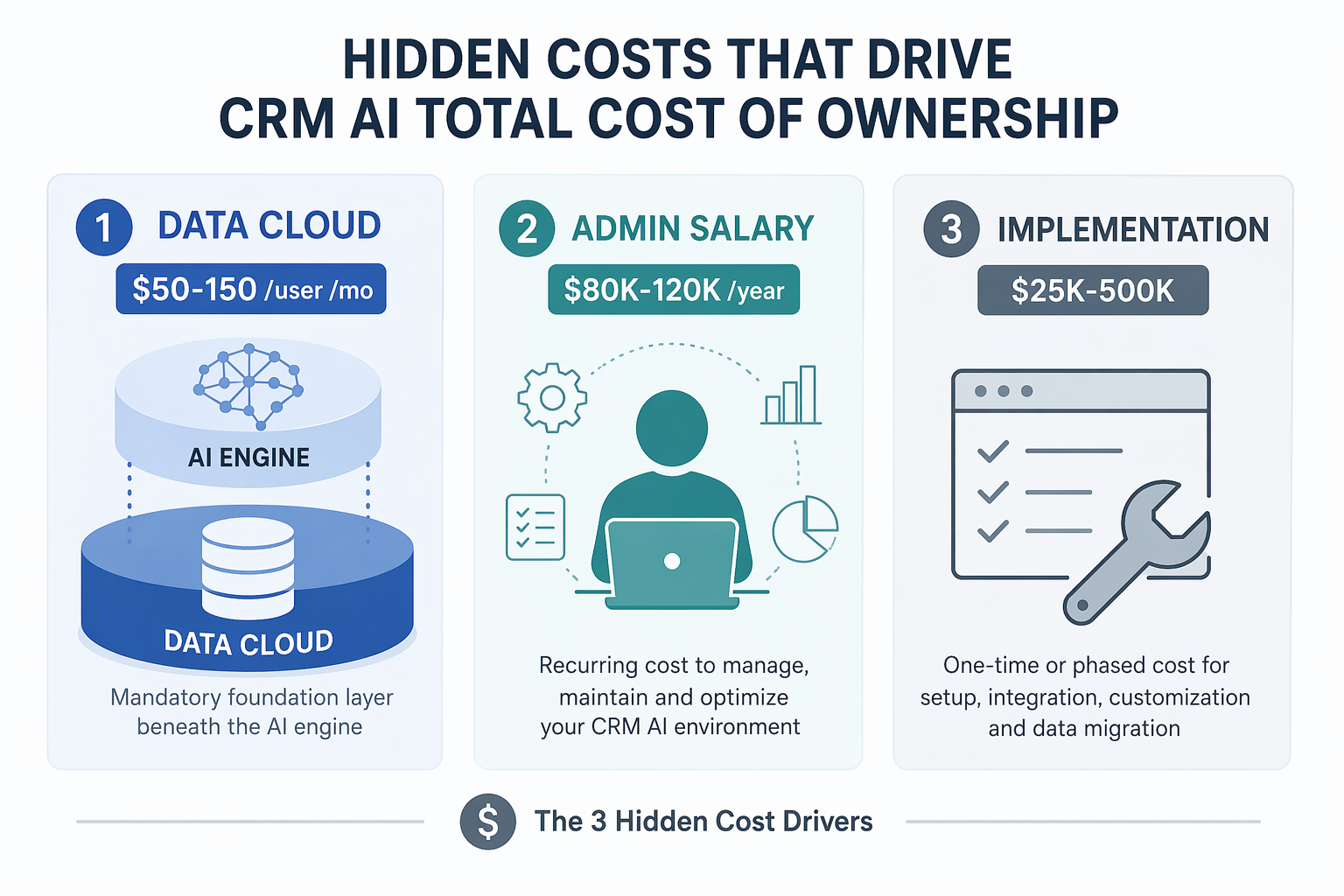
The most commonly missed Salesforce line item is Data Cloud. In the 2026 comparison materials, Data Cloud is treated as a mandatory Agentforce prerequisite and is estimated at $50 to $150 per user per month on top of Salesforce licensing.[1] For a 50-user team, that is not a rounding error. It is an additional operating layer that can run from $30,000 to $90,000 per year before implementation services, internal administration, or AI usage charges are counted.
That cost may be justified when the company has multiple systems of record and needs a governed customer data layer to support enterprise automation. It is much harder to justify when the buyer mainly wants faster lead research, assisted follow-up, routing, summaries, support deflection, and cleaner handoffs.
Implementation Is Where the Buying Meeting Gets Too Optimistic
Implementation ranges are blunt, but they are still useful. HubSpot implementations are cited around $1,500 to $3,500, while Salesforce rollouts are cited from $25,000 to more than $500,000 depending on scope.[3][2] The upper end of the Salesforce range is not what every mid-market buyer will pay. It is a warning about how quickly “we just need CRM plus AI” becomes data migration, custom objects, security roles, automation design, integration work, sandbox testing, reporting rebuilds, and user enablement.
This is also where a bad comparison article quietly cheats. It compares a HubSpot setup that includes onboarding with a Salesforce setup that assumes the buyer already knows how the org should be designed. For a team without mature RevOps architecture, the missing design work does not disappear. It lands on someone internal.
Admin Labor Is the Line Item That Becomes a Person
Salesforce typically requires dedicated administration at mid-market and enterprise scale, with cited annual admin cost around $80,000 to $120,000.[1][2] HubSpot rarely requires the same dedicated admin overhead at mid-market scale, though that does not mean it runs itself. Someone still owns data hygiene, permissions, lifecycle stages, reporting, workflows, and AI governance.
The difference is intensity. In HubSpot, that work often remains part of a RevOps or marketing ops role. In Salesforce, the platform is capable enough, customizable enough, and consequential enough that administration becomes a job function. If the business needs that capability, the salary is rational. If it does not, the salary is overhead created by the platform choice.
AI Pricing Is Now a Procurement Risk, Not a Footnote
AI usage pricing is where the two vendors are moving in different directions. HubSpot announced outcome-based pricing effective April 14, 2026: $0.50 per resolved Customer Agent conversation and $1 per qualified lead from Prospecting Agent, with no charge when the task is not completed.[4] That changes the budgeting discussion from seats and actions to completed work.
It is still new. A pricing model can be attractive in the first quarter after launch and still surprise customers later if usage expands faster than expected. The advantage is not that HubSpot has eliminated AI cost uncertainty. The advantage is that a RevOps leader can explain the unit of value more directly: a resolved conversation or a qualified lead.
Salesforce Agentforce has been harder to model. The 2026 sources describe three pricing approaches in roughly 18 months: $2 per conversation, Flex Credits at $0.10 per action, and per-user pricing at $125 or more per month.[1][5][2] That is not just vendor evolution. For a buyer building a three-year model, it means the procurement assumption may age before the implementation is fully adopted.
The operational issue is simple: finance does not want to hear that AI cost depends on a definition of “action” that may change, a credit system that may be re-bundled, or a per-user model that may not match actual usage. If Salesforce is the right architecture, buyers can accept that risk. They should not pretend it is the same risk profile as a stable subscription line.
Where Salesforce Still Has a Real Capability Case
There is a lazy version of this comparison where HubSpot wins because it is easier and Salesforce loses because it is complicated. That misses the reason Salesforce keeps winning complex deals. Salesforce can be defensible when the company needs deeper workflow orchestration, more granular customization, sophisticated security and approval structures, and AI agents operating across a broader Salesforce cloud environment.
The native Agentforce ceiling matters most when the buyer can actually use it. GPTfy’s comparison cites native Agentforce strengths including more than 6,000 concurrent interactions and 66% autonomous resolution.[1] Those are capability claims from a source with commercial interests in the Salesforce ecosystem, so they should be tested against the buyer’s own use case. Still, they point to the kind of environment where Salesforce’s cost structure starts to make sense: high-volume service, complex routing, and automation that depends on governed enterprise data.
A 200-user company with multiple sales motions, regional permissions, layered partner processes, custom revenue objects, and a real Salesforce operations bench is not buying the same thing as a 35-person SaaS team trying to qualify inbound leads faster. The first may be buying infrastructure. The second may be buying avoidable complexity.
The BYOM Complication
There is a third path for companies already committed to Salesforce: keep Salesforce Sales Cloud and add a third-party AI layer instead of adopting Agentforce. GPTfy frames this bring-your-own-model approach as a way to cut the TCO gap roughly in half compared with Salesforce plus Agentforce.[1] That is worth considering, but the source has an obvious incentive to make the path look attractive.
The economic trade is not free. BYOM can reduce the native Agentforce cost burden, but it shifts work into integration design, vendor management, security review, data access rules, monitoring, and support boundaries. It may also give up native Agentforce advantages, including the concurrency and autonomous-resolution capabilities cited in the same comparison.[1]
For a Salesforce-native organization with technical staff and clear AI use cases, that may be a reasonable compromise. For a mid-market team trying to avoid building a CRM operations department, it can become another version of the same problem: lower invoice, higher coordination cost.
A Buying Framework by Team Size and Complexity
The better question is not “Which AI CRM is better?” It is “Which operating model can this company afford to maintain?” Team size matters, but workflow complexity matters more.
| Company profile | Likely better economic fit | Reason |
|---|---|---|
| 10–25 CRM users, straightforward sales process, limited RevOps capacity | HubSpot | Salesforce fixed costs arrive before the team is likely to use the enterprise capability |
| 25–75 users, growing sales and support teams, need AI assistance without dedicated CRM administration | HubSpot | The lower setup burden and outcome-based AI pricing are easier to defend against actual completed work |
| 50–200 users, complex territories, custom revenue workflows, multiple systems of record | Salesforce can be defensible | Data Cloud, admin labor, and implementation cost may buy capabilities the company will use |
| Salesforce-installed company that wants AI but not full Agentforce economics | Salesforce plus BYOM may be worth modeling | It can narrow the cost gap, but adds integration and governance work |
| High-volume service or autonomous-agent environment with enterprise data requirements | Salesforce + Agentforce | The native capability ceiling may matter more than the cost floor |
For most companies in the 20–200 employee range, HubSpot is the lower-risk economic choice when the desired AI outcomes are practical: faster prospecting, better follow-up, support deflection, conversation resolution, routing, summarization, and cleaner CRM execution. The platform may not match Salesforce’s ceiling, but many mid-market teams are not constrained by ceiling. They are constrained by adoption, admin time, data cleanliness, and budget predictability.
Salesforce becomes easier to defend when the buyer can name the workflows that require Salesforce, name the systems that Data Cloud must unify, name the person who will administer the environment, and explain why Agentforce’s native capabilities are worth the extra three-year cost. Without those answers, the purchase depends too heavily on brand comfort and too lightly on operating reality.
What to Verify Before You Sign
Before a CFO sees the final model, the Salesforce version should include Data Cloud, Agentforce pricing under the current contract structure, implementation services, integration work, sandbox and testing time, admin salary or managed services, and a usage sensitivity case. The HubSpot version should include the right hub tier, onboarding, any required partner work, AI usage under outcome-based pricing, data cleanup, and the internal owner’s time.
The safest rule is also the least dramatic one: choose HubSpot when the business needs AI CRM capability without enterprise overhead; choose Salesforce when the organization’s workflow complexity, data architecture, and internal admin capacity justify the extra three-year cost.
References
- HubSpot vs Salesforce AI: 2026 Architecture Compared — GPTfy, 2026
- HubSpot vs Salesforce 2026: AI Features and Pricing — Digital Applied, 2026
- HubSpot vs Salesforce 2026: Real Cost, AI Tools, Setup Time & Best CRM by Business Size — HyphenX Solutions, 2026
- HubSpot's Customer Agent and Prospecting Agent: Now you pay when the task is complete — HubSpot, April 14, 2026
- Salesforce Einstein vs HubSpot Breeze Comparison 2026 — Prometheus Agency, 2026

Comments
Join the discussion with an anonymous comment.