
From Reactive to Predictive: A Marketing Analytics Maturity Framework for AI-Driven Teams
Most marketing teams are stuck at descriptive reporting. This article provides a staged maturity model (Descriptive → Diagnostic → Predictive → Prescriptive) with sourced accuracy benchmarks, helping performance marketers and marketing ops leads assess their current stage and prioritize their next capability investment.
The Analytics Maturity Curve: Where Does Your Team Stand?
Most marketing teams operate on a simple cycle: pull a report, see what happened, and react. This is descriptive analytics, and it is where the vast majority of organizations live. The problem is that reacting to yesterday's data in a landscape where customer behavior, platform algorithms, and competitive moves shift weekly is a losing strategy.
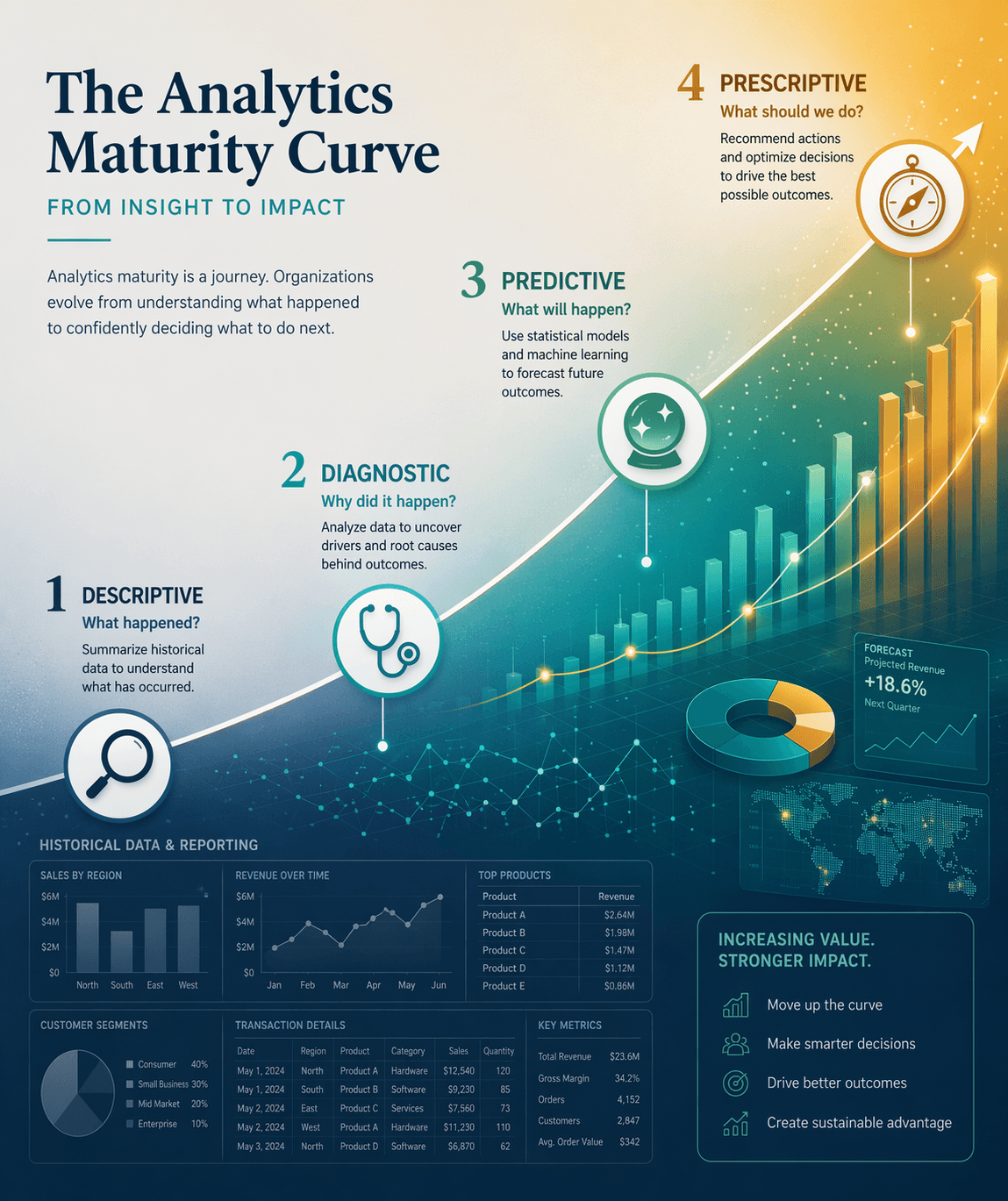
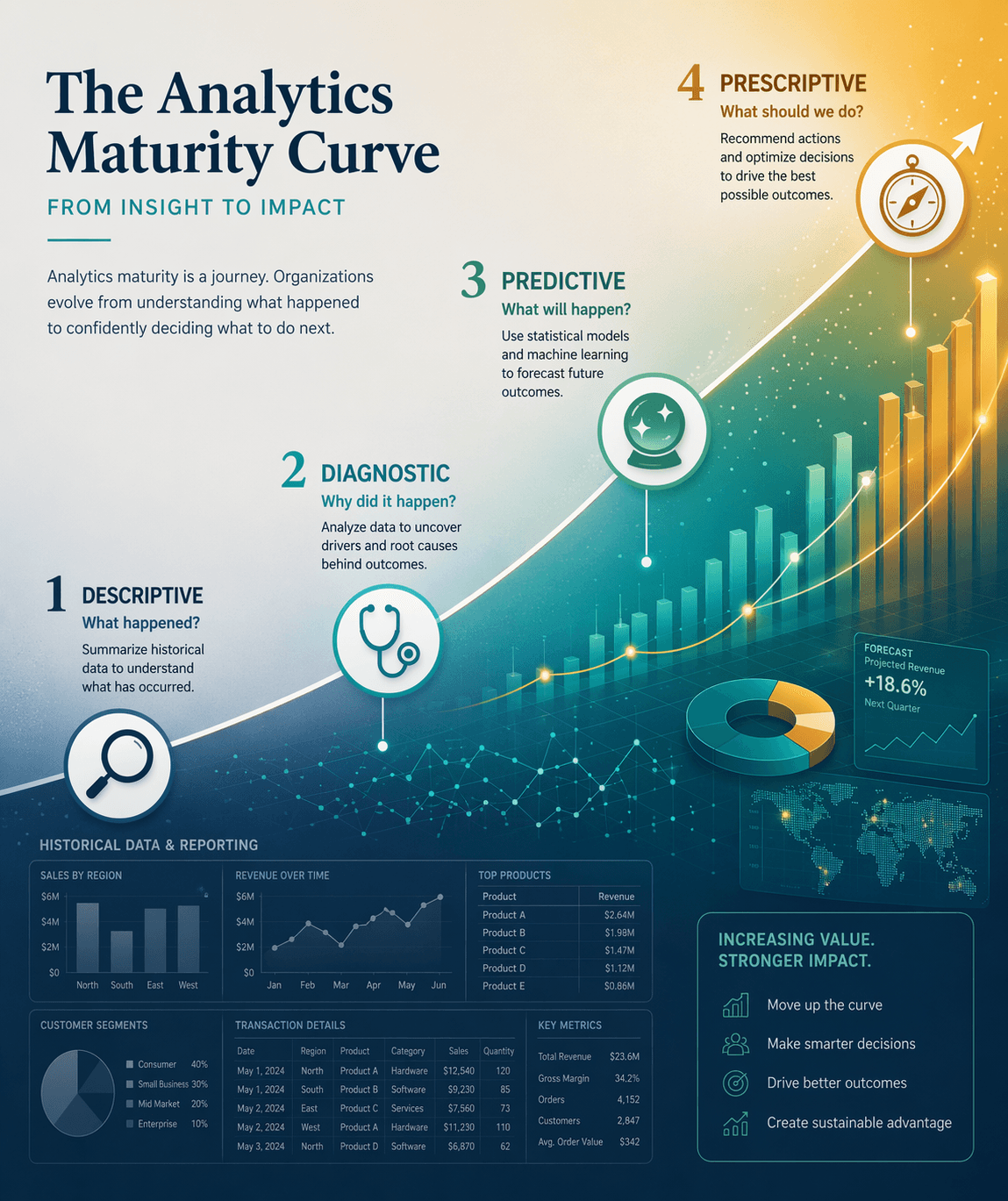
AI's most transformative contribution to marketing analytics is not faster dashboards or prettier visualizations. It is the ability to move from reactive reporting to proactive intelligence. The framework that captures this progression is the Analytics Maturity Curve, which has four distinct stages:
- Descriptive — "What happened?" You track KPIs, build dashboards, and report on past performance. Example: "Last month, email campaigns drove 12% of total revenue."
- Diagnostic — "Why did it happen?" You drill into root causes, segment data, and identify patterns. Example: "Revenue from email dropped because the B2B segment's open rates fell 8% after we changed the subject line format."
- Predictive — "What will happen?" Machine learning models forecast outcomes based on historical patterns and real-time signals. Example: "Our churn model flags 340 accounts with a >60% probability of churning in the next 60 days."
- Prescriptive — "What should we do about it?" AI recommends specific actions and optimizes resource allocation. Example: "Deploy retention sequence B to the flagged accounts; allocate 30% of next week's ad budget to the high-propensity segment."
The jump from diagnostic to predictive is where the competitive leverage lives. Teams that can forecast churn, predict customer lifetime value, and score propensity before a campaign launches operate with a fundamentally different information advantage than teams that only know what happened last quarter.
Why Most Marketing Teams Are Stuck at Descriptive
The barriers to moving up the curve are rarely technical. Most teams have access to tools that can do more than they are currently using. The real obstacles are structural and behavioral.
Data Silos and Fragmented Journeys
Customer data lives in your CRM, your email platform, your ad manager, your analytics tool, and your customer support system. When these systems do not talk to each other, AI models are forced to work with an incomplete picture. A predictive model trained only on website behavior will miss the signals buried in support tickets or sales call notes. According to Digital Applied's 2026 guide, AI-powered attribution models can account for 40 or more touchpoints across the customer journey, but that capability is useless if the data feeding those models is siloed.
Last-Click Attribution Addiction
Despite years of evidence that last-click models distort investment decisions, many teams still default to them. The same Digital Applied guide notes that last-click models miss more than 60% of the customer journey. When you only credit the final touchpoint, you systematically underinvest in the awareness and consideration channels that actually drive conversions. Moving to data-driven attribution is often the single highest-leverage step a team can take toward diagnostic and predictive capability.
Dashboard Overload Without Decision Support
More dashboards do not equal better decisions. In fact, they often produce the opposite effect: teams spend so much time reconciling conflicting data sources that they have no energy left for analysis. The symptom is a weekly meeting where stakeholders debate whose number is correct rather than discussing what to do. AI analytics tools that automate data unification and anomaly detection can reduce reporting time by 60-80%, according to Digital Applied's efficiency estimates, freeing teams to focus on interpretation and action.
Lack of Predictive Tooling and Skills
Even when teams have access to predictive features — Google Analytics 4 offers predictive audiences, HubSpot provides predictive lead scoring — they often do not use them. A Salesforce survey cited by Hello Operator found that 70% of employers do not provide generative AI training. The capability exists in the tool stack, but the organizational knowledge to activate it does not. This is not a failure of individual marketers; it is a failure of team development and prioritization.
The Four Predictive Capabilities That Move the Needle
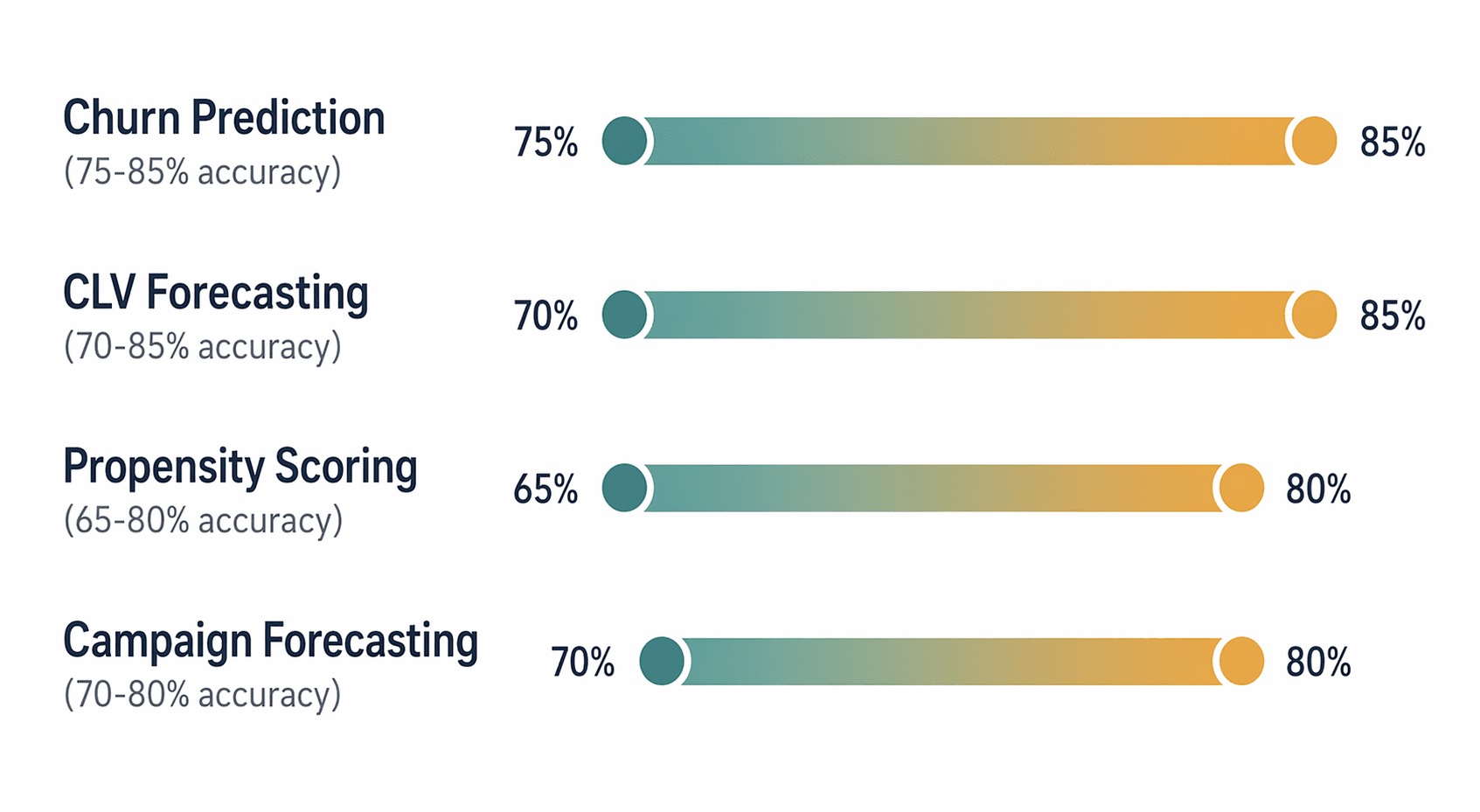
Once a team has solid diagnostic analytics in place — clean data, unified customer journeys, and multi-touch attribution — the next step is building predictive models. Four capabilities consistently deliver the highest return for marketing teams, each with typical accuracy ranges reported in industry deployments.
| Predictive Capability | What It Does | Typical Accuracy Range | Why It Matters |
|---|---|---|---|
| Churn Prediction | Identifies customers likely to stop engaging or purchasing within a defined window (e.g., 30-90 days) | 75-85% | Enables proactive retention outreach before revenue is lost; preserves CLV |
| CLV Forecasting | Predicts the total value a customer will generate over their relationship with your brand | 70-85% | Informs acquisition budget limits, segment prioritization, and tiered service strategies |
| Propensity Scoring | Ranks leads or accounts by their likelihood to convert, upgrade, or take a specific action | 65-80% | Focuses sales and marketing resources on the highest-potential opportunities |
| Campaign Forecasting | Predicts campaign performance metrics (CTR, conversion rate, ROAS) before launch | 70-80% | Enables budget optimization and creative testing before spend is committed |
These four capabilities are not independent. Churn prediction and CLV forecasting often share underlying data and models. Propensity scoring feeds directly into campaign forecasting by helping you estimate which segments will respond. Teams that build one capability typically find it easier to add the next, because the data infrastructure and modeling expertise transfer across use cases.
Beyond these core models, timing optimization is a lower-effort predictive win. Digital Applied reports that AI-driven timing optimization alone can improve response rates by 20-30% — a significant lift for a relatively simple model that analyzes when individual contacts are most likely to engage.
How to Move Up the Curve: A Phased Approach
Advancing from descriptive to predictive analytics does not require a massive upfront investment or a data science team. The most effective approach is incremental: build the foundation, capture quick wins, then expand into advanced capabilities. Digital Applied's three-phase implementation guide provides a practical roadmap.
Phase 1: Foundation (Weeks 1-4)
The goal of this phase is to get your data infrastructure ready for predictive modeling. Start by unifying your data sources into a single analytics environment. This does not have to be a full data warehouse — a tool like HockeyStack or Mixpanel that ingests data from multiple platforms and deduplicates touchpoints is sufficient for many teams. While you are unifying data, implement automated anomaly detection so your team stops wasting time manually scanning dashboards for outliers.
- Key actions: Connect CRM, ad platforms, email, and analytics tools to a single destination. Set up automated alerts for significant metric deviations. Establish a data quality audit cadence.
Phase 2: Quick Wins (Weeks 5-8)
With clean, unified data, you can move from descriptive to diagnostic analytics. Implement data-driven attribution to replace last-click models. This alone will surface which channels and touchpoints are actually driving conversions. Digital Applied's guide notes that AI-powered attribution can account for 40+ touchpoints, eliminating the blind spots that cause teams to misallocate budget.
For a deeper comparison of attribution approaches, see our guide on AI Marketing Attribution Models in 2026, which covers how to layer MMM, MTA, and incrementality testing.
- Key actions: Switch from last-click to data-driven attribution. Build your first diagnostic reports that answer "why" questions. Identify the top three patterns that explain performance variance across campaigns.
Phase 3: Advanced Capabilities (Months 3-6)
This is where you build predictive models. Start with the capability that addresses your most pressing business problem. For a subscription business, that is likely churn prediction. For a high-volume ecommerce operation, CLV forecasting or propensity scoring may come first. Use the accuracy ranges in the table above as benchmarks to evaluate whether your models are performing within expected parameters.
- Key actions: Build and validate your first predictive model. Integrate model outputs into campaign planning workflows. Establish a feedback loop to measure prediction accuracy against actual outcomes and retrain models quarterly.
For detailed guidance on selecting and integrating the tools that support each phase, see our article on How to Build an AI Marketing Analytics Stack.
Real Example: Predicting B2B Churn 30–90 Days in Advance
To illustrate how these capabilities work in practice, consider a composite scenario based on patterns observed across B2B software companies. A mid-market SaaS company with 2,000 accounts and a 12-month average contract value of $15,000 notices that its churn rate has crept up from 4% to 6% per quarter. Traditional descriptive analytics shows the trend but offers no explanation and no lead time.
The team deploys a churn prediction model trained on historical account data: product usage frequency, support ticket volume, login recency, contract renewal timing, and email engagement patterns. The model outputs a churn probability score for each account, updated weekly.
- What the model reveals: 340 accounts have a >60% predicted churn probability within the next 90 days. Of those, 85 accounts show a >85% probability within 30 days. The strongest predictors are a drop in daily active users below 3 sessions per week and an increase in support tickets related to a specific feature.
- Proactive actions taken: The 85 high-risk accounts receive a personalized outreach sequence from customer success managers, including a product walkthrough of the problematic feature. The remaining 255 accounts enter an automated email nurture track with case studies and upgrade offers. The product team is alerted to the feature issue for prioritization.
- Outcome: Over the next quarter, the company retains 72 of the 85 high-risk accounts (85% retention rate in that segment) and reduces overall churn from 6% to 4.2%. The cost of the retention program is a fraction of the revenue preserved.
Tool Mapping: Which Platforms Serve Which Stage
Different analytics platforms are designed for different maturity stages. Understanding where each tool fits helps you avoid over-investing in capability you are not ready to use or under-investing in the infrastructure you actually need.
| Tool | Best Suited For | Key Predictive Capabilities | Typical Team Fit |
|---|---|---|---|
| Google Analytics 4 | Descriptive to Diagnostic | Predictive audiences, anomaly detection, data-driven attribution | Teams already using Google's ecosystem; good entry point for basic predictive features |
| HockeyStack / Mixpanel | Diagnostic to Predictive | Multi-touch attribution, journey intelligence, account scoring, AI assistant for text-to-report | B2B and mid-market teams needing cross-platform journey unification |
| Salesforce Einstein | Predictive to Prescriptive | Lead scoring, opportunity insights, campaign forecasting, next-best-action recommendations | Enterprise teams with existing Salesforce investment; requires clean CRM data |
| HubSpot Marketing Hub | Descriptive to Predictive | Predictive lead scoring, content optimization recommendations, basic churn signals | SMB and mid-market teams using HubSpot as their primary platform |
A common mistake is buying an enterprise predictive platform before the team has clean, unified data to feed it. The tool will not fix data quality problems — it will surface them faster. Start with the tool that matches your current stage and data readiness, then expand as your capabilities grow.
Measuring Success and Justifying Investment at Higher Stages
As you move up the maturity curve, the way you measure success changes. At the descriptive stage, success is dashboard accuracy and report delivery speed. At the diagnostic stage, it is the number of actionable insights surfaced per week. At the predictive stage, it is model accuracy and the revenue impact of actions taken based on predictions.
| Maturity Stage | Primary Success Metric | Example Target | Common Pitfall |
|---|---|---|---|
| Descriptive | Data accuracy and reporting velocity | Reduce reporting time by 60% | Building more dashboards instead of better questions |
| Diagnostic | Actionable insights per reporting cycle | 3-5 root-cause findings per week | Analysis paralysis — insights without action |
| Predictive | Model accuracy and prediction-driven revenue | Churn model accuracy >75%; 15% reduction in churn rate | Over-reliance on models without human judgment |
| Prescriptive | Automated decision adoption rate and ROI | 40% of campaign decisions informed by AI recommendations | Blind automation without monitoring for drift |
Justifying investment in predictive analytics requires a different argument than justifying a new dashboard tool. You are not asking for a faster way to see what happened — you are asking for the ability to see what will happen and act on it. The ROI case rests on three numbers: the cost of inaction (churn, missed revenue, wasted ad spend), the accuracy of the predictions, and the cost of the model infrastructure.
For a detailed framework on measuring and communicating AI analytics ROI to leadership, see our article on The AI Analytics ROI Gap. It covers the specific methodology for calculating returns from predictive investments and addressing stakeholder skepticism.


Comments
Join the discussion with an anonymous comment.