

Why Consumer Trust in Brand AI Is Declining — and How to Restore It
Consumer trust in brands using AI has declined sharply, but the discomfort is not uniform across applications. This article breaks down which AI uses trigger the most erosion and provides a four-pillar framework for preserving trust while scaling AI in marketing.
AI business marketing teams are using it to draft copy, summarize research, generate variants, localize campaigns, assist service interactions, and reduce the amount of production work that used to consume entire weeks. Inside the building, that momentum can feel obvious. Outside the building, the trust signal is moving the other way.
As of the most recent published Qualtrics data, consumer comfort with brands using AI dropped from 57% to 46% year over year, and only 26% of consumers said they trust brands to use AI responsibly.[1] That is not a small hesitation. It is the kind of number that should make a marketing leadership team slow down before turning every customer touchpoint into an automation candidate.
The mistake is treating that decline as one big anti-AI mood. It is more useful, and more operationally honest, to ask where customers feel helped and where they feel replaced, managed, or unable to reach a person. Attest’s 2025 research across four markets gives the emotional mechanism: 59% of consumers named “loss of the human touch” as the top disadvantage of brand AI, while loss of the ability to speak to a real person tied close behind at 57%.[2]
That distinction matters because the trust problem rarely appears first in a dashboard. It shows up when support volume rises after a bot fails, when social teams have to explain why an AI campaign sounded wrong, or when a customer realizes the brand has made the cheapest possible choice at the exact moment the interaction felt personal.
The discomfort is not evenly distributed
YouGov’s 2024 research across 17 markets shows a hierarchy that is much more useful than a general statement that consumers “do not trust AI.” Consumers were most uncomfortable with AI virtual brand ambassadors, at 51% uncomfortable. AI-written ad copy followed closely, with 49% uncomfortable. By contrast, 43% were comfortable with AI writing product descriptions.[3]
| AI marketing application | Published consumer signal | What the reaction suggests for marketing leaders |
|---|---|---|
| AI virtual brand ambassadors | 51% uncomfortable | Highest risk because AI appears to replace a human-facing relationship role |
| AI-written ad copy | 49% uncomfortable | High risk because AI is visibly involved in persuasion and claims |
| AI-written product descriptions | 43% comfortable | More acceptable when the use feels practical, accurate, and behind the scenes |
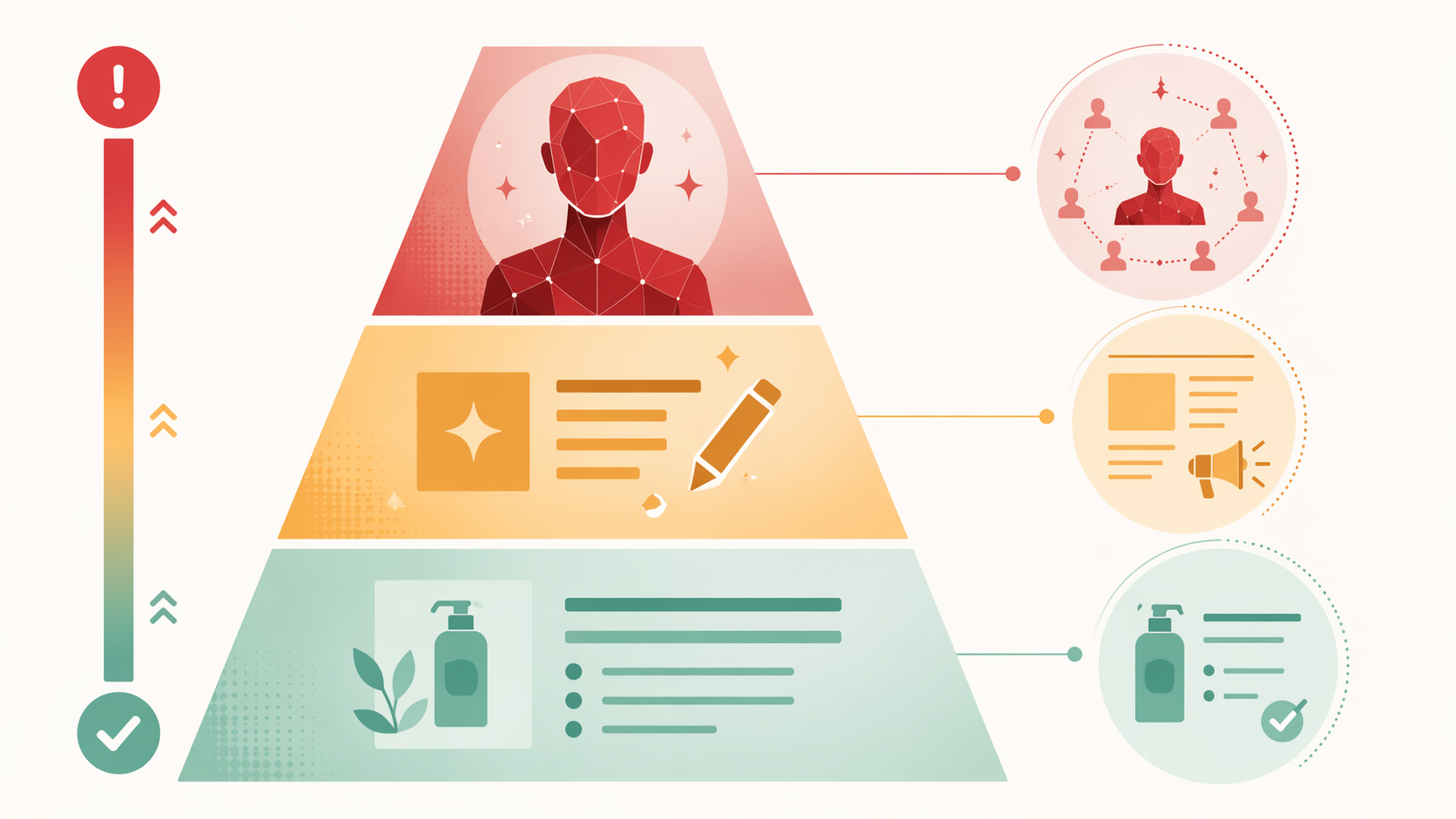
Those are different trust risks. A virtual ambassador asks the customer to accept a synthetic representative in a role historically associated with personality, relationship, and accountability. AI-written ad copy raises a persuasion problem: customers may wonder whether the brand is optimizing language to influence them without enough human judgment behind the claim. Product descriptions sit in a different zone. If the description is accurate, specific, and useful, the customer may experience the AI as production support rather than a substitute for a person.
This is where many rollout plans become too blunt. “Use AI for content” is not a strategy. A customer-facing avatar, a promotional claim, a PDP description, an internal brief, and a service chatbot do not carry the same emotional load. They should not pass through the same approval path.
For related context on the broader decline in consumer confidence, see the existing analysis of the AI marketing trust gap. The practical question here is narrower: once the discomfort hierarchy is visible, what should marketing leaders change before they scale?
Visible human replacement creates a different kind of exposure
The highest-risk AI use cases are not always the most technically complex. They are the ones where customers can see that a human role has been removed.
An AI brand ambassador is a good example. Even if the output is polished, the format can make the customer ask who is actually accountable for the message. Is the avatar representing the company’s values, a creative concept, a model trained on prior content, or a campaign team trying to increase output without hiring talent? The consumer does not need to articulate all of that to feel the substitution.
AI-written ad copy carries a related but slightly different risk. Advertising is already understood as persuasion. When customers believe the persuasive language has been generated by AI, the concern is not only whether the sentence is grammatically clean. It is whether the claim has been reviewed, whether nuance survived the optimization process, and whether anyone inside the brand would stand behind the message if challenged.
Product descriptions, however, can be less threatening because the job is more functional. Customers want accurate specs, clear use cases, compatibility notes, sizing guidance, ingredients, care instructions, or comparisons. If AI helps produce that information faster and the final page is correct, the use may feel like operational competence. That does not make it risk-free. It simply means the trust burden is different.
The same pattern appears in B2B content, though the audience and context should not be flattened into B2C consumer sentiment. HubSpot’s 2026 State of Marketing composite reports that 81% of B2B buyers do not mind AI-assisted content if it is factually accurate, specific, and includes original examples.[4] That is a quality threshold, not a blank permission slip.
The implication is uncomfortable for teams chasing speed: the more an AI output appears to carry judgment, persuasion, empathy, or accountability, the more human review has to be visible inside the operating model, even if it is not visible in every asset.
The four controls that should sit between AI output and the customer
A useful AI governance model for marketing does not start with a philosophical debate over whether AI is good or bad. It starts by matching controls to the trust risk of the use case. The following four controls are the ones I would want in place before scaling AI across customer-facing marketing.

1. Human-in-the-loop editing for anything customers may treat as advice, claim, or brand judgment
Human review is often described too vaguely. A quick skim before publishing is not the same as editing for accuracy, specificity, evidence, tone, legal sensitivity, and usefulness. If a page makes a product claim, gives category guidance, compares options, handles objections, or speaks in the brand’s name, the reviewer needs enough authority to change the output, not merely approve it.
There is also a performance reason not to treat editing as ceremonial. A 2026 composite of HubSpot, Semrush, and Ahrefs studies found that teams using AI with human editing at 20% or more of word count reported 2.7x better organic traffic outcomes than teams publishing with less than 5% editing.[5] That should not be read as a universal benchmark that applies cleanly to every industry or content type. It is better understood as a converging signal: meaningful editing tends to produce better outcomes than lightly touched AI output.
This is where AI content programs often fall into the quality trap. They measure how much content the team shipped, then discover later that the work is too generic to rank, too thin to persuade, or too bland to help sales. The editing layer should be designed before volume targets are set. The pieces on the AI content quality trap and the AI content quality threshold go deeper on how to define that bar operationally.
2. Disclosure where AI affects the customer’s interpretation of the interaction
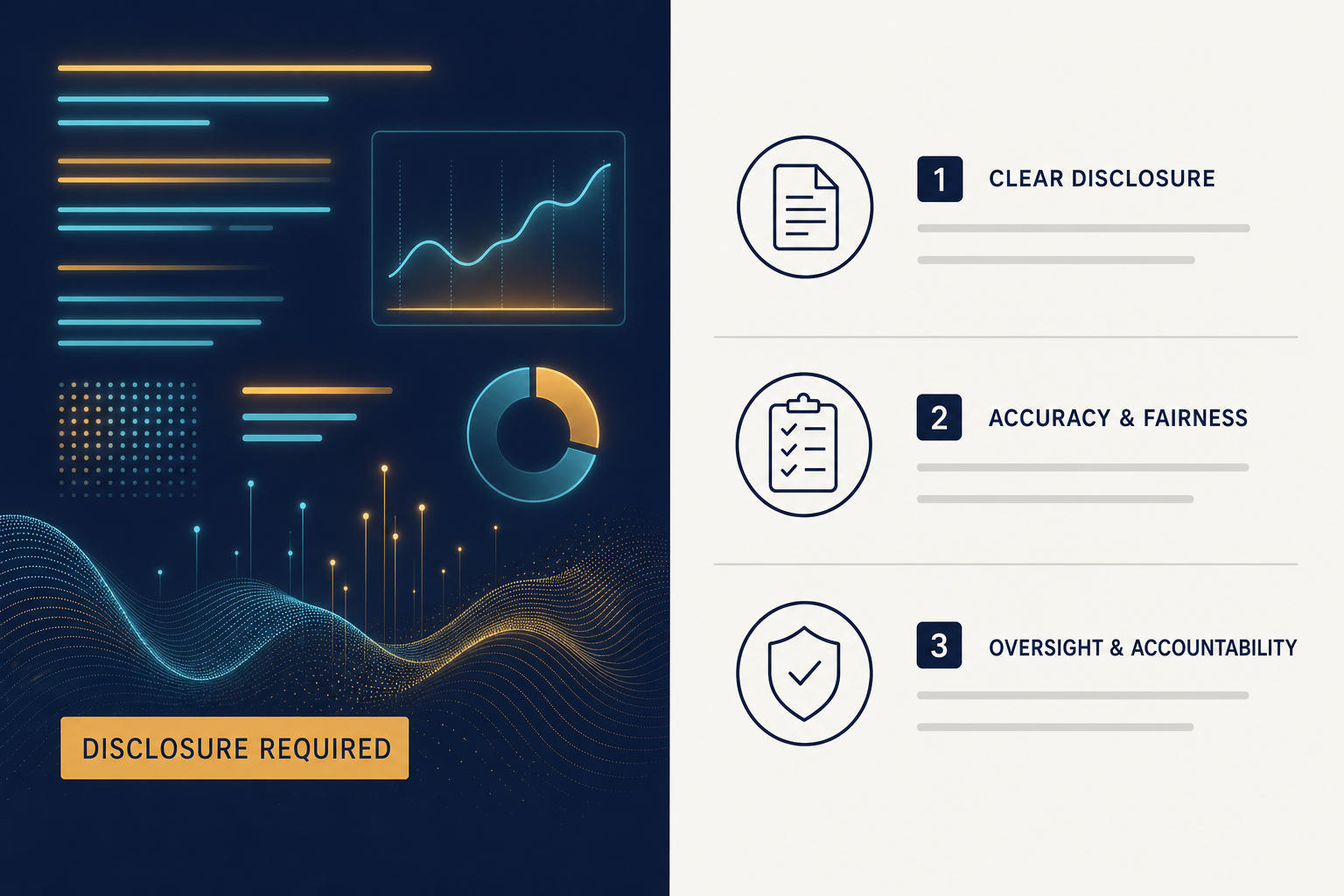
Disclosure should not be treated only as a legal footer. It is a trust mechanism. The question is whether knowing AI was involved would reasonably change how the customer interprets the interaction.
For an internal campaign brief, disclosure to the customer is usually irrelevant. For a product description edited and approved by a merchandising team, the more important control may be accuracy and review. For a chatbot, AI spokesperson, recommendation engine, synthetic influencer, or automated service response, disclosure becomes much harder to dismiss because the customer may believe they are interacting with a human agent or human representative.
Good disclosure is plain and useful. It tells the customer what is automated, what the system can and cannot do, and how to reach a person if the issue needs human attention. Bad disclosure hides behind vague phrasing or appears only after the customer is already frustrated.
3. Human escalation that customers can actually find
The Attest data makes this control non-negotiable. If loss of human touch and loss of access to a real person are among the leading consumer fears, then hiding escalation behind a loop of automated prompts directly amplifies the trust problem.[2]
Escalation should be designed by issue severity, not by the brand’s desire to deflect tickets. A sizing question, store-hours request, or basic order-status check may be a reasonable automation candidate. A complaint involving money, safety, medical concern, cancellation difficulty, damaged goods, identity access, or repeated failed resolution should not require the customer to outsmart the bot.
The operational test is simple: if a customer needs a human, can they see the path, understand when they will get help, and avoid repeating the entire story? If not, the brand has not preserved escalation. It has simply installed a waiting room with better language.
4. Encoded brand voice before scale
Brand voice is often the last thing teams formalize and the first thing AI exposes. Without a durable voice system, AI tends to average out the brand: polished, inoffensive, broadly correct, and emotionally forgettable.
An encoded voice system is more than a list of adjectives. It should include approved claims, banned phrasing, category-specific language, examples of strong and weak copy, escalation rules for sensitive topics, audience-specific tone ranges, and sample rewrites. That artifact gives writers, reviewers, agencies, and AI tools the same operating standard.
This is especially important for AI business marketing teams managing multiple channels. The same prompt that produces acceptable SEO support may produce unusable executive thought leadership or tone-deaf lifecycle copy. The piece on why AI content still sounds generic is useful here because the fix is not more adjectives in the prompt. It is better source material, clearer constraints, and stronger editorial judgment.
Translate the controls into workflow, not policy theater
A policy document helps only if it changes who reviews what before the customer sees it. The practical move is to separate AI use cases by risk and assign different operating rules.
| Use case type | Typical examples | Minimum control expectation |
|---|---|---|
| Low visibility, low judgment | Internal summaries, first-draft outlines, campaign research synthesis | Team-level review and source checking |
| Customer-facing but functional | Product descriptions, FAQs, metadata, basic help content | Human editing for accuracy, specificity, and brand voice |
| Customer-facing persuasion | Ad copy, landing pages, email campaigns, comparison pages | Human editing, claim review, brand voice control, and channel-owner approval |
| Human replacement or service interaction | Chatbots, virtual ambassadors, synthetic spokespeople, automated complaint handling | Disclosure, escalation path, monitoring, risk review, and clear ownership |
This type of sorting prevents two common failures. The first is over-governance, where every low-risk AI assist is trapped in approval traffic until teams quietly work around the process. The second is under-governance, where a high-visibility AI interaction launches with the same review standard as an internal draft.
For teams building this into day-to-day production, the most useful next layer is workflow design: what AI can draft, what humans must edit, what should be skipped, and which KPIs prove the system is improving rather than merely accelerating output. The hybrid AI-human workflow playbook, the guide to what to automate, edit, or skip, and the AI content marketing workflow are better operating references than a generic AI principle sheet.
The leadership decision
The trust problem in AI business marketing is not solved by hiding AI, and it is not solved by announcing every AI assist as if customers asked for a production diary. It is solved by deciding which AI outputs can remain invisible, which require disclosure and review, and which should never remove the customer’s path back to a human.
References
- 2024 Consumer Trust Study, Qualtrics XM Institute, 2024.
- Brand AI Sentiment Research 2025, Attest, 2025.
- AI & Brand Trust Report 2024, YouGov, 2024.
- State of Marketing 2026, HubSpot, 2026.
- Composite of HubSpot, Semrush, and Ahrefs 2026 studies, HubSpot, Semrush, Ahrefs, 2026.
Comments
Join the discussion with an anonymous comment.