
The hybrid content playbook: structuring AI and human workflows that outperform either alone
Content marketers in 2026 face a choice between pure AI, pure manual, or a structured hybrid. This playbook presents data-backed workflows and editing ratio benchmarks that show when and how human review of AI-generated content produces measurably better ranking, traffic, and reader trust outcomes.
Most content teams are past the clean debate about whether AI belongs in digital marketing. It is already in the workflow somewhere: briefing, keyword clustering, outline generation, draft cleanup, repurposing, or reporting. Salesforce’s 2026 State of Marketing figure that 87% of marketers use generative AI in at least one recurring workflow is useful for one reason: it confirms that the real decision is no longer adoption, but delegation.[1]
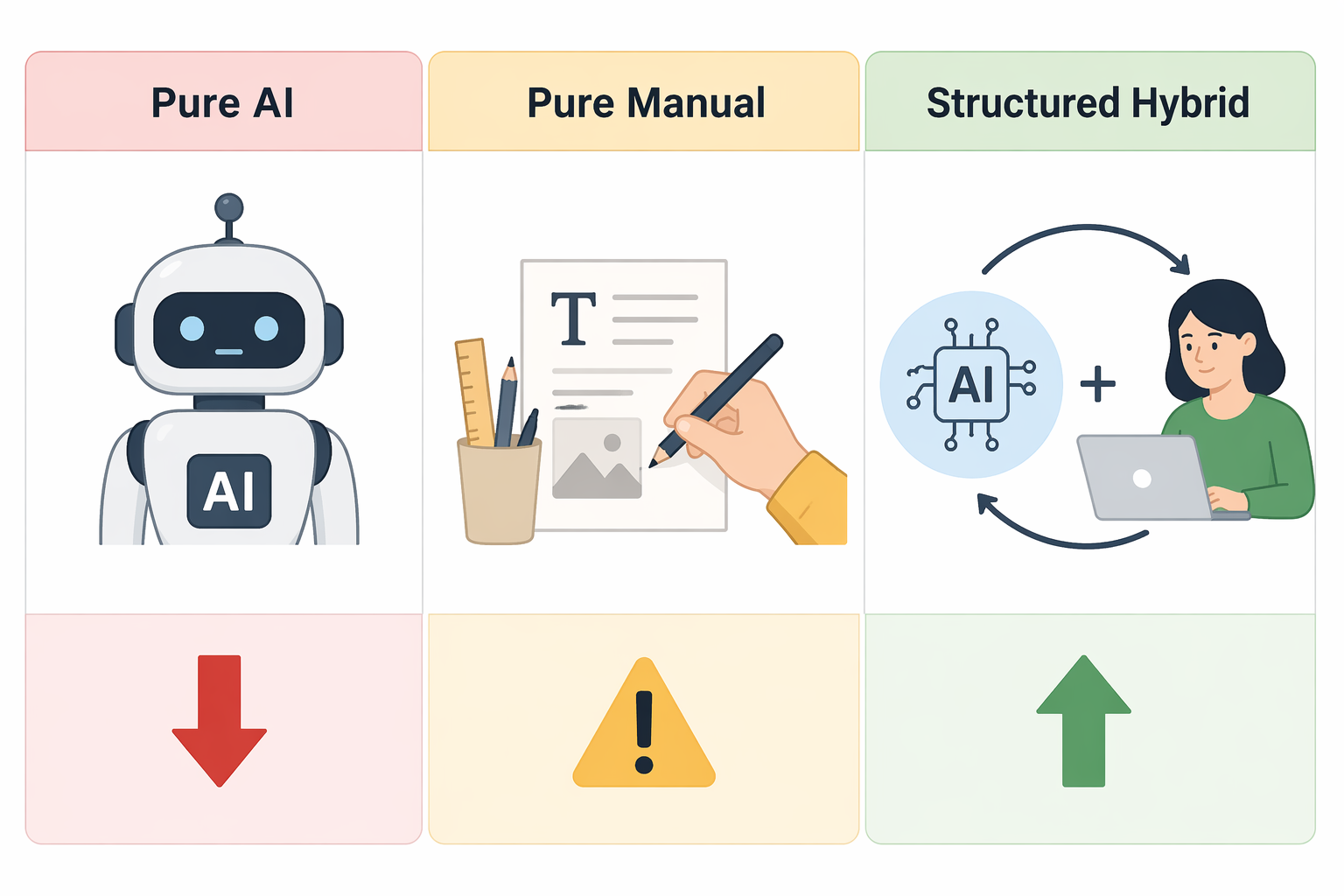
For small teams, the choice usually shows up as three operating models:
| Model | What it usually means | Where it breaks |
|---|---|---|
| Pure AI | AI handles research, structure, drafting, and light cleanup with minimal human revision. | Fast output, but weak judgment, generic examples, voice drift, and higher ranking risk when published at scale. |
| Pure manual | Humans handle strategy, research, drafting, editing, and repurposing without AI assistance. | Better control, but slower turnaround and higher production costs that many small teams cannot sustain. |
| Structured hybrid | AI accelerates synthesis, outlines, first drafts, and repurposing; humans retain strategy, originality, verification, voice, and final judgment. | Requires a repeatable review standard, not vague “human oversight.” |
The weak version of the hybrid argument is “use AI, but keep a human in the loop.” That sentence has caused a lot of bad content because it does not say where the loop is, what the human is responsible for, or how much review is enough. A workable 2026 content operation needs a sharper standard: AI can create leverage, but humans must still own the parts of content that require accountability.
The ranking penalty shows up when AI owns the whole job
The cleanest warning sign is ranking performance. Composite 2026 ranking studies summarized by Digital Applied found that purely AI-generated pages won top-three rankings 3.1x less often than human-reviewed AI content.[2] That is not a moral judgment about AI-generated text. It is a workflow signal: when the model produces the research framing, the examples, the claims, and the final language without meaningful editorial intervention, the page is less likely to have the specificity and usefulness needed to compete.
The difference matters most in content marketing because ranking is not only about clean prose. A page needs to choose the right angle, match search intent, make credible distinctions, include details that are not copied from the same public summaries, and avoid confidently wrong filler. Those are editorial decisions. If a model is asked to make all of them from thin input, the editor has not saved time; the editor has moved the risk downstream.
The March 2026 Google update data should be handled carefully. Digital Applied reported that 18% of sites publishing unedited AI content at scale lost more than 40% of organic traffic after the update.[2] That does not prove Google punishes every AI-assisted article. It does point to a much narrower and more useful conclusion: scaling unedited AI pages is a real organic-risk pattern.
This is where a lot of teams misread the problem. They see “AI risk” and think the only safe response is to ban the tool. But the pattern in the data is not “AI touched the content.” The pattern is weak review, low originality, and scale without editorial control.
Manual content still performs, but it is not automatically a sustainable operating model
Human-generated content still has a measurable performance advantage in some datasets. Averi’s 2026 content marketing analysis reported that human-generated content received 5.44x more traffic than AI-generated content, with human content increasing steadily over five months while AI content fluctuated.[3]
That number is worth taking seriously, but not lazily. It may partly reflect topic selection: higher-intent, more differentiated, or more strategically important pieces are more likely to be assigned to human writers in the first place. The result supports investing human effort where the stakes are high. It does not prove that every sentence must be manually produced from scratch.
The cost side is not theoretical either. Improvado described one agency’s AI-free positioning as producing 73% higher production costs, a nine-day turnaround instead of two days, and 22% client churn.[4] It is one case, not a universal law. Still, it captures a failure mode many small teams recognize: a principled manual-only workflow can become a missed-publishing-calendar workflow very quickly.
A three-person team can often handcraft a flagship report, a founder POV article, or a sensitive conversion page. It usually cannot handcraft every SEO refresh, newsletter variation, social adaptation, comparison-page update, and sales enablement summary at the same depth. The question is not whether human judgment matters. It is where that judgment changes the outcome enough to deserve the hours.
The editing ratio is the part most teams skip
“Review the AI draft” is too soft to be an operating rule. In practice, many teams treat review as a quick pass for grammar, formatting, and obvious factual errors. That is usually under 5% editing, and it leaves the model’s structure, assumptions, examples, and language largely intact.
The stronger benchmark is revision depth. Composite findings attributed to HubSpot, Semrush, and Ahrefs show teams editing AI content at 20% or more of total word count reported 2.7x better organic traffic outcomes than teams editing less than 5%, with a 25–45% editing ratio identified as the stronger range.[5] The sources behind this kind of benchmark vary in methodology and are not the same as a controlled academic trial, so the number should not be treated as a magic threshold. It is still a useful operational line: if the edit is too light to change the piece materially, the human probably has not added much judgment.
A 25–45% edit does not mean randomly rewriting every fourth sentence. It usually means changing the draft at the levels that affect performance:
- Reframing the angle when the draft answers the keyword too broadly.
- Replacing generic examples with real customer, product, industry, or editorial observations.
- Cutting unsupported claims that sound plausible but are not evidenced.
- Adding distinctions the model flattened, such as adoption versus effectiveness or correlation versus causation.
- Rebuilding the introduction so it enters through the reader’s actual decision, not a generic trend statement.
- Tightening voice so the piece sounds like the company has a point of view, not a neutral encyclopedia entry.
If a team wants a practical companion for diagnosing that generic feel, the guide on why AI content still sounds generic is the more focused place to go deeper on the quality symptoms. For this workflow, the important point is simpler: light proofreading is not the same as editorial ownership.
What AI should own in the workflow
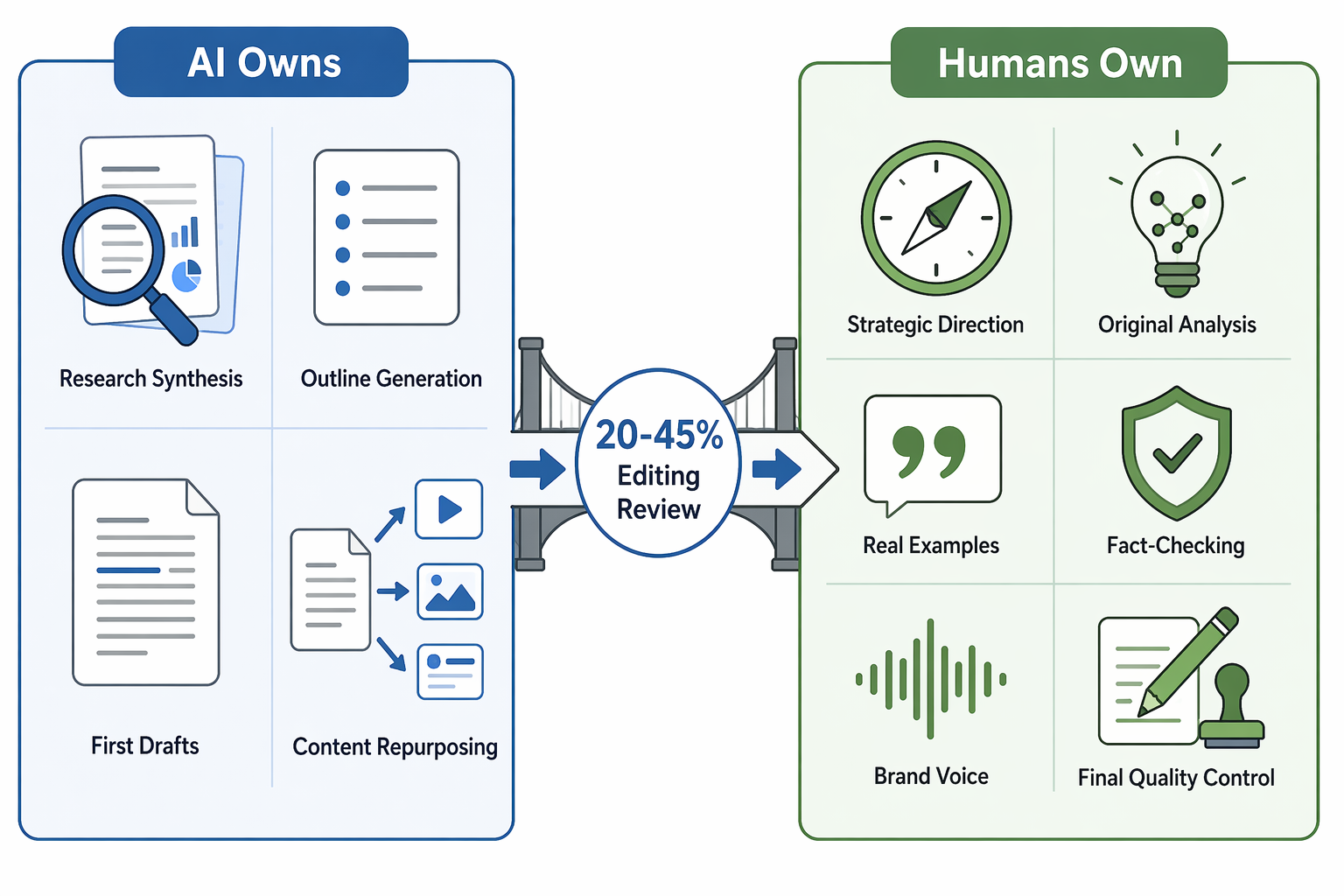
AI is most useful when the task has clear inputs, a defined output shape, and a human ready to judge the result. That makes it strong at compression and transformation work: turning messy material into usable starting points.
| Workflow stage | AI can own | Human must decide |
|---|---|---|
| Research synthesis | Summarizing provided sources, extracting repeated themes, grouping objections, creating comparison notes. | Which sources are trustworthy, which claims are usable, and which gaps require original input. |
| Outline generation | Drafting possible structures, mapping search intent, suggesting section order, identifying missing subtopics. | The final angle, the reader’s real decision, and what deserves the most space. |
| First draft | Producing a rough version from a human-approved brief and source set. | Whether the draft has judgment, specificity, accurate claims, and a defensible point of view. |
| Repurposing | Turning an approved article into emails, social posts, sales snippets, or short-form scripts. | Which claims can travel safely, what context must remain, and what should be omitted. |
| Refreshes | Flagging outdated passages, suggesting rewritten summaries, comparing old and new briefs. | Whether the page still deserves to rank and what new evidence changes the recommendation. |
This division keeps AI close to the work it does well without pretending it understands the business consequence of being wrong. For a small content team, that is the point: reduce the number of blank-page hours while preserving the decisions that make the page worth publishing.
Tool choice matters, but it should follow the workflow instead of replacing it. A writer may need one tool for drafting, an SEO lead may need another for clustering or briefs, and a demand generation manager may need something different for campaign repurposing. A role-based breakdown belongs in a tool guide, not in the middle of an editorial operating model; the role-by-role AI marketing guide is better suited for that selection work.
What humans cannot hand off
The human-owned work starts before the draft request. If the content brief is vague, the model will fill the gaps with the safest average answer. That is how teams end up with drafts that are polished, plausible, and indistinguishable from twenty other pages on the same topic.
Humans need to own five decisions before an AI draft is allowed to exist:
- The audience decision: who is reading, what they already know, and what consequence they are trying to avoid.
- The search-intent decision: what the page must answer to deserve the query, and what it should refuse to over-explain.
- The evidence decision: which facts are allowed, which claims need citations, and which numbers are too weak or too context-dependent to use.
- The originality decision: what lived experience, customer insight, internal data, product knowledge, or expert judgment the page will add.
- The brand decision: how the company speaks when it has to be precise, skeptical, helpful, or opinionated.
After the draft, humans also own verification. That includes checking citations against the original sources, removing claims the source does not support, separating single cases from general trends, and making sure the article does not turn vendor research into a universal law. This is also where hallucination controls belong. If the team does not already have a source-checking protocol, the guide to AI content hallucination risks in marketing is the right operational extension.
A practical 20–45% review protocol
The editing-ratio benchmark becomes useful only when it changes the review process. A small team does not need a complicated editorial bureaucracy. It needs a repeatable pass that is deeper than cleanup and lighter than starting over.
A workable review sequence looks like this:
| Review pass | What the editor changes | What “done” looks like |
|---|---|---|
| Brief alignment | Remove sections that answer the wrong question; add missing decision points. | The article follows the reader’s actual problem, not the model’s generic structure. |
| Evidence and claims | Check every number, causal claim, quote, and source-backed statement against approved materials. | No unsupported statistics, inflated conclusions, or citation laundering. |
| Originality | Add examples, expert judgment, product context, customer patterns, or operational distinctions. | The page contains material a generic model would not know to include. |
| Voice and positioning | Replace neutral filler with the company’s actual stance; cut phrases that could appear on any competitor’s blog. | The article sounds accountable, not merely fluent. |
| Search and usefulness | Confirm the title promise, headings, internal links, and answer depth match the target query. | The piece is useful enough to rank and specific enough to be trusted. |
That sequence will not always produce a neat 25–45% text-change score, and it does not need to. The ratio is a proxy for review depth. A short technical update may need fewer rewritten words because the source material is already exact. A thought-leadership piece may need more because the first draft misses the argument. The warning sign is a supposedly strategic article where the final version is almost identical to the AI draft.
Reader trust depends on accuracy and specificity more than disclosure theater
B2B buyers are not automatically rejecting AI assistance. HubSpot’s 2026 buyer-trust data reported that 81% of B2B buyers do not mind AI-assisted content if it is factually accurate, specific, and includes original examples.[6] That aligns with what editors see in practice: readers object to content that wastes their time, makes unsupported claims, or sounds like it was assembled from the top five search results.
This is why the review protocol has to protect more than grammar. Accuracy without specificity produces bland content. Specificity without verification produces confident misinformation. Voice without evidence produces brand theater. The hybrid workflow only works when all three are present in the final draft.
Where this fits inside AI and digital marketing strategy
Content is only one part of AI and digital marketing, but it is often where weak governance becomes visible first. A bad audience segment may stay hidden in a dashboard for a while. A generic AI article is public immediately. It can dilute brand voice, compete poorly in search, and create cleanup work for the same people it was supposed to help.
For teams building a broader implementation plan, the content workflow should sit inside a phased marketing operating model: choose use cases, define review standards, assign owners, measure results, then expand. The 90-day AI marketing strategy roadmap covers that broader rollout, while the AI in digital marketing benchmarks are useful for comparing adoption and ROI by use case.
For the content operation itself, the decision rule is straightforward. If the team edits under 5%, it is probably outsourcing judgment while keeping only the appearance of review. If it removes AI entirely, it may be buying quality at a cost and speed penalty it cannot sustain. If it uses AI for draft leverage and reserves humans for strategy, originality, verification, voice, and substantial editing, it is closest to the 2026 evidence.
References
- Salesforce State of Marketing 2026, Salesforce
- AI Marketing Statistics 2026: 200+ Adoption Insights, Digital Applied
- 10 Content Marketing Trends That Will Define 2026, Averi
- 7 AI Marketing Trends for 2026: Strategy & Data Insights, Improvado
- HubSpot/Semrush/Ahrefs composite editing-ratio benchmark
- HubSpot 2026 buyer-trust data

Comments
Join the discussion with an anonymous comment.