

Why Unedited Generative AI Content Is Hurting Your Organic Rankings
Research shows unedited generative AI content ranks 3.1 times less often in top-3 search results. This article breaks down the specific editing thresholds and quality controls that separate content surviving Google penalties from content losing organic traffic.
The most expensive mistake in generative ai marketing right now is not using AI. It is letting AI drafts move through the content system with no real editorial pressure, then calling the result “scaled content.” The ranking data is blunt enough to change the conversation: purely AI-generated pages with no human editing win top-3 organic rankings 3.1 times less often than mixed or human-led content, according to composite 2026 studies summarized by Digital Applied.[1]
That gap matters because it shows up where teams actually feel pain: not in a policy document, but in rank loss, traffic decline, and post-update cleanup. After Google’s March 2026 core update, composite industry studies found that 18% of sites publishing unedited AI content at scale lost 40% or more of organic traffic, with outcomes varying by vertical, domain authority, and baseline content quality.[1] That caveat is important. The update did not hit every AI-assisted site equally. It hit the weakest version of the workflow: volume without intervention.
The useful question is no longer whether a draft touched a model. In 2026, that is almost assumed. The useful question is whether enough human judgment changed the draft before publication to make it more accurate, more specific, more differentiated, and more consistent with the brand behind it.
The threshold is no longer vague
The cleanest operating benchmark in the available research is this: teams that edit at least 20% of AI-generated word count report 2.7 times better organic traffic outcomes, with the strongest range appearing between 25% and 45% human word-count intervention.[1] This is practitioner-survey and composite-study evidence, not a controlled laboratory experiment, so it should not be treated as a law of physics. But it is specific enough to be useful, and it matches what many content teams see in production: light proofreading does not change the asset enough.
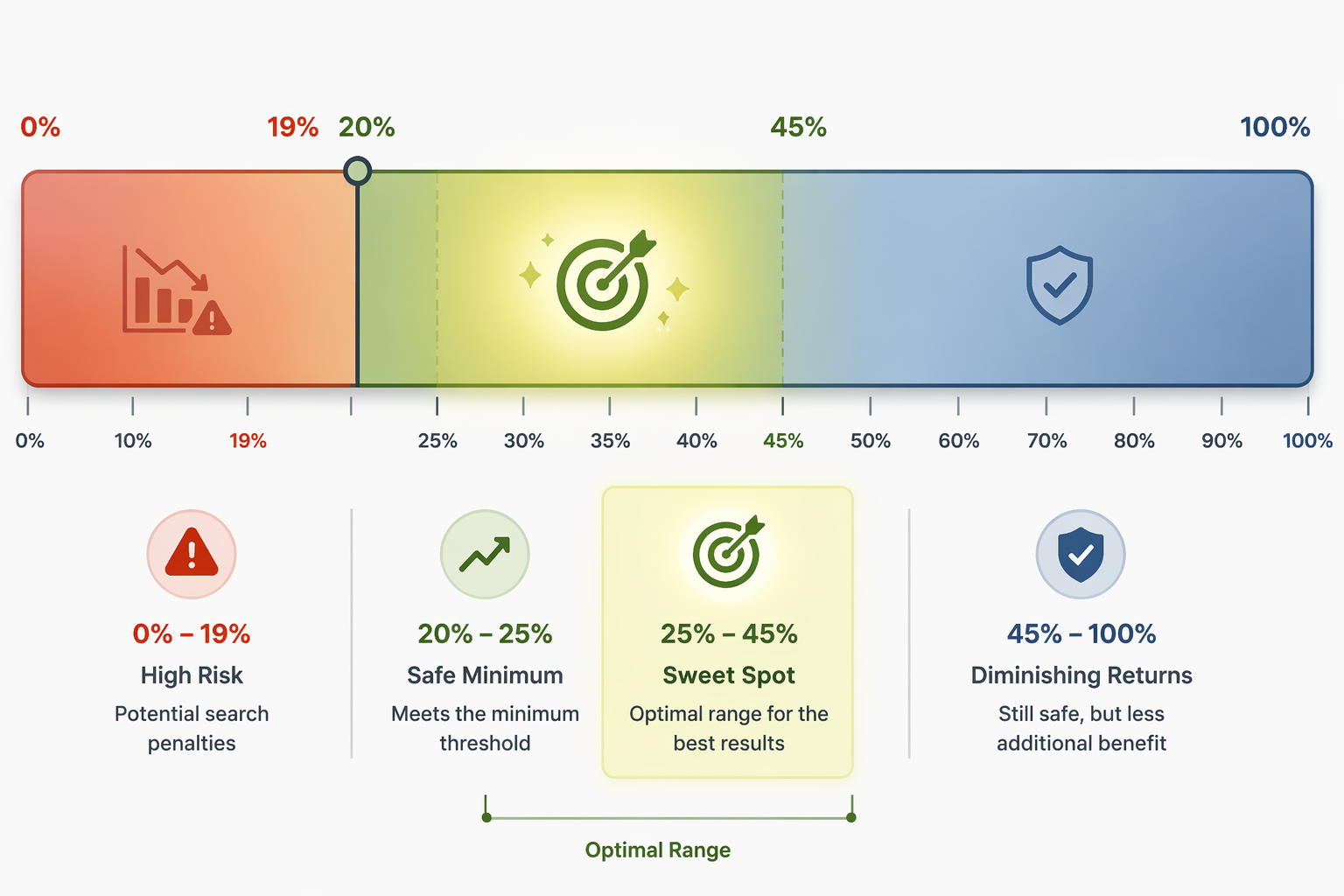
A 20% intervention does not mean changing every fifth word. It means the published version contains enough human editorial work that the piece no longer behaves like a lightly polished model output. The editor has added, removed, reorganized, challenged, validated, and localized the material. The final article has made choices.
The 25% to 45% range is especially useful because it avoids two bad extremes. Below the threshold, teams often publish something that still carries generic structure, interchangeable phrasing, shallow examples, and unsupported claims. Far above it, the AI draft may have been so weak that the editor is effectively rewriting from scratch. That can still produce good content, but it is no longer evidence that the AI workflow is efficient.
| Human editing level | What it usually means in practice | Organic risk |
|---|---|---|
| 0-19% | Proofreading, minor wording changes, formatting, maybe a few added links | Highest risk; often still reads and behaves like bulk AI output |
| 20-24% | Minimum meaningful intervention; some restructuring, fact checks, and brand adjustments | Better than raw AI, but still needs strong review discipline |
| 25-45% | Substantive editorial shaping, source validation, specificity, examples, and voice work | Best-supported range in the available practitioner data |
| 45%+ | Heavy rewrite or human-led article using AI as a drafting aid | Often strong quality, though efficiency gains may narrow |
The table is not a scoring system for every article. A short product update, a technical explainer, and a thought-leadership piece do not need the same kind of editing. But if a content program cannot roughly tell whether a draft received 5%, 20%, or 40% human intervention, “edited by a human” is not a quality control. It is a label.
Why light editing fails
Light editing usually fixes the surface of the draft while leaving the ranking problem intact. The grammar improves. The headline gets less dull. A few sentences are tightened. But the article may still answer the same generic question in the same generic order with the same generic examples as dozens of other AI-assisted pages.
That is where organic performance gets fragile. Search systems do not need to “detect AI” in some theatrical way for weak content to lose. They only need to prefer pages that are more useful, more original, better sourced, and more satisfying. The research summary also found that first-party data, expert interviews, and original research content outranks pure AI content by 2.4 times.[1] The lesson is not that every article needs a proprietary study. It is that the content needs some human-owned substance the model could not have produced by averaging the web.
Meaningful intervention changes the informational value of the page. An editor may replace a broad claim with a narrower one, add a field-tested caveat, remove a section that exists only because the model expected it, or insert a workflow detail from the team’s own process. Those edits are not cosmetic. They alter what the page contributes.
What counts as meaningful intervention
A useful edit changes at least one of four things: the claim, the structure, the evidence, or the voice. If none of those changes, the team probably proofread the draft rather than edited it.
- Claim editing: narrowing broad statements, removing unsupported certainty, and making the argument match the available evidence.
- Structural editing: moving the article away from default AI sequencing, deleting filler sections, and expanding the parts readers actually need.
- Evidence editing: validating numbers, adding source context, distinguishing surveys from experiments, and separating correlation from causation.
- Voice editing: making the piece sound like the company, not like a neutral B2B template with the logo swapped in.
- Experience editing: adding examples, decision rules, constraints, and consequences from real work rather than generic advice.
This is also where AI content briefs matter. A stronger brief can reduce cleanup time, but it does not remove the need for editorial judgment. A model can follow instructions and still produce a piece that is too symmetrical, too safe, or too detached from the audience’s real decision. Teams that want to tighten this upstream layer can treat an AI content brief playbook as a drafting control, not as a substitute for review.
Brand voice drift is a ranking problem, not just a copy problem
Brand voice drift rarely announces itself in one terrible paragraph. It accumulates. One article gets a little more generic. A landing page sounds slightly less specific. A product explainer drops the phrases customers actually use and replaces them with polished category language. After enough volume, the site still looks active, but the point of view has thinned out.
That is why the brand-voice finding deserves more attention than it often gets. Digital Applied’s 2026 compilation identifies brand voice drift as the number-two AI marketing challenge, and it reports that 91% of marketers already edit AI copy even when the draft is accurate.[1] The interesting part is not that marketers edit. Of course they do. The gap is whether they edit systematically enough to prevent a large content library from becoming bland at scale.
Accuracy alone does not protect organic visibility. A page can be factually acceptable and still fail because it has no recognizable expertise, no editorial stance, no examples that show lived understanding, and no language that signals who the brand is for. At small volume, this is a style issue. At scale, it becomes an information architecture issue: too many pages saying similar things in similar ways, with too little reason for search engines or readers to prefer one over another.
The fix is not to paste a voice guide into the prompt and hope the model internalizes it. Voice needs a review layer. Editors should check whether the draft uses the brand’s actual vocabulary, whether examples fit the customer’s environment, whether the level of confidence matches the evidence, and whether the piece makes tradeoffs the brand would actually make. For teams already dealing with this at scale, documented AI brand voice consistency failures are often more useful than another generic style checklist.
The editorial layer that keeps “edited” honest
The teams that get the most from AI usually do not treat editing as one pass at the end. They build a small quality-control system around the draft. It does not need to be elaborate, but it does need to be repeatable. Otherwise, the standard depends on whichever editor is available that day.
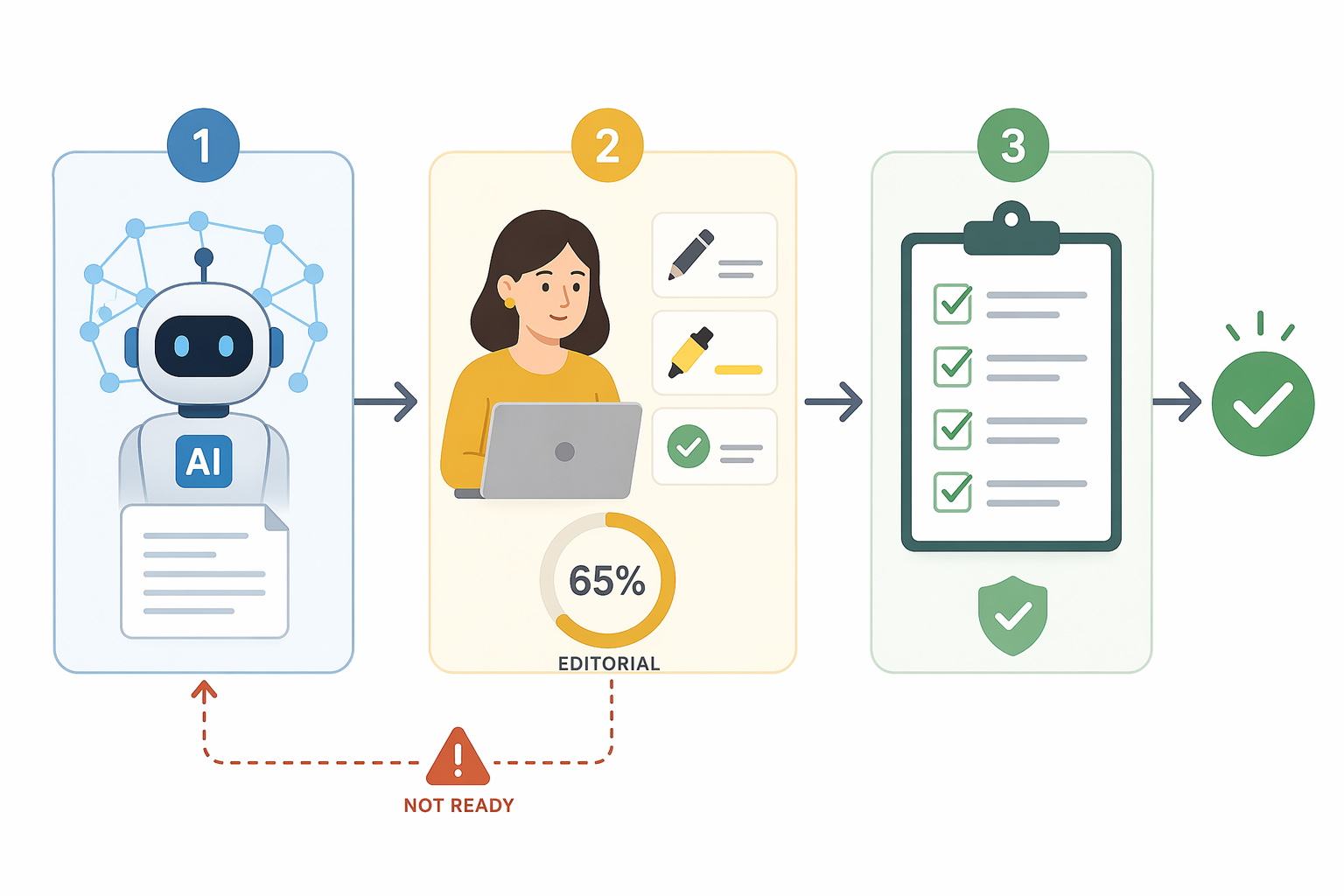
A practical workflow has three gates: draft shaping, editorial intervention, and validation. The first gate controls what the model is asked to produce. The second gate changes the substance of the draft. The third gate decides whether the page is safe to publish.
| Gate | What to check | What should change before publishing |
|---|---|---|
| Draft shaping | Search intent, audience, source boundaries, internal expertise, required exclusions | The draft starts from a defined content job rather than a generic prompt |
| Editorial intervention | Structure, claims, examples, brand voice, originality, usefulness | At least 20% meaningful human intervention, with 25-45% as the practical target |
| Validation | Facts, citations, hallucinations, internal links, compliance, duplication, final search intent fit | The page earns publication instead of passing because it is already written |
The validation gate is where many teams are still too casual. A draft can look finished before anyone has checked whether the cited study says what the article claims, whether a statistic is current, whether a quote exists, or whether the page overlaps too heavily with five existing URLs. That is how AI speed turns into future content debt.
For marketing teams, hallucination control should be treated as part of SEO hygiene, not as a separate AI ethics exercise. If a page invents a source, exaggerates a benchmark, or implies causation where the evidence only supports correlation, the issue is not only factual risk. It weakens the trust signals the page depends on. A dedicated AI hallucination detection and prevention process belongs before publication, not after rankings slip.
A pre-publish check that actually catches weak AI content
- Can the editor identify what changed from the AI draft besides wording and formatting?
- Does the article contain evidence, examples, or judgment that did not come from the model’s generic training patterns?
- Are all numbers, dates, quotes, and causal claims traceable to approved sources?
- Does the structure match the search intent, or does it follow a predictable AI outline?
- Does the voice still sound like the brand across the whole piece, including transitions and conclusions?
- Would this page still deserve to exist if three competitors published on the same keyword this week?
That last question is uncomfortable, which is why it is useful. A lot of AI-assisted content passes basic checks and still has no reason to rank. It is readable. It is not wrong. It simply adds nothing durable.
Adoption explains the pressure, not the solution
The market has already moved. Digital Applied’s 2026 compilation reports that 87% of marketers use generative AI and that 72% of top-ranking organic results contain some AI assistance.[1] Those numbers are useful background, but they do not prove that AI content works by default. They prove that AI is now inside the content supply chain.
This distinction matters. “AI-assisted” can mean a strategist used a model to cluster search intent, an editor used it to pressure-test an outline, or a team published a near-raw draft with a stock intro and six predictable subheads. Those workflows should not be grouped together when judging performance. The ranking gap between unedited AI and mixed or human-led content suggests that the handling after generation is where much of the value is won or lost.[1]
Tool choice still matters, but it is not the center of the problem. A better model can reduce friction. A stronger platform can help with governance, permissions, and workflow. Teams building or replacing their stack can use a guide to choose an AI content creation tool in 2026. But no tool removes the need for a publication threshold. If the content operation rewards speed alone, the stack will simply help the team create more pages that need cleanup later.
How to apply the 20% rule without turning it into theater
A word-count threshold is helpful because it gives teams something concrete to manage. It is also easy to game. Someone can rewrite sentences mechanically until a document comparison tool shows enough change. That misses the point.
The better use of the threshold is as an editorial audit signal. If a page receives less than 20% intervention, ask why. Maybe the draft was unusually strong because the brief was excellent, the source material was constrained, and the topic was narrow. More often, the low-change rate means the editor did not have enough time, context, or authority to improve the piece.
For high-value SEO pages, the 25% to 45% range is a more realistic target. That range gives editors room to reshape the argument, add missing expertise, compress filler, validate claims, and bring the voice back into the brand’s lane. It also leaves enough of the AI-assisted workflow intact that the process can still be faster than starting from a blank page.
A simple audit can track five fields for every AI-assisted article: original AI word count, final word count, estimated human-rewritten or added words, source-validation status, and editor approval. This will not capture every qualitative decision, but it creates accountability. It also gives the team a way to compare pages that survived updates with pages that lost visibility.
The broader threshold concept is worth documenting in a shared standard, especially for teams with multiple writers, agencies, or subject-matter reviewers. A separate AI content quality threshold can define what minimum intervention means by page type, so editors are not negotiating the standard from scratch on every assignment.
The practical verdict for organic search in 2026
The available evidence does not support panic about every AI-assisted page. It supports a narrower and more useful conclusion: unedited AI content at scale is a measurable organic risk, and the risk drops when human editors make substantive changes before publication.
For teams publishing into competitive search results, the baseline should be at least 20% meaningful human intervention, with 25% to 45% as the working range for important organic pages. That intervention should change claims, structure, evidence, voice, and usefulness, not just grammar. It should be backed by a validation gate that catches weak sourcing, hallucinated details, duplication, and brand drift before the URL goes live.
The question is no longer whether AI wrote the first draft. The question is whether the editorial process is strong enough to make the final page look and behave like content worth ranking.
References
- AI Marketing Statistics 2026 Adoption Data Points, Digital Applied

Comments
Join the discussion with an anonymous comment.