

The AI Content Marketing Workflow: From Using AI to Using AI Well
A step-by-step guide to moving your team from sporadic AI use to a repeatable AI-augmented content operation, with a staged rollout plan, quality tier system, and KPI framework that bridges the gap between adoption and measurable results.
The gap between using AI and operating with AI
The awkward part of AI in content marketing is not that teams refuse to use it. It is that they use it everywhere and measure almost none of it. In one 2026 marketing statistics roundup, 88% of respondents reported daily AI use and 96% said they had adopted AI in some form, yet only 19% tracked AI-specific KPIs [1]. Another benchmark cited by secondary sources put abandonment of generative AI initiatives at 42%, with unclear success criteria named as the top failure mode at 41% [2]. That is how content teams end up with drafts, outlines, summaries, and repurposed posts moving through the calendar, while nobody can say which assets deserve AI help, which ones need heavy human authorship, or what counts as acceptable quality before publication.
That measurement gap matters because output gains are real, but they do not sustain themselves. A Digital Applied compilation of HubSpot, Semrush, and Ahrefs studies found that teams adopting AI tools published 4.1x more content per marketer per month, with performance flattening around month 12 to 15 when quality controls and feedback loops were weak [3]. The practical lesson is not that AI stops working; it is that the surrounding workflow stops supporting it.
Build the operating system before scaling the output
The first mistake is treating AI as a drafting shortcut instead of a workflow layer. A useful setup gives each role a narrow job: the strategist defines the content type and quality tier, the AI tool supports research or drafting, the writer rewrites for specificity, the editor enforces the threshold, the SME checks claims where needed, and the reporting owner closes the loop on measurement. If tool choice is still unresolved, that decision belongs in the role-by-role AI marketing guide, the ChatGPT vs. Claude for Content Marketing Teams, and the Jasper AI Marketing Tool review rather than in this operating system.
| Stage | What changes | Primary owner | What gets measured |
|---|---|---|---|
| Month 1–3 | Set up measurement infrastructure and pilot on low-stakes content. | Content ops lead, strategist, editor, reporting owner. | Baseline cycle time, edit ratio, publish rate, and quality notes. |
| Month 4–6 | Scale Tier 1 content with human-in-the-loop review. | Writer, editor, strategist. | First-pass acceptance, bounce rate, and time saved per draft. |
| Month 7–9 | Expand into Tier 2 content with SME involvement. | Strategist, SME, editor. | Claim corrections, revision depth, and trust signals. |
| Month 10–12 | Deploy fuller coverage and tighten feedback loops. | Content ops lead, analyst, editors. | Performance trends, rollback triggers, refresh cadence, and KPI drift. |
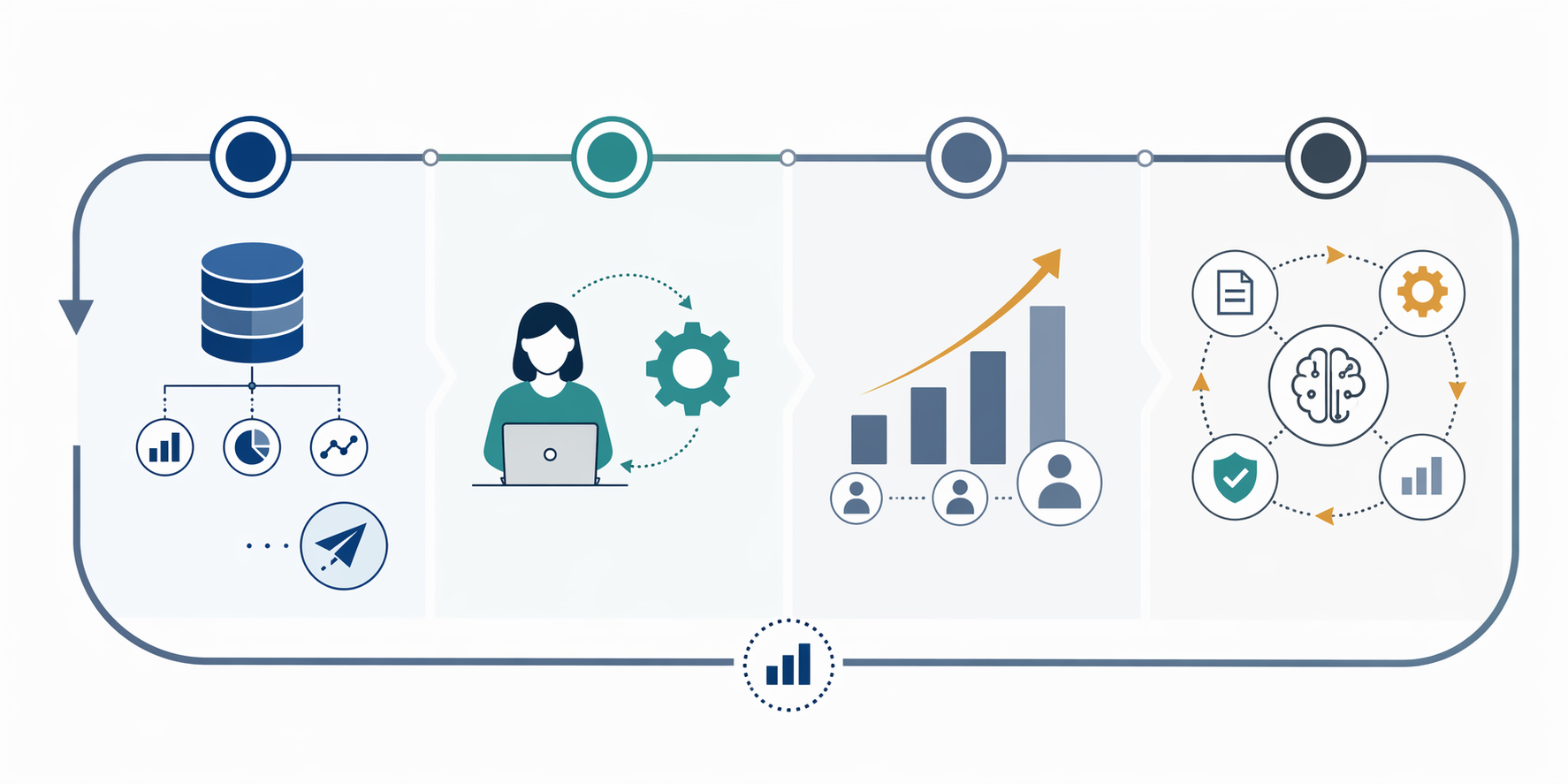
The sequence is deliberate. Quarter 1 is for proving that the team can measure what AI changes. Quarter 2 is for proving that the team can publish more without letting editing work explode. Quarter 3 is for testing where SME time actually matters. Quarter 4 is for making the system durable enough that a change in tool, channel, or editor does not collapse the process.
Use a quality tier system, not one editorial rule for everything
The quality system is what keeps AI-assisted work from drifting into generic output. Internal guidance on The AI Content Quality Threshold and Why AI Content Still Sounds Generic already makes the larger point: quality is not fixed by the model alone. In a Digital Applied composite of HubSpot, Semrush, and Ahrefs studies, content with roughly 25% to 45% human editing outperformed work with under 5% editing by 2.7x on organic traffic outcomes, while human-edited AI content also showed a 73% bounce-rate reduction versus unedited AI output [3][4].
A workable tier system looks like this:
- Tier 1: SEO and AEO content. Use AI for research support, first drafts, and repurposing, then apply moderate human editing and two review passes. This is where throughput matters most, so the goal is to keep the machine helpful without letting the draft sound assembled.
- Tier 2: Thought leadership. Use AI to accelerate outlining and rough drafting, but expect heavier editing, a tighter claim check, and SME involvement before publication. The point is not speed alone; it is preserving point of view and credibility.
- Tier 3: Flagship assets. Keep these mostly human-led, with AI serving as research support, structural help, or polishing support rather than the main authoring engine. These pieces carry the most trust risk, so the review chain has to be correspondingly stronger.
That caution is not abstract. A theStacc compilation reports that 67% of B2B buyers can identify unedited AI content and 58% say detection reduces trust [5]. For consumer-facing work, a Presenc AI dataset cited by secondary sources found only 4% consumer trust in unedited AI output [4]. The same lesson appears from two sides: unedited AI may be fast, but it is often fast in the wrong direction.

Measure by layer, not by one vanity total
The KPI layer has to bridge the practitioner who wants to know whether the workflow is working and the manager who needs to justify spend without promising revenue that cannot be cleanly attributed. Digital Applied’s ROI framework notes that only 19% of teams track AI-specific KPIs, but those that do report 2.4x better content ROI; the same source also cites a 420% average ROI figure for content creation tools, though both figures are self-reported or compiled and should be treated as directional rather than guaranteed outcomes [1][3].
| KPI layer | Examples | Why it matters |
|---|---|---|
| Activity | Drafts produced, repurposes completed, time to first draft. | Shows whether AI is actually reducing blank-page friction. |
| Quality | Edit ratio, review passes, bounce rate, claim corrections, trust feedback. | Shows whether output is publishable or merely faster. |
| Efficiency | Cycle time, editor hours per asset, cost per publish. | Shows where the workflow is gaining or losing leverage. |
| Business-adjacent outcomes | Qualified sessions, assisted conversions, pipeline influence where attribution is stable. | Shows whether the content operation is supporting broader goals without overclaiming causation. |
This is also where the AI for Sales and Marketing ROI Reality Check belongs, because the useful question is not whether AI can produce a headline lift in isolation. It is whether the team can see where the lift came from, whether the lift survives a quarter later, and whether a decline in quality should trigger a change in tier, review depth, or task routing. If that answer is missing, the dashboard is just another optimism surface.
What mature AI use looks like in a content team
A team is not mature because it uses AI often. It is mature when it can say which tasks AI handles, which quality tier each asset belongs to, who reviews it, what gets measured, and what changes when results decline. The model matters, but it is not the moat. The moat is the operating discipline around the model.
References
- Digital Applied. “AI Marketing Statistics 2026: Adoption Data Points”.
- Averi. “2026 Benchmark Report,” cited by secondary sources including theStacc.
- Digital Applied. “Measuring AI Marketing ROI: Complete Framework Guide”.
- Presenc AI. “2026 dataset”.
- theStacc. “AI Content Marketing Statistics”.

Comments
Join the discussion with an anonymous comment.