
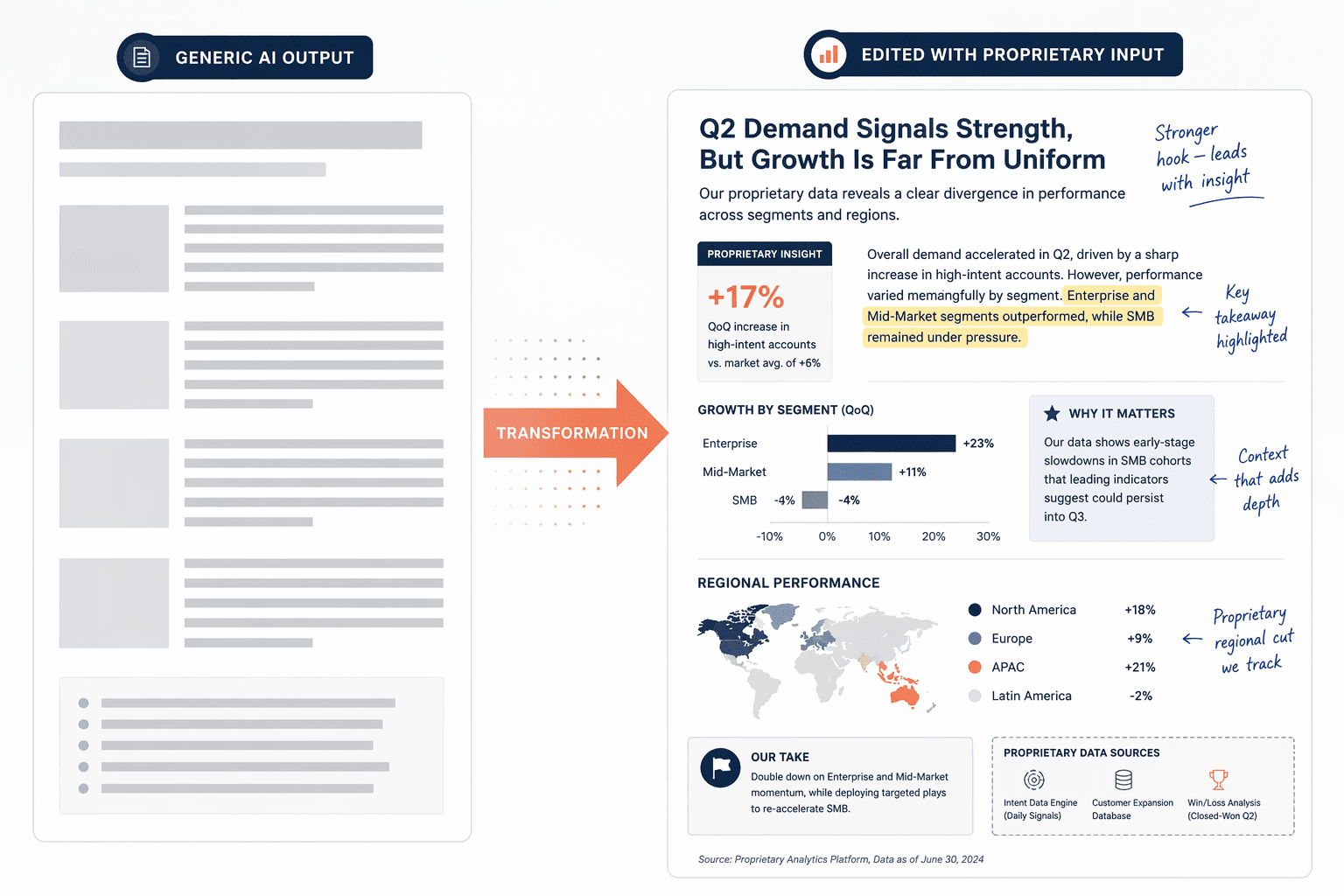
Why AI Content Still Sounds Generic (and How to Fix It)
A data-backed workflow for content marketing managers who are frustrated with flat, interchangeable AI output. Learn why generic-sounding content is the #1 quality concern in 2026, and how a structured editing process — including the 25-45% human edit sweet spot — can produce distinctive, high-performing content.
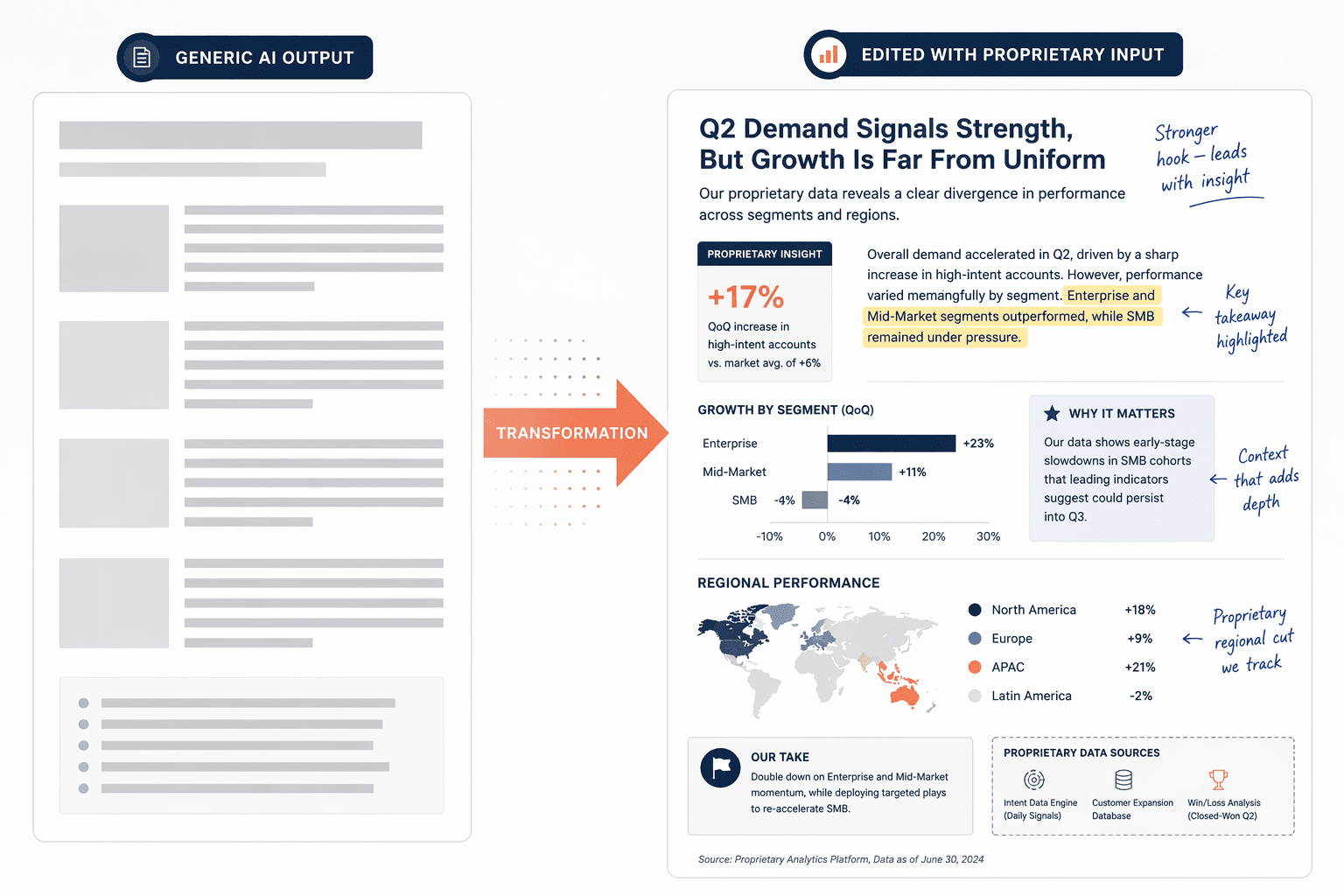
The #1 AI Content Problem in 2026 Isn’t Accuracy — It’s Sameness
If you’ve been using AI to produce content for more than a few months, you’ve likely noticed a pattern. The drafts are coherent. They’re grammatically correct. They hit the right word count. But they also feel interchangeable — as though they could have been written by any brand, for any audience, about any topic. You are not alone in noticing this.
In June 2026, Brafton surveyed 132 marketers about their biggest AI content quality concerns. The result was decisive: 87 respondents — 66% of the sample — selected “The content is thin or generic-sounding” as their top issue. That figure far outpaced concerns about outdated information (51), time to reach quality (46), and content not reflecting expertise (43).
What makes this finding particularly telling is who reported it most acutely. Brafton’s data shows that experienced marketers with 11+ years in the field, along with marketing managers and directors, were the most likely to flag generic output as their primary frustration. These are the people who have spent years developing a brand voice, building audience intuition, and learning what makes content resonate. They can feel the flatness of AI-generated prose in a way that someone new to the craft might not.
Interestingly, concerns about off-brand messaging and irrelevant audience targeting ranked much lower than in prior years. That shift suggests prompting skills have improved — marketers have learned how to ask AI for on-brand, audience-aware copy. But they have not yet solved the deeper problem of distinctiveness. The article you are reading argues that the fix is not a better prompt or a newer model. It is an editorial workflow designed to inject what the AI cannot supply: proprietary perspective, specific evidence, and a human editorial voice.
What Causes ‘AI Sameness’ — and Why Prompting Alone Won’t Fix It
To fix generic output, it helps to understand why it happens at a structural level. Large language models are statistical text predictors. When you give a model a prompt, it generates the most probable sequence of tokens based on its training data — which is drawn from the public internet. The most probable phrasing for any given topic is, by definition, the most common phrasing. The model is optimized for likelihood, not originality.
This creates several compounding problems:
- Safe defaults: The model avoids controversial or unusual statements because they are statistically less probable. The result is content that hedges, qualifies, and stays within well-worn rhetorical grooves.
- No proprietary input: The model has no access to your internal data, customer conversations, product roadmap, or subject-matter expertise. It cannot reference the specific finding from your Q2 user research or the anecdote your sales team hears weekly.
- Training data homogenization: The training corpus over-represents certain types of content — listicles, generic advice, SEO-optimized fluff — because those formats dominate the indexed web. The model reproduces these patterns faithfully.
- Prompt saturation: Thousands of marketers are using similar prompts for similar topics. Even if your prompt is well-crafted, the output will share structural DNA with content from competitors using the same model and similar instructions.
Better prompting helps at the margins. You can instruct the model to “avoid clichés” or “use a conversational tone,” and it will comply to a degree. But these instructions operate on the surface level of language, not on the underlying substance. The model still lacks access to the raw material that makes content distinctive: your proprietary data, your specific examples, your editorial judgment about what matters.
The Data Case for Structured Human Editing
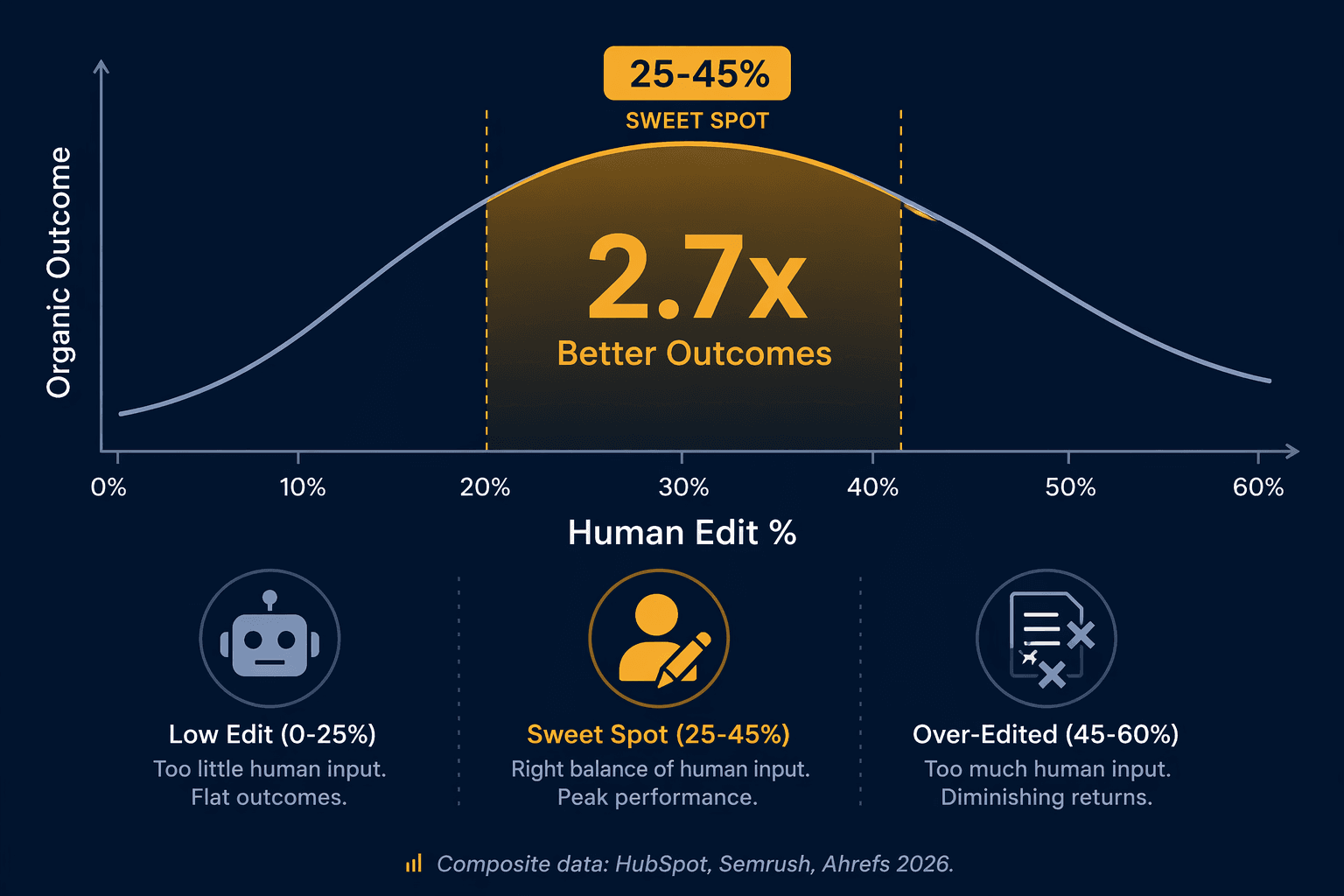
If the problem is structural, the solution must be structural as well. The most compelling evidence for what works comes from a composite analysis of 2026 studies from HubSpot, Semrush, and Ahrefs, compiled by Digital Applied. The finding is straightforward: teams that edit 25-45% of AI-generated word count see 2.7x better organic traffic outcomes than teams that edit less than 5%.
The relationship is not linear. Editing less than 5% produces content that search engines and readers treat as low-effort. Editing more than 45% begins to show diminishing returns — you are essentially rewriting the draft from scratch, which defeats the efficiency purpose of using AI in the first place. The sweet spot, where efficiency gains and quality improvements intersect, sits squarely in the 25-45% range.
| Editing Ratio (Word Count) | Observed Organic Outcome | Source |
|---|---|---|
| Less than 5% | Baseline — low differentiation, low trust | HubSpot/Semrush/Ahrefs 2026 composite |
| 25-45% | 2.7x better organic traffic outcomes | HubSpot/Semrush/Ahrefs 2026 composite |
| More than 45% | Diminishing returns on effort | HubSpot/Semrush/Ahrefs 2026 composite |
The trust dimension reinforces this finding. Omnibound’s 2026 B2B survey reports that only 4% of marketers consider AI-generated content “highly trustworthy” without human oversight. Among B2B buyers, 67% say they can usually identify unedited AI content, and 58% say that identification reduces trust in the publishing brand. These numbers should give any content team pause. If your audience can detect unedited AI content and loses trust when they do, the cost of skipping the editing step is not just poor performance — it is brand erosion.
The data also shows that the market is moving in this direction. Siege Media’s 2026 survey (conducted with Wynter) found that 97% of content marketers plan to use AI to support content marketing efforts in 2026, up from 64.7% in 2023. But only 1% report that 100% of their work is AI-generated. The use of AI for editing has doubled year-over-year — 38% in 2026 versus 19% in 2025. The industry is slowly recognizing that the value lies in the collaboration, not the automation.
A 5-Step Workflow for Distinctive AI Content
The following workflow is designed to operationalize the editing ratio data into a repeatable process. It treats AI as a drafting collaborator — capable of producing a competent first pass, but incapable of producing distinctive content without human intervention at specific points.
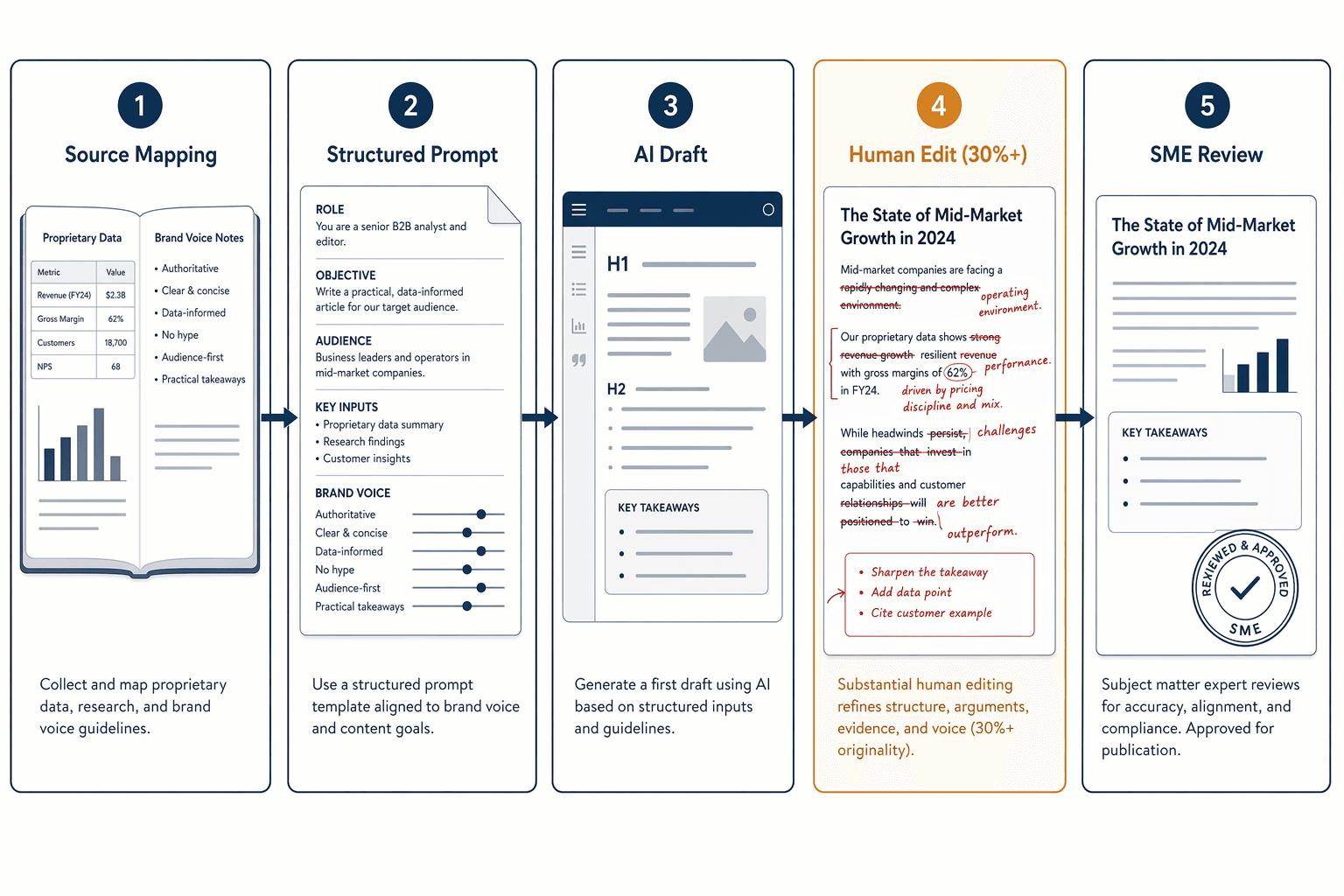
Step 1: Source Material Mapping
Before you write a single word of the prompt, gather the proprietary inputs that will differentiate the output. This includes:
- Internal research data or survey results
- Customer interview quotes or case study notes
- Product roadmap details or feature specifications
- Sales team anecdotes or common customer objections
- Competitive analysis or market positioning documents
The goal is to have at least three pieces of proprietary material that the AI cannot access on its own. These will be fed into the prompt as context.
Step 2: Structured Prompt with Brand Voice Constraints
Write a prompt that includes:
- The proprietary source material as context
- Specific structural requirements (e.g., “start with a specific data point, not a general statement”)
- Explicit instructions to avoid generic phrasing (e.g., “do not use phrases like ‘in today’s digital landscape’ or ‘it’s important to note’”)
- A defined brand voice reference (e.g., “tone: direct, practitioner-focused, avoids hype”)
Step 3: Generate a First Draft
Run the prompt and accept the output as a draft — not as finished content. Do not edit during this step. The goal is to get a structurally sound first pass that you can then reshape.
Step 4: Human Edit Targeting 30%+ Word-Count Changes
This is the critical step. Open the draft and edit with the explicit target of changing at least 30% of the word count. The changes should be substantive:
- Add specific data points and examples that the model could not have known
- Replace generic statements with your own analysis or opinion
- Rewrite sentences to match your brand’s rhythm and vocabulary
- Remove hedging language and weak qualifiers
- Insert transitional logic that reflects your actual argument, not the model’s predicted structure
A concrete example of this ratio in practice comes from Vector, a graphics software company. Jess Cook, Vector’s Head of Marketing, describes their CEO ghostwriting system: “The AI gets me about 80% of the way there and a quick 15-minute review and edit gets the posts to 99%.” The system feeds a transcript of the CEO’s speaking into a trained AI, which drafts LinkedIn posts. An editor then reviews for accuracy and tone before final approval. The result: the CEO’s LinkedIn following grew from 7,000 to 11,000 followers, and inbound demo requests quadrupled.
Step 5: SME or Stakeholder Review Layer
For content that involves technical accuracy, brand positioning, or sensitive claims, add a subject-matter expert review step. This is not a second editing pass — it is a verification layer that checks for factual errors, misrepresentations, and tone misalignment that the editor may have missed. In Vector’s case, the CEO provides this final sign-off.
Before and After: What the Editing Ratio Actually Changes
To make the editing ratio concept concrete, consider two real examples from the research that illustrate the difference between light editing and substantial editing.
| Scenario | Approach | Editing Ratio | Outcome |
|---|---|---|---|
| Vector CEO LinkedIn posts | AI drafts from transcript → human editor reviews for accuracy and tone → CEO approval | ~20% (15-minute edit on 80% draft) | LinkedIn following grew from 7,000 to 11,000; inbound demo requests quadrupled |
| Adore Me product descriptions | Writer’s AI Studio generates SEO-optimized descriptions in brand tone → human review | Not specified, but human oversight built into workflow | Description generation reduced from 20 hours to 20 minutes per batch; 40% increase in non-branded SEO traffic |
The Vector example is particularly instructive because it isolates the editing ratio. The AI produces an 80% draft — structurally sound, on-topic, grammatically correct. The human editor’s 20% contribution is not about fixing errors. It is about adding the specific details, tonal adjustments, and perspective that make the content feel like it came from the CEO, not from a language model. The 15-minute edit is the difference between generic thought leadership and distinctive thought leadership.
Adore Me, a DTC lingerie brand, took a different approach. They used Writer’s AI Studio to build role-specific AI agents — one for SEO product descriptions, one for Spanish translations, and one for personalized stylist notes. The human oversight was built into the workflow design, not added as an afterthought. The results included a 36% reduction in stylist note writing time and a localized launch time slashed from months to 10 days. The key takeaway: even with highly specialized AI agents, the human layer was non-negotiable.
Prompt Templates That Set Up Better Edits
The following prompt templates are designed to produce drafts that are easier to edit toward distinctiveness. They are tool-agnostic — tested on ChatGPT and Claude as of mid-2026 — and focus on requesting specific structures and explicit avoidance of generic phrasing.
Template 1: Data-Driven Article Draft
You are drafting a blog post for a B2B marketing audience. Use the following proprietary data as the foundation:

[INSERT DATA POINTS]

Requirements:
- Start with a specific data point, not a general statement.
- Do not use any of the following phrases: "in today's digital landscape," "it's important to note," "the bottom line," "in conclusion."
- Include at least three specific examples or case references.
- Use short paragraphs (2-4 sentences max).
- Tone: direct, practitioner-focused, avoids hype.
- Structure: problem → evidence → actionable takeaway.

Topic: [INSERT TOPIC]
Template 2: Brand Voice Enforcement
Rewrite the following draft to match this brand voice profile:

Brand voice: [DESCRIBE VOICE — e.g., "direct, slightly irreverent, avoids jargon, uses second-person"]

Specific instructions:
- Replace every instance of passive voice with active voice.
- Remove all hedging language ("might," "could," "perhaps").
- Add one specific, concrete example per major point.
- Cut the word count by 20% without losing substance.

Draft:
[INSERT DRAFT]When Not to Use AI for Content
An honest assessment of AI’s limitations is as important as knowing how to use it effectively. There are clear boundary conditions where AI-assisted content does more harm than good.
- Original research and data journalism: If the value of the content comes from proprietary analysis, survey methodology, or data collection that you conducted, AI should not be involved in the analytical or interpretive writing. It can assist with formatting and presentation, but the intellectual work must be human.
- Strong opinion and thought leadership: Content that stakes out a controversial position, criticizes industry norms, or makes a bold prediction requires a human author who owns the argument. AI-generated opinion pieces lack the credibility of a named human taking a stand.
- Sensitive brand positioning: Crisis communications, layoff announcements, diversity statements, and other high-stakes brand communications should never be AI-generated. The reputational risk of a tone misstep is too high.
- Deep subject-matter expertise: Content that requires specialized knowledge — legal analysis, medical advice, financial guidance, technical architecture decisions — should be written or heavily supervised by a qualified human. AI hallucination rates in specialized domains remain a documented risk.
The market signals support these boundaries. Omnibound’s 2026 survey found that 67% of B2B buyers say they can usually identify unedited AI content, and 58% say that identification reduces trust in the publishing brand. However, 81% of buyers say they do not mind AI-assisted content if it is factually accurate, specific, and includes original examples. The distinction is critical: buyers tolerate AI assistance when it is transparent and when the content still delivers human value.
The decision to use AI for a piece of content should be a deliberate choice based on the content’s purpose and audience expectations, not a default setting. When the content requires original perspective, proprietary data, or authoritative voice, the human should lead and the AI should support. When the content is informational, procedural, or high-volume — and the human editing ratio is maintained — AI can be a powerful efficiency tool.

Comments
Join the discussion with an anonymous comment.