
What to Automate, Edit, and Skip When Using AI for Marketing in 2026
This article presents a three-tier decision framework that helps marketing practitioners identify which tasks to fully automate with AI, which require substantial human editing, and which to leave to humans entirely — based on 2026 data on ranking outcomes, buyer trust, and team effectiveness.
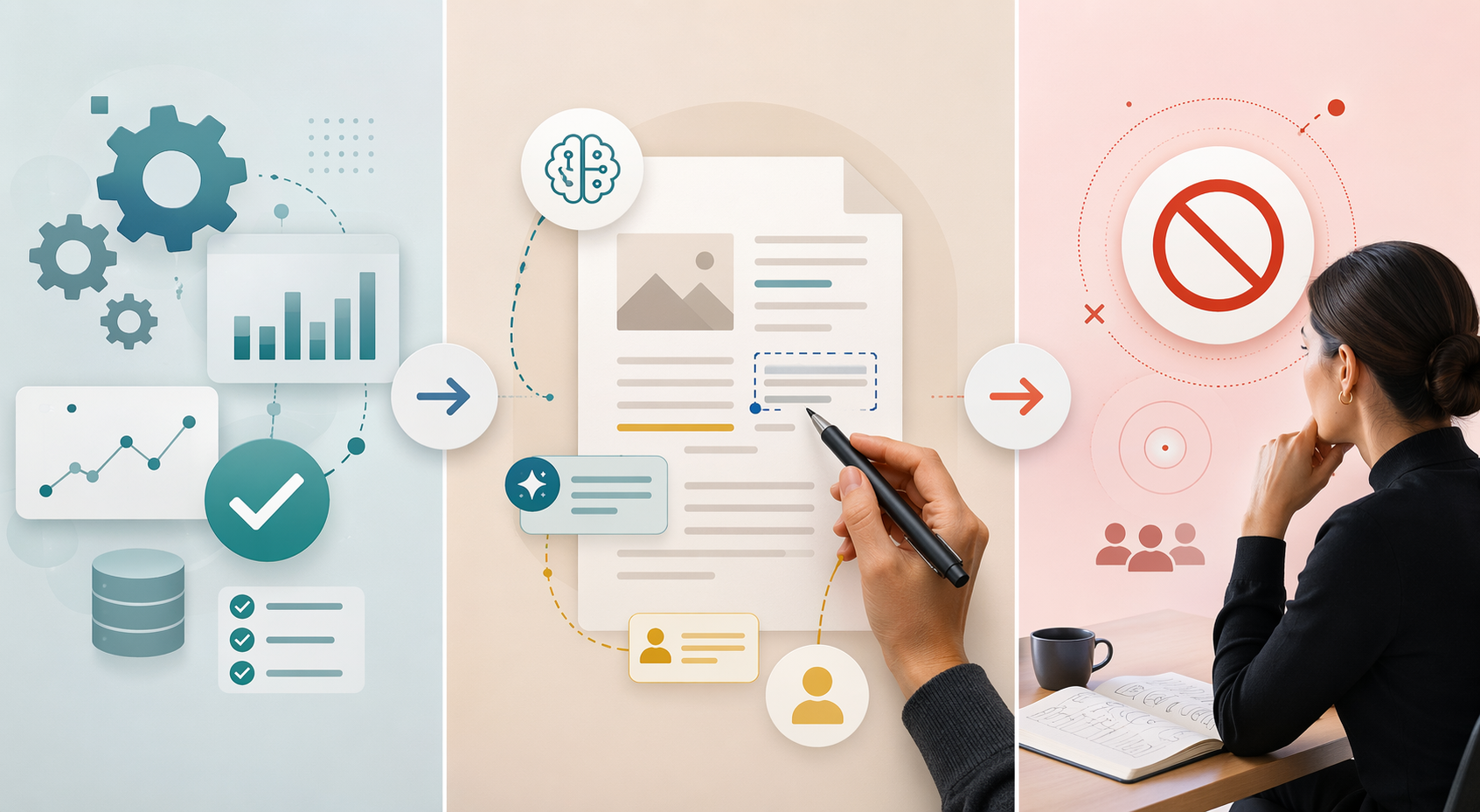
Using AI for marketing in 2026 is no longer a question of whether the team should use it. The harder question is where the handoff stops. The practical answer is narrow: automate work where AI is mainly finding patterns, require meaningful human editing where AI is producing market-facing material, and skip full automation when accuracy, trust, or brand judgment carries the consequence.
That distinction matters because the penalty for treating every marketing task the same is now visible. Digital Applied’s 2026 summary reports that 87% of marketers use AI, but also that unedited AI-generated pages win top-three organic rankings 3.1 times less often than human-edited or human-led content, based on composite 2026 ranking studies. It also reports that teams applying at least 20% human editing to AI drafts see 2.7 times better organic traffic outcomes.[1]
Those figures should not be read as a controlled laboratory rule. The source summarizes composite and survey-based evidence, and “20% editing” is a practitioner benchmark rather than a precise mechanical threshold. Still, it is useful because it gives teams a working line: if an AI draft is close enough to publish with only a quick skim, it is probably not receiving the level of editorial judgment associated with better outcomes.
The working split: automate, edit, skip
The fastest way to make AI useful is to stop asking whether a task is “AI-friendly” and ask who bears the cost when the output is wrong. If the cost is low and a person reviews the result later, automation is reasonable. If the output reaches buyers, search engines, customers, or executives, AI should become a draft layer, not the final author. If the task requires trust, accountability, or clean underlying data that the team does not have, automation should wait.
| Tier | Use AI for | Human role | Do not use it for |
|---|---|---|---|
| Automate | Research synthesis, SEO brief generation, ad variant creation, campaign anomaly detection, reporting dashboard updates | Review inputs, check outliers, decide what the finding means | Publishing or approving the result without review |
| Edit | Content drafts, image concepts, email subject line options | Fact-check, restructure, add original examples, adjust voice, remove generic claims | Treating a polished draft as finished because it reads smoothly |
| Skip | Tasks where AI would replace judgment rather than support it | Keep humans accountable for strategy, claims, spokesperson roles, and sensitive personalization | Unreviewed content at scale, virtual brand ambassadors without audience confidence, personalization built on dirty data, tool-chasing without a use case |
This is not a purity test. IMPACT cites B2B buyer survey data showing that 81% of buyers do not mind AI-assisted content when it is factually accurate, specific, and includes original examples. The issue is not whether AI touched the work. The issue is whether the finished work shows evidence of human judgment.[2]
Automate the work that is already structured
AI is strongest in marketing when the task has a clear input, a repeatable pattern, and a later checkpoint. That makes research synthesis, brief generation, reporting, anomaly detection, and variant production better candidates than final creative approval.
For a content strategist, that might mean feeding interview notes, search results, customer questions, and existing internal pages into a briefing workflow. AI can cluster themes, surface repeated objections, compare competing pages, and produce a first outline. The strategist still decides which claim is worth making, which angle is overused, and which promise the company can actually defend.
For paid media, automation is often useful earlier in the cycle than marketers expect. AI can generate ad copy variants for testing, group similar queries, flag unusual movement in campaign performance, or summarize which segments changed week over week. None of those tasks should decide budget allocation alone. They shorten the distance between raw data and the human decision.
The same logic applies to recurring reporting. AI can draft the first version of a weekly performance narrative: what rose, what fell, what looks abnormal, and which campaigns need inspection. The marketer’s job is to reject false patterns, add business context, and decide whether the movement is meaningful enough to act on.
Teams building this into a repeatable process can pair the automation tier with a broader AI content marketing workflow. The important discipline is to automate the preparation of judgment, not the judgment itself.
Edit anything that becomes part of the brand’s public argument
The editing tier is where many teams underinvest. A usable AI draft can look finished before it has done the work that marketing content is supposed to do: make a specific claim, earn trust, show relevant evidence, and sound like it came from a company with a point of view.
This is where the 20% benchmark is most helpful. It should not be reduced to changing one-fifth of the words. In practice, the meaningful edit is often structural: replacing generic sections, verifying claims, adding customer-specific context, cutting unsupported assertions, improving examples, and changing the order so the piece answers the real buyer question earlier.
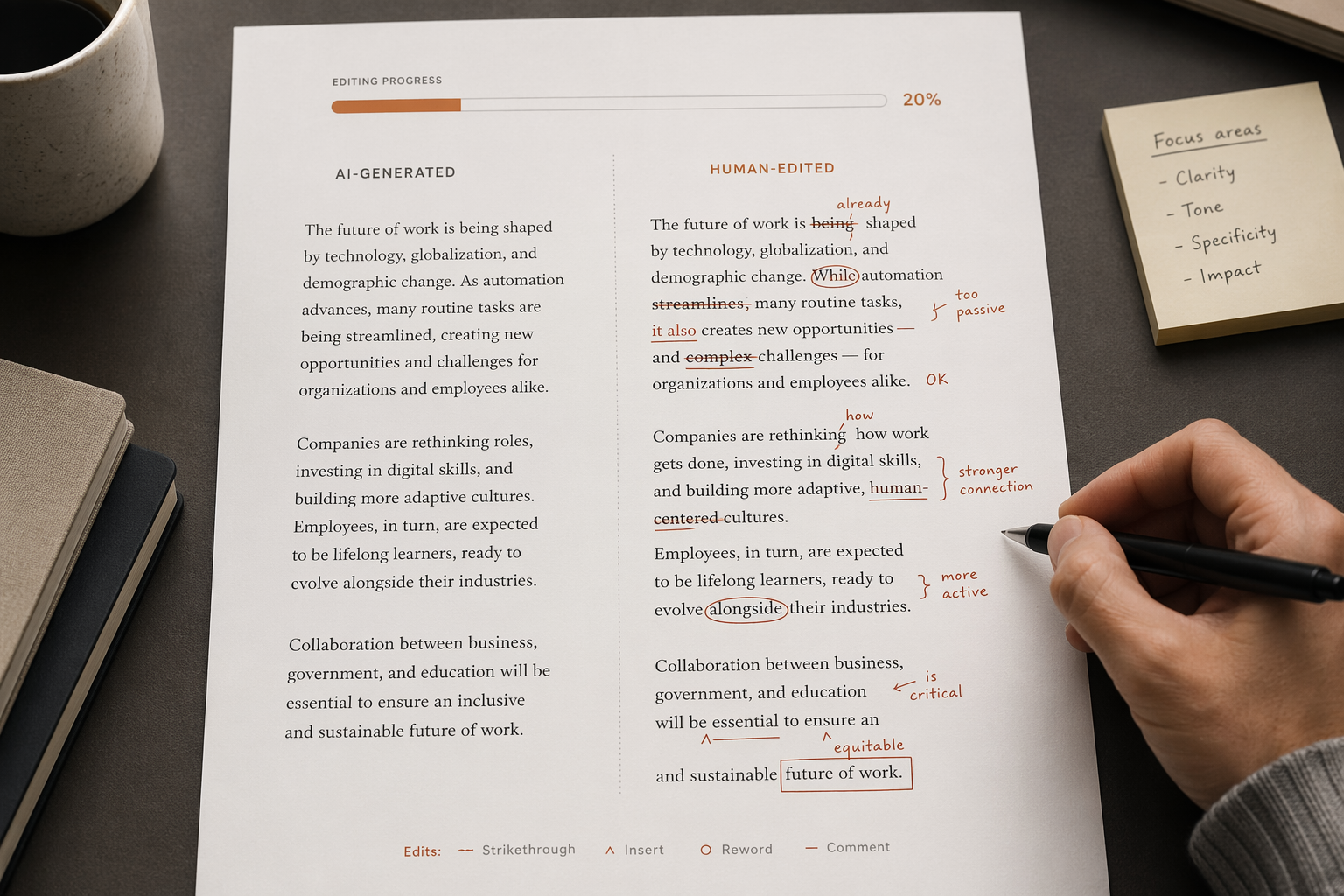
Search data gives this editorial work a business consequence. Digital Applied reports that unedited AI-generated pages appear in top-three rankings 3.1 times less often than human-edited or human-led pages, and that teams crossing the 20% human-editing benchmark report 2.7 times better organic outcomes.[1] For teams relying on organic acquisition, the edit is not cosmetic.
The risk became sharper after Google’s March 2026 core update. Digital Applied reports that 18% of sites publishing unedited AI content at scale lost more than 40% of traffic after that update.[1] That does not prove every unedited AI page will lose traffic, and it does not isolate one universal cause. It does show that scaled, unreviewed publishing sits in a higher-risk category than AI-assisted editorial production.
Buyer response points in the same direction. IMPACT cites B2B buyer survey data showing that 67% of buyers can identify unedited AI content, and 58% say that identification reduces trust in the publishing brand.[2] The useful nuance is that the same buyer group is not rejecting AI assistance outright. They are rejecting content that feels unexamined, interchangeable, or thin.
A practical edit pass should therefore ask different questions than a proofreading pass:
- Does the draft answer the buyer’s actual question in the first few paragraphs?
- Which claims require evidence, and are those claims supported?
- Where has the draft used a generic example instead of a specific operational detail?
- Which sentences could appear unchanged on a competitor’s site?
- What does the company actually believe, recommend, or refuse to recommend?
This is also a skills issue. If the person editing an AI draft cannot evaluate the topic, the draft may become smoother without becoming more accurate. Teams seeing that pattern should address the AI marketing skills gap before they increase output volume.
Use AI-generated creative as a concept layer, not a substitute for review
AI-assisted images, headlines, subject lines, and campaign concepts belong in the edit tier because they influence perception even when they do not carry long-form claims. A subject line can overpromise. A generated image can misrepresent a product, customer, or use case. A campaign concept can drift into a tone the brand would not choose if a person had slowed down long enough to notice it.
The safer use is to ask AI for range: ten subject line directions, five visual treatments, three campaign angles, or a set of testable ad variants. Humans then remove options that exaggerate, confuse the offer, conflict with brand voice, or depend on claims the company cannot substantiate.
Email subject line optimization is a good example. AI can produce alternatives quickly and can help avoid repeating the same phrasing across campaigns. But deliverability, audience fatigue, promise accuracy, and lifecycle context still need a marketer’s judgment. A subject line that wins attention by overstating the message creates a downstream trust problem.
Skip full automation where trust is the product
Some marketing tasks should not be fully automated because the output carries more than efficiency risk. This includes unreviewed content production, public-facing spokesperson roles, sensitive personalization, and strategic decisions made from unreliable data.
The clearest skip category is scaled content with no human review. It combines the ranking risk, the buyer-trust risk, and the internal quality-control problem in one workflow. If the team cannot afford to edit what it publishes, it cannot afford to publish at that volume.
AI virtual brand ambassadors also deserve caution. Secondary sources cited in the research brief report that 51% of consumers are uncomfortable with AI virtual ambassadors.[2] That does not mean every synthetic spokesperson will fail, and the available figure should not be stretched into a universal B2B or B2C rule. It does mean teams should not treat a virtual representative as a low-cost replacement for human credibility without testing audience response.
Personalization built on poor data is another skip. AI can scale a bad assumption faster than a human can. If lifecycle stage, account ownership, product usage, consent status, or firmographic data is unreliable, automated personalization may create messages that feel invasive, irrelevant, or simply wrong. The problem is not personalization as a strategy; it is automation on top of inputs no one trusts.
Gartner-related 2026 figures cited in the research brief point to the same operational constraint: 45% of marketing leaders say generative AI is creating confusion within their teams, and 73% cite hallucination concerns.[1] These are not reasons to stop using AI. They are reasons to define ownership before adding more tools.
Tool-chasing belongs in the skip tier until there is a use case. A new platform may help a specific role, but adoption by itself does not create a workflow, a review standard, or a measurable result. Teams struggling here may find the broader AI marketing implementation gap more important than another product comparison.
A decision test for this week’s work
For each recurring marketing task, decide the tier before choosing the tool. The test is simple enough to apply in a planning meeting.
- If the task summarizes, clusters, detects, formats, or generates options from known inputs, automate the first pass.
- If the task produces something a buyer, customer, prospect, executive, or search engine will evaluate, require a substantial human edit.
- If the task depends on accountability, sensitive data, brand trust, or claims the company must defend, do not fully automate it.
That test will classify most everyday work without debate. SEO brief generation usually lands in automate. A thought-leadership article lands in edit. Publishing 200 unreviewed pages lands in skip. Weekly reporting can be automated up to the point where someone explains what the movement means. AI-generated ad variants can enter a test queue, but a person still approves the promise being made.
For tool selection after the workflow is clear, a role-by-role guide such as Best AI for Marketing in 2026 is the better next step. Tool choice should follow the decision about which work is safe to automate.
Where the framework stops
This framework does not settle every edge case. AI-generated data visualizations, podcast production, automated experimentation, and AI-assisted sales enablement each need more specific review rules. The evidence here is strongest for content, SEO outcomes, buyer trust, and team workflow decisions.
It also does not prove that human-led work always beats AI-assisted work. The stronger conclusion is narrower and more useful: in the available 2026 evidence, unedited AI content performs worse and is less trusted, while AI-assisted work that is accurate, specific, and substantially edited can be acceptable to buyers and more effective for teams.
References
- AI Marketing Statistics 2026, Digital Applied
- AI for Marketing, IMPACT

Comments
Join the discussion with an anonymous comment.