

The AI Marketing Implementation Gap: Why 91% Adoption Delivers Only 25% Meaningful Results
Most marketing teams have adopted AI tools, but only a quarter see meaningful business results. This article breaks down the root causes—missing workflows, quality control gaps, and unconnected measurement—and provides a framework to close the implementation gap.
The short answer is that most AI digital marketing efforts are still adoption at the tool layer. A team adds a writing assistant, an image generator, a reporting copilot, or an email personalization feature, then keeps the same intake process, review process, publishing standards, and ROI model. That can reduce production cost. It does not automatically create better pipeline, stronger brand recall, or more trusted content.
That distinction explains the uncomfortable gap: HubSpot reports that 91% of marketers use AI, while only a much smaller share say it is producing meaningful business outcomes; the 25% figure often cited in industry discussion should be read as a self-reported outcome measure, not a universal performance benchmark with one fixed definition across teams.[1]
The evidence points less to a failure of AI tools in general than to an implementation gap. Teams are using AI frequently, but they often have not redesigned the work around it. They have prompts, subscriptions, and experiments. They do not yet have operating rules for where AI enters the workflow, what humans must verify, which outputs require brand review, and how AI-assisted work connects to revenue measurement.
The adoption number hides several different behaviors
“Using AI” can mean a strategist asking a model to summarize interviews, a demand generation team generating ad variants, a content manager drafting a blog outline, or a lifecycle marketer personalizing email copy. These activities do not carry the same risk, and they do not create the same business value.
The most common early win is efficiency. HubSpot’s 2026 marketing data, as summarized in industry coverage, puts the cost of producing a blog article at $820 without AI and $476 with AI, a 42% reduction.[1][2] That is material. For a team publishing at volume, the savings are real enough to matter in budget conversations.
But cost reduction is not the same as market impact. A lower-cost article that does not rank, convert, support sales conversations, or strengthen a differentiated point of view is still a weak asset. Executives notice this quickly: the marketing team can show faster production, yet pipeline contribution remains hard to prove.
This is also why more tool spend rarely fixes the problem by itself. If the team has no shared content brief, no decision rule for automation, no source verification step, and no connection between content activity and revenue reporting, a better model may only make the old process faster.
Workflow is the first missing layer
The practical question is not whether AI should be used. It is where AI should be allowed to make decisions, where it should only assist, and where it should stay out until a human has defined the judgment.
A useful distinction is between production assistance and strategic ownership. AI can accelerate clustering search intent, turning a transcript into notes, creating first-pass variants, identifying gaps in a content calendar, or repurposing approved material into channel-specific formats. It is less reliable when asked to define positioning, decide what a buyer truly needs to believe, invent evidence, or substitute for expert review.
| Marketing work | Reasonable AI role | Human responsibility that should not disappear |
|---|---|---|
| Content briefs | Summarize source material, map search intent, surface subtopics | Choose the angle, define the audience need, approve claims |
| Blog drafts | Create a first draft from an approved brief and source set | Restructure, verify facts, add judgment, remove generic phrasing |
| Paid media variants | Generate message variations from approved positioning | Select the promise, set guardrails, monitor performance quality |
| Email personalization | Adapt approved messaging to segment context | Define segmentation logic and review sensitive claims |
| Reporting | Summarize trends and anomalies | Decide attribution logic and business interpretation |
Practitioner workflow frameworks make a similar separation between tasks suitable for automation and tasks that should remain human-led, though those frameworks should be treated as implementation guidance rather than broadly validated performance evidence.[3]
The team that benefits from AI usually turns this distinction into an actual workflow. A strategist approves the brief before generation. The writer or content lead edits against audience intent rather than simply correcting grammar. A subject-matter reviewer checks the claims that could affect trust. A final owner decides whether the asset advances the campaign objective.
Without that sequence, AI output tends to enter the process too early and too broadly. The draft becomes the strategy. The outline becomes the argument. The summary becomes the research. That is where speed starts to produce sameness.
Quality control has to be tiered, not improvised
Quality control is the part of AI marketing implementation that many teams postpone because it feels like a drag on efficiency. The data suggests the opposite: weak quality control is one of the reasons efficiency fails to become business impact.
Onely’s 2026 content marketing analysis cites hallucination rates ranging from 15% to 27% depending on model and context, and reports that only 23.2% of companies have established quality control processes for AI content.[2] Those figures should not be used to claim that every fourth sentence is false. They do show that factual verification cannot be treated as an optional final pass.
A flat review process is usually too blunt. A social post, a glossary update, a product comparison page, and a regulatory claim should not receive the same level of scrutiny. The review burden should rise with risk.
- Low-risk assets can use a light review: brand tone, obvious factual issues, formatting, and channel fit.
- Medium-risk assets need source checking, claim review, and a human edit for usefulness and specificity.
- High-risk assets need subject-matter review, legal or compliance review where relevant, source traceability, and final approval from an accountable owner.
The important change is accountability. Someone must know which claims came from approved internal knowledge, which came from external sources, which were generated by the model, and which were added by an editor. If that trail is missing, the team may still publish quickly, but it cannot reliably defend the asset.
There is also a brand cost. Industry sources cited in the research brief connect consistent brand voice with materially higher revenue outcomes, while also reporting that many consumers abandon brands when tone feels inconsistent; because these figures are commonly circulated through vendor and secondary sources, they are best treated as directional rather than precise causal proof.[4]
The operational implication is still clear. If every team member prompts a model differently, using different examples, different terminology, and different standards for what “on brand” means, the organization is training itself into inconsistency. Brand voice then becomes a memory test instead of a system.
Generic content is a market-level problem, not just an aesthetic complaint
The quality problem is not limited to hallucinations. AI can be factually safe and still strategically weak. It can produce a clean article that sounds like every competitor’s clean article.
That risk is increasing as AI-generated material becomes more common. Onely cites research finding that 74.2% of newly created webpages in April 2025 contained AI text.[2] The precise proportion may vary by dataset and detection method, but the direction matters: the web is filling with content that has similar structure, similar phrasing, and similar levels of abstraction.
For marketing teams, this changes the editorial burden. It is no longer enough for a piece to be accurate, optimized, and publishable. It has to contain something the market could not get from a generic prompt: a sharper diagnosis, proprietary data, customer evidence, expert judgment, original examples, or a more useful operating model.
This is where human editing should do more than polish. The editor should cut unsupported generalities, replace vague benefits with consequences, add constraints, remove claims the source material cannot support, and make the piece answer the decision the reader is actually trying to make.
Measurement has to move beyond activity and unit cost
A team can measure AI savings without measuring AI value. That is one reason implementation looks successful inside the marketing department and less convincing in the executive meeting.
The easy metrics are production metrics: drafts created, hours saved, article cost, campaign variants generated, turnaround time reduced. These are useful, especially when budgets are tight. But they do not answer whether AI-assisted work changed pipeline creation, sales velocity, conversion quality, customer acquisition cost, retention, or expansion.
The better measurement question is narrower: where should AI reasonably affect the funnel, and what evidence would show that effect? For a blog program, the answer might be qualified organic-assisted pipeline, not just publishing volume. For paid media, it might be conversion rate by message family, not just number of variants. For lifecycle email, it might be segment-level revenue or retention movement, not just open rate.
| If AI is used for | Do not stop at | Add a business-connected measure |
|---|---|---|
| Content production | Articles published and cost per article | Qualified organic pipeline, assisted conversions, sales usage |
| Ad creative variation | Number of variants generated | Cost per qualified conversion by message theme |
| Email personalization | Open rate or click rate alone | Segment-level conversion, retention, or expansion influence |
| Reporting assistance | Dashboards summarized faster | Decisions made faster, budget shifts supported, forecast accuracy improved |
This does not require pretending that every asset has a clean single-touch revenue number. It does require a measurement design before scaling AI output. Otherwise, the team creates more marketing activity than the business can interpret.
Training is part of implementation, not a separate enablement project
The skills gap matters because AI changes the shape of the work. A marketer who once needed to write every line may now need to brief better, evaluate faster, verify more carefully, and understand where model output is likely to be weak.
Industry summaries cited in the research brief report that many marketers use AI tools daily while far fewer have received job-specific training. The exact figure should be verified against the original survey before being treated as a benchmark, but the pattern is consistent with what implementation failures look like: people are handed tools before they are given operating standards.
Generic AI training is usually too broad. A content strategist needs to know how to build source-grounded briefs and evaluate whether an argument is differentiated. A demand generation lead needs to know how to test message variants without confusing novelty for signal. A marketing operations manager needs to know how AI-generated activity enters attribution, campaign taxonomy, and reporting.
Training should therefore be tied to the workflow, not delivered as a detached prompt-writing session. The useful artifact is not a list of clever prompts. It is a shared way of working.
Some friction is real, even with strong process
It would be too neat to blame the entire gap on marketing teams. Some implementation friction comes from the tools themselves. Models change behavior. Platforms deprecate features. API costs and access rules shift. Output quality can vary by task, context window, source material, and model version. Compliance expectations are also still moving.
That uncertainty strengthens the case for workflow discipline rather than weakening it. When the tool layer is unstable, the organization needs clearer rules for review, source control, versioning, approval, and measurement. The process should be strong enough that a model upgrade does not quietly rewrite the brand’s standards.
What closes the gap
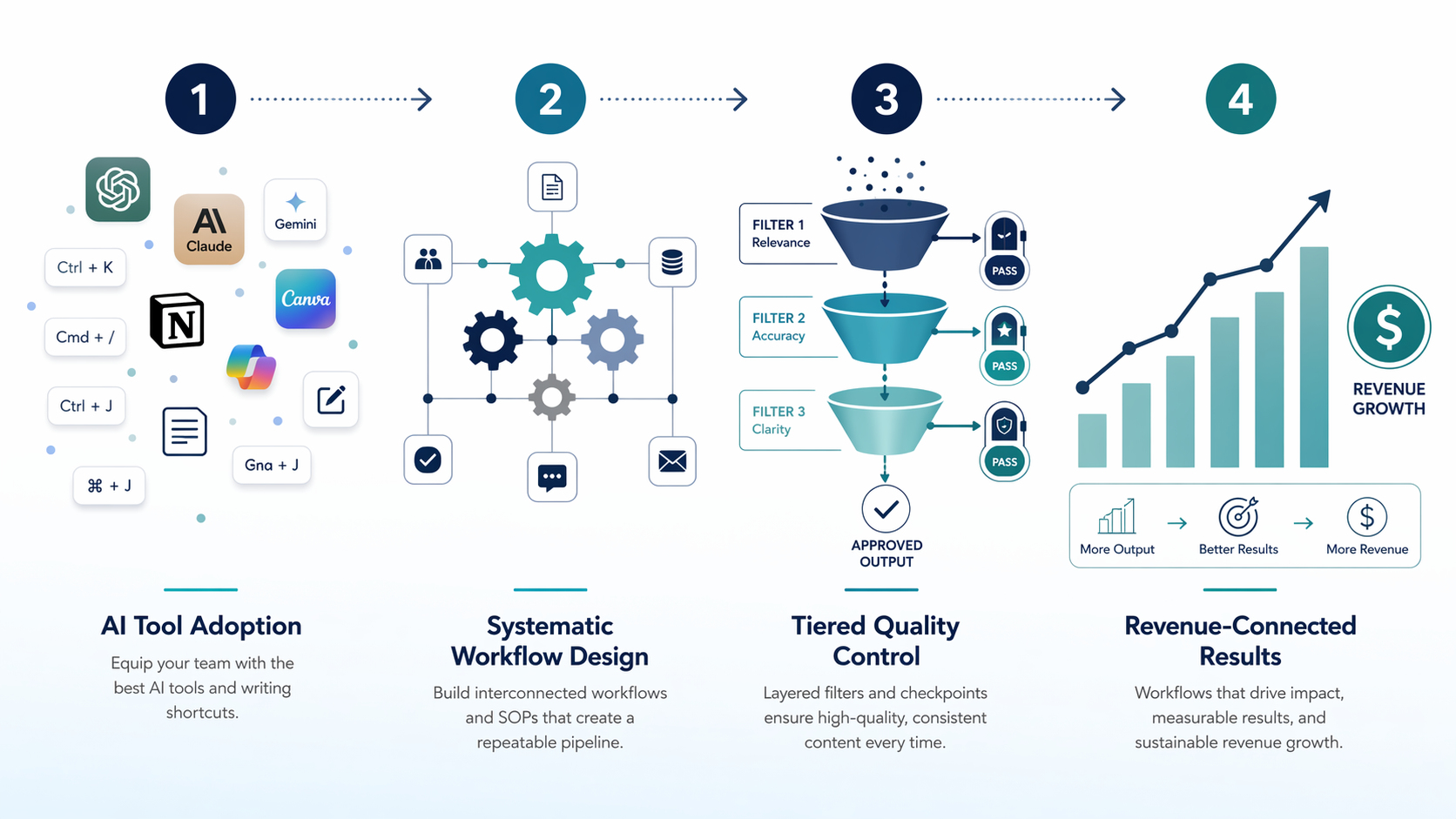
The teams most likely to turn AI adoption into business results make three changes before they scale output.
- They define where AI belongs in the workflow. AI is assigned to specific tasks, and each task has a human owner before and after generation.
- They build tiered quality control. Review depth changes with risk, and factual claims, brand voice, compliance-sensitive language, and strategic judgment are not left to a final skim.
- They connect AI-assisted work to revenue-relevant measurement. Efficiency remains visible, but it is not allowed to substitute for pipeline, conversion, retention, or sales impact.
This is the more restrained conclusion the evidence supports. AI can reduce marketing production costs and improve throughput. It can also raise the floor for routine execution. But the leap from adoption to meaningful results depends on the system around the tool: workflow design, quality control, differentiated human judgment, and measurement that reaches beyond activity.
References
- State of Marketing, HubSpot
- How to Use AI for Content Marketing in 2026, Onely
- AI Marketing Strategy: Frameworks and Tools, Tommaso Maria Ricci
- 7 AI Marketing Trends for 2026, Improvado

Comments
Join the discussion with an anonymous comment.