

How to Build Your Small Business AI Marketing Stack: A Framework That Works
Small business owners overwhelmed by AI marketing tool options need a systematic approach. This article provides a hub-and-layer framework to choose and combine tools by addressing your biggest operational bottleneck first, informed by real adoption data from small business surveys.
If you are looking up ai for small business marketing in 2026, the uncomfortable part is probably not whether AI matters. It is that the market already feels too large to shop rationally. One market estimate puts the number of available solutions at 15,384. Even if only a fraction of those are relevant to a small business, that is still too many tabs for an owner trying to finish a newsletter after dinner.
The data does not make AI marketing look fringe anymore. SBE Council reported that 82% of small business employers had invested in AI, with a median of five AI tools in use; marketing was the top use case, 93% planned to continue investing, and 62% planned to increase spending.[1] QuickBooks, working from a much larger 2026 survey across four countries, reported that 43% use AI for marketing.[2] Sopro’s December 2025 roundup put AI adoption among marketers at 94%.[3]
Those numbers should remove one anxiety and create another. You are not late because you have not built an elaborate AI marketing machine. The more practical risk is random adoption: one tool for captions, one for images, one for email subject lines, one for meeting notes, one because a competitor mentioned it, and no clear answer to what each tool is supposed to remove from the workday.
The Stack Rule: One Hub, Then One Layer at a Time
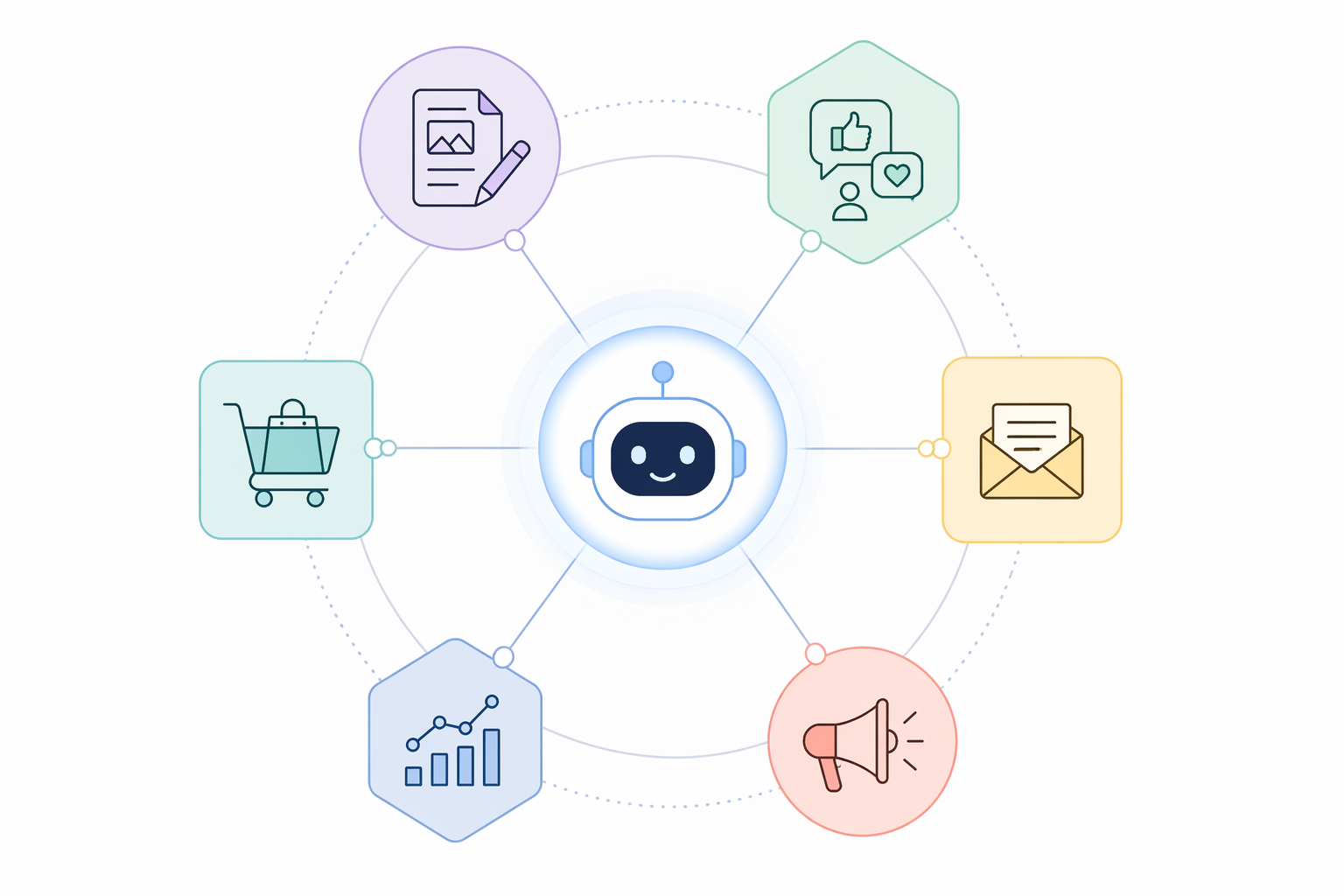
A small business AI marketing stack should start with one general assistant as the operating hub. For most owners, that means a flexible tool such as ChatGPT or Claude: the place where you plan campaigns, rewrite rough ideas, turn customer language into messaging angles, draft briefs, summarize notes, and pressure-test offers before work moves into a publishing or sales system.
Then, and only then, add a specialized layer when the hub hits a named bottleneck. Not a vague desire to “do more AI.” A named bottleneck: product photos take too long to create, follow-up emails are inconsistent, social scheduling keeps slipping, ad variations never get tested, customer reviews are not being mined, or ecommerce product descriptions are blocking launch.
| Decision point | What to ask | What usually happens next |
|---|---|---|
| Bottleneck | Which marketing task is slowing revenue, consistency, or customer response right now? | Pick one constraint before shopping. |
| Hub | Can a general assistant handle this with your existing notes, offers, and customer language? | Use the hub until the workflow, not the model, becomes the limitation. |
| Layer | Does a specialized tool remove steps the hub cannot remove by itself? | Add one function-specific tool. |
| Connection | Where will the output go, and who reviews it? | Tie the tool to email, CRM, ecommerce, scheduling, ads, or analytics. |
| Review | Did the tool save time, improve quality, or increase follow-through? | Keep, replace, or cancel before adding another subscription. |
This is less exciting than a “top 25 tools” list, but it is closer to how a small team can actually operate. The hub keeps the thinking, voice, and campaign logic in one place. The layers exist only where a separate interface, integration, template system, or automation saves enough effort to justify another login.
Find the Bottleneck Before You Pick the Tool
The first decision is not “Which AI tool is best?” It is “Where does marketing keep getting stuck?” Small business marketing usually breaks in one of four places: the offer is unclear, content does not get produced, leads do not get followed up, or performance data does not turn into decisions.
A useful bottleneck has a consequence attached to it. “We need better social posts” is too loose. “We have three launches a month, but product posts go live late because the owner rewrites every caption” is specific enough to design around. “We should use AI for email” is loose. “New inquiries wait two days for a personalized reply because every response starts from scratch” is specific.
Adobe’s small business study gives one reason this matters. Among 431 respondents, Adobe reported that 38% use AI for social content and that small businesses using AI save an estimated 175 hours and $5,816 annually; the study reports a 95% confidence interval with a ±5% margin of error.[4] That is useful, but it does not answer the operational question by itself. If those saved hours go into more undifferentiated posts, the stack is busy, not better. If they go into stronger offers, faster customer response, cleaner product pages, or better local creative, the same hours become capacity.
Before subscribing to anything, write one sentence in this format: “If AI helped us reduce ______, we would be able to ______.” The second blank is the business reason. If you cannot fill it in, the tool is probably curiosity, not infrastructure.
A Quick Bottleneck Sort
- If customers do not understand what you sell, start with positioning, offers, landing pages, and sales copy inside the hub.
- If good ideas exist but publishing is inconsistent, add structure around content planning, repurposing, and scheduling.
- If leads arrive but follow-up is slow, prioritize email, CRM, and customer response workflows.
- If you spend money on ads but learn too slowly, look at creative testing, reporting, and analytics layers.
- If ecommerce operations are the drag, focus on product content, merchandising, review mining, and lifecycle email.
Use the Hub for Thinking, Drafting, and Translation Between Tasks
The hub earns its place because small business marketing is full of translation work. A conversation with a customer has to become website copy. A seasonal promotion has to become an email, a few posts, a landing page note, a staff talking point, and maybe an ad angle. A good assistant helps turn one clear input into several usable drafts without pretending that all channels are the same.
This is also where customer data matters. The hub is much more useful when it has access to real inputs: reviews, sales calls, FAQs, support tickets, survey responses, winning emails, product notes, and objections heard at the counter or on the phone. An empty request produces generic marketing. A request grounded in customer language produces something an owner can actually judge.
For a deeper look at why AI marketing gets weaker when it is disconnected from customer evidence, see the first-party data speed trap. The short version for stack building is simple: do not add a layer to compensate for an empty hub. Feed the hub better material first.
When a Specialized Layer Is Worth Adding
A specialized AI tool is worth adding when it does at least one of three things better than the hub: it connects directly to the system where work happens, it removes repetitive production steps, or it gives you a review loop you will actually use.
A social scheduling platform with AI features may be worth it if your real problem is queue management, approvals, and channel formatting. It is less compelling if you only need caption drafts. An email platform with AI segmentation or subject-line assistance may be worth it if the list is active and follow-up is already tied to revenue. It is probably premature if you have not sent consistently in months. An image tool may be worth it if visual production is blocking product launches, local promotions, or ad tests. It is noise if the business has no plan for where the images will run.
The test is not whether the specialized tool is impressive. It is whether it shortens the path from idea to reviewed, published, measured work. If the owner still has to copy outputs between six places, rewrite everything, and remember which subscription stores which asset, the stack has started charging rent without doing enough chores.
Use Budget Bands, Not Fantasy Pricing
AI tool pricing changes often, and several platforms adjusted pricing during Q1 and Q2 2026. For small businesses, it is safer to think in bands than fixed monthly promises: free tier for testing, roughly $20–$50 per month for a serious single-user tool, and roughly $100–$200 per month for a small stack with one or two paid layers. The exact vendor mix matters less than the total burden: money, setup time, training time, review time, and cancellation discipline.
How the Layers Change by Business Type
No single AI marketing stack fits every small business. The hub can be similar across businesses, but the first layer should follow the place where marketing friction meets revenue.
Ecommerce: Product Content, Merchandising, and Lifecycle Email
An ecommerce shop often feels the drag in product-level work. The owner or coordinator needs product descriptions, collection copy, email flows, review summaries, ad angles, and seasonal merchandising language. In that case, the hub should first learn the product catalog, customer objections, return reasons, and review language. The first specialized layer may be an ecommerce-connected content or email tool, not a standalone social caption generator.
A practical first stack might be: one hub assistant, the ecommerce platform’s built-in AI where it shortens product work, and an email or lifecycle marketing tool if abandoned cart, post-purchase, and repeat-purchase flows are underused. Image generation or ad creative tools come later if visual testing is the bottleneck.
Service Business: Offers, Authority, and Follow-Up
A service business usually needs fewer product assets and more trust-building. The constraint may be explaining the offer clearly, turning expertise into useful content, responding to leads quickly, or keeping proposals and nurture emails from starting at zero every time.
Here, the hub should hold sales call notes, objections, client outcomes, service boundaries, and proof points. The first layer may be a CRM or email tool with AI-assisted follow-up, especially if inquiries are slipping. If the business depends heavily on thought leadership, the content layer may come first, but the source material should still be the owner’s expertise, not a pile of generic “tips” posts.
When copy itself is the bottleneck, use a decision framework before buying another writing tool. The AI copywriting tool use-case framework is the better next stop than a generic ranking if you are deciding between website copy, ads, email, sales pages, and ongoing content.
Local Retail: Promotions, Events, Reviews, and Community Presence
A local retail business may not need a sophisticated AI content operation. It may need a faster way to turn weekly realities into marketing: new arrivals, staff picks, events, weather changes, neighborhood moments, customer questions, and reviews.
The hub can turn those inputs into a weekly promotion plan, short email, social captions, signage language, and talking points for staff. A social scheduling layer may make sense if posting consistently is the bottleneck. A review management or local listings layer may matter more if discovery and reputation are the constraint. The mistake is buying an advanced content engine when the actual problem is that nobody has captured what happened in the store this week.
A Simple Adoption Order
For most small businesses, the cleanest order is hub first, then the layer closest to revenue leakage, then the layer closest to consistency.
- Set up the hub with your offer, customer language, brand constraints, common objections, products or services, and examples of marketing you would be willing to publish.
- Use the hub for two to four weeks on planning, drafting, repurposing, and reviewing before adding paid layers.
- Choose the first layer where manual work is causing missed revenue, slow response, or inconsistent publishing.
- Connect that layer to the system of record: email platform, CRM, ecommerce store, scheduler, ad account, analytics tool, or review platform.
- Review after one campaign cycle. Keep the tool only if it clearly saves time, improves output quality, or increases follow-through.
If you already have several subscriptions, do the same process in reverse. List each tool, the bottleneck it is supposed to solve, the person who uses it, the system it connects to, and the last time it changed a marketing decision. Tools that cannot survive that list are not a stack. They are sediment.
Where All-in-One Platforms Fit
There is a reasonable case for all-in-one platforms, especially for owners who value one login, one vendor, and fewer integration decisions. The trade-off is flexibility. A single platform may be easier to manage but less strong in any one function; a hub-and-layer stack may fit the business better but requires more discipline.
The deciding factor is not sophistication. It is management capacity. If nobody on the team will maintain connections, review outputs, or prune tools, a simpler platform can outperform a theoretically better stack. If the business has a hands-on marketer who understands the workflow, point tools can be worth the extra coordination.
If you are comparing stack patterns by use case, use the stack-based AI marketing comparison. If your needs have grown into a platform buying decision, the AI marketing cloud buyer’s guide is the more appropriate lens.
The Quality Trap
AI makes it easier to produce marketing assets. That is not the same as making the marketing better. When many businesses use similar tools against similar prompts, the average output starts to sound strangely familiar: polished, harmless, and forgettable.
This is why the review step matters. The owner, founder, salesperson, stylist, contractor, consultant, shop manager, or customer support lead still has to add the part AI cannot infer from the internet: what customers actually say, what the business refuses to promise, what makes an offer profitable, what tone would feel wrong, and which details make the message believable.
Use AI to get from blank page to first draft, from one idea to five channel-specific versions, from scattered customer notes to usable themes. Do not use it as an excuse to stop listening. The better small businesses will spend saved time on customer understanding, sharper offers, stronger creative judgment, and more personal follow-up. The weaker ones will spend it publishing more sameness.
If you want a broader diagnostic for why AI marketing systems often disappoint, see why most AI marketing strategies fail. For a role-specific breakdown of what practitioners may need once the basics are stable, use the role-by-role AI marketing guide.
What Should Earn a Place in the Stack
A tool earns its place when it removes a named bottleneck, connects to work already happening, and leaves the business with more useful marketing capacity than before. Five AI tools can be reasonable. Two can be too many. The count is not the standard.
The practical advantage is not owning the most advanced stack. It is knowing why each part exists, what work it reduces, who reviews the output, and where the saved time goes.
References
- SUCCESS STRATEGIES: The AI Tools Small Businesses Are Using, SBE Council, April 25, 2026.
- 2026 AI Impact Report, QuickBooks.
- 75 Statistics About AI in Sales and Marketing for 2026, Sopro, December 2025.
- How Small Businesses Maximize ROI With AI Tools, Adobe.
Comments
Join the discussion with an anonymous comment.