
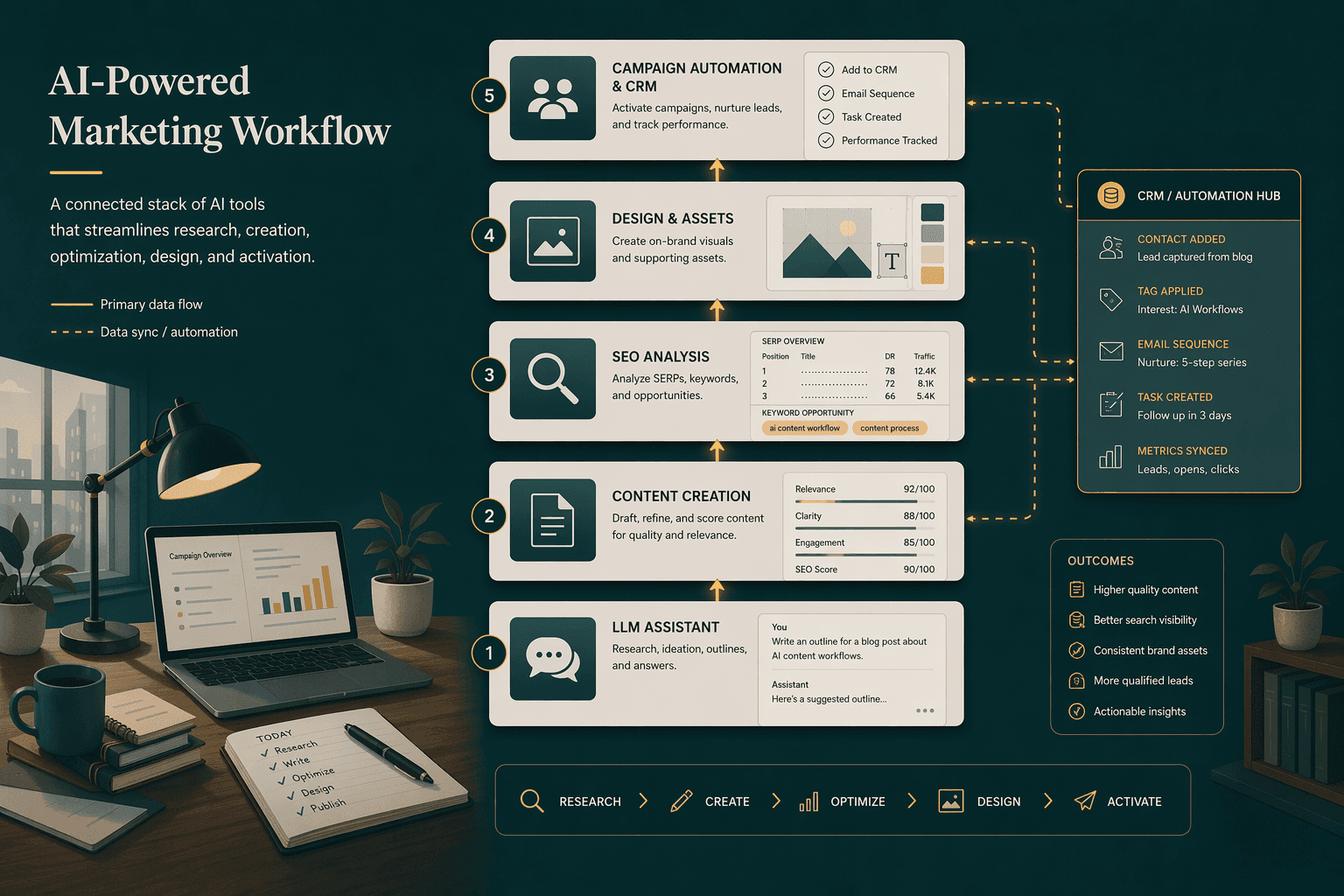
Stack-Based Comparison Guide
A practical, honest comparison for marketing managers and agency leads building their AI tool stack. Instead of a feature-list roundup, this guide provides a bottleneck-first decision framework, real pricing with limitations, and recommended 3–5 tool stacks organized around your team's actual workflow needs.
Key Integrations
Marketing Categories
⚠ Notable Limitations
Pricing changes rapidly; hybrid pricing can obscure total cost; integration costs often overlooked
The AI Marketing Tool Landscape in 2026: 15,384 Solutions, but Most Teams Need 3–5
The AI marketing tool market has exploded to an estimated 15,384 solutions. That number comes from industry tracking, and it grows every month. For a marketing manager or agency lead evaluating tools in mid-2026, the problem is not a lack of options — it is the opposite. The sheer volume of platforms, point solutions, and AI features bolted onto existing software creates a decision paralysis that most comparison articles only make worse by listing 20+ tools with thin analysis.
The data on adoption tells a clear story. Between 87% and 94% of marketers now use AI in at least one workflow, up from roughly 51–63% in 2024. In the UK specifically, 54% of firms now actively use AI, compared to 35% just one year earlier, according to a March 2026 survey by the British Chambers of Commerce and the University of Essex. The question is no longer whether to use AI — it is how to build a coherent stack that actually improves output rather than adding subscription bloat.
The five major large language models — ChatGPT, Claude, Microsoft Copilot, Gemini, and Perplexity — now account for roughly 95% of meaningful professional AI usage among small marketing teams. That means most teams already have a foundation layer in place. The question is what to add on top, and in what order, to solve the specific bottleneck holding your team back: content quality, workflow automation, SEO performance, or ad optimization.
How to Evaluate AI Marketing Tools: A 6-Criteria Framework
Before comparing specific tools, it is worth establishing a consistent evaluation framework. Feature lists are easy to manipulate — every vendor can claim they do everything. The real differentiators are harder to surface. Here are six criteria that matter more than the number of features a tool lists on its pricing page.
- Workflow fit. Does the tool slot into your existing process, or does it force you to change how your team works? The best tool for a task is the one that reduces friction, not the one with the most impressive demo.
- Integration cost. A tool that does not connect to your CRM, CMS, or ad platform creates manual transfer work that eats into any time savings. Check native integrations before signing up.
- Pricing transparency. Nearly 31% of AI vendors now use hybrid pricing — a subscription base plus usage-based overage charges — that can obscure total cost of ownership. Ask for a total-cost projection before committing.
- Output quality with human oversight. Unedited AI content underperforms. Human-edited AI content performs 127% better in search rankings than raw AI output. Evaluate tools on how well they support a human-in-the-loop workflow, not on how autonomous they claim to be.
- Scalability. A tool that works for a solo content creator may break at the team level. Check seat pricing, collaboration features, and whether the tool has enterprise-grade permissions and audit logs if you expect to grow.
- Vendor stability. The AI tool landscape is volatile. A tool that raised a large Series A in 2024 may have pivoted, been acquired, or changed its pricing model by 2026. Prioritize tools with clear business models and transparent roadmaps.
Category-by-Category Comparison: Pricing, Strengths, and Limitations
The following sections break down the major AI tool categories a marketing team needs to consider. Each category includes 2–3 top contenders with real pricing, key strengths, and honest limitations. The goal is not to declare a single winner — it is to help you understand which tool fits your specific context.
AI Assistants (The Foundation Layer)
Every marketing stack starts here. The five major LLMs — ChatGPT, Claude, Gemini, Microsoft Copilot, and Perplexity — anchor the vast majority of professional usage. ChatGPT alone held roughly 64.5% of the consumer-facing AI assistant market by usage share as of January 2026, and now reports 900 million weekly active users. But market share is not the same as best fit.
| Tool | Starting Price | Best For | Key Limitation |
|---|---|---|---|
| ChatGPT Plus | £16–20/month | Everyday writing, brainstorming, image generation | Output can be generic without detailed prompting; limited structured analysis |
| Claude | £16–20/month (Pro tier) | Long-form writing, structured analysis, research synthesis | Smaller ecosystem of integrations vs. ChatGPT |
| Gemini | Included with Google Workspace | Google Workspace users; tight integration with Docs, Sheets, Gmail | Less capable on creative writing tasks than Claude or ChatGPT |
| Perplexity Pro | £16–20/month | Research with citations; fact-checking and source verification | Not designed for content generation; best used as a research layer |
For most teams, the smartest move is to pick one primary assistant and one secondary tool for specialized tasks. A common pattern: Claude for long-form content and analysis, ChatGPT for quick drafts and image generation, and Perplexity for research with source citations. The total cost for two seats is roughly £32–40/month.
Content Creation and Brand Voice
Content and copywriting remains the leading AI application, with 50% of marketers using AI for this purpose. The tools in this category go beyond general-purpose LLMs by offering brand voice controls, content templates, and workflow features designed for marketing teams.
| Tool | Starting Price | Best For | Key Limitation |
|---|---|---|---|
| Jasper | £59/seat/month | Brand voice consistency, long-form content, team collaboration | Higher per-seat cost; overkill for solo creators or simple tasks |
| Copy.ai | £30–40/seat/month | Ad copy, social posts, email sequences | Less effective for long-form or research-heavy content |
| ContentShake (Semrush) | Included with Semrush Guru (£230/month) | SEO-optimized content briefs and drafts | Requires Semrush subscription; not a standalone tool |

Comments
Join the discussion with an anonymous comment.