

AI Subject Line Testing: When It Works, When It Doesn't, and How to Keep the Human in the Loop
A balanced, evidence-backed assessment of where AI subject line testing delivers real open-rate improvements, where it produces unusable garbage, and what governance practices separate the successes from the failures.
AI email subject line testing is doing two things at once: producing lifts large enough to take seriously, and producing copy no responsible marketer would let near a send button. That split is the useful starting point. Digital Applied reported a 35% to 95% open-rate lift range across Mailchimp, Klaviyo, and HubSpot client benchmarks in Q1 2026, with the lower end tied to brands that already had reasonably optimized subject lines and the upper end tied to senders starting from generic baselines. The caveat matters: this was a benchmark synthesis across platforms, not one controlled study with a single design, audience, and control group.[1]
Set that beside the uglier evidence. Woodpecker’s tests of AI subject line tools found outputs such as “Here’s something you don’t need,” “Huge fan” attached to an undisclosed 80% open-rate claim, and the wonderfully useless “Nussle-Flakes.” It also described Storylab.ai as “not intelligent at all.” Those tests were conducted in cold-email and sales contexts from 2023 to 2025, so they should not be treated as a universal verdict on newsletter or lifecycle marketing tools. They are still a fair warning about what happens when “AI subject line testing” really means “a tool generated some words and called them optimized.”[2]
Paved ran into the same divide from another angle: ChatGPT-generated subject lines felt “bland and generic,” while the version that combined human writing with SendCheckIt optimization performed better.[3] That is not an indictment of AI. It is an indictment of pretending that generation and testing are the same discipline.
The Real Question Is Not Whether AI Can Write a Subject Line
A general model can produce twenty subject lines in seconds. That is useful, especially for teams that otherwise test one safe option against another safe option and call it learning. But speed is not the same as evidence. The operational question is whether the system has enough audience history, a defensible way to compare variants, and a human review process that keeps the brand from sounding desperate, misleading, or bizarre.
Mailmend reports 34% higher open rates from AI subject line testing.[4] Emercury reports 10% to 22% lift from AI generation, with a 26% lift when personalization is added.[5] Those are meaningful numbers, but they do not say that every AI-generated line is better than a human-written line. They say that, under certain operating conditions, AI can expand the test set, apply patterns from prior performance, and help teams find variants they might not have written themselves.
That distinction also explains why marketers see such different outcomes from tools that sound similar on a sales page. A dedicated subject-line optimizer, an ESP-native feature inside HubSpot or Klaviyo, and a blank ChatGPT request do not have the same data access or the same guardrails. If you are mapping subject line testing into a broader AI email stack, the more useful comparison is not “Which tool writes catchier copy?” It is “Which system can learn from our sends without creating a governance mess?” For the wider stack, see Signal & Convert’s AI email marketing guide and its guide to AI email automation and personalization.
Generation Alone Is the Weakest Version of AI Testing
The weakest workflow is familiar: someone opens a model, asks for “10 high-converting subject lines,” picks the least embarrassing one, and sends it to the full list. That may be AI-assisted brainstorming, but it is not AI email subject line testing. Nothing has been tested unless there is a control, an audience definition, a measurement window, and a decision rule.
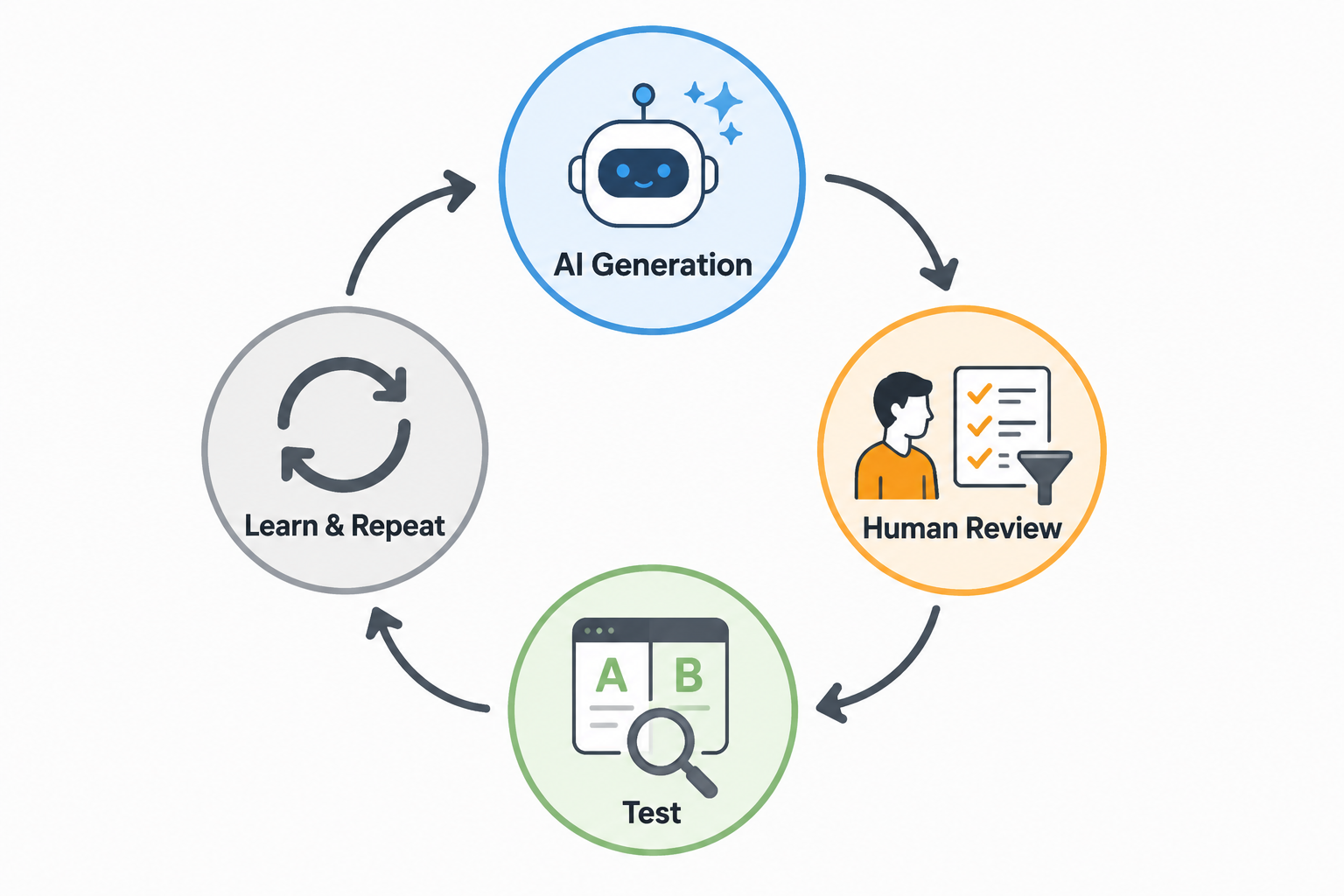
The stronger workflow is slower on purpose:
- AI generates or scores candidate subject lines using campaign context, brand rules, audience segment, and prior performance where available.
- A marketer filters for meaning, tone, compliance, promise accuracy, and fatigue from repeated emotional triggers.
- The team runs a real test against a relevant control instead of comparing a new line to a vague memory of past performance.
- Results are logged with the segment, offer, send timing, creative angle, and downstream behavior.
- The next test uses that record instead of starting from a blank request again.
Digital Applied’s iteration framework is a good example of the difference between a one-off request and a repeatable program: log every test result, look for patterns after 10 to 15 tests, update AI models monthly, and challenge winners quarterly. It also flags emotional trigger fatigue, reporting that urgency and surprise triggers lose 8% to 12% per additional use beyond twice per month to the same audience.[1] That is the kind of finding a marketer can actually use before approving yet another “Last chance” line.
Condition One: The Data Has to Be Worth Learning From
AI testing does not rescue a messy list. If the audience includes inactive subscribers, mixed lifecycle stages, outdated preferences, and untagged customers, the model is learning from noise. A subject line that wins with discount-trained buyers may be the wrong signal for a product-education segment. A line that works on recent webinar attendees may tell you little about a cold reactivation list.
Baseline quality matters just as much. A 95% lift from replacing bland, generic subject lines is not the same achievement as a 35% lift over a team that has been testing carefully for years.[1] The larger number may be real and still not portable to a mature program. This is where many vendor screenshots become less useful than they look: they show the lift, but not whether the control deserved to lose.
Open-rate data also carries more distortion than many dashboards admit. Apple Mail Privacy Protection can inflate or blur open tracking depending on audience composition, which makes opens a less clean proxy for attention than they used to be. For subject lines, opens still matter because the subject line’s first job is to earn the open. But when the campaign has a business goal, a cleaner read also looks at clicks, replies, conversions, unsubscribes, spam complaints, and whether the winning line set the right expectation for the message inside.
That is why “AI found a winner” should prompt a few unglamorous questions: Was the list segmented? Did the system have historical engagement by segment? Was the control already strong? Was the open-rate lift supported by any downstream behavior? If not, the result may still be interesting, but it is not yet a rule.
Condition Two: The Test Design Decides How Much You Can Believe
Basic A/B testing is still useful, especially when a team is choosing between two genuinely different hypotheses. The trouble starts when teams treat a tiny A/B result as a universal audience truth. A 52% to 48% split on a small sample may feel decisive in a meeting, but it can easily be noise. The subject line then becomes office folklore: “Personalization works for us,” “Questions don’t work,” “Urgency always wins.” Often, what actually happened was that one send produced one fragile result.
Sample-size recommendations vary because different sources are solving different problems. A lower threshold may be acceptable when the expected effect is large and the decision is low-risk. A much larger audience is needed when the expected lift is small, the list is heterogeneous, or the team wants higher confidence before rolling a pattern into future campaigns. The numbers are not contradictory so much as incomplete without the minimum detectable effect, confidence level, and business consequence.
Predictive scoring changes the workflow. Instead of sending every candidate to a live sample, the system estimates likely performance before the campaign goes out. Ortto describes a neural-network approach trained on every subject line its platform has sent, weighted by audience engagement, and claims accuracy within a few basis points. That claim comes from the company’s CEO and is not independently validated, so it should be treated as a vendor disclosure rather than settled fact. Still, the method is directionally important: scoring is most useful when it reduces weak variants before the live test, not when it pretends to replace all experimentation.[6]
Multivariate testing is where AI can become more interesting than a faster copywriter. Subject lines contain multiple variables: length, specificity, offer framing, emotional trigger, personalization, product reference, punctuation, sender context, and preview-text pairing. A human team can test these manually, but it takes discipline and time. AI can help generate structured variations across those dimensions and identify recurring patterns after enough sends. The marketer’s job is to keep the variables interpretable. If every variant changes the offer, tone, length, and personalization at once, the team may know which line won without knowing why.
| Approach | What It Can Tell You | Where It Breaks |
|---|---|---|
| Random AI generation | Which ideas sound usable after human review | No evidence of audience fit unless tested |
| Basic A/B test | Which of two variants performed better in one send | Weak if sample is small, control is poor, or result is overgeneralized |
| Predictive scoring | Which candidates appear stronger before live deployment | Depends on training data quality and vendor transparency |
| Multivariate testing | Which subject-line elements repeatedly influence behavior | Requires enough volume and clean variable design |
For teams trying to decide what belongs in automation and what still needs editing, the same logic applies beyond subject lines. Signal & Convert’s automate, edit, or skip framework is a useful companion because subject lines sit in the middle: high-volume enough for automation help, visible enough to punish lazy approval.
Condition Three: Human Oversight Has to Be Built Into the Workflow
Human-in-the-loop is too often used as a comforting phrase after the real process has already been automated. In subject line testing, oversight has to happen before the send, during the test design, and after the result is logged. The person reviewing the line is not there to make the AI feel less threatening. They are there because the audience will experience the subject line as the brand’s promise.
HubSpot’s Breeze AI guidance is a practical example of production guardrails: structured prompts, brand voice rules, forbidden-word lists, approval workflows, fallback values, and CAN-SPAM compliance checks. HubSpot also notes that CAN-SPAM penalties can reach $53,088 per email, which is a useful reminder that “the model suggested it” is not a compliance defense.[7]
The guardrails should be specific enough that a tired reviewer can apply them quickly:
- No false urgency unless the deadline or scarcity is real.
- No personalization token unless a fallback value has been checked.
- No claim in the subject line that the email body does not immediately support.
- No words that legal, compliance, sales, or customer success have already banned.
- No “winning” variant promoted into a playbook until it has been tested beyond one send or one segment.
This is also where the AI skills gap shows up. A marketer who can make a clear request but cannot design a test will get more variants, not more knowledge. A team that buys a tool without defining approval rights, learning logs, and brand boundaries gets adoption without operating discipline. That broader pattern is covered in Signal & Convert’s pieces on the AI marketing skills gap and the AI marketing implementation gap.
Why Bad AI Subject Lines Are More Than a Copy Problem
A bad AI subject line is not just inefficient. It teaches the audience how seriously to take the sender. “Nussle-Flakes” is funny in a review document; it is not funny in an inbox attached to a brand that wants trust. Blandness has a quieter cost. If a subscriber sees the same generic curiosity gap, forced urgency, or fake personalization too often, the brand becomes easier to ignore even when the next email is worth reading.
That is why the human reviewer should not only ask, “Will this open?” They should ask, “Will this feel honest after the email opens?” Subject lines that win by overpromising often move the disappointment one click deeper. Depending on the campaign, that can show up in weak click-through, higher unsubscribes, spam complaints, lower reply quality, or simple erosion of attention over time. For a broader look at how unedited AI output can affect perception, see Signal & Convert’s analysis of the AI content trust penalty.
When AI Subject Line Testing Is Worth Using
AI subject line testing is worth using when the team can give the system enough context and enough consequences. That usually means a clean list, meaningful segments, a history of sends, a control worth beating, and a process for recording what happened. It also means the team is willing to let AI generate more hypotheses than a human might produce, while still requiring a human to approve the promise being made.
The use cases that make the most sense are practical rather than glamorous: refreshing stale lifecycle emails, generating structured variants for a campaign with enough volume to test, adapting one core message across segments, scoring weak candidates before they consume live sample, and looking for repeated patterns across 10 or more tests rather than celebrating one lucky send.[1]
It is not worth trusting when the tool has no audience history, no segment context, no brand rules, no approval step, and no measurement plan beyond “the AI said this should perform well.” That is how subject line testing becomes a novelty generator. It may occasionally stumble into a good line, but it cannot explain the win or protect the brand from the next bad suggestion.
For teams evaluating platforms, tool choice should follow governance needs. ESP-native optimizers may have better access to engagement data. Dedicated AI copy tools may offer more variation and scoring features. General LLMs may be useful for ideation, especially when given campaign context and examples of past sends. None of those categories is automatically superior. The wrong setup can make a strong tool careless; the right workflow can make a modest tool useful. If platform selection is the immediate problem, Signal & Convert’s AI marketing tools by role guide and AI marketing cloud buyers guide give the broader buying context.
A Governance Standard for the Next Send
Before approving an AI-tested subject line, the standard should be simple enough to use and strict enough to matter. The campaign owner should be able to name the control, the segment, the sample logic, the measurement window, and the rule for choosing a winner. They should know whether Apple MPP-heavy audiences make the open-rate read less reliable. They should be able to say why the subject line matches the message inside the email. They should have somewhere to log the result so the next send starts smarter.
That is the practical threshold. AI email subject line testing can improve performance when it operates inside a learning loop: AI generates or scores, a human filters, the test runs, results are recorded, and the next round uses what was learned. It is not ready to be trusted when it is only producing clever-sounding lines without audience history, brand rules, or measurement discipline.
References
- AI Email Subject Line Testing Open Rates, Digital Applied.
- AI tools for email subject lines, Woodpecker.
- Subject Line Testers, Paved.
- AI-Driven Email Statistics, Mailmend.
- AI Email Subject Line, Emercury.
- Subject Line Testing AI Software, Ortto.
- AI Email Subject Line Optimization, HubSpot.

Comments
Join the discussion with an anonymous comment.