
What Nvidia's earnings signal means for AI ad platforms
Nvidia's Q2 FY27 report lands alongside a record $166B hyperscaler capex quarter — the money behind the inference-heavy ad systems Google and Meta are rolling out. This dated watchlist tells you what to check over the next two quarters: new force-migrations and on-by-default features, pre-migration CPA/CPM baselines, and why the Vera Rubin price hike is a lagged cost signal rather than a mechanical pass-through to your CPAs.
- Platform
- Google Ads0 Meta Ads
- Campaign type
- AI Max for Search0 Advantage+
- Spend range
- $0B hyperscaler capex quarter
- Timeframe
- Q0-Q4 2026
- Hyperscaler capex
- $0B
- Verdict
- mixed
- Industry vertical
- Ad tech
- Last reviewed
- 0-08-26
Nvidia reports Q2 FY27 results after the close today, Aug. 26, 2026, with the company call scheduled for 2 p.m. PT. For paid-media teams, the useful read is not “AI demand up, ROAS up.” The useful read is whether the print gives Google, Meta, and the ad-tech middle layer more room to keep moving inference-heavy products from optional tests into default account behavior over the next two quarters. The actual Q2 FY27 results are still pending until Nvidia reports, so the numbers below are a watchlist and update path, not a completed earnings analysis. [1]

| What to watch now | Why it matters for ad accounts | What changes after the call |
|---|---|---|
| Nvidia scorecard | Company guide, consensus, Data Center mix, margin, and beat size help date the next investor and platform-budget narrative. | Append reported revenue, Data Center revenue, gross margin, China commentary, and guidance only after the print is public. |
| Hyperscaler capex already spent | Amazon, Alphabet, Microsoft, and Meta were already at a compiled $166B capex quarter, using issuer-specific definitions. That is the budget layer behind more inference-heavy ad systems. [1] | Do not wait for a clean market narrative. Treat the capex buildout as already visible. |
| Account-level automation pressure | The next practical risk is not a chip headline. It is a migration notice, a default-on feature, or a reporting break inside Performance Max, AI Max, Advantage+, or programmatic buying. | Check baselines, settings, and change history before accepting any platform upgrade as performance-neutral. |
If you want the earnings table itself, keep the Nvidia earnings AI ad tech tracker open tonight and update it after the call. This article is the operating note that sits next to it: what to check in the accounts before the platform turns a compute-funded product roadmap into your new default.
The scorecard is a timing signal, not the destination
The preview setup is straightforward enough to put in one table. Nvidia guided Q2 FY27 revenue to $91.0B, plus or minus 2%, and that guide excludes China Data Center compute revenue. Consensus sat around $92B of revenue and $2.09 of EPS in the preview materials. Q1 FY27, the last reported quarter before today’s print, was $81.6B of revenue, up 85% year over year; Data Center revenue was $75.2B, up 92%; GAAP net income was $58.3B, up 211%; and GAAP gross margin was 74.9%. [1][2][3]
| Line item | Pre-print fact to verify | Buyer-side interpretation |
|---|---|---|
| Q2 FY27 revenue guide | $91.0B, plus or minus 2%, excluding China Data Center compute revenue. [1] | If the result clears or misses the guide, do not translate that directly into CPA expectations. Use it to date platform confidence around AI rollout pace. |
| Consensus setup | About $92B revenue and $2.09 EPS in the preview set. [1][3] | A guide-versus-consensus gap is not a China-revenue read because the guide assumption already excludes China Data Center compute. |
| Q1 FY27 base | $81.6B revenue, $75.2B Data Center revenue, $58.3B GAAP net income, 74.9% GAAP gross margin. [2] | Data Center is the relevant segment for the ad-platform infrastructure story, but segment strength still does not prove advertiser efficiency. |
| Beat-streak compression | The prior 13-quarter beat streak had compressed from 22.8% above guide in Q2 FY24 to a 2.5%–5.6% range over the last five quarters. [1] | A smaller beat can still support large platform commitments if hyperscalers have already spent or guided the capex. |
The China assumption deserves its own caution because it is easy to overread. If reported revenue, guidance, or commentary moves around the Street number tonight, that does not automatically mean China compute revenue is back in the model. The guide cited in the preview assumes zero Data Center compute revenue from China, so the right post-call update is to record what management actually says and keep it separate from the ad-platform checklist. [1]
The capex-to-platform chain is already visible
The more useful number for media buyers is not Nvidia’s final EPS. It is the compiled $166B hyperscaler capex quarter: Amazon at $54.2B, Alphabet at $44.9B, Microsoft at $35.8B, and Meta at $31.1B, up 87% year over year and 27% quarter over quarter in the REX Shares compilation. Meta’s line alone moved from $19.8B to $31.1B quarter over quarter, and Meta narrowed its FY26 capex guide to $130B–$145B. [1]
That table is not perfectly apples-to-apples. The compilation uses each issuer’s own cash-flow line: Amazon gross property and equipment purchases, Alphabet property and equipment purchases, Microsoft FY26 Q4 additions, and Meta capex including finance-lease principal. The caveat matters. It keeps the number from becoming a fake precision machine. It does not make the spending irrelevant. [1]
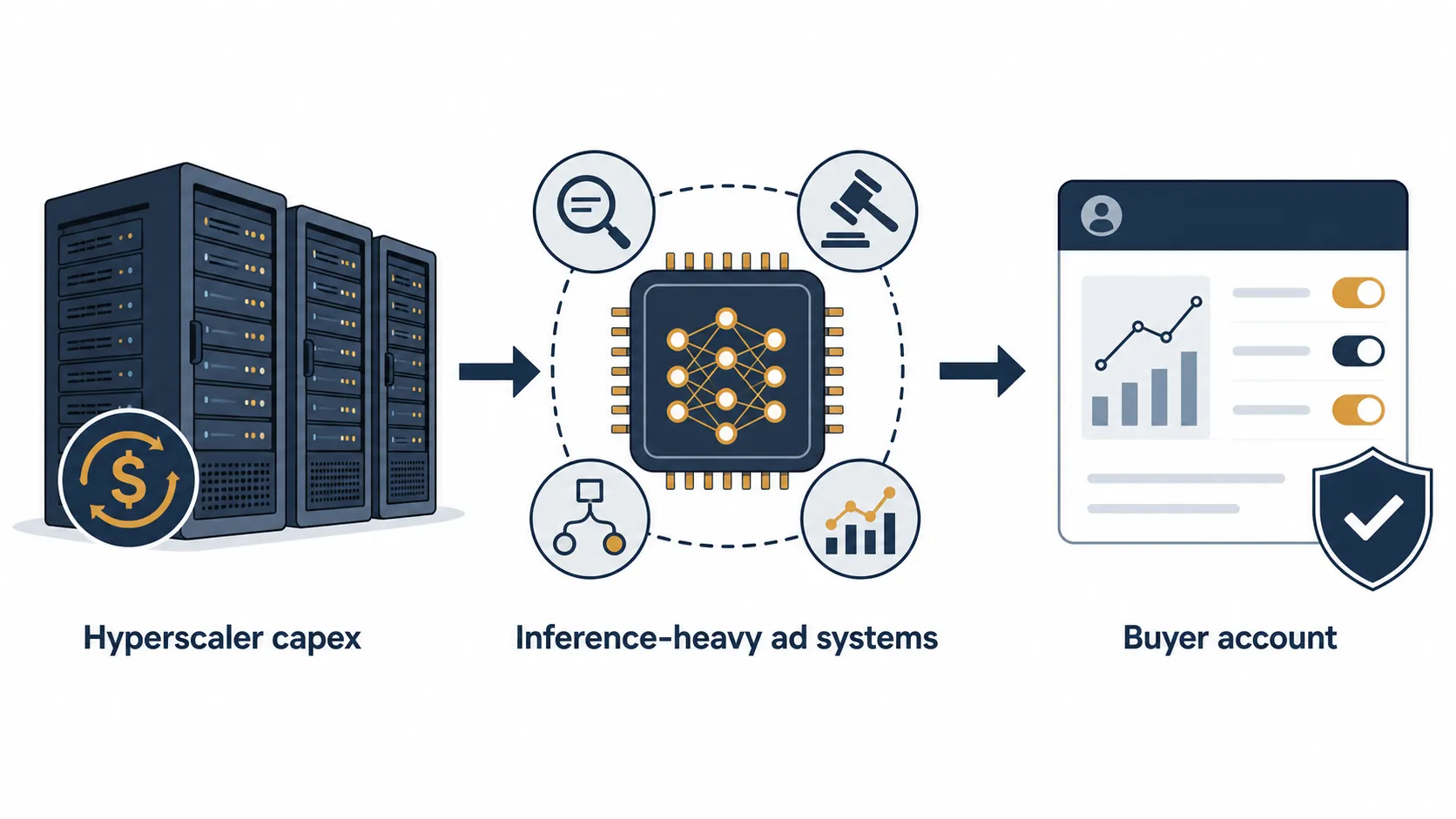
Once that much infrastructure is committed, the buyer-side question changes. It is no longer “will platforms experiment with AI-heavy ad products?” They already are. The question is where those products surface in accounts, whether the platform labels the change clearly, and whether the buyer has a clean pre-change baseline.
Meta’s Andromeda is the cleanest example of the infrastructure story turning into ad-serving behavior. Meta described Andromeda as a next-generation personalized ads retrieval engine for Advantage+ automation, built on NVIDIA Grace Hopper, with the system designed to expand retrieval capacity and improve candidate selection before later ranking stages. Meta published the engineering note in December 2024, making rollout pressure a 2026 watch item for buyers. [4]
That is genuinely impressive systems work. It also stops short of proving anything inside your account. Better retrieval can change which ads and audiences enter the auction path; it does not tell you whether last week’s CPA movement was model quality, auction pressure, budget mix, creative fatigue, attribution noise, or a migration side effect.
Google’s DSA-to-AI Max upgrade is more directly operational for search buyers because it is a named migration path. Google has told advertisers that Dynamic Search Ads will be upgraded to AI Max for Search campaigns in 2026, which makes this less like a speculative AI feature and more like a dated account-change event. [5]
That is where the earnings story becomes boring in the most useful way. A platform with capex behind it can afford to run more inference-heavy defaults. A buyer still has to ask whether the migration preserved query coverage, negatives, brand controls, landing-page behavior, budget allocation, and reporting continuity. For Google-specific follow-up, keep the AI Max cost benchmark and the Sept. 1 AI Max auto-upgrade watch item next to the account change log.
The same transmission pattern appears outside the walled gardens. PubMatic said its NVIDIA-powered work delivered about 1ms decisioning and 5x faster, smarter advertising decisions. That is a real programmatic infrastructure claim, and it belongs in the mechanism file for faster bidding and decisioning. It is not, by itself, a forecast that your open-web CPM goes up or down next month. [6]
Criteo is the training-side version of the same point. Nvidia’s June 2026 write-up said Criteo used cuEmbed to get roughly a 2x training speedup and save about 17,000 GPU hours a year. That can improve how quickly models are trained and refreshed. It still does not tell a buyer whether a CPM move came from model infrastructure, supply mix, or auction demand. [7]
For the longer version of that cost path, use the existing records on how Nvidia infrastructure costs can inflate programmatic CPMs and how AI can drive digital ad costs through separate mechanisms. The important separation is still the same: faster decisioning, higher infrastructure spend, denser model use, and advertiser clearing prices are related, but they are not the same measurement.
The account watchlist for Q3 and Q4 2026
The next two quarters should be handled like a migration season. Not every account will see a dramatic change. Some accounts may benefit from better retrieval, matching, and bidding. The point is simpler: when a platform changes the machine under the campaign, the buyer needs a record from before the machine changed.

1. Find forced migrations before they become performance explanations
Start with the boring screens: recommendations, change history, campaign settings, asset settings, experiment drafts, billing notes, and any inbox message that uses “upgrade,” “migration,” “eligibility,” or “limited availability” language. The work is not to reject every upgrade. The work is to keep the platform from rewriting the test conditions without a note in your own log.
- In Google Ads, check Dynamic Search Ads, AI Max eligibility, Performance Max settings, automatically created assets, broad-match expansion prompts, final URL behavior, brand exclusions, and negative keyword handling.
- In Meta, check Advantage+ campaign setup, Advantage audience controls, placement expansion, creative enhancements, catalog matching, and any account prompt that moves from recommendation to default.
- In programmatic platforms, check bidding model changes, supply-path changes, identity or contextual model upgrades, floor-price handling, and reporting taxonomy changes.
- In every account, export the current settings before accepting the prompt. Screenshots are not elegant, but they settle Slack arguments later.
This is also where default-on features deserve more suspicion than beta labels. A beta usually gets a line in a test plan. A default often appears as a quiet setting change that later gets discussed as if the campaign simply “learned.” The existing Performance Max AI voice-over test is a useful precedent file for how on-by-default AI features should be recorded before creative or conversion movement gets overexplained.
2. Freeze the pre-migration baseline
Before accepting an upgrade or entering a migration window, pull a baseline that can survive the next reporting argument. Do not use one blended dashboard number if the campaign mixes brand, nonbrand, remarketing, prospecting, shopping, video, and display. Split the baseline by the parts that the migration can plausibly affect.
| Baseline field | Why it matters |
|---|---|
| CPA, ROAS, conversion rate, AOV, and conversion volume | These are the performance numbers everyone will argue about after the migration. |
| CPM, CPC, CTR, impression volume, and impression share where available | These help separate auction-price movement from conversion-rate movement. |
| Search terms, query categories, product groups, landing pages, and URLs | These show whether the system changed what it was matching to, not just how efficiently it bid. |
| Budget, bid strategy, targets, learning status, audience controls, placements, and exclusions | These keep a platform migration from being confused with a management change. |
| Attribution setting, conversion action set, consent-mode or measurement changes | These catch the cases where the denominator moved while everyone is staring at CPA. |
Use enough history to cover normal weekday mix and promo cycles, but do not pretend that a baseline eliminates auction noise. It gives you a starting line. It does not give you a lab.
3. Separate migration effects from market effects
When the numbers move, do not jump straight from Nvidia to CPA. Work through the account-level sequence first: did the platform change eligibility, matching, retrieval, creative assembly, bid shading, supply access, measurement, or budget allocation? If yes, note the date and compare the affected slices against unaffected or less-affected slices.
- If CPM rises while CTR and conversion rate hold, look first at auction pressure, supply mix, frequency, and placement changes.
- If CPC falls but CPA rises, check query mix, audience expansion, landing-page match, and conversion quality.
- If conversion volume rises while ROAS falls, check whether the platform widened toward lower-value conversions or changed optimization weighting.
- If reporting breaks at the migration date, treat the first post-change read as provisional, especially in campaigns with delayed conversions.
The capex side has its own record. The Nvidia earnings, capex, and ad-prices tracker carries the already-proven end of the chain, including Meta ad-price and operating-cash-flow context. Use that to avoid re-litigating infrastructure spend inside every account review.
The Vera Rubin price hike is a cost signal, not a CPA formula
Reuters, citing Bloomberg News, reported on Aug. 22, 2026, that Nvidia customers had been notified of AI-related price increases above 15% for systems including Vera Rubin and Grace Blackwell, with the increases applying to systems shipped early next year. [8]
That belongs on the 2027 cost watchlist. It does not belong in a Q3 2026 CPA postmortem unless there is a much more specific platform pricing change attached to it. The pass-through path has too many steps: server-system price, hyperscaler procurement, depreciation and utilization, internal platform cost allocation, feature packaging, auction liquidity, advertiser demand, and campaign-level bidding.
The cleaner use is to date the next round of questions. If ad platforms keep making AI features heavier, more default, or more expensive to access in 2027, this is one of the input-cost signals to have in the file. It should sit beside the chip export restrictions and server-cost watch item, not replace account evidence.
What to update tonight
After the call, update the earnings tracker with reported Q2 FY27 revenue, Data Center revenue, gross margin, guidance, China commentary, and any management language about supply, inference demand, or next-generation systems. Keep those reported facts separate from account observations. A strong print can explain why platform teams have confidence to keep shipping AI-heavy systems. It does not verify that a given Performance Max, AI Max, Advantage+, or programmatic campaign improved because of them.
The practical read is restrained: the print helps date the next wave of platform automation pressure, while the buyer’s job remains inside the account. Find the migration. Record the default. Freeze the baseline. Then decide what actually moved.
References
- NVIDIA Earnings, REX Shares
- NVIDIA Announces Financial Results for First Quarter Fiscal 2027, NVIDIA Newsroom
- Nvidia's Q2 earnings to test resurgent AI trade, Yahoo Finance
- Meta Andromeda: Advantage+ automation, next-gen personalized ads retrieval engine, Meta Engineering, Dec. 2, 2024
- DSA upgrade to AI Max in Search campaigns, Google
- PubMatic Delivers 5x Faster, Smarter Advertising Decisions with NVIDIA, PubMatic, Oct. 8, 2025
- NVIDIA blog on Criteo cuEmbed GPU training work, June 2026
- Nvidia customers notified about AI-related price hikes above 15%, Bloomberg News reports, Reuters, Aug. 22, 2026
Built on this evidence
No Bidding tactic or Creative record currently cites this case file. Compare it against other results in Benchmarks.
Related benchmark reading
Report a corroborating or contradicting result
Seeing something different in your own account? Feed the data-integrity loop instead of leaving an open comment.