
Google's AI leadership reshuffle won't change your ad tools
Google's August 5 DeepMind reshuffle changed no Google Ads product, setting, or migration date, yet it landed right before the September 1 AI Max auto-upgrade window. Media buyers get a dated, sourced record of what's real, what's scheduled, and what still counts as vendor language.
- Platform
- Google Ads
- Change category
- bidding
- Effective date
- 0-09-01
- Change type
- default-on change
- Impact level
- high
Dated answer for media buyers
| Field | Current record |
|---|---|
| Last reviewed | August 26, 2026, UTC |
| Platform surface | Google Ads, with emphasis on Search campaigns moving toward AI Max |
| Leadership-news event | August 5, 2026: Google reorganized parts of the DeepMind/Gemini model organization. The reviewed sources do not report a Google Ads product, setting, default, bidding rule, placement rule, or migration-date change from that reshuffle. |
| Account-level event to calendar | September 1, 2026: the auto-upgrade window begins for Search campaigns that use automatically created assets and campaign-level broad match, moving them to AI Max. The window runs through September 30, 2026; the manual opt-out path is to turn the legacy feature off before migration. [1][2] |
| Affected users | Search advertisers with the legacy ACA plus campaign-level broad-match setup; adjacent risk reviews also apply to teams running Performance Max, Local Inventory Ads, Demand Gen, and AI Overviews inventory because other dated changes are active in the same period. |
| Source status | The AI Max account date is sourced to ad-product reporting and advertiser guidance. The August 5 reshuffle is sourced to Google and business/tech-news reporting, but those sources stop at the model-org layer. [3][4][5][6][7] |
| Impact level | Reshuffle itself: no account action. September AI Max window: high account-checklist priority. |

The short answer to “google ai leadership reshuffle impact on ai ad tools” is boring in the useful way: the August 5 reshuffle did not change the Google Ads tools you manage. The date that can change account behavior is September 1, when the AI Max auto-upgrade window opens for a specific Search campaign configuration. Those two events are close enough on the calendar to be confused, but the source trail does not connect them.
That distinction matters because the next month is already crowded. If a client or executive asks whether the DeepMind news means AI Max, PMax, Demand Gen, or AI Overviews ads are being forced into a new setting, the sourced answer is no. If they ask whether anything in Google Ads needs review before September, the answer is yes.
What changed on August 5 — and where the trail stops
Google’s August 5 memo framed the move as the next phase of its AI push: Demis Hassabis stepped out of the Google DeepMind CEO role to become Chair and Alphabet Chief Scientist while continuing with Isomorphic Labs; Koray Kavukcuoglu, previously CTO and Chief AI Architect, became SVP of Google DeepMind reporting to Sundar Pichai, with oversight of Gemini model development, frontier research, and Gemini app and developer teams; Jeff Dean, Sanjay Ghemawat, Oriol Vinyals, and Quoc Le left to form Discovery Loop. [3]
Axios, CNBC, TIME, and Pure AI covered the same basic shape: less “new ad product launch,” more consolidation around the model layer and the Gemini execution stack. [4][5][6][7] Pure AI also reported that Alphabet shares fell as much as 5.4% after the announcement, which is a market reaction, not an Ads-setting event. [7]
The negative finding is the useful part. None of the reviewed reshuffle sources reports a change to the Ads & Commerce organization, to Vidhya Srinivasan’s remit, to AI Max eligibility, to Performance Max controls, to Demand Gen billing or inventory, to AI Overviews placement rules, or to the already scheduled migration calendar. No Google Ads Help page, Google Ads announcement, Commerce announcement, or policy page reviewed for this tracker attributes an account-level change to the August 5 leadership move.
That does not mean the org chart is irrelevant forever. Gemini model cadence, app distribution, and developer tooling can eventually flow into ad surfaces. But “eventually” is not a checkbox. Until there is a dated product source, the reshuffle belongs in the context column, not in the change log.
The account-level change set running on its own schedule
The reason the leadership headline feels operational is timing. It landed inside a dense stretch of Google ad-tool changes. The work is not to infer a hidden master plan from the reshuffle; it is to keep the dated changes from blurring together.
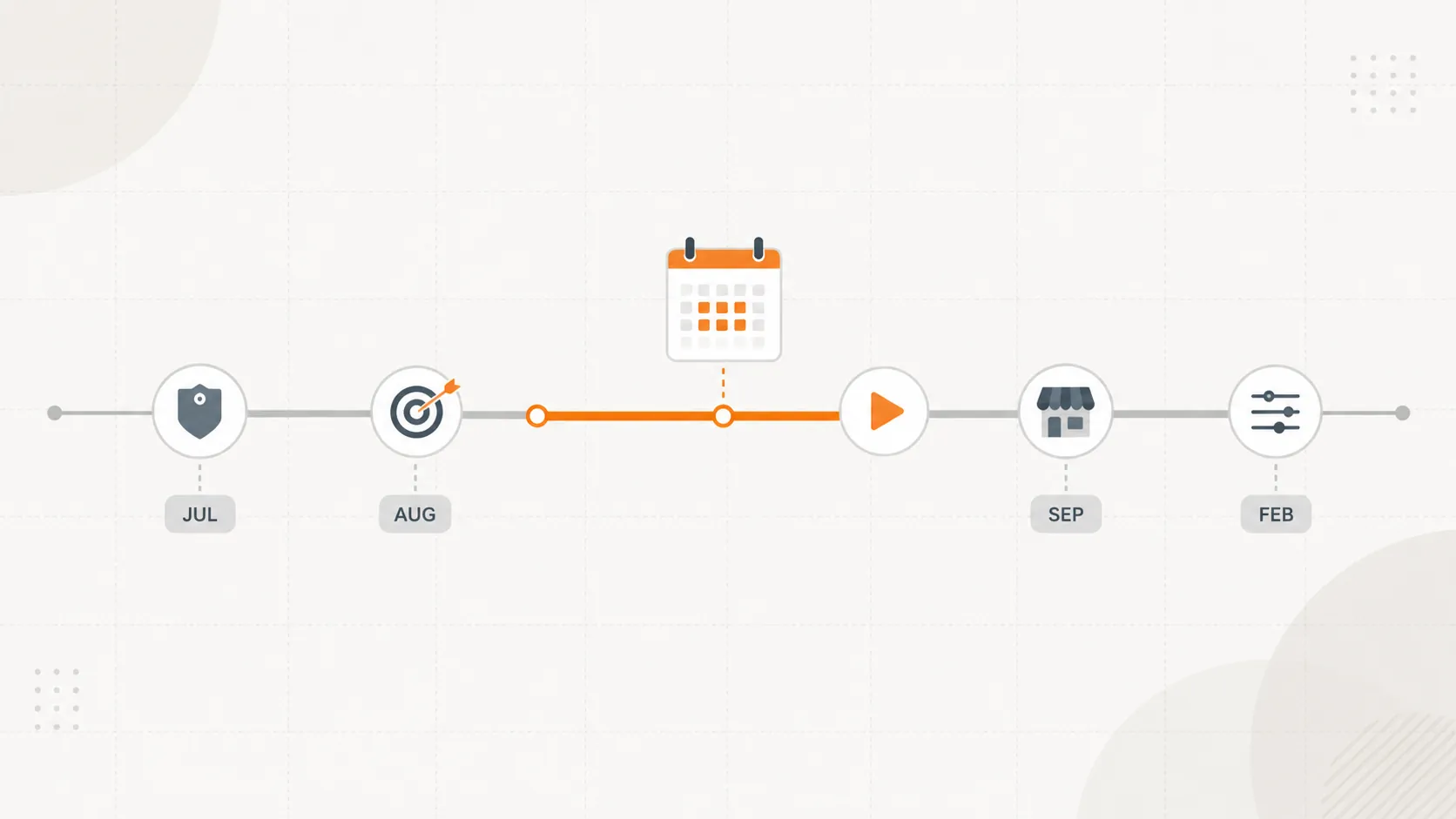
| Date | Change | Account relevance | Source status |
|---|---|---|---|
| July 9, 2026 | AI-labeling requirements across Ads, DV360, CM360, Merchant Center, and Ads Editor | Compliance review, especially for advertisers using AI-generated or materially altered assets that fall under covered disclosure rules. | Policy-source item. [8] |
| August 17, 2026 | Target CPA and Target ROAS floor/ceiling change | Bidding guardrails need review where accounts rely on explicit floors or ceilings rather than post-launch performance checks. | Ad-product reporting and advertiser guidance. [1][2] |
| August 19, 2026 | Performance Max generative video auto-resize | Creative QA issue: generated or resized video variants can affect approval review, brand fit, and asset-level sign-off. Opt-out date noted as September 4, 2026. | Ad-product reporting and advertiser guidance. [1][2] |
| August 31, 2026 | Local Inventory Ads default change | Retail and omnichannel advertisers should verify store-feed assumptions and local inventory defaults before the September AI Max window starts. | Ad-product reporting and advertiser guidance. [1][2] |
| September 1–30, 2026 | Search campaigns using automatically created assets plus campaign-level broad match begin auto-upgrade to AI Max | Main account checklist item. Confirm eligible campaigns, decide whether to accept migration, and turn the legacy feature off before migration if opting out. | Ad-product reporting and advertiser guidance. [1][2] |
| February 2027 | Dynamic Search Ads upgrade to AI Max delayed | DSA migration planning moves out of the September scramble; do not merge it with the September ACA plus broad-match Search auto-upgrade. | Google Ads & Commerce announcement. [9] |
The September 1 AI Max window is the checklist item
The September auto-upgrade is narrow enough to audit and broad enough to cause avoidable mess if nobody owns it. The reported eligibility pattern is Search campaigns that use automatically created assets together with campaign-level broad match. Those campaigns are slated to move into AI Max during the September 1–30 window unless the advertiser turns the legacy feature off before migration. [1][2]
That makes the practical account review straightforward. Pull the Search campaigns using the legacy ACA plus campaign-level broad-match setup. Mark the ones where AI Max expansion is acceptable. For the rest, document the opt-out decision before September 1 and confirm that the legacy feature has actually been turned off before the migration reaches the account. Do not wait for an August 5 org-chart story to become a product notice; the migration notice already has its own date.
The DSA delay is the other useful separator. Google’s Dynamic Search Ads upgrade to AI Max is now a February 2027 item, so DSA accounts should not be swept into the September panic unless they also have separate September-eligible Search campaign setups. [9]
The July labeling rule is already a compliance task
The July 9 AI-labeling requirement is not glamorous, which is exactly why it can be missed. It reaches across Google Ads, Display & Video 360, Campaign Manager 360, Merchant Center, and Ads Editor, so the owner may not be the same person who owns Search campaign structure. [8]
For teams already using generated assets, the safest process is boring: label where required, keep approval evidence near the asset, and make sure Merchant Center and trafficking teams are not treating the rule as a Search-only issue. This is also where related compliance tracking belongs; the site’s Generation Beta AI ad impact record is the better place to follow the wider disclosure timeline.
Bidding, video, and local defaults need quiet QA
The August 17 bidding floor/ceiling change does not require the same communication as an auto-upgrade, but it can still change how a campaign behaves against constraints. Accounts with strict Target CPA or Target ROAS guardrails should be reviewed for where the floor or ceiling matters operationally, not just where a strategy label exists. [1][2]
The August 19 PMax generative video auto-resize item is a creative-control issue. If a brand already has tight video approvals, the September 4 opt-out date belongs next to legal and brand-review calendars, not buried in a media-activation sheet. [1][2]
The August 31 Local Inventory Ads default change sits in the retail feed lane. It is easy to miss because it is not the flashiest AI announcement, but store inventory, pickup expectations, and local availability are exactly the places where a “default” can become a customer-service problem before it becomes a paid-search problem. [1][2]
Vendor performance claims do not become migration proof
Google’s AI-ad performance language is worth tracking, but it should not be used as proof that the August 5 reshuffle changed campaign controls. The commonly repeated AI Max numbers — including Google-stated lift figures, AI Max plus PMax claims, advertiser-count language, and the Gemini monthly-active-user figure in Pichai’s memo — remain vendor claims unless independently verified. [3]
There is also reporting friction around the same earnings-call narrative: some coverage described one conversion-lift figure while other PPC coverage reported another. That discrepancy is a reason to keep the numbers in a benchmark file, not to smuggle them into an account-migration decision. For the claim-verification trail, use the site’s AI Max benchmark record.
This is the same reason Alphabet capex stories and competitive OpenAI ad-platform stories belong in strategy trackers, not in the September AI Max checklist. They can explain why Google is moving quickly; they do not, by themselves, tell a buyer which setting changed. The related roadmap context belongs in the Alphabet earnings AI ads strategy tracker and the competitive AI-ad entries such as the ChatGPT self-serve ad platform tracker.
What stays on the watchlist
AI Mode and AI Overviews ad serving deserve a separate watchlist because they are real placement context. Google Ads Help says ads can show in AI Overviews through AI-powered targeting, including AI Max for Search, Performance Max with broad match, or keywordless targeting, and that advertisers cannot opt out of AI Overviews placements separately. [10]
That does not make the August 5 reshuffle an AI Overviews placement change. The placement rule exists; the leadership link does not. If Google later changes opt-out rules, eligibility, reporting segmentation, or serving controls for AI Overviews or AI Mode ads, that future source would turn the watchlist into an account action.
Gemini 3.5 Pro cadence is in the same category. Faster model shipping could matter to ad generation, search experience, or Gemini-app monetization later. No reviewed source confirms that the reshuffle accelerates AI Max migrations, changes the ads-in-Gemini timeline, or alters the September auto-upgrade rules.
So the working read for Q3 2026 is simple enough to put on the account calendar: monitor the September AI Max auto-upgrade window, handle opt-outs before migration, review July labeling compliance, check the August bidding and creative/default changes, and keep the DeepMind reshuffle in the context file unless a future sourced Ads change makes it operational.
References
- Google to auto-upgrade some Search campaigns to AI Max, Search Engine Land.
- Google AI Max auto-upgrade: what changes on 1 September, Upp.ai.
- The next chapter of our AI momentum, Google.
- Google DeepMind CEO Demis Hassabis stepping into new role, Axios.
- Google is expanding its AI empire — and losing the people who built it, CNBC, August 5, 2026.
- Inside Google DeepMind's Reshuffle After CEO Demis Hassabis Steps Aside, TIME, August 6, 2026.
- Google Reshuffles DeepMind Leadership as AI Race Shifts from Research to Execution, Pure AI, August 6, 2026.
- AI-generated content disclosure requirements, Google Ads Policies Help, July 9, 2026.
- We're upgrading Dynamic Search Ads to AI Max, Google Ads & Commerce.
- Ads in AI Overviews, Google Ads Help.
Primary source: https://blog.google/products/ads-commerce/ai-max-search-campaigns/