
What actually shipped in ChatGPT's self-serve ad platform
ChatGPT Ads went from a $200K–$250K-minimum closed pilot in February to a $0-minimum self-serve platform across roughly 40 markets by August 2026. This dated, sourced tracker logs every pricing move, market launch, and feature ship — labeled OpenAI-stated or independently observed — so media buyers can see what is testable today versus what OpenAI still has not shipped or scheduled.
- Platform
- ChatGPT Ads
- Change category
- bidding
- Effective date
- 0-05-05
- Change type
- opt-in feature
- Impact level
- Medium
Status as of Aug. 25, 2026
The short answer: ChatGPT's self-serve advertising platform for brands is no longer just an enterprise pilot. Self-serve buying is live with a $0 minimum, CPC bidding exists, OpenAI has shipped pixel and CAPI support, and the market footprint is now best described as roughly 40 markets after the August European expansion. That is enough to run a real test. It is not yet enough to treat ChatGPT Ads like a mature performance platform, because CPA bidding, full third-party measurement, paid-tier reach controls, and prompt-level reporting still have no committed shipping date in the materials available today.[1][2]
| Buyer question | Current status | Source label | Account-level implication |
|---|---|---|---|
| Can a non-enterprise advertiser buy directly? | Yes. OpenAI announced self-serve Ads Manager access with a $0 minimum on May 5, 2026.[1] | OpenAI-stated | A small agency or in-house team can now budget a controlled test without clearing the February six-figure gate. |
| Is CPC bidding available? | Yes. OpenAI’s May 5 buying update added CPC buying and recommended starting bids in the $3–$5 range.[1] | OpenAI-stated | A buyer can frame the test around click cost, but low bids are still a delivery risk rather than a reliable efficiency lever. |
| Can campaigns use pixel or server-side conversion events? | Partly. OpenAI announced pixel and Conversions API support with the May 5 self-serve rollout.[1] | OpenAI-stated | Basic conversion plumbing exists, but that is not the same as mature attribution, third-party verification, or automated CPA optimization. |
| Are custom audiences available? | Observed as live after launch, with trade coverage pointing to a 25,000-user minimum; a 100,000-user figure has appeared elsewhere but remains unverified from the available crawled sources.[3] | Independently observed / trade-reported | Useful for larger first-party lists, less useful for smaller brands expecting Meta-style seed audience flexibility. |
| Is CPA bidding live? | No committed live status in the available materials. Digiday reported on May 5 that OpenAI was promising CPA bidding, not that it had shipped.[3] | Trade-reported promise | Performance teams still need to buy clicks or impressions and judge downstream quality manually. |
| Is full third-party measurement live? | Not fully. Third-party measurement was also reported as a promised capability on May 5, not a completed buyer control.[3] | Trade-reported promise | Post-test defense still depends heavily on OpenAI-reported data plus whatever the buyer can reconcile through its own stack. |
| Can advertisers reach paid ChatGPT subscribers? | No committed expansion in the cited rollout materials. OpenAI’s advertising approach framed ads around expanding access to ChatGPT, while the buyer-facing rollout does not provide a paid-tier reach control.[4] | OpenAI-stated framing / no shipped buyer control | Reach assumptions should not quietly include paid tiers unless the account UI and contract say so. |
| Is prompt-level reporting available? | No. Hands-on limitation reporting describes meaningful reporting gaps, including missing prompt-level visibility.[5] | Independently observed | The buyer can evaluate aggregate campaign outcomes, but cannot fully audit which conversational contexts produced them. |
| How many markets are live? | Roughly 40. The pre-Europe footprint reached about nine markets, then OpenAI announced 31 European markets on Aug. 18; the UK overlap makes a neat exact total less honest than an approximate count.[2] | OpenAI-stated, with arithmetic caveat | Market availability is now broad enough for multi-market testing, but the exact country list still has to be checked inside the buying flow. |
| How many advertisers are actually using it? | OpenAI says “tens of thousands of marketers.” Adthena separately counted 7,378 distinct ChatGPT advertisers for the week of July 13–20, 2026.[2][6] | OpenAI-stated vs independently observed | Use both numbers carefully: OpenAI’s count lacks a breakdown, while Adthena’s number is scoped to its own observed dataset and week. |
That table is the practical center of the rollout. It separates a media buyer’s first question from the platform’s announcement rhythm. A launch post can say access expanded; the account still has to show whether the buyer can select the country, bid at a workable level, pass conversion events, build a usable audience, and explain the readout afterward.
The dated rollout record
Jan. 16: the U.S. test becomes a media-buying reality
CNBC’s Jan. 16 report is the first useful starting point for this tracker because it moved the story from advertising speculation into a concrete U.S. ad test. The important buyer distinction is that a test existed, not that self-serve buying existed. There was no reason yet for a small agency to assume it could open an account, enter a credit card, and launch.[7]
OpenAI’s own January framing, published as “Our approach to advertising and expanding access to ChatGPT,” mattered for expectations more than operations. It told the market how OpenAI wanted ads to sit inside ChatGPT, but it did not answer the questions that decide whether a line item can be added to a media plan.[4]
February: the pilot price kept most brands out
By early February, the buying terms being circulated were still enterprise-shaped: a $200,000–$250,000 minimum and roughly $60 CPM. StackAdapt’s guide captured that early pilot economics, which made ChatGPT Ads interesting to watch but hard to recommend for a $2,000 or $20,000 test budget.[8]
That price wall matters more than the headline novelty. At a six-figure minimum, a buyer is not testing a channel in the normal performance sense. They are buying access, learning, and internal visibility, with the usual burden of explaining why the platform cannot yet be benchmarked against Performance Max, Advantage+, or paid search.
Mar. 26: revenue momentum, plus Canada, Australia, and New Zealand
The March 26 revenue story gave the pilot a different kind of weight. Reuters reported that OpenAI’s U.S. ad pilot had exceeded $100 million in annualized revenue after six weeks; that figure could not be independently crawled here and should be treated through corroborating coverage rather than as a freshly verified primary record. The same coverage period also marked expansion beyond the U.S. into Canada, Australia, and New Zealand.[9]
For a buyer, the revenue number is useful only in a narrow way. It shows advertiser demand and sales velocity. It does not prove that the auction had cleared into efficient pricing, that conversion quality was stable, or that buyers had enough reporting to defend results.
April 10–13: the quiet beta starts to look like a real Ads Manager
April is where the announcement record starts to lag the product record. Field reports put a quiet Ads Manager beta in market around April 10–13, ahead of the May 5 public launch. The reported minimums were lower than February’s pilot level, around $50,000 in some accounts, while CPMs were already compressing. PPC Land reported ChatGPT ad CPMs dropping to $25 as OpenAI moved toward a broader auction.[10]
The April evidence is not as clean as an OpenAI launch note. That is exactly why it belongs in the tracker. If an account can access a beta, see a lower minimum, or buy at a different clearing price before the documentation says so, that is part of availability history. Buyers live in the account UI, not in the press room.
May 5: $0 minimum, CPC bidding, pixel, and CAPI
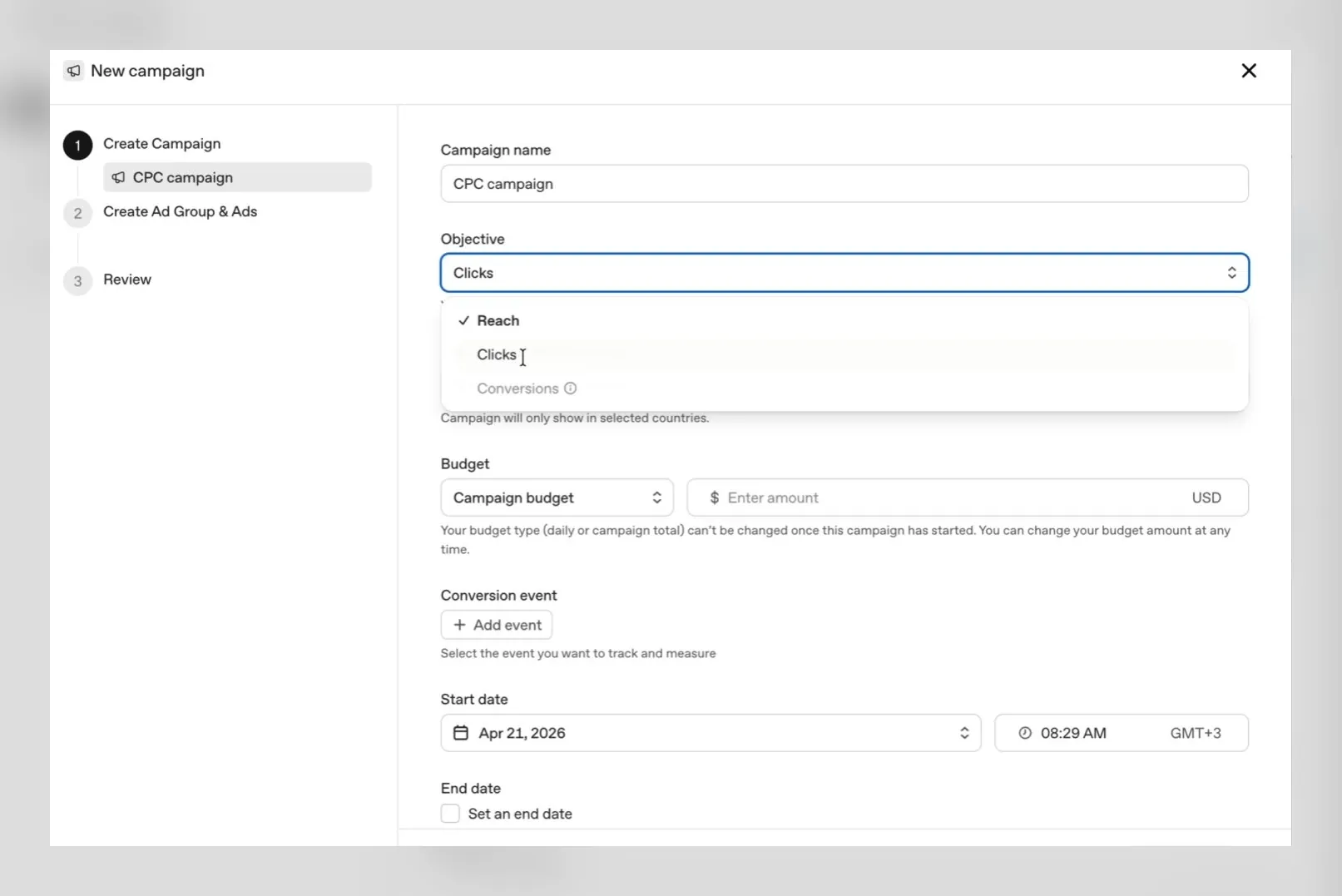
May 5 is the cleanest product date in the whole record. OpenAI announced “New ways to buy ChatGPT ads,” opening self-serve buying with a $0 minimum, adding CPC bidding, and making pixel and Conversions API support part of the buyer-facing setup.[1]
Search Engine Land and other trade coverage treated the same update as the moment ChatGPT Ads moved beyond invite-only enterprise buying into a self-serve channel that smaller advertisers could at least attempt to test.[11] That does not mean the platform became performance-complete on May 5. Digiday’s coverage on the same date specifically framed third-party measurement and CPA bidding as promised capabilities, not shipped controls.[3]
The CPC guidance also changed how a test budget could be written. OpenAI’s recommended $3–$5 starting bids gave buyers a concrete starting point instead of a CPM-only pilot model.[1] The catch is that a starting bid is not a delivery guarantee. Hands-on buyer reporting after the launch found that bids below that range could struggle to spend, which matters if the test plan assumes cheap exploratory traffic.[12]
May 14: custom audiences arrive, but with scale requirements
Custom audiences were observed after the self-serve launch, with May 14 as the useful tracking date. The best-supported minimum in the available materials is 25,000 users, reported through trade and practitioner coverage; a 100,000-user minimum appeared in an uncrawled social post and should not be treated as verified here.[3][12]
This is one of those details that decides whether “self-serve” means much for a smaller brand. A $0 media minimum opens the door. A five-figure audience-size requirement can still limit what the buyer can do once inside.
June: the market map starts filling in
June added important market signals: the UK became part of the rollout on June 6, and by June 22 self-serve availability had extended across Japan, Korea, and the UK in reported account-level access. These were not just press-list countries; they changed where a buyer could plausibly test without negotiating an enterprise insertion order.[12]
The country-by-country detail matters because ChatGPT Ads is not yet the kind of platform where a global availability claim can be trusted without checking the account. A market can be announced, partially visible, available to managed accounts, or available in self-serve. Those are different buying states.
Aug. 11–18: five-market confirmation, Mexico and Brazil, then 31 European markets
By Aug. 11, buyer-facing coverage had confirmed a five-market self-serve footprint in practice. On Aug. 17, Mexico and Brazil entered the rollout, and advanced matching for the pixel was reported as a default behavior rather than a later manual upgrade. Those changes are easy to miss if the only record being followed is OpenAI’s larger announcement cadence.[12]
Then OpenAI made the bigger move on Aug. 18: ChatGPT Ads expanded across 31 European markets. OpenAI also said on that page that “tens of thousands of marketers” were using ChatGPT Ads, but it did not provide a country, spend, advertiser-size, or active-account breakdown.[2]
The market-count math is slightly messier than a round number suggests. Before the European expansion, the practical list had reached about nine markets: the U.S., Canada, Australia, New Zealand, the UK, Japan, Korea, Mexico, and Brazil. Adding 31 European markets sounds like 40, but the UK overlap means the cleanest description is “roughly 40,” not a falsely precise total.[2]
Aug. 24: Europe goes from announced to live
The Aug. 18 expansion page announced Europe; the Aug. 24 coverage is useful because it marked ads as live in Europe and described OpenAI’s increasing focus on enterprise advertisers. That distinction is not cosmetic. A market is not budgetable until the buyer can actually select it, launch into it, and monitor delivery.[13]
The pricing arc changed the buyer class
The most important commercial change from February to August is not the creative format or the AI positioning. It is the collapse of the access price. February’s reported $200,000–$250,000 minimum and roughly $60 CPM put ChatGPT Ads in a category where only large brands, holding-company clients, or highly motivated test budgets could participate.[8]
By mid-April, field reporting had CPMs as low as $25, while Ad Age’s $15 figure circulated with less transparent sourcing. Those are useful directional signals, not a rate card a buyer should repeat without qualification.[10]
May 5 changed the floor more decisively than it changed the optimization model. A $0 minimum lets a brand test with a small, bounded budget. CPC bidding lets the buyer avoid committing entirely to impression pricing. But the recommended $3–$5 CPC starting range means this is not automatically cheap traffic, and sub-$3 bidding can create the familiar early-platform problem: the campaign looks efficient in the plan and then fails to deliver in the account.[1][12]
That is why the May 5 launch deserves both credit and restraint. OpenAI made the platform accessible to a different class of advertiser. It did not ship the full bidding and measurement stack that would let a buyer judge it with the same operating assumptions used in mature automated channels.
OpenAI-stated is not the same as independently observed
OpenAI’s “tens of thousands of marketers” claim is plausible as a directional adoption statement, but it is not very actionable without a definition. Does it mean created accounts, active advertisers, campaigns launched, spenders above a threshold, or marketers attached to an organization? The public page does not say.[2]
Adthena’s count is more concrete but narrower: 7,378 distinct ChatGPT advertisers for the week of July 13–20, 2026. That is an independently observed number, not a universal platform census. It should not be forced to reconcile perfectly with OpenAI’s marketer count because the two numbers likely measure different things.[6]
The same caution applies to frequency and exposure figures. Adthena measured ads on 4.47% of U.S. queries across one March–May window and 24.7% during the week of July 13–20. Those figures show a sharp observed difference across measured windows, but the available materials do not support a clean apples-to-apples growth calculation against Similarweb-style response-level datasets or other third-party panels.[6]
This is the useful discipline for this rollout: label the claim before using it. OpenAI-stated numbers tell you what the platform wants the market to believe about availability and momentum. Independently observed numbers tell you what one measurement provider or practitioner could see from a defined vantage point. Neither one replaces the account-level check.
What still blocks a clean performance read
The blocker list is shorter than it was in February, but it is still serious. The platform now has buying access, CPC bidding, and conversion-event plumbing. It still lacks the controls that usually let a performance buyer move from “we tested it” to “we know how to scale it.”
- CPA bidding remains promised rather than shipped in the cited materials, so conversion efficiency has to be managed indirectly through bids, audiences, creative, and post-click analysis.[3]
- Full third-party measurement remains incomplete, which leaves buyers reconciling OpenAI reporting against their own analytics and server-side events rather than relying on a mature independent verification setup.[3]
- Prompt-level reporting is not available in the hands-on limitation reports, limiting a buyer’s ability to audit which conversational contexts are driving clicks or conversions.[5]
- Paid-tier reach is not a committed buyer control in the rollout materials, so reach planning should stay anchored to the inventory actually exposed in the account.[4]
Those gaps do not make ChatGPT Ads untestable. They define the test. A sensible August 2026 test should be scoped as a controlled exploration of traffic quality, audience fit, delivery stability, and conversion-event consistency. It should not be sold internally as a fully optimized CPA channel.
Business Insider’s July coverage of market doubts around OpenAI’s ad-growth projections belongs in the background, not the center of the buying decision. Long-range revenue projections may explain why OpenAI is moving quickly, but they do not tell a growth lead what bid to set next Tuesday or how to defend the attribution readout at the end of the month.[14]
The better comparison is the one a buyer can actually use: announced versus shipped, OpenAI-stated versus independently observed, visible in documentation versus visible in the account. That is also the format used in our Grok AI for Ads tracker: the date matters, the label matters, and undocumented movement is still part of the rollout history.
The practical judgment
As of Aug. 25, 2026, ChatGPT Ads is testable for far more brands than it was in February. The platform moved from a $200,000–$250,000 closed pilot to a $0-minimum self-serve product in a few months, added CPC bidding, shipped pixel and CAPI support, introduced custom audiences, and expanded into roughly 40 markets.[1][2][8]
It is still not a fully measurable performance channel by the standards buyers use for Performance Max or Advantage+. The usable record is the dated tracker, not the launch narrative: follow the shipped dates, inspect the source labels, and treat account-level feature movement as signal rather than noise.
References
- New ways to buy ChatGPT ads, OpenAI, May 5, 2026
- ChatGPT Ads expands across Europe, OpenAI, Aug. 18, 2026
- OpenAI opens up ChatGPT Ads Manager to the U.S. while promising third-party measurement, CPA bidding, Digiday, May 5, 2026
- Our approach to advertising and expanding access to ChatGPT, OpenAI, Jan. 2026
- ChatGPT Ads Limitations: AI, Instant Forms, Jon Loomer
- Retail took 39% of ChatGPT ads on 24% of US queries, Adthena finds, PPC Land
- OpenAI ChatGPT Ads US, CNBC, Jan. 16, 2026
- How to Advertise on ChatGPT, StackAdapt
- ChatGPT ads are now open to small businesses as OpenAI builds a full self-serve ad platform, The Decoder
- ChatGPT ad CPMs drop to $25 as OpenAI races toward global auction, PPC Land
- ChatGPT ads expand with self-serve buying, Search Engine Land, May 5, 2026
- ChatGPT Ads Self-Serve, Jon Loomer
- OpenAI is sharpening its focus on enterprise advertisers, Digiday, Aug. 24, 2026
- OpenAI projects ChatGPT ad growth, but market doubts remain, Business Insider, July 21, 2026
Primary source: https://openai.com/index/new-ways-to-buy-chatgpt-ads/