
Alphabet's Q2 earnings signal AI is raising Google Ads costs
Alphabet's Q2 2026 earnings and buyer-reported CPC data indicate AI Max has raised the cost of entry into Google Search auctions. The dated AI Max timeline and in-account lift-test protocol let media buyers verify Google's 15% conversion-lift claim before restructuring spend.
- Platform
- Google Ads
- Campaign type
- AI Max for Search
- Spend range
- Various account spend levels
- Timeframe
- May 0 to July 2026
- CPC
- 0-15% reported increase
- Verdict
- mixed
- Last reviewed
- 0-08-26
The cost question comes before the earnings victory lap: what did Google’s AI push do to the auction an advertiser has to enter tomorrow morning? One year after AI Max launched, named buyers were reporting roughly 10–15% CPC increases, some accounts reportedly running as high as 25%, and Adthena estimated a 35% year-over-year increase in advertisers participating in search auctions.[1] Alphabet’s Q2 2026 print does not prove AI Max caused those account-level increases, but it does show the pressure did not arrive in a soft ad market: Google Search & other revenue reached $63.271 billion, up 17%, while total Google advertising reached $81.629 billion, up 14.4%.[2] Search growth also stepped down from 19% in Q1 2026, its first deceleration in six quarters by Digital Applied’s recomputed series.[3]
That is the useful frame for the advertiser question. Not whether Alphabet can still grow. It can. The more expensive question is whether AI automation is making the first dollar of qualified Search traffic harder to buy before the promised conversion lift has been proven inside the account paying the bill.

The first-year record is short, dated, and uncomfortable
AI Max is not just another settings panel if it changes where Google can find queries, how broadly campaigns can match, and how many advertisers are eligible for the same auction. The important record is the sequence, because the cost reports become more meaningful when they sit beside adoption and product-forcing milestones.
| Date | What changed | Why it matters to a buyer |
|---|---|---|
| May 6, 2025 | Google launched AI Max for Search campaigns.[4] | The clock starts on Google’s AI expansion inside Search buying, not just in a demo environment. |
| Around April 2026 | AI Max reached broad availability and Google cited roughly 500,000 advertiser adopters on its Q2 2026 call.[4] | Adoption becomes large enough to affect auction density, even if the advertiser mix varies by vertical. |
| May 6, 2026 | Digiday reported buyer-side CPC and spend pressure one year on: Mediaplus cited 10–15% average CPC increases; Collective Measures cited roughly 10% typical CPC rises, with some clients up to 25%; Go Fish cited a 15% increase in search spend.[1] | These are attributed buyer reports, not a universal benchmark, but they describe the pressure many account teams were already seeing. |
| May 20, 2026 | Google Marketing Live coverage described AI Mode ad formats including Conversational Discovery, Highlighted Answers, Direct Offers, and Ask Advisor.[5] | These product surfaces help explain why Google wants broader automation, but the format announcements are not performance proof. |
| July 22, 2026 | Alphabet reported Q2 2026 Google Search & other revenue of $63.271 billion, up 17%, after 19% growth in Q1.[2][3] | The aggregate print supports continued Search demand, but the step-down keeps the buyer-side cost complaints from being waved away as pure market expansion. |
| September 2026 | Google’s Dynamic Search Ads auto-upgrade to AI Max is scheduled to begin. | Avoidance becomes less realistic for accounts still using legacy DSA coverage; testing becomes a migration control, not a nice-to-have. |
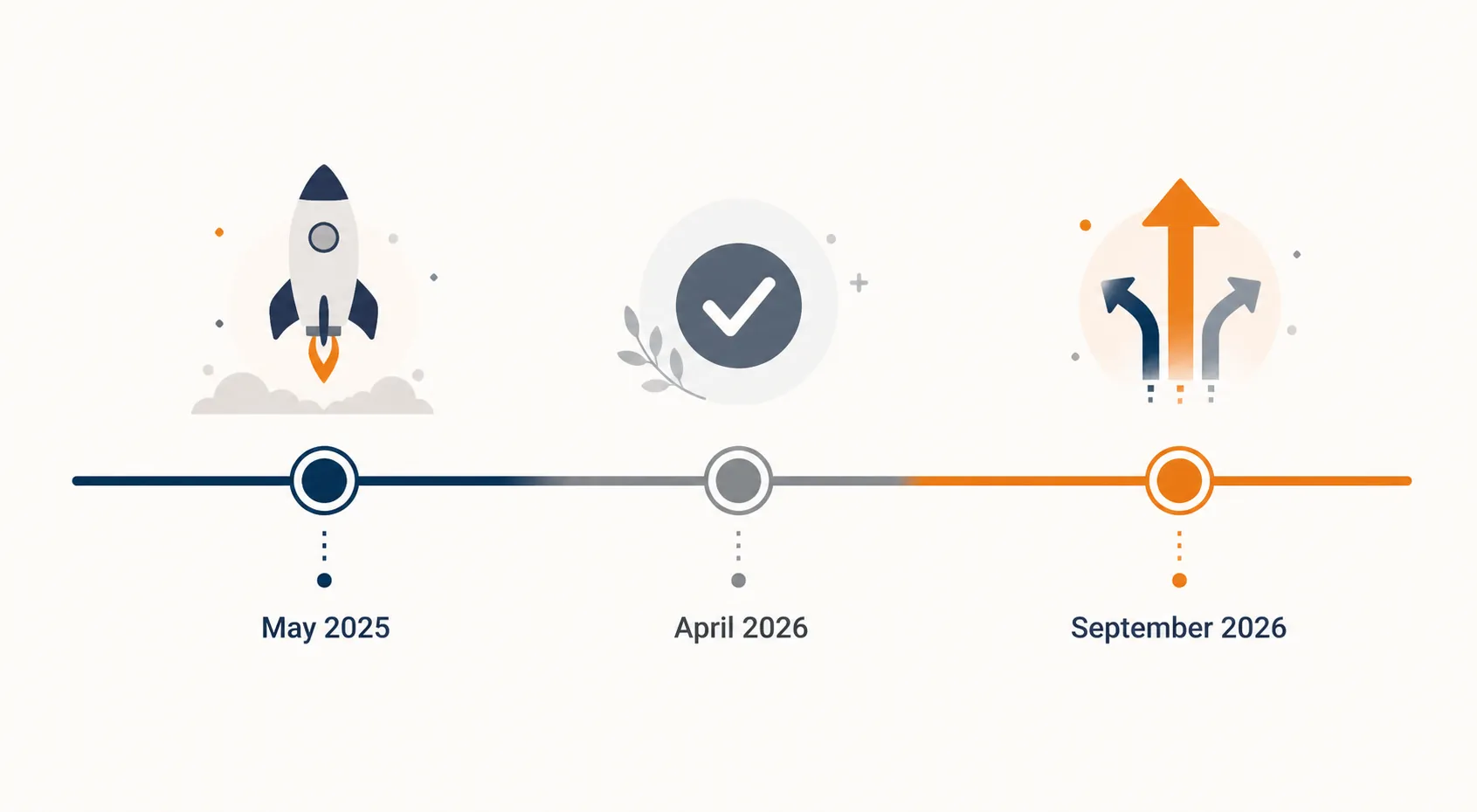
The last row is the operational problem. A buyer can dislike the naming, discount the keynote language, and still end up in the migration path. Once DSA coverage is being folded into AI Max, the question shifts from “Should we experiment?” to “Which accounts get exposed first, under what budget guardrails, and what would count as incremental value?”
Why the cost-of-entry argument holds — with limits
There are three separate signals here, and they should not be blended into a fake benchmark. First, buyers reported CPC inflation in live accounts. Digiday quoted Mediaplus’ Nick Tong saying “CPC inflation is definitely happening,” with average increases of 10–15%.[1] Collective Measures’ Lauren Beerling described roughly 10% typical CPC rises, with some clients up to 25%, and tied 7–10% year-over-year spend growth to AI Max being used as a growth lever.[1] Go Fish reported a 15% rise in search spend.[1]
Those figures are useful because they are named and directional. They are not useful as a pricing table. Four agency-side observations do not tell a retailer, SaaS advertiser, healthcare lead-gen account, and local services advertiser to all plug 12% into next quarter’s CPC forecast. They do tell the person holding the pacing sheet that cost pressure is no longer just a vague complaint from one noisy account.
Second, Adthena’s Ashley Fletcher estimated that the number of advertisers participating in search auctions rose 35% year over year, and told Digiday that “The CPC pain is real.”[1] More eligible participants do not mechanically raise every clearing price. Auction outcomes still depend on query intent, Quality Score, bid strategy, creative relevance, conversion value, and budget constraints. But if automation expands query eligibility and more advertisers show up in overlapping auctions, the entry price for clean volume can rise even before an account sees better conversion quality.
Third, Alphabet’s own Search line is still large and growing. Q2 Search & other revenue was $63.271 billion, up 17%, while YouTube ads were $11.055 billion, up 13%, and Google Network revenue was $7.303 billion, down 1%.[2] That mix matters. The strongest advertising surface is still Search, and the weaker Network line does not offer much comfort to buyers trying to keep marginal Search clicks affordable.
The Q2 Search step-down keeps the read honest. If Search revenue had accelerated while every buyer was complaining about higher CPCs, the story might be easier: more demand, more auctions, more money. Instead, Search & other slowed to 17% growth after 19% in Q1, the first deceleration in six quarters in Digital Applied’s series.[3] That does not refute the cost-pressure reports. It suggests buyers may be paying more to stay present while the segment’s growth rate is no longer accelerating.
For a broader translation of the same Q2 print into budget pressure, the site’s earnings benchmark piece is the right companion. The point here is narrower: the first-year AI Max record supports a rising cost-of-entry conclusion, not a universal CPC forecast.
The conversion-lift number is the part that needs the most skepticism
Google’s official Q2 2026 earnings-call statement is the primary vendor claim: advertisers using AI Max in Search campaigns saw 15% more conversions or conversion value at a similar CPA or ROAS.[4] That is the number buyers will hear in sales decks, internal budget arguments, and migration conversations. It should be treated as a hypothesis to test, not a planning benchmark.
The reason is not that a 15% lift is impossible. The reason is that the public record around the claim is messy. Digiday referenced a 7% average conversion increase in its AI Max coverage.[1] CNBC’s live blog at one point misstated the figure as 50%.[6] The official transcript should carry more weight than a live-blog error, but the spread between 7%, 15%, and 50% is exactly how planning fog forms. Vendors benefit when a lift claim travels faster than its test design. Buyers pay for the budget expansion while the definition gets cleaned up later.
The official claim also has several questions a media plan cannot ignore: Which advertisers were included? Were weak accounts excluded? How long did the measurement run? Was the lift incremental, or did automation reallocate credit toward campaigns already likely to convert? Did similar ROAS hold after scale, or only during controlled rollout? None of those questions invalidate the claim. They determine whether it belongs in next month’s forecast.
A practical lift test before reallocating spend
The cleanest response is not to reject AI Max by default. It is to make the claim earn its way into the account. Before moving budget from existing Search coverage, set the test up so the result answers the question finance will actually ask: did the account get incremental conversions or conversion value after paying the higher entry cost?
- Pick campaigns where conversion tracking is already trusted. Do not use AI Max to diagnose a broken conversion setup.
- Separate brand, nonbrand, and high-intent commercial query coverage wherever possible. A blended result can hide whether the lift came from newly valuable reach or cheaper credit capture.
- Use a holdout or experiment structure that keeps a comparable control exposed to the same seasonality and budget environment. A before-and-after comparison is weak if auction density is changing at the same time.
- Freeze the success metric before launch: CPA, ROAS, conversion value, new-customer value, qualified lead rate, or margin-adjusted return. Do not let the winning metric change after the campaign has spent.
- Track CPC, impression share, query expansion, search-term quality, conversion rate, and conversion value together. A conversion lift that arrives with worse query quality and higher marginal CPC may still fail the business case.
- Cap the test budget so exploration cannot consume the account’s core demand coverage before the result is readable.
- Review assisted and final conversion paths after the test. The danger is not only overspending; it is mistaking attribution movement for new demand.
The pass/fail line should be stricter than “Google found more conversions.” If CPC rises and conversion volume rises by the same account-level dollars, the buyer still has to know whether marginal ROAS held. If ROAS holds only because branded or already-qualified traffic did the work, the test has not proven that AI Max deserves more nonbrand budget.
For teams building a repeatable evidence framework across AI ad claims, the site’s verified-versus-vendor-stated tracker is the right place to standardize which claims can enter a budget model and which stay in the test queue.
What not to over-read from the AI story
AI Mode ad formats deserve monitoring, but they do not yet settle the performance question. Google Marketing Live coverage described Conversational Discovery, Highlighted Answers, Direct Offers, and Ask Advisor as new AI Mode ad experiences.[5] Those formats may eventually matter a lot. As of this evidence record, they are product distribution claims, not independent proof that advertisers should raise Search budgets.
AI Overviews CTR pressure is also a boundary note, not the center of this argument. Seer Interactive found paid CTR fell from 19.70% to 6.34% across its tracked AI Overview context from June 2024 through September 2025, but that analysis applied to informational queries, not commercial-query auction performance.[7] It is a warning about how AI surfaces can alter click behavior, not a direct forecast for bottom-funnel Search CPCs.
Alphabet’s Q2 net income is another tempting distraction. Net income jumped 298%, but the result was distorted by a $99 billion unrealized equity gain.[2] That number should not be used as a signal that Google Ads suddenly became more efficient for advertisers, or that AI Max has already paid for itself in auction quality. The ad-segment lines and buyer-reported account pressure are more relevant to the media plan.
Capex and infrastructure costs matter for the long-run shape of Google’s ad business, but they are not necessary to prove the near-term buyer problem here. If the question is how AI infrastructure costs may move through advertising markets, that belongs in the separate AI data center and ad-cost tracker. This article’s evidence is closer to the auction: more participants, reported CPC pressure, AI Max adoption, and a Search segment still growing but no longer accelerating.
The budget call
The first-year AI Max evidence supports a cautious conclusion: Google’s AI automation appears to have raised the cost of entry into Search auctions. The support is not a clean causal study, and the buyer-reported CPC figures should not be pasted into every forecast. But the direction is hard to ignore when agency reports of 10–15% CPC pressure, a 35% increase in auction participants, and AI Max adoption at roughly 500,000 advertisers all sit inside the same first-year window.[1][4]
The DSA auto-upgrade makes waiting less realistic. Accounts that still depend on legacy dynamic coverage need an AI Max test plan before migration pressure arrives, not after the first surprise pacing readout. Google’s 15% conversion or conversion-value claim belongs in that test plan as the hypothesis. It does not belong in the budget as a proven account benchmark until the advertiser has measured incremental value against its own control.
References
- CPC pain is real: One year on, Google’s AI Max has pushed up search budgets and costs, Digiday, May 6, 2026
- Alphabet Announces Second Quarter 2026 Results, SEC 8-K Exhibit 99.1
- Alphabet Q2 2026 earnings: Search ads, AI Overviews, Digital Applied
- 2026 Q2 Earnings Call, Alphabet Investor Relations, 2026
- Google Marketing Live 2026: Everything you need to know, Search Engine Land, May 20, 2026
- Google earnings Q2 live updates, CNBC, July 22, 2026
- AIO impact on Google CTR: September 2025 update, Seer Interactive
Built on this evidence
No Bidding tactic or Creative record currently cites this case file. Compare it against other results in Benchmarks.
Related benchmark reading
Report a corroborating or contradicting result
Seeing something different in your own account? Feed the data-integrity loop instead of leaving an open comment.